




Standard Plan G and High-Deductible Plan G give you the same standardized Medigap benefits. The difference is who carries the first dollars of cost. With High-Deductible Plan G you pay a lower monthly premium, but you cover up to $2,950 in Medicare-covered costs in 2026 before the policy pays anything. With standard Plan G you pay a higher premium and, after the Part B deductible, you generally owe nothing more for covered services.
This guide shows how the two work, how to run the break-even math with your own quotes, and what to check before you switch.
TL;DR
- After the deductible is met, High-Deductible Plan G pays the same benefits as standard Plan G. This is a question of financial risk, not coverage quality.
- In 2026 the High-Deductible Plan G deductible is $2,950. CMS has announced $3,050 starting January 1, 2027.
- Standard Plan G suits people who expect frequent care or want predictable budgeting. The high-deductible version suits people with low expected use and cash set aside for the deductible.
- Switching later can mean medical underwriting. A cheap premium today can turn into a trap if your health changes.
- Premiums vary by insurer, ZIP code, age and tobacco use, so compare carriers in your state before deciding.
Table of Contents
- How the two plans are built
- The numbers side by side
- Two deductibles people confuse
- The deductible changes every year
- A break-even example you can copy
- Who tends to choose standard Plan G
- Who tends to choose High-Deductible Plan G
- The risk people overlook: getting back out
- Switching safely, step by step
- Questions to ask before you pick a carrier
- Our perspective
- Get a side-by-side quote
- FAQ
- Sources
How the two plans are built
Medigap plans are standardized. Every insurer that sells a Plan G must offer the same core benefits, and plans of the same letter are identical in what they cover. Only price, service and underwriting rules differ.
Standard Plan G picks up your Part A hospital deductible and coinsurance, Part B coinsurance, skilled nursing facility coinsurance, hospice cost-sharing, Part B excess charges and emergency care abroad, within plan limits. It does not cover the annual Part B deductible, which is $283 in 2026. You pay that once a year, then Plan G handles the rest of the listed benefits. You can see the full grid on Medicare’s plan benefit comparison.
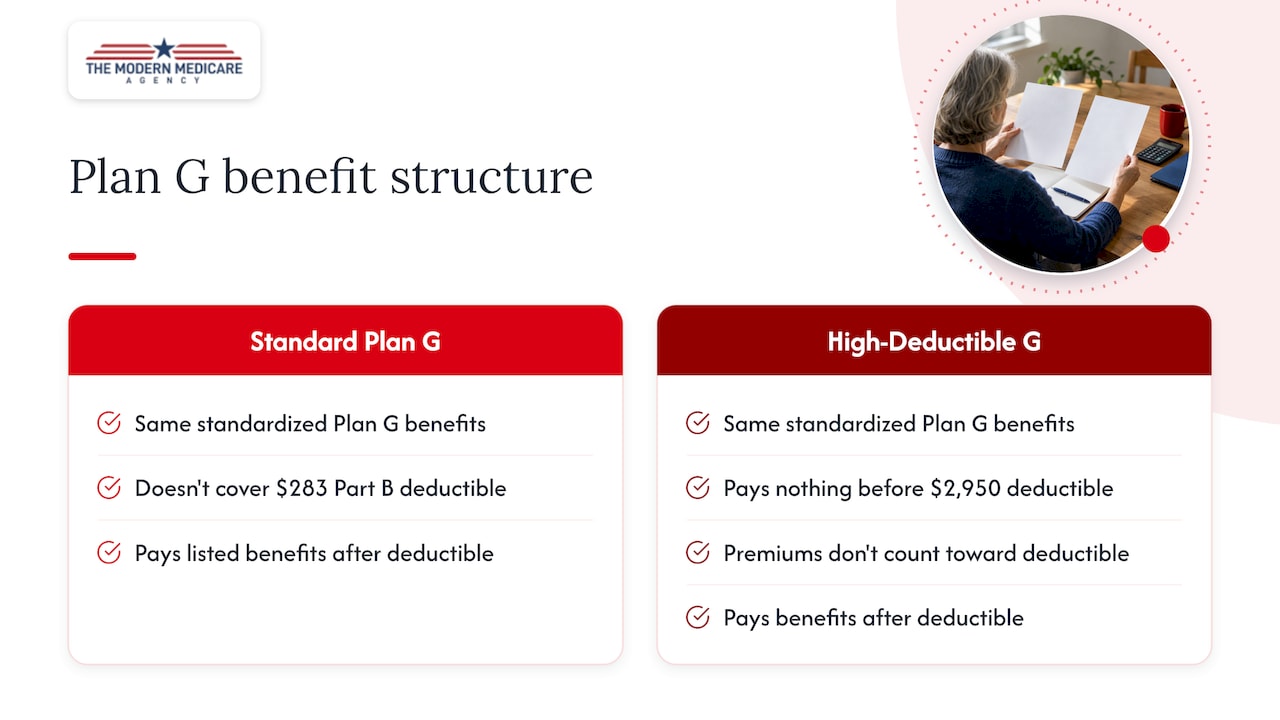
High-Deductible Plan G uses the same benefit package, with one gate in front of it. Until you have paid the annual deductible out of pocket, the policy pays nothing toward covered cost-sharing. Your premiums do not count toward that deductible. After you reach it, you are back to the Plan G experience for the rest of the calendar year.
The numbers side by side
| Standard Plan G | High-Deductible Plan G | |
|---|---|---|
| Monthly premium | Higher | Lower |
| Annual deductible you pay first | Part B deductible, $283 in 2026 | Up to $2,950 in 2026 ($3,050 in 2027) |
| Benefits after deductible | Standardized Plan G | Same standardized Plan G |
| Part B excess charges | Covered | Covered after deductible |
| Budget predictability | High | Lower, varies with your health |
| Foreign-travel emergency | Covered at 80% to plan limits, separate $250 deductible | Same, subject to plan limits |
There is no national premium for either plan. Insurers price Medigap by location, age, tobacco use, discounts and underwriting rules, so any table that shows one price for everyone is guessing. For ballpark figures in your area, our Plan G cost breakdown is a good start, and a personal quote beats any average.
Two deductibles people confuse
The $283 Part B deductible and the $2,950 High-Deductible Plan G deductible are different things. The first is a Medicare threshold that you meet before Original Medicare starts paying its share of outpatient care. The second is the amount of covered Medigap cost-sharing you must pay before the high-deductible policy begins paying.
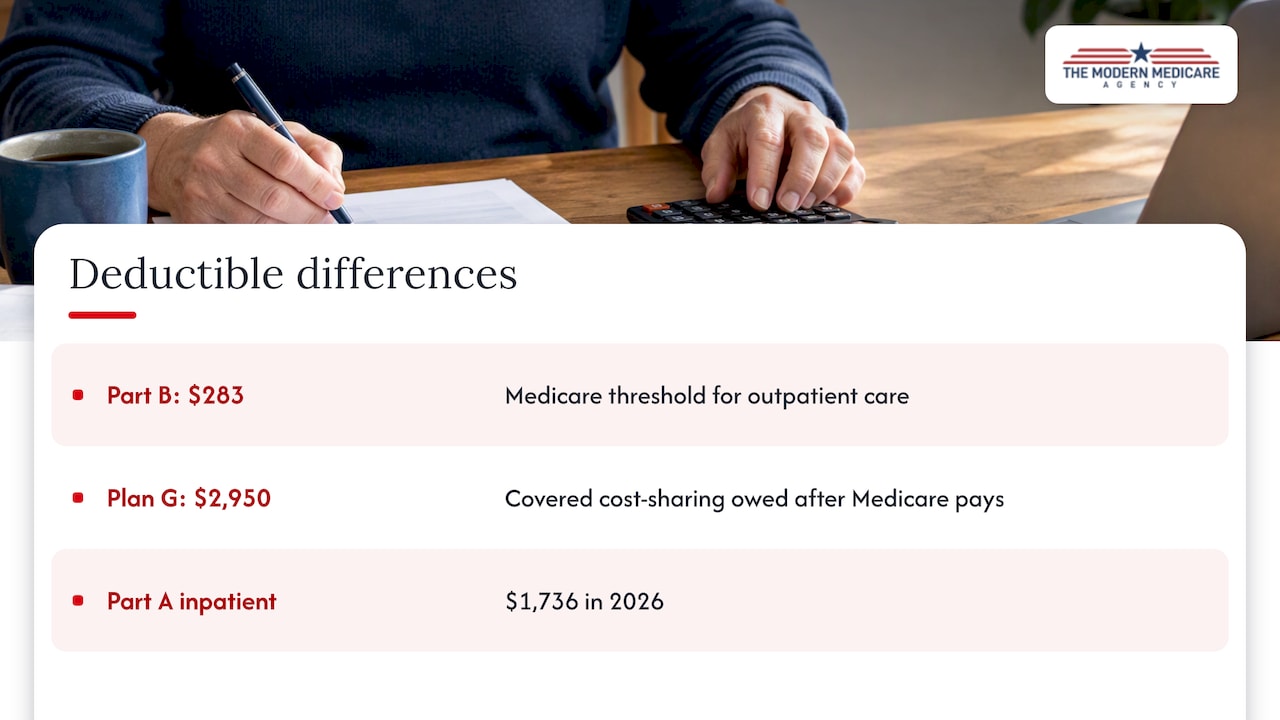
The deductible is also not simply the full bill. Original Medicare pays first. What counts toward the High-Deductible Plan G amount is what is left over: the Medicare-covered deductibles, coinsurance and copayments that you owe. A single hospital admission can use a big chunk of it, because the Part A inpatient deductible is $1,736 in 2026. Add outpatient coinsurance, and a bad year can reach $2,950 quickly.
Tests and scans are typical line items here. If you are wondering what an imaging service might cost out of pocket, a local price guide to DEXA scan cost shows how widely prices can differ by provider and by whether insurance applies. That variation is exactly why you should ask your own providers what you owe.
The deductible changes every year
CMS adjusts the High-Deductible Plan G amount annually using the CPI-U. It was $2,950 for 2026, and CMS has announced $3,050 effective January 1, 2027. If you are shopping during the fall enrollment season for a January start, use the 2027 figure for your worst-case planning, not the 2026 one.
High-Deductible Plan G is also the relevant high-deductible option for newer beneficiaries. CMS says it is available to people first eligible for Medicare on or after January 1, 2020, whether by age, disability or ESRD, while the high-deductible version of Plan F is restricted to people who were not new to Medicare as of that date. Availability still depends on your state and on which insurers sell it there.
A break-even example you can copy
The test is not the premium gap alone. Compare 12 months of standard Plan G premiums with 12 months of High-Deductible Plan G premiums plus the cost-sharing you realistically expect to pay.
Here is a made-up example to show the method. Your own quotes will differ.
- Suppose standard Plan G quotes at $140 a month and High-Deductible Plan G at $80 a month. These are hypothetical numbers.
- The premium savings are $60 a month, or $720 a year.
- Under standard Plan G you would pay the $283 Part B deductible and little else for covered care.
- Under High-Deductible Plan G, in a heavy year you could pay up to $2,950, which includes that Part B deductible. That is roughly $2,667 more than standard Plan G in cost-sharing (our arithmetic: $2,950 minus $283).
- Net of the $720 premium savings, the worst-case extra cost in that year is about $1,947.
If you rarely see doctors, you keep the $720. If a hospital stay or cancer treatment shows up, you give back far more than you saved. The savings are small and certain, the exposure is large and uncertain. That is the trade.
The gap you see in real quotes decides everything. A wide gap makes the high-deductible plan more tempting. A narrow gap makes it hard to justify the risk.
Who tends to choose standard Plan G
Standard Plan G is usually the stronger fit if any of these describe you:
- You have chronic conditions or expect regular specialist visits, imaging or procedures.
- You do not have a cash reserve equal to the full deductible.
- You want a monthly budget with few surprises.
- You would rather not think about whether a given bill pushes you toward the deductible.
Its main drawback is the premium, which is higher and can rise over time. Premiums for the same letter plan can differ substantially between insurers, so shopping carriers matters more than the letter.
If you are also weighing a cheaper standardized option with copays, see our comparison of Plan G vs Plan N.
Who tends to choose High-Deductible Plan G
The high-deductible version is more defensible when:
- You are healthy and use few services.
- You can set aside the full deductible, and you would actually leave that money untouched.
- You prefer lower fixed premiums and accept variable annual costs.
- The premium gap in your state is large enough to justify the exposure.
It is a legitimate Medigap option, not a lesser product. Our own High-Deductible Plan G explainer walks through how it works in practice.
The risk people overlook: getting back out
The cheaper premium can hide a one-way door. Medicare’s guidance is that there is no automatic federal right to change Medigap policies whenever you like. You have a six-month Medigap Open Enrollment Period that starts the first month you have Part B and are 65 or older. During it, an insurer cannot refuse to sell you any policy it offers or use medical underwriting to decide on acceptance or price.
Outside that window, or a guaranteed-issue situation, a new insurer may use medical underwriting. That can mean higher premiums or denial. Some states give more generous rights, so check with your State Insurance Department or State Health Insurance Assistance Program (SHIP) for the rules where you live.
In practice, someone who moves from standard Plan G to the high-deductible version at 67 because they feel healthy may find it hard to move back at 72 after a diagnosis. Moving the other direction, from the high-deductible plan to standard Plan G, can face the same underwriting. If you are new to Medicare and unsure, the open enrollment period is the moment when choosing is safest.
Switching safely, step by step
If you already have a Plan G and are considering the high-deductible version, the process Medicare recommends points to this order:
- Confirm which insurers sell High-Deductible Plan G in your state, and get their premiums and rating method.
- Ask the new insurer about underwriting questions and the effective date before you apply.
- Apply for the new policy first.
- Keep your current policy until the new one is issued. The new policy has a 30-day free-look period, and during it you generally pay both premiums.
- Cancel the old policy only after the new one is in force. Once dropped, it may not be recoverable.
- Check your state’s rules, since some states offer extra switching protections.
The most common mistake is canceling Plan G before the replacement is approved. That can leave you with a gap or with no way back.
Questions to ask before you pick a carrier
Because benefits are standardized, the decision becomes which company, not which benefits. Compare these within your state:
- Rating method. Does the premium rise with age, or is it set at the age you buy? This shapes affordability a decade from now.
- Discounts. Household, payment method and other discounts can change the gap between the two plans.
- Financial strength and complaints. Your state insurance department can tell you about complaint history.
- Rate history. Ask how often and by how much the company has raised rates on this plan.
- Tobacco and health class. These can move your quote significantly.
A low first-year premium means little if the rate climbs steeply after you are locked in.
Our perspective
We have helped people through this decision since 2007, and the pattern is consistent: the premium gets all the attention and the deductible gets too little. A person looks at a $60 monthly gap, sees $720 saved, and forgets that one hospital stay can erase it several times over.
We do not push either option. Because we work with more than 40 carriers, we can put real quotes for both plans side by side for your ZIP code and let the numbers speak. Sometimes the high-deductible plan wins, usually for a healthy 65-year-old with solid savings and a big premium gap. Often the standard Plan G wins, because peace of mind and predictable bills are worth the difference.
Our rule is education first. If you understand what the deductible really means, which bills count toward it, and how hard it can be to switch later, you will make a good choice either way. And we check in each year so your coverage keeps matching your life.
— Paul
Get a side-by-side quote
If you want both plans priced for your state, our team can compare carriers, explain the underwriting rules that apply to you and walk you through enrollment without pressure. Start on our Medicare Supplement plans page, or look at our complete guide to High-Deductible Plan G first if you prefer to read before you talk to anyone.
FAQ
Is there a high-deductible Plan G Medigap?
Yes. High-Deductible Plan G is a standardized Medigap option with the same benefits as standard Plan G once the deductible is met. Availability depends on your state and insurer. CMS says it is open to people first eligible for Medicare on or after January 1, 2020.
Can I switch from Plan G to High-Deductible Plan G?
You may be able to, but there is no automatic federal right to switch whenever you want. Outside your six-month open enrollment period or a guaranteed-issue event, the new insurer can use medical underwriting, though some states are more generous. Apply for the new policy first and keep the old one until the new one is issued.
What is the disadvantage of Plan G?
The main drawback is the monthly premium, which is relatively high and can increase over time. It also does not cover the annual Part B deductible, which is $283 in 2026. In exchange you get predictable cost-sharing and coverage of Part B excess charges.
Does the High-Deductible Plan G deductible include my premiums?
No. Premiums do not count toward the deductible. Only the Medicare-covered deductibles, coinsurance and copayments that you pay count toward the $2,950 amount in 2026, or $3,050 in 2027.
Which High-Deductible Plan G is best?
Because benefits are identical across insurers, the best one is usually the carrier with a competitive premium, a stable rate history and good service in your state. Compare several carriers using your ZIP code, age and tobacco status instead of relying on a national average.
Sources
- CMS: 2026 Medigap high-deductible options for Plans F, G and J
- CMS: F, G and J deductible announcements
- CMS: 2026 Medicare Parts A and B premiums and deductibles
- Medicare.gov: Compare Medigap plan benefits
- Medicare.gov: Getting Started with Medicare Supplement Insurance
- Medicare.gov: Get ready to buy a Medigap policy
- Medicare.gov: Changing Medigap policies