




Medicare coverage for medical transportation is limited: Original Medicare generally doesn’t pay for routine rides from home to a doctor. It may cover an ambulance when transportation is medically necessary and another way to travel could endanger your health. Rules also depend on the service and, for some trips, the facility involved.
It’s understandable to feel unsure when a ride is essential and the coverage rules seem complicated. In 2026, this guide explains when Original Medicare may cover ambulance transportation, how facility-to-facility and other destination rules work, and what to look for in a Medicare Advantage plan with ride benefits. You’ll come away with a clearer sense of which coverage may apply and what details shape the decision.
Key Takeaways
- Original Medicare generally doesn’t cover routine rides from home to a doctor, but it may cover an ambulance when medical needs make other transportation unsafe.
- Ambulance coverage depends on medical necessity, the destination, and whether the facility can provide the care you need.
- Medicare Advantage plans may include rides, but covered trips and approved transportation services vary by plan.
- Review a plan’s Evidence of Coverage to understand its ride benefits, approved providers, and any authorization rules.
- Learn when scheduled non-emergency ambulance rides may require prior authorization under a Medicare demonstration program.
How do I find Advantage plans with transportation benefits?
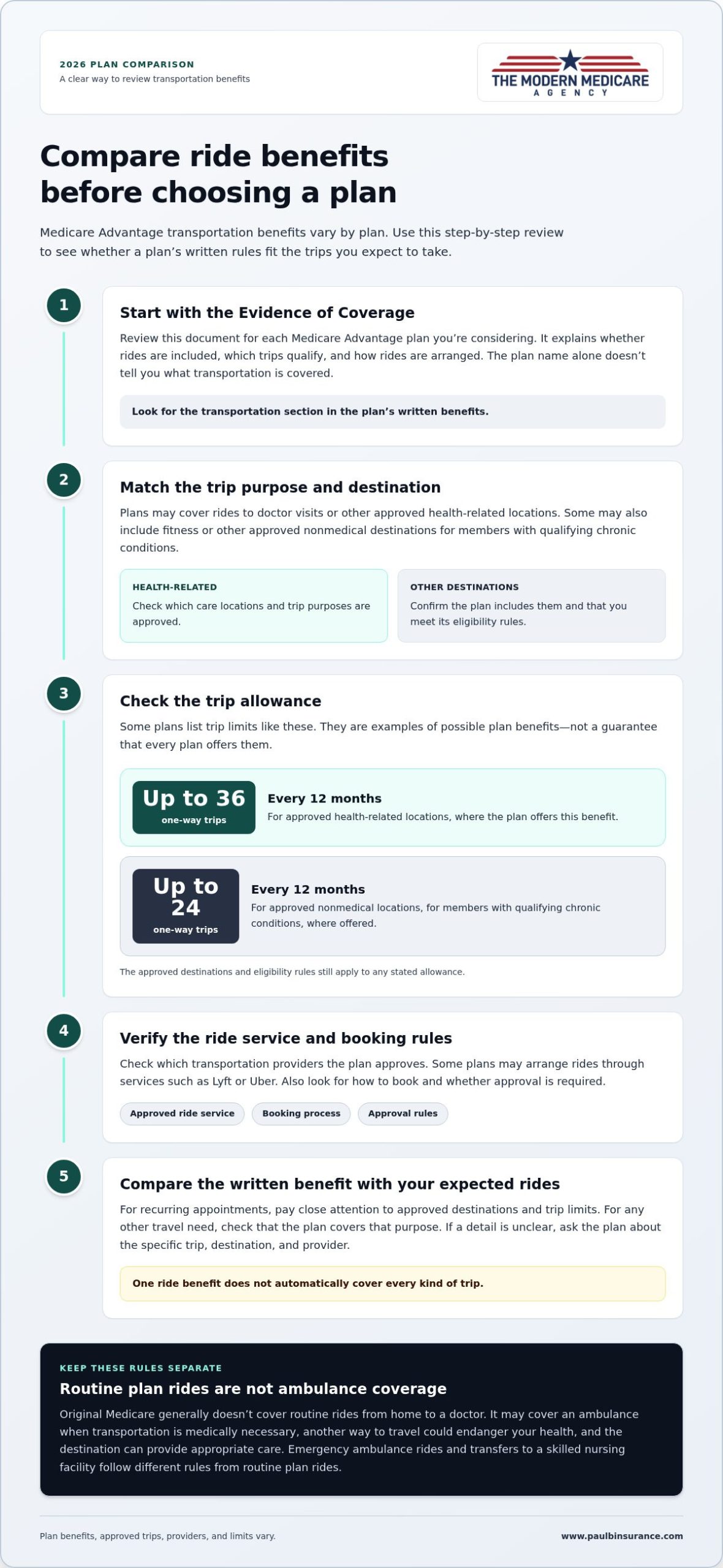
For a 2026 plan comparison, start with the Evidence of Coverage for each Medicare Advantage plan you’re considering. This document explains whether rides are included, which trips qualify, and how to arrange them. Some plans cover transportation to doctor visits; others may include health-related trips through services such as Lyft or Uber. Benefits vary by plan, so the Medicare Advantage name alone doesn’t tell you what rides are covered.
Read the transportation section with your own travel needs in mind. Look for covered reasons for travel, eligible destinations, approved ride services, and any trip limits. A plan may cover up to 36 one-way trips every 12 months to approved health-related locations. That allowance is useful only if the destinations and ride rules match the care you need.
Some plans also offer transportation to approved nonmedical locations for members with qualifying chronic conditions. A plan may cover up to 24 one-way trips every 12 months for those trips. To compare benefits, look for details such as:
- Purpose: Are rides for medical care, fitness activities, or both?
- Destination: Which health-related or other locations are approved?
- Ride service: Which transportation providers can you use?
- Limits: What trip allowance and eligibility rules apply?
- Arrangements: How do you book a ride, and is approval required?
Compare the plan’s written benefit with the trips you expect to take. For recurring appointments, focus on approved destinations and any trip allowance. If you need transportation for another purpose, confirm that the plan covers it. Don’t assume one ride benefit covers every kind of trip. Transfers to a skilled nursing facility and emergency ambulance rides follow different rules from routine plan rides.
If the Evidence of Coverage leaves a detail unclear, ask the plan’s customer service about the specific trip, destination, and transportation provider. Medicare Advantage plans include hospital and medical coverage and may offer services beyond Original Medicare Parts A and B. Compare transportation with your other coverage needs, rather than treating it as a stand-alone feature. The best fit is the plan whose written terms match your expected rides and eligibility.
Does Medicare cover transportation services?
Original Medicare generally doesn’t cover routine rides to medical appointments, but may cover ambulance transportation in specific situations. Medicaid may cover emergency and some non-emergency rides for eligible people receiving covered services. Enrollment in a Medicare Savings Program alone doesn’t establish transportation coverage.
Emergency Transportation Coverage
Emergency transportation means an ambulance ride needed for urgent medical care when other travel could endanger your health. Original Medicare may cover ground ambulance service to a hospital or skilled nursing facility when you need medically necessary care and can’t safely travel another way. It may also cover air ambulance transportation when rapid transport is needed and ground transport can’t provide it. Understanding Medicare coverage for medical transportation can help you see why the vehicle and destination matter during a crisis.
Non-Emergency Medical Transportation
Non-emergency medical transportation is planned travel for care when there’s no immediate emergency. Original Medicare generally doesn’t pay for routine rides from home to a doctor, even when the appointment is important. It may cover a non-emergency ambulance in limited situations, such as when your condition makes other transportation unsafe and the trip meets Medicare’s requirements. A Medicare Advantage plan may offer additional ride benefits, but covered trips and approved providers depend on the plan.
Medical Necessity and Written Orders
Medical necessity means your health requires ambulance transportation because another form of travel could put you at risk. For non-emergency ambulance service, a health care provider’s written order should explain why an ambulance is needed and why other transportation could endanger your health. This documentation connects the ride to your medical condition. A routine appointment alone doesn’t establish that ambulance transportation is medically necessary.
Medicare Part B generally covers eligible ambulance services. Consider whether you need medically necessary care, whether another vehicle is safe, and whether the destination can provide appropriate treatment. Medicare generally covers ambulance service to the nearest appropriate medical facility able to provide that care. A longer trip to your preferred location doesn’t automatically meet this destination rule.
For example, a person who needs urgent hospital care and cannot safely ride in a car may meet the medical-need test for an ambulance. Someone who can safely travel by car to a routine appointment generally won’t qualify for Original Medicare ambulance coverage. A Medicare Advantage plan may have a separate ride benefit, so its Evidence of Coverage can clarify covered trips and booking rules. The details of Medicare coverage for medical transportation differ from one kind of ride to another. Review the Medicare Advantage plan guide when comparing those additional benefits.
Medicaid is another possible option for eligible beneficiaries. It covers emergency and some non-emergency transportation to appointments for services covered by Medicaid. Coverage depends on your Medicaid eligibility and whether the service is covered. These rules are separate from Original Medicare’s ambulance coverage, so identify which program covers your care before arranging a ride.
Medically necessary transportation under Part B
Medicare Part B may cover ambulance transportation when medical need makes other travel unsafe. The key question is whether your condition requires an ambulance, not simply whether you have an appointment.
Medical Necessity and Physician Documentation
Medical necessity means ambulance transportation is needed to protect your health while you receive care. A doctor’s written order documents that need and explains why another vehicle could endanger you. Needing help getting to a clinic, by itself, doesn’t establish that an ambulance is medically necessary. The order connects your health condition, the type of transportation, and the care destination.
For a planned ride, the written order should explain why ordinary transportation is unsafe for you. A senior whose condition makes it unsafe to sit in a car may need an ambulance to reach medically necessary services. The documentation should explain the risk, rather than merely state that an appointment is scheduled. This helps distinguish medical need from convenience or a preference for special transportation.
Part B’s medical-necessity test considers the risks of using another vehicle. Someone who can safely travel by car is different from someone whose condition requires ambulance transport. For the latter, another means of travel could jeopardize their health. A doctor’s certification and written order support that distinction. The destination matters too: covered ground ambulance transportation may be to a hospital, critical access hospital, or skilled nursing facility for needed services.
Non-Emergency Ambulance Necessity
Non-emergency ambulance transportation is a planned ambulance ride for medically necessary care, not an urgent response. Part B may cover limited non-emergency ambulance trips when a doctor orders them as medically necessary. This can matter when a condition makes a car or other vehicle unsafe, even for a scheduled appointment rather than an emergency.
For example, someone travelling to a dialysis center may have medical needs that affect safe transportation. The diagnosis alone doesn’t determine whether an ambulance is needed. The key question is whether another vehicle could endanger your health. A routine ride to a doctor’s office isn’t covered just because the appointment is medically important. Medicare won’t pay for transportation from home to your physician’s office.
Before a planned ambulance trip, focus on these details:
- Medical need: The service must be medically necessary.
- Safe travel: The order should explain why other transportation could endanger your health.
- Care destination: The trip must meet Medicare’s destination rules.
These details help determine whether Part B’s ambulance rules apply to your situation. They also distinguish medically necessary transportation from a ride needed only to get to an appointment.
Original Medicare coverage for ground ambulance transportation
Original Medicare covers ground ambulance transportation when it’s medically necessary and another vehicle could endanger your health. It may also cover air ambulance transportation when rapid transport is needed and ground transportation can’t provide it.
Medicare-Certified Ambulance Providers
A Medicare-certified ambulance provider is approved to provide services billed to Medicare. This matters because Medicare-covered ambulance transportation must come from a certified provider. The vehicle and crew must also provide the level of care your condition requires. A medically necessary trip to a hospital may qualify, while a ride chosen for convenience doesn’t meet the same test.
Medicare generally covers ambulance transportation to the nearest appropriate medical facility that can provide the care you need. This destination rule can affect trips to a hospital, critical access hospital, or skilled nursing facility. A transfer may qualify when the original location can’t provide appropriate care for your illness or injury. A longer ride to a preferred facility isn’t automatically covered.
Ground ambulance coverage may also apply in specific care situations. Medicare may cover ambulance transportation to and from a dialysis center for someone with end-stage kidney disease. It may cover transport between a hospital and skilled nursing facility, or from either facility to the person’s home. A round trip from a skilled nursing facility to another provider may qualify when medically necessary care isn’t available at the facility.
Ambulance Coinsurance and Deductible
Coinsurance is the share of a covered service’s approved amount that you pay after meeting the deductible. Medicare Part B generally requires a 20 percent copayment of the Medicare-approved amount for covered ambulance services after the annual deductible is met, according to the Centers for Medicare & Medicaid Services. This matters because coverage doesn’t necessarily mean the ambulance ride has no out-of-pocket cost.
Review your Medicare Summary Notice after the claim appears. It shows what Medicare approved, what it paid, and what you may owe. Compare it with the ambulance bill and trip details. If Medicare denied the claim, review the reason before appealing. The issue may involve medical necessity, the destination, or whether another form of transportation was safe.
To appeal a denied ambulance claim, send a letter explaining why the transportation was medically necessary. Include supporting physician documentation, such as a written explanation of why other transportation could endanger your health. Keep copies of the Medicare Summary Notice, bill, and records you submit. Clear documentation can show how the ambulance trip related to your condition and the care you received.
Does Medicare cover non-emergency medical transportation?
Original Medicare generally doesn’t cover routine non-emergency rides, such as a car trip from home to a doctor’s appointment. It may cover a non-emergency ambulance when medical need makes other transportation unsafe. The distinction matters: needing care doesn’t, by itself, make an ambulance medically necessary.
Under a Medicare demonstration program, scheduled non-emergency ambulance transportation may be subject to prior authorization when a person receives 3 or more round trips in a 10-day period, according to the Centers for Medicare & Medicaid Services. Prior authorization means the request is reviewed before the service. The demonstration applies to scheduled ambulance transportation, not every routine ride to a medical appointment.
For a planned ambulance trip, Medicare Part B coverage depends on your medical condition, the safety of other transportation, and the destination. A health care provider’s written order should explain why an ambulance is medically necessary and why another vehicle could endanger your health. The trip must also meet Medicare’s destination rules. Medicare generally covers transportation to the nearest appropriate facility able to provide the care you need.
Keep the type of ride clear. A non-emergency ambulance transports someone who needs an ambulance for medical reasons, even without an immediate crisis. A routine car ride, wheelchair van, or other ride to an appointment is different. Original Medicare generally doesn’t cover routine transportation or wheelchair van transportation. A Medicare Advantage plan may include additional ride benefits, but covered trips and approved providers depend on the plan.
Medicaid may help people who qualify. It covers emergency and some non-emergency transportation to appointments for services covered by Medicaid. People enrolled in both Medicare and Medicaid can explore their eligibility for Medicaid transportation. Local PACE programs may also offer transportation services. These options are separate from Original Medicare’s limited ambulance benefit.
For a scheduled ambulance, focus on the records that explain the need and the ride:
- Provider order: Keep the written explanation of medical necessity.
- Trip details: Record the destination and the care being received.
- Prior authorization: Identify whether the demonstration applies to repeated scheduled trips.
- Plan benefits: Review Medicare Advantage terms for routine rides beyond ambulance coverage.
If routine rides are your concern, compare plan benefits rather than assuming Original Medicare pays. Explore Medicare Advantage plan options to understand how plan-specific transportation benefits may differ from Original Medicare.
The Modern Medicare Agency: Medicare Advantage Plans
The Modern Medicare Agency helps you compare Medicare Advantage Plans when transportation benefits matter to your daily care. In 2026, plan benefits and ride rules vary, so comparing written coverage details can help you focus on options that fit your needs. The agency provides personalized, unbiased guidance and helps eligible individuals compare plans from over 40 carriers.
The Modern Medicare Agency can help you weigh transportation benefits alongside a plan’s other coverage. Its independent Medicare brokers also help compare Medicare Supplement (Medigap) Plans and Medicare Part D Plans. Get personalized guidance based on your priorities, without pressure to choose a particular plan.
Contact The Modern Medicare Agency to discuss your Medicare plan options.
Make your next coverage decision with confidence
Understanding Medicare coverage for medical transportation in 2026 can help you ask more focused questions when comparing coverage. Before making a change, think about the rides you actually need, the care you expect to receive, and how transportation benefits fit alongside your other health coverage. Keep any plan documents and medical transportation notes together so you can refer to them during a conversation about your options.
The right next step is a careful review of how your coverage supports your needs as a whole. The Modern Medicare Agency can help you compare Medicare plans and understand the differences that matter to you. If you’d like personal guidance as you consider your options, contact The Modern Medicare Agency.
Take this decision one step at a time, with clearer information and support for the road ahead.
Frequently Asked Questions
Does Medicare Cover Rides to the Doctor?
Original Medicare generally doesn’t cover routine rides from home to a doctor’s office. Needing a ride to a scheduled checkup, for example, doesn’t make an ordinary car trip a covered ambulance service. Some Medicare Advantage plans include transportation benefits for medical visits, but covered trip types and ride providers vary. The plan’s Evidence of Coverage describes those benefits and helps distinguish routine rides from ambulance coverage.
How Do I Know If Medicare Will Cover My NEMT?
Start by identifying whether you need an ambulance or a routine ride. Original Medicare generally doesn’t pay for routine transportation, while Part B may cover a non-emergency ambulance when your condition makes other travel unsafe. The medical record and written order should explain that risk and the care destination. For a Medicare Advantage ride benefit, the Evidence of Coverage lists covered trip purposes, approved providers, and booking requirements.
Does Original Medicare cover ambulance transportation?
Yes, Original Medicare may cover ambulance transportation when it meets Medicare’s medical-need and destination rules. Ground ambulance service may qualify when another vehicle could endanger your health and you need medically necessary care. Medicare generally covers transport to the nearest appropriate facility able to provide that care. For instance, a hospital-to-facility transfer may qualify when the first facility can’t provide the appropriate level of treatment.
When does Medicare cover emergency ambulance services?
Medicare may cover emergency ambulance service when your condition requires urgent medical care and you can’t safely travel another way. Ground transport may take you to a hospital or skilled nursing facility for needed care. Air ambulance service may qualify when rapid transport is necessary and ground transportation can’t provide it. Coverage depends on medical urgency, safe transportation options, and an appropriate destination, not simply the distance travelled.
What are Medicare’s medical necessity and prior authorization rules for ambulance rides?
Medical necessity means your health could be endangered by using another form of transportation, and a provider’s written order should explain why an ambulance is needed. Under a Medicare demonstration program, scheduled non-emergency ambulance transportation may be subject to prior authorization when you receive 3 or more round trips in a 10-day period, according to the Centers for Medicare & Medicaid Services. The authorization rule applies to scheduled ambulance rides under that demonstration.
How much does Medicare pay for ambulance transportation, and what are the copays?
For eligible ambulance transportation under Part B, Medicare generally pays 80 percent of the Medicare-approved cost after you meet the deductible. You’re generally responsible for the remaining coinsurance. Medicare Part B generally requires a 20 percent copayment of the Medicare-approved amount for covered ambulance services after the annual deductible is met, according to the Centers for Medicare & Medicaid Services. Your Medicare Summary Notice shows the approved amount and your share.
How does Medicare Advantage coverage for medical transportation differ from Original Medicare?
Medicare Advantage plans may include transportation benefits beyond Original Medicare’s limited ambulance coverage. Benefits vary by plan: one may cover certain medical trips, while another may have different destinations, ride providers, or trip limits. Compare the Evidence of Coverage for plans available to you, focusing on whether the benefit fits your regular appointments and how rides are arranged. Don’t assume every Medicare Advantage plan offers the same transportation benefit.
What Medicare-approved transportation providers are available in my area?
Medicare requires a Medicare-certified provider for covered ambulance transportation. The nearest appropriate facility rule also affects which destination is covered, so a provider’s availability alone doesn’t determine coverage. If you have Medicare Advantage, its Evidence of Coverage identifies approved providers for plan ride benefits. Available services can differ by plan and location. A provider approved for routine plan rides isn’t automatically the ambulance provider for a Medicare-covered trip.

Article by
Paul Barrett
Paul Barrett, CMIP is the founder of The Modern Medicare Agency, an independent Medicare-only brokerage based in Melville, NY. With 18 years of Medicare-exclusive experience, a CMIP designation, and more than 5,000 clients served across 37 states, Paul is one of the most credentialed independent Medicare specialists on Long Island — and one of the most direct.
He represents 40+ carriers with no quotas and no allegiances, which means his recommendations are based entirely on what fits each client's specific situation. He is the author of Medicare Mastery Unlocked and host of the Wise Guys Retirement Talk podcast. His content is grounded in primary sources, real carrier intelligence, and 18 years of watching what happens when people get Medicare right — and when they don't.
📞 631-358-5793 | paulbinsurance.com