




Bonds and annuities both pay you income, but they solve different problems. A bond pays interest for a set period and returns your principal at maturity. An income annuity is an insurance contract that can keep paying for as long as you live. If your biggest worry is running out of money at 95, an annuity addresses that directly. If you want flexibility, easy access to cash and a government-backed borrower, bonds do that better. Many retirees end up using both, each for a different job.
Below we walk through how each works, where they differ, how a bond ladder and a bond fund change the picture, what the tax rules say, and how to decide. We are an independent Medicare and senior insurance agency, so we also cover how this choice connects to the healthcare costs most people forget to budget for.
TL;DR
- Bonds pay income for a fixed period and return principal at maturity. Income annuities can pay for life, which bonds cannot do.
- Treasury bonds rest on the U.S. government. An annuity rests on the insurance company’s claims-paying ability, with state guaranty protection as a backstop.
- Bonds are easier to sell. Annuities trade liquidity for guaranteed income, and early withdrawals can bring taxes and penalties.
- Bond funds and individual bonds held to maturity behave differently. A bond ladder is the closer match for a fixed-term income plan.
- The question is rarely one or the other. A common approach is to cover essential expenses with guaranteed income and keep bonds for flexible goals.
Table of Contents
- How bonds and annuities work
- Where annuities and bonds differ
- Safety: government backing vs insurer strength
- Bond funds, individual bonds and bond ladders
- What about a fixed annuity vs a bond fund?
- Taxes and withdrawal rules
- Our perspective
- When an annuity tends to fit
- When bonds tend to fit
- Combining both: a practical framework
- Questions to ask before you buy either
- Talk it through with us
- FAQ
- Sources
How bonds and annuities work
A bond is a loan. You lend money to a government or company, collect interest, and get your principal back on the maturity date. Bonds provide income for a fixed period, while annuities can provide income for life. That one difference drives most of the rest of this article.
An annuity is a contract with an insurance company. You pay a premium, either as a lump sum or over time, and the insurer agrees to make payments to you. The SEC describes it as a contract under which the insurer agrees to make periodic payments, starting immediately or at a future date. That page covers variable annuities specifically, but the basic contract idea carries across types.
Three annuity types come up most when people compare them with bonds:
- Immediate income annuity: you hand over a lump sum and start receiving payments right away, often for life.
- Fixed (multi-year guaranteed) annuity: you earn a stated rate for a set number of years, much like a certificate of deposit from an insurer.
- Deferred income annuity: you pay now and income starts years later, say at 75 or 80.
If you are weighing fixed against variable contracts, our guide to fixed vs. variable annuities lists the contract details worth checking before you sign.
Where annuities and bonds differ
| Feature | Bonds | Annuities |
|---|---|---|
| What you are buying | A loan to a government or company | An insurance contract |
| Income length | Fixed term, tied to maturity | Fixed term or lifetime, depending on contract |
| Who stands behind it | Issuer (Treasuries: U.S. government) | The insurance company, plus state guaranty association |
| Access to cash | Generally easy to sell, price can vary | Limited, surrender charges and tax penalties may apply |
| Longevity protection | None | Yes, with lifetime income |
| Price swings | Yes, if sold before maturity | Not on guaranteed income, but you cannot sell for market value |
| Taxes on income | Interest is taxable (Treasury interest is exempt from state tax) | Taxed as ordinary income when distributed |
The longevity row deserves a closer look. Some insiders describe income annuities as actuarial bonds that add mortality credits: people in the pool who die earlier effectively help fund payments to those who live longer. A traditional bond has no such feature. That is what lets a life annuity pay more per dollar than a bond could for someone who lives a long time, and less in total for someone who does not. Retirement researcher David Blanchett has argued that shifting retirement risk into annuitized income, whether from Social Security, pensions or lifetime annuities, is a more efficient way to fund retirement than carefully spending down a portfolio.
Safety: government backing vs insurer strength
This is the part many articles gloss over. Credit risk is not the same on both sides.
Treasury bonds carry the full faith and credit of the U.S. government. An annuity is only as sound as the insurer that issues it. Morningstar’s analysis of the two puts it bluntly: there is no way to close the gap in credit quality. It also notes that each state reimburses at least $250,000 of an annuity if the issuer becomes insolvent. Limits vary by state, so check your own state’s guaranty association before putting a large sum with one company.
Two practical habits follow from this:
- Look at the insurer’s financial strength ratings from the independent rating agencies before you buy.
- If you are placing a large amount, consider splitting it across more than one insurer so no single contract exceeds your state’s guaranty limit.
As an independent agency with access to more than 40 carriers, this is a comparison we can run for you, rather than showing you one company’s product.
Bond funds, individual bonds and bond ladders
People searching this topic often mean one of three different things by “bonds,” and they behave very differently.
Individual bonds held to maturity give you a known payment schedule. If rates rise after you buy, the market price falls, but you still get your principal back at maturity.
Bond funds have no maturity date. Practitioners warn that a fund can lose value for good if rates rise while you are selling shares to fund income. Advisor Perspectives makes a related point: retirees who fund spending from a portfolio may have to sell bond funds at a loss when interest rates climb, while income annuities avoid that problem for the amounts they fund.
A bond ladder is a set of bonds maturing in different years. The simplest ladder spreads money equally across Treasuries maturing over each of the next 10 years, and each year one rung matures and pays out.
Here is a simple illustration, with made-up round numbers and no interest to keep the math clear. Put $100,000 into a five-rung ladder, $20,000 per maturity year. Each year $20,000 of principal comes back, plus interest. After year five the ladder is empty. If you are alive and still need income, you must reinvest or find another source. A life annuity has no such cliff, but you give up the ability to pull the lump sum back out.
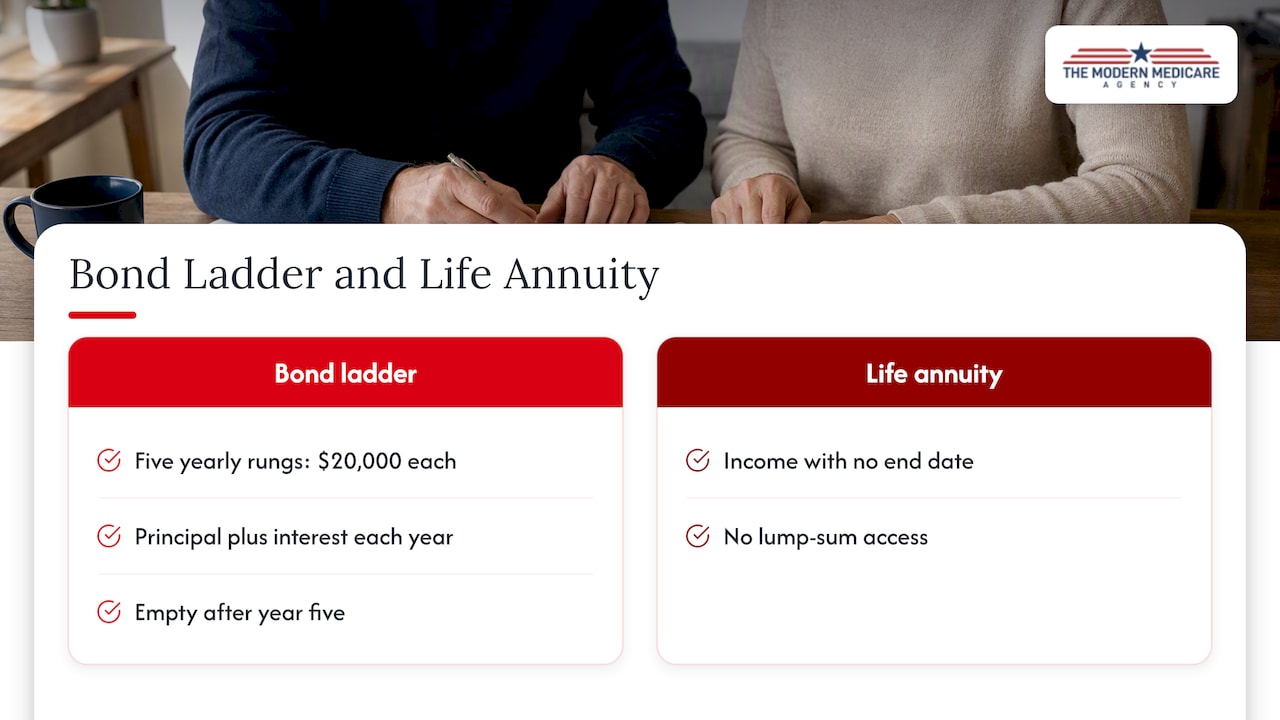
That is why comparing a bond ladder with an annuity is often called a false choice. Retirement Watch notes that financial professionals see them as serving different purposes rather than competing. A ladder gives flexible, dated cash flow. An annuity gives income with no end date.
What about a fixed annuity vs a bond fund?
A fixed annuity has a guaranteed rate for a stated period, and the insurer carries the investment risk. A bond fund’s value moves daily with interest rates, and you carry that risk. In a year when rates rise, the fund’s share price can drop while your fixed annuity’s stated value does not. In a year when rates fall, the fund can gain while your annuity stays at its contracted rate.
The tradeoff is access. You can sell fund shares any business day. A fixed annuity usually has a surrender period, and withdrawals during it can cost you. If you might need the money within a few years, that matters more than a half-point of yield.
Taxes and withdrawal rules
Taxes can tip the decision, so read this section before you move money.
- Annuity payments are taxed as ordinary income. The SEC notes that withdrawals from non-qualified annuities are taxed as ordinary income, not at long-term capital gains rates.
- Annuities in an IRA or 401(k) add no extra tax break. The SEC states the contract’s tax deferral is already provided by the account, so its value rests on other features such as lifetime income.
- Early withdrawals before age 59½ from an annuity or retirement account generally trigger ordinary income tax and may add a 10% penalty. Exceptions exist, so confirm yours with a tax professional.
- Required minimum distributions (RMDs) apply to traditional IRAs. The IRS explains how to calculate them in Publication 590-B, including special rules when a traditional IRA is an individual retirement annuity.
If you hold an annuity inside an IRA, talk to a CPA or enrolled agent about how the RMD is figured before you buy. For retirees on Medicare there is another wrinkle: higher taxable income can raise Part B and Part D premiums through IRMAA surcharges. We explain one way to spread income in our piece on a 3/5/7 annuity ladder for Medicare retirees.
Our perspective
We have worked with Medicare consumers since 2007, and we see the same pattern. People spend months comparing yields and almost no time asking what they actually need the money to do.
Our view is simple. Sort your spending into two buckets. The first is essentials: housing, food, utilities, insurance premiums, and the healthcare costs Medicare does not pay. The second is everything else: travel, gifts, a legacy. Guaranteed income should be sized to cover the first bucket together with Social Security and any pension. Bonds, a ladder or other investments can then serve the second bucket, where a bad year is uncomfortable rather than dangerous.
We also think annuities are oversold by some and unfairly dismissed by others. A product that gives up liquidity for lifetime income is a good tool for the right slice of your money, and a poor one if it takes your emergency fund. We do not push a single answer. We start with education, lay out the options, and let you decide at your own pace. Because we are independent, the comparison is not tied to one carrier’s shelf.
— Paul
When an annuity tends to fit
An annuity is worth a serious look when:
- Your guaranteed income (Social Security, pension) falls short of your essential expenses.
- You worry about outliving your savings, or your family has a history of long lives.
- You want to take the guesswork out of withdrawals.
- You are comfortable locking up part of your money for a guaranteed payment.
Our guides on how to create guaranteed income in retirement and annuity rates for retirees go deeper on payout structures and what drives them. Payout depends on your age, the type of contract and prevailing interest rates, so a quoted figure for someone else will not be yours. That is also the honest answer to “how much will a $100,000 annuity pay each month?”: it depends on those inputs, and the only reliable number is a current quote.
When bonds tend to fit
Bonds or a bond ladder are the stronger choice when:
- You need money at known dates, such as a planned home purchase or a tax bill.
- You want the backing of the U.S. government through Treasuries.
- You value being able to sell and keep control.
- You want to leave assets to heirs, since a ladder’s principal returns to you or your estate while a life-only annuity may pay nothing to heirs.
Remember the caution on timing. The SEC’s investor guidance and other experts note that taking large market losses early in retirement is hard to recover from, which is why many people keep short-term needs in cash-like holdings and use annuities to hedge the risk of a long life.
Combining both: a practical framework
Here is a way to put it together. This is a framework for discussion, not personal advice.
- Add up essential spending per month, including premiums for Medicare, Medigap or Medicare Advantage and Part D.
- List guaranteed income you already have: Social Security, pensions.
- Find the gap. If essentials exceed guaranteed income, that gap is the figure an income annuity could address.
- Hold a cash reserve for one to two years of surprises.
- Use bonds or a ladder for dated goals and flexible spending.
- Review each year, since needs, rates and health change.
Healthcare belongs in step 1. Medicare does not cover everything, and long-term care can be a large cost. Our articles on using annuities to cover healthcare costs in retirement and using an annuity to fund long-term care show how the pieces fit. If you also manage a stock portfolio for the flexible bucket, this retirement income portfolio model shows one way to structure growth and income sleeves around a guaranteed base.
Questions to ask before you buy either
For an annuity:
- What is the insurer’s financial strength rating?
- What are the surrender charges and how long do they last?
- Is income guaranteed for life, for a period, or joint with a spouse?
- What happens to the remaining value if I die early?
- Are there fees or riders that reduce the payout?
For bonds:
- Am I buying individual bonds or a fund?
- What is the credit quality of the issuer?
- Can the issuer call the bond early?
- When does each rung mature, and what will I do with the principal?
Talk it through with us
We are a team of independent agents who specialize in Medicare and senior insurance. Our principal agent, Paul Barrett, has helped Medicare consumers since 2007. If you want to see how a guaranteed-income annuity could sit alongside your Medicare coverage and your bond holdings, start with our annuities page. We explain the options, compare carriers and leave the pressure out of it.
FAQ
Is an annuity better than bonds for retirement?
Neither is better in every case. An income annuity is stronger at covering you for life, while bonds are stronger on liquidity and government backing if you hold Treasuries. Many retirees use an annuity for essential expenses and bonds for flexible goals.
Are annuities safer than bonds?
Not across the board. Treasuries rest on the U.S. government, while an annuity relies on the insurer’s ability to pay, with state guaranty protection of at least $250,000 in each state according to Morningstar. A fixed annuity can be steadier than a bond fund when rates move, since its guaranteed rate does not fall in price.
Can I use a bond ladder instead of an annuity?
A ladder can supply income for the years it covers, but it ends when the last bond matures. It does not protect against living longer than the ladder. Some people pair a ladder for the early years with a deferred income annuity that begins later.
What are the tax differences between annuities and bonds?
Annuity withdrawals are generally taxed as ordinary income, and early withdrawals before 59½ can add a 10% penalty. Bond interest is also taxable, with Treasury interest exempt from state income tax. Ask a tax professional how your own situation applies.
Sources
- Annuities vs. Bonds: Key Retirement Investment Differences, Investopedia
- Treasuries or Annuities? Choosing Between Two Sources of Guaranteed Income, Morningstar
- Investor Tips: Variable Annuities, SEC
- Publication 590-B, Distributions from IRAs, IRS
- Substituting Income Annuities for Bond Funds in Retirement, Financial Advisor
- The Best Retirement Advice of All Time, Kiplinger
- Using Bond Ladders and Income Annuities for Retirement Income, AAII
- Why Bond Funds Don’t Belong in Retirement Portfolios, Advisor Perspectives
- Comparing Annuities and Bond Ladders, Retirement Watch