




A quick insurance decision can feel reassuring, but it may not be the right fit. To avoid emotional decisions when choosing insurance, give yourself time to compare costs and benefits, identify what you’re worried about, and ask questions before deciding. Your feelings can help clarify what matters to you, but they don’t have to make the choice for you.
It’s understandable to feel stressed when weighing protection against cost or imagining what could go wrong. Clear information can make the decision more manageable. This article explains how to slow down, compare options on equal terms, address uncertainty, and balance practical needs with the peace of mind you want.
You’ll also learn which questions can clarify coverage, costs, and trade-offs, so you can move forward with greater confidence and less pressure.
Key Takeaways
- Pause before deciding and notice whether fear, anxiety, or optimism is shaping what feels urgent.
- Compare options using the same coverage limits and deductibles so you can judge costs and benefits fairly.
- Focus on the risks that matter to your circumstances instead of letting worst-case scenarios or wishful thinking make the choice for you.
- Ask clear questions about what a plan covers, what you pay, and how its trade-offs fit your needs.
- For Medicare coverage decisions, The Modern Medicare Agency can help you compare Medicare plan options with personalized guidance.
Taking time to review insurance choices
Insurance decisions can feel urgent after a frightening event or when a deadline is near. Before choosing coverage, pause and identify the feeling driving the decision. Are you anxious about a possible loss, overly cautious after hearing someone’s story, or too optimistic about a risk you may face? Noticing your reaction helps separate emotional pressure from practical needs.
Give yourself time to understand the choices instead of deciding during a stressful conversation. Read the available information, write down what you understand, and flag anything unclear. Return to your notes later with a calmer perspective. For example, after a family member’s medical emergency, you might feel drawn to buy every available protection. Pausing lets you ask which risks affect your situation and which stem from someone else’s circumstances.
Review coverage when your circumstances change, not only when fear prompts you to act. For auto insurance, review your limits annually and after a major life change. A move, a different vehicle, or a change in how you use your car can affect your needs. Set an annual reminder, then make a separate note whenever a major change occurs.
- Name the feeling: Write down whether fear, caution, or optimism is influencing your choice.
- Identify the trigger: Note whether a deadline, recent event, or conversation is making the decision feel urgent.
- Record the question: List what you still need to understand about coverage or exclusions.
- Set a review point: Return to your notes when you can read and compare choices without pressure.
This simple record can help reveal when a decision is reacting to one vivid possibility. If a news story about a break-in makes you reconsider home protection, separate the story from your own concerns. Ask what property or financial loss you want coverage to address. That keeps the event in perspective without dismissing a concern that genuinely matters to you.
Taking time also makes it easier to spot overly optimistic assumptions. You might believe an accident is unlikely because you’ve never had one. Rather than treating that belief as proof, consider the financial impact an unexpected event could have. You don’t need to predict the future. You need to understand which consequences you could manage and which you want coverage to help address.
A deliberate pause isn’t avoidance. It’s part of how to avoid emotional decisions when choosing insurance. Keep a record of your needs, feelings, and open questions, then review each option against it. This gives you a steadier basis for deciding what fits, especially when a recent event has made one risk feel unusually close.
Weighing insurance costs and benefits
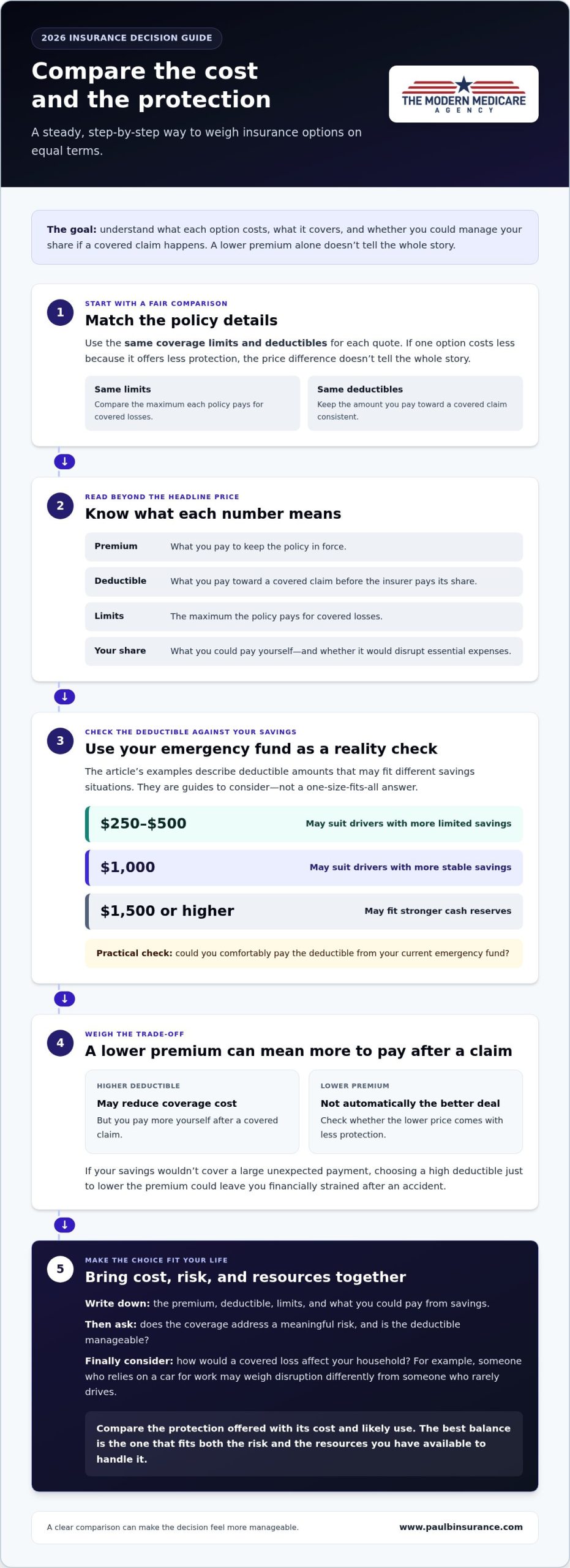
A reasonable deductible is one you could comfortably pay from your current emergency fund. A deductible of $250 to $500 may suit drivers with more limited savings, while $1,000 may suit those with more stable savings; $1,500 or higher may fit stronger cash reserves.
That’s why a lower premium isn’t automatically the better deal. A higher deductible can reduce the cost of coverage, but it also means paying more yourself after a covered claim. Consider a driver whose savings wouldn’t cover a large unexpected payment. Choosing a high deductible to lower the premium could leave that driver financially strained after an accident. Protection should fit both the risk and the resources available to handle it.
Compare insurance quotes on equal terms. Use the same coverage limits and deductibles for each, then look beyond the headline premium. If one option costs less because it offers less protection, the price difference doesn’t tell the whole story. Write down what each option covers, what you would pay yourself, and which trade-offs matter to your household. Matching the details makes comparisons clearer and less vulnerable to a persuasive price or a frightening scenario.
- Premium: What you pay to keep the policy in force.
- Deductible: What you pay toward a covered claim before the insurer pays its share.
- Limits: The maximum the policy pays for covered losses.
- Out-of-pocket impact: Whether you could manage the deductible without disrupting essential expenses.
Next, connect each benefit to a real concern. A driver who relies on a car for work may weigh disruption differently from someone who rarely drives. That doesn’t make one choice right for everyone. It gives each person a practical basis for comparing the protection offered with its cost and likely use.
Address cost concerns before deciding. Consider how your coverage choices affect the premium and the risks you’re taking on. Consulting an independent professional, such as AllCover Insurance Brokers, can help you evaluate your risks and explain available options without encouraging more coverage than you need. Clear explanations can also prevent a quick decision driven by a number that feels alarming or a loss that seems certain.
Try a simple comparison: note the premium, deductible, limits, and what you could pay from savings. Then ask whether the coverage addresses a meaningful risk and whether the deductible is manageable. If your answer changes when you imagine an emergency, revisit the balance instead of choosing from fear. This measured approach makes it easier to weigh cost and protection together.
Addressing uncertainty about the future
Fear of an accident, disaster, or unexpected medical bill can make protection feel urgent. But urgency can push you toward more coverage than you need, or a rushed choice you haven’t fully understood. In 2026, separate the risk you want to prepare for from the anxiety surrounding it. A policy can help manage financial effects, but it can’t remove every uncertainty.
Start with a specific scenario, not an imagined worst case. For example, if an unexpected medical bill worries you, identify which costs concern you and what resources you could use. Then compare those concerns with what a policy covers. This turns a general fear into a concrete question: would this coverage help with the expense you have in mind?
The opposite reaction can also affect a decision. If you assume a bad event is unlikely because it hasn’t happened before, you may underestimate the risk and choose too little coverage. A driver who has never had an accident can still consider how a serious collision might affect household finances. The goal isn’t to predict an event, but to calmly consider its consequences.
- Name the scenario: Describe the event you’re concerned about, such as a serious illness or home damage.
- Identify the impact: Write down what the event could mean for your health, income, or savings.
- Connect it to coverage: Find out which costs a policy addresses and which remain your responsibility.
- Notice your reaction: Ask whether fear is pushing you to buy quickly or optimism is making you dismiss the risk.
Health coverage can also feel uncertain when eligibility or financial support changes. An estimated 17 million Americans are expected to lose health insurance coverage over the coming decade because of federal funding cuts and expiring premium tax credits. That projection doesn’t answer what any one person should choose. It does show why reviewing your current needs and understanding your available options matter.
Use a short written comparison to keep future worries in proportion. For a possible medical expense, note the concern, the coverage that may apply, and the cost you could still face. For a disaster, consider the property or income at risk and the policy’s relevant protections. This keeps the decision focused on your circumstances, not the most alarming headline or a reassuring guess.
Finally, treat uncertainty as a reason to ask for clear explanations, not to buy every available policy. Ask what each policy protects, what it excludes, and how its benefits relate to the scenario you identified. If the answers don’t address your actual concern, revisit the choice. This gives you a practical way to seek control without letting fear or overconfidence decide for you.
Asking questions before choosing insurance
Clear questions make a recommendation easier to assess. Ask for plain-language explanations, then compare the answers with your needs and concerns.
Evaluating Agent Recommendations
A recommendation is easier to assess when you understand why it fits and what alternatives were considered. Whether speaking with a specialist agent or an independent broker like Just Quote Me, ask how they are compensated, which options they can compare, and how each choice addresses your needs. A direct, specific explanation gives you a solid basis for evaluating the advice.
A recommendation should make sense for your situation, not just sound reassuring. For example, if an agent suggests more coverage after you mention a health concern, ask what risk it addresses and what the policy would do. Ask about the trade-offs, too. You can also ask whether another option addresses the same concern differently. Compare the reasoning, not just the confidence or urgency behind the recommendation.
Checking Exclusions and Claim Limits
Exclusions describe situations a policy doesn’t cover, while claim limits set boundaries on what it may pay. Before buying, ask which exclusions and limits apply to the protection you care about, including health insurance benefits.
Then look for the answers in the policy documents. Ask how a limit applies to one claim, a particular service, or a period of coverage. If a health insurance policy describes a benefit broadly, ask which conditions or services are excluded. For example, a benefit that sounds relevant to a treatment may still have a limit or exception that affects your situation. Ask the agent to explain unfamiliar terms and point to the relevant policy language. Understanding these details can help prevent surprises when you use your coverage.
Avoiding Excess or Duplicate Coverage
Overinsurance means paying for protection beyond the risks or needs you want to address; duplicate coverage means two policies may address the same expense. Review your existing policies before adding another.
Make a simple inventory of each policy, its purpose, and the benefits you expect to use. Then compare the new option with that list. For example, if two policies appear to help with the same medical expense, ask whether both could pay, whether one affects what the other covers, and what each costs. Don’t assume similar policy names mean identical benefits or that two policies automatically provide twice the protection. The terms determine how their benefits work together. Keep coverage only when it has a clear role in your overall plan.
Before deciding, write down your three most important questions and ask them in one conversation. For example: “What does this cover?”, “What could limit a claim?”, and “How does it differ from what I already have?” Clear answers can help you weigh the recommendation without pressure.
Balancing rational analysis with emotional concerns
Emotions can highlight what matters, while clear criteria help you judge the available choices. In 2026, use both: recognize the concern, then assess the coverage against your needs.
Recognizing Emotional Buying Biases
Emotional buying biases are feelings that distort how you judge risk, cost, or protection. Fear may make a rare loss feel certain, while overconfidence can make a serious risk seem irrelevant. Hope and a desire for control can influence decisions about auto, home, life, and health insurance. Spotting these reactions matters because they can lead you to choose too much or too little coverage.
Try naming the feeling before acting. For example, after hearing about a neighbor’s medical emergency, you might feel pressure to add coverage immediately. Ask whether that story points to a risk in your own circumstances or mainly explains why you feel unsettled. The concern still deserves attention, but naming it can help you consider it without letting one vivid example decide everything.
Using an Objective Decision Framework
An objective decision framework is a short checklist that tests each option against the same needs. It matters because consistent questions make emotional reactions easier to notice and compare.
For each policy, record its purpose, covered risks, exclusions, limits, premium, and deductible. Then note whether the coverage addresses a real concern and whether you could manage its out-of-pocket costs. For example, compare two options using the same questions rather than choosing the one with the most reassuring description. If an answer is unclear, write down the specific point to ask about.
- Need: What risk or expense are you trying to address?
- Fit: Which policy terms relate directly to that concern?
- Trade-off: What cost or limitation comes with the protection?
- Feeling: Is fear, hope, or confidence changing how you judge the option?
Use the same checklist for every option, including keeping your current policy. This prevents the comparison from favoring whichever option you reviewed most recently. If you’re considering health insurance, focus on the services and expenses that matter to you, then check how each option covers them. The framework doesn’t remove personal values. It gives those values a clear place alongside practical details.
Finally, ask someone you trust to listen as you explain your reasoning. Share the concern, the policy terms you reviewed, and the trade-off you’re accepting. A calm conversation can reveal a missing question or an assumption you hadn’t noticed. You remain in control of the choice, with your feelings acknowledged and your decision grounded in information.
The Modern Medicare Agency: Medicare Advantage Plans
The Modern Medicare Agency helps eligible individuals compare Medicare Advantage Plans alongside Medicare Supplement (Medigap) and Medicare Part D options. If you’re reviewing Medicare coverage and want to understand how choices fit your needs, its independent brokers provide personalized guidance and compare plans from over 40 carriers.
A calm comparison can help you weigh benefits, costs, and trade-offs without letting fear or urgency set the direction. You can discuss your priorities, ask questions in plain language, and consider which options suit your circumstances. The agency also offers Life Insurance for people reviewing that protection.
If you’d like help comparing Medicare plan choices, contact The Modern Medicare Agency.
Make Your Next Choice With Clarity
A steady decision doesn’t require predicting every twist ahead. Start by knowing what matters to you now and being able to explain why a choice fits. Write down the main reason for your decision. If your circumstances or priorities change, that note can help you revisit the choice thoughtfully rather than reacting to a new worry.
That’s a practical way to learn how to avoid emotional decisions when choosing insurance: treat your feelings as useful signals, then let clear needs and understandable terms guide the final choice. You don’t have to silence concern or chase perfect certainty. Take the next step when the information makes sense to you.
If you’re weighing Medicare coverage and would like guidance with your decision, explore your options with The Modern Medicare Agency. Take the time you need, ask what matters to you, and move forward with confidence in your reasoning.
Frequently Asked Questions
What insurance coverage do I actually need based on my risks and finances?
Choose coverage by matching likely financial responsibilities with losses you couldn’t comfortably handle yourself. Consider who depends on your income, which debts or care needs you’re responsible for, and what protection you already have. For example, a parent supporting a child may weigh income protection differently from someone whose household can manage without their earnings. List your obligations and existing policies, then focus on gaps that could disrupt your plans.
How do I compare insurance policies using coverage limits, deductibles, exclusions, and premiums?
Compare the same details for each policy, then consider how they work together in a situation that matters to you. Imagine a covered medical expense or property loss and note the policy limit, your deductible, and any exclusion that could apply. A lower premium may come with a tighter limit or a larger share paid by you. Keep the policy documents beside your comparison notes so your conclusions reflect the actual terms.
How can I compare insurance quotes without focusing only on the monthly price?
Compare what each quote protects and what you may have to pay after a claim, not just its monthly amount. Check that the quotes use matching benefits, limits, and deductibles, then note exclusions and differences in how claims are handled. For example, a quote with a lower payment may leave out a benefit you consider important. Rank the features you value, then compare each quote against that list.
How long should I wait before making a major insurance purchase decision?
Take the time you need to understand policy terms, compare suitable options, and resolve questions that could change your choice. No single waiting period fits every decision. If a deadline applies, identify it first, then use the available time to review the documents and clarify key terms. For example, don’t let a recent accident alone dictate your decision. Choose once you can explain what the policy does and why it fits your needs.

Article by
Paul Barrett
Paul Barrett, CMIP is the founder of The Modern Medicare Agency, an independent Medicare-only brokerage based in Melville, NY. With 18 years of Medicare-exclusive experience, a CMIP designation, and more than 5,000 clients served across 37 states, Paul is one of the most credentialed independent Medicare specialists on Long Island — and one of the most direct.
He represents 40+ carriers with no quotas and no allegiances, which means his recommendations are based entirely on what fits each client's specific situation. He is the author of Medicare Mastery Unlocked and host of the Wise Guys Retirement Talk podcast. His content is grounded in primary sources, real carrier intelligence, and 18 years of watching what happens when people get Medicare right — and when they don't.
📞 631-358-5793 | paulbinsurance.com