




To file a long-term care insurance claim, you contact your insurer, ask for the claim forms, and have a licensed health care practitioner certify that you meet your policy’s benefit triggers. Then you wait out the policy’s elimination period and submit the care records the insurer asks for. Policies differ, so your own contract decides the details. This guide walks through the process in the order you will live it, including what to do when a claim stalls.
TL;DR
- Start the claim as soon as care is needed or likely. Call the insurer, request the claim packet, and keep copies of everything you send.
- Most policies pay only after a licensed practitioner certifies that you cannot do at least two activities of daily living without substantial help, or that you need substantial supervision because of severe cognitive impairment.
- The elimination period is a waiting period that starts after the trigger. You generally pay for care yourself until it ends.
- Describe the help you need exactly as it happens on your worst days, with specifics, not as “I manage fine.”
- If the claim is denied, act inside the deadline in your denial letter and request a written review. Appeals have strict windows.
Table of Contents
- What has to happen before a policy pays
- The long-term care claim process, step by step
- Understanding the elimination period
- How the benefit is paid
- What to say, and what to avoid saying, on your claim
- Why claims get delayed or denied
- If your claim is denied
- A checklist to keep in one folder
- Our perspective
- Get help understanding your coverage
- FAQ
- Sources
What has to happen before a policy pays
A long-term care policy is not like a health plan that pays when you walk into a clinic. It pays when you meet the “benefit triggers” written in your contract. In the federal program for government employees and their families, the triggers are spelled out plainly: a licensed health care practitioner must certify that you are unable to perform at least two activities of daily living without substantial assistance for an expected period of at least 90 days, or that you require substantial supervision because of severe cognitive impairment (Federal Long Term Care Insurance Program claims guide). Many private policies use the same two-path structure, though the wording differs.
The activities of daily living, or ADLs, are the basic self-care tasks. Policies commonly list bathing, dressing, eating, toileting, continence and transferring (moving in and out of a bed or chair). Your policy’s definitions matter, so read that section before you call anyone.
That same federal guide says the practitioner certification is typically required within the last 12 months, so an old doctor’s note will not carry a claim. Check your own policy for its look-back window.
Two more points trip people up:
- No hospital stay is needed. Medicare requires a three-day hospital stay before it covers skilled nursing care, but most long-term care policies do not require a prior hospitalization, according to the National Association of Insurance Commissioners shopper’s guide. If you are comparing the two kinds of coverage, our page on long-term care insurance vs Medicare explains where each one stops.
- Assessment is usually independent of your doctor. LongTermCare.gov, run by the Administration for Community Living, explains that most policies use a nurse or social worker assessment to decide whether the benefit triggers are met (ACL guide to receiving benefits). Expect a visit or a call from someone the insurer chooses.
The long-term care claim process, step by step
1. Read your policy and gather the basics
Before calling, find your policy number, the policy schedule (daily or monthly benefit, benefit period, elimination period), and the section that defines benefit triggers and covered services. If you bought the policy years ago, ask the family member who handled the paperwork where the original is. Many policyholders, and their children, discover at claim time that nobody knows which insurer holds the policy or whether premiums were kept current.
If you are the adult child or caregiver, you will usually need legal authority to act. In the federal program, a legal representative must provide durable financial power of attorney or guardianship papers (claims guide). Private insurers have similar requirements, so ask which documents they accept.
2. Notify the insurer and request the claim packet
Call the claims number on your policy or the insurer’s website. In the federal program, the first step is reviewing the eligibility requirements and calling the program’s claims administrator, where a customer service consultant explains the process and the required forms (claims guide). Private policies work much the same way.
Write down the date, the representative’s name and a reference number. Ask:
- Which forms do I need, and where do I send them?
- Does the insurer need to see a care plan before approving a provider?
- When does my elimination period start, and does it count calendar days or only days I receive paid care?
- How will I be notified of the decision, and how long does the insurer typically take?
You can notify the insurer before you are certain you will qualify. Starting early does not commit you to anything, and it gives you a head start on paperwork.
3. Complete the forms
The packet varies by insurer. In the federal program, you submit a Claims Initiation Form, a Medical Release and IRS Form W-9 (claims guide). Private carriers commonly ask for a policyholder statement, a healthcare provider statement, a nursing assessment and plan of care, and an authorization to release medical information. That list is typical, not universal, so use the packet your insurer sends.
The medical release lets the insurer obtain records from your doctors. Without it, nothing moves. Sign it, but note which providers you listed and make sure they are expecting requests.
4. Get the practitioner certification
The certification is the heart of the claim. Your physician, nurse practitioner or other licensed practitioner describes your condition and your limitations. The federal guide says the certification should describe the nature and degree of physical or cognitive loss, how long services may be needed, and the services you may require (claims guide).
A short, vague note is a common reason claims stall. Help your practitioner by bringing a plain list of what you can and cannot do, and a copy of your policy’s trigger definitions. Ask them to speak to those definitions directly.
5. Submit everything and keep copies
Send complete packets, not pieces. Use a trackable method or the insurer’s secure portal if it has one, and keep a copy of every page, plus every letter, email and call note. If the insurer later says it never received something, your copy and delivery record settle it.
6. The insurer’s review
After receiving the initial forms, a program like the federal one reviews the information to decide benefit eligibility, may request medical records or additional evaluations, and contacts you when a decision is made (claims guide). Expect the nurse or social worker assessment during this stage. Be at home, have a family member present if you wish, and have your medication list and care notes within reach.
7. Satisfy the elimination period and start receiving benefits
Approval does not always mean payment on day one. You must meet the eligibility requirements and also satisfy the policy’s waiting period before reimbursement for covered services begins (claims guide).
Understanding the elimination period
The elimination period works like a deductible measured in time. The NAIC describes it as a waiting period that must pass after a benefit trigger occurs before the insurer begins paying, and says that during it the policyholder is generally responsible for the cost of care (NAIC shopper’s guide).
This is why the elimination period deserves attention at purchase and again at claim time. A few questions to settle with the insurer:
- Does the clock start on the date of the practitioner’s certification, the date of the assessment, or the first day you receive care?
- Do days of unpaid help from family count?
- Is it a one-time period, or does it reset if you recover and need care again?
Our guide to long-term care elimination periods shows how a long waiting period can leave months of costs on your side, and how to weigh that choice when you buy.
How the benefit is paid
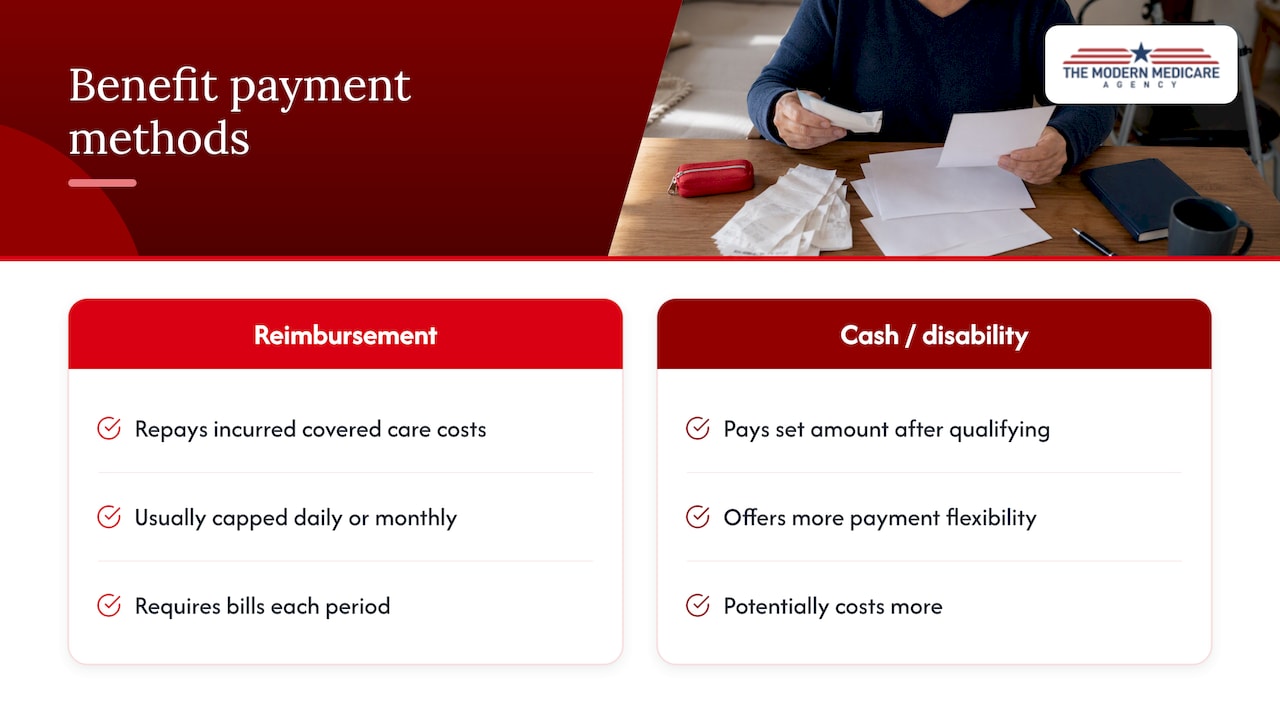
Policies pay in two main ways. Reimbursement policies repay you for covered care costs you have already incurred, usually up to a daily or monthly limit, and you submit bills or invoices each period. Cash or disability-style policies pay a set amount once you qualify. LongTermCare.gov notes that cash disability policies offer more payment flexibility but are potentially more expensive than reimbursement-style policies (ACL guide).
If you have a reimbursement policy, set up a simple routine from the first month: collect invoices from the home care agency or facility, note the dates of service, and submit them on the insurer’s schedule. Late or incomplete bills are an avoidable cause of delays. Ask whether your policy lets the insurer pay the provider directly.
Benefits may also have tax implications, and premiums for qualified policies can be deductible within limits. See our page on the long-term care tax deduction, and confirm your situation with a tax professional.
What to say, and what to avoid saying, on your claim
The most useful habit is accuracy about your worst days. People who have managed independently all their lives tend to understate their needs. They say “I’m fine” or “I get by,” and an assessor writes that down.
Do:
- Describe how you do each ADL, how long it takes, and what happens when you try alone (falls, near-falls, exhaustion, needing someone standing by).
- Give examples from the last few weeks, with dates when possible.
- Say how often help is needed and how long you expect to need it. The 90-day expectation is a key phrase in many policies.
- Explain cognitive symptoms through concrete events: wandering, unsafe stove use, missed medications, unpaid bills.
- Let a family member who sees daily life describe what they observe.
Avoid:
- Describing your best day as if it were typical.
- Minimizing out of pride, or saying you “don’t really need” help you actually receive.
- Guessing at dates or diagnoses. Say “I’m not sure, my records will show it.”
- Exaggerating. Inaccurate statements can cause trouble later, so stay factual.
The type of help counts too. One industry guide notes that most policies treat ADL assistance as at least stand-by help, while a few require hands-on help (Home Instead long-term care insurance guide). Check whether your policy counts someone standing nearby to prevent a fall.
When the claim involves memory loss
For severe cognitive impairment, the trigger is usually substantial supervision, not a count of ADLs. The certification should describe how often the person needs cueing or protection from harm. Families also look for ways to keep a person with dementia engaged during the claim period, and ideas such as games for people with dementia can fit into the daily routine, though they do not replace the clinical documentation the insurer needs.
Why claims get delayed or denied
Most problems fall into a few categories:
| Problem | What it looks like | What helps |
|---|---|---|
| Incomplete forms | Insurer requests more information, clock stalls | Return complete packets and track dates |
| Vague certification | Practitioner note does not address policy triggers | Bring the policy’s trigger language to the appointment |
| Understated needs | Assessment records “independent” in several ADLs | Describe your hardest days, with a family witness |
| Unqualified provider or setting | Care is not delivered by a covered type of provider | Ask the insurer to confirm covered providers before care starts |
| Policy lapse | Premiums unpaid | Keep premium notices and confirm status when you call |
A denial is not always the end. It is the start of a deadline.
If your claim is denied
Read the denial letter first. It should state the reason and the appeal procedure. Then:
- Note the deadline. In the federal program, you must request a review in writing within 60 days after the denial, and if the initial denial is upheld, you may file an appeal (claims guide). Your policy may give a different window, so use the one in your letter.
- Request your claim file and compare what the insurer relied on against your own records.
- Ask your practitioner for a stronger statement addressing the exact trigger the insurer said was not met.
- Appeal in writing and send it by a trackable method.
- Contact your state insurance department if you believe the insurer is not following the policy or state rules.
State rules add protections. Wisconsin, for example, requires policies to describe the benefit appeal procedure, and the insurer must review the appeal and decide within 30 days (Wisconsin Office of the Commissioner of Insurance guide). Other states set their own rules, so check with yours.
Denials under Medicare plans follow a separate system. If you are dealing with one, see our Medicare coverage denial appeal guide.
A checklist to keep in one folder
- Policy, schedule of benefits, and any riders
- Photo ID and, if you are acting for someone, power of attorney or guardianship papers
- Claim forms and the medical release, signed
- Practitioner certification dated within your policy’s window
- Medication list and recent medical records
- Care plan from the home care agency or facility
- Invoices with dates of service
- A log of every call and letter, with names and reference numbers
Our perspective
Over the years we have sat with many families at the kitchen table when a claim becomes real. The pattern is consistent: the policy was bought with good intentions, then nobody can find it, nobody knows what the triggers say, and the person who needs care is too proud to describe how hard things have become.
That is why we believe in education first. A long-term care policy only works if you understand it before the day you need it. We encourage clients to keep a one-page summary: insurer, policy number, daily benefit, elimination period, and who to call. Review it at your annual coverage checkup so your family is not guessing.
As independent agents with access to 40+ carriers, we are not tied to one company’s story. When we help someone look at long-term care coverage, we start with how the claim will actually go: how the waiting period works, what the trigger language says, and how benefits are paid. A policy that looks inexpensive but is hard to use is not a good deal for you.
If you already have a policy and are starting a claim, we are glad to help you understand your options and plan next steps. If you do not have one yet, the best time to ask questions is before you need to file.
Paul
Get help understanding your coverage
We are an independent Medicare and senior insurance agency, and we help people review long-term care insurance alongside Medicare supplements, Medicare Advantage and other coverage. If you are weighing a policy, or want a clear read on how your current coverage fits with Medicare, our team can walk you through the options without pressure. Start with our Medicare Supplement and long-term care page, or see what long-term care insurance covers before you decide.

If cost is your main question, our overview of long-term care insurance costs is a good next read.
FAQ
How do I file a long-term care insurance claim?
Call the claims number on your policy, request the claim packet, and return the completed forms with a licensed practitioner’s certification and a signed medical release. The insurer then reviews your records, usually arranges a nurse or social worker assessment, and tells you its decision. Keep copies of everything and log each call.
How long does a long-term care claim take?
It depends on the insurer, how quickly your records arrive and whether more evaluations are requested. Your policy or state rules may set decision timelines, so ask the insurer for its typical turnaround when you open the claim. Returning complete forms is the best way to avoid delays.
Do I need a hospital stay before my policy pays?
Usually not. The NAIC notes that, unlike Medicare’s skilled nursing benefit, most long-term care policies do not require a prior hospital stay (NAIC shopper’s guide). Your policy’s benefit triggers and elimination period decide when payments begin.
What can I do if my claim is denied?
Read the denial letter for the reason and deadline, then request a review or appeal in writing within that window. In the federal program the review request is due within 60 days of the denial (claims guide). If you think the insurer is not following your policy, contact your state insurance department.
Sources
- Beginning the Claims Process, Federal Long Term Care Insurance Program
- A Shopper’s Guide to Long-Term Care Insurance, NAIC
- Receiving Long-Term Care Insurance Benefits, Administration for Community Living
- Consumer’s Guide to Long-Term Care, Wisconsin Office of the Commissioner of Insurance
- Long-term care insurance guide, Home Instead