



A no-deductible Part D plan lets you pay a share of the cost of your covered prescriptions from the first fill of the year, without first paying a set amount out of pocket. You still pay a monthly premium, plus copayments or coinsurance. Medicare.gov says that some Medicare drug plans don’t have a deductible, and that a $0 deductible does not mean $0 drugs.
Whether that plan is the cheapest for you depends on your medications, your pharmacy and the plan’s premium. This guide covers what “no deductible” means, how the costs add up over a year, where deductibles are waived on every plan, and how to compare plans before enrolling.
TL;DR
- A $0 deductible means the plan starts sharing costs on your first covered fill. Premiums, copays and coinsurance still apply.
- By law, no Part D plan may charge a deductible above $615 in 2026 or $700 in 2027, and some plans charge none.
- Once your out-of-pocket spending hits $2,100 in 2026 ($2,400 in 2027), you pay $0 for covered Part D drugs for the rest of the year.
- The best plan is the one with the lowest total yearly cost for your drugs and pharmacy, not the one with the lowest deductible alone.
- Missing your enrollment window without creditable coverage can add a lifetime penalty, so check your timing first.
Table of Contents
- What “no deductible” means in a Part D plan
- The three stages of Part D, with and without a deductible
- What you still pay with a $0 deductible
- Drugs with no deductible on any plan
- Extra Help can make the deductible $0 for you
- How to choose a Part D plan when deductible matters to you
- Enrollment timing: don’t let a penalty undo your savings
- Do the numbers change in 2027?
- Our perspective
- Get your drug list compared by an independent agent
- FAQ
- Sources
What “no deductible” means in a Part D plan
A deductible is what you pay for covered drugs before your plan starts paying its share. Medicare.gov explains that no drug plan may have a deductible more than $615 in 2026 ($700 in 2027). Plans are free to set it lower, and some set it at $0.
CMS describes the effect in its low-income guidance: when a plan has no deductible in its approved benefit package, the member has first-dollar coverage. In plain terms, the plan shares the cost starting with your first prescription of the year.
Two details matter here:
- Some plans cover certain drugs before the deductible even if they have one. Medicare’s own guide notes that in some plans certain drugs are covered before you meet your deductible, often lower-tier generics. A plan with a deductible on paper can behave a lot like a no-deductible plan if your drugs are on those tiers.
- “No deductible” describes one cost, not the whole bill. The premium, the cost-sharing on each fill and the pharmacy you use all still shape what you pay.
The three stages of Part D, with and without a deductible
Medicare.gov describes drug plans as having three stages:
- Deductible stage (if the plan has one). You pay the full negotiated price of covered drugs until you reach the deductible.
- Initial coverage stage. You pay 25% coinsurance until your out-of-pocket spending reaches $2,100 in 2026 ($2,400 in 2027).
- Catastrophic stage. You pay nothing for covered Part D drugs for the rest of the calendar year.
A no-deductible plan skips stage one. The National Council on Aging’s 2026 chart puts numbers on it: with no deductible, you would pay up to $1,485 in the initial coverage period and the plan would pay up to $4,455 before catastrophic coverage begins. The same chart shows that after you reach $2,100 in out-of-pocket spending you pay $0 for covered drugs through December 31, 2026, and the benefit resets on January 1, 2027.
If you want to understand that final stage in more depth, our guide to Part D catastrophic coverage and the annual cap walks through it step by step.
A simple way to picture the year
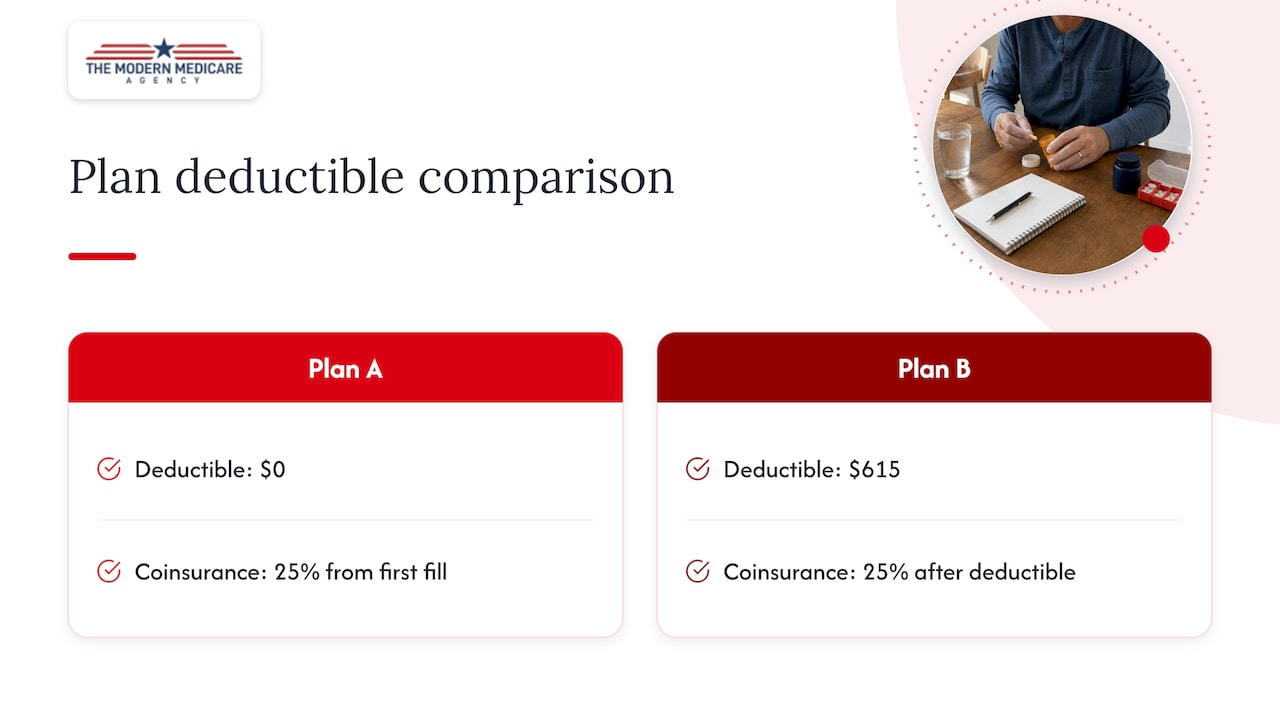
Imagine two plans in 2026, both with 25% coinsurance on the drugs you take. Plan A has a $0 deductible. Plan B has a $615 deductible. With Plan B, you pay the first $615 of drug costs in full, then 25% afterward. With Plan A, you pay 25% from the first fill. The no-deductible plan spreads your costs more evenly through the year, which many people find easier to budget.
That is only half of the comparison, though. Plan A may charge a higher monthly premium, or it may place your drugs on higher tiers. A plan’s yearly cost is premiums plus what you pay at the pharmacy, and the two move in opposite directions across plans.
What you still pay with a $0 deductible
Medicare is direct on this point: a $0 deductible means you don’t have to meet a drug deductible, but copayments or coinsurance may still apply. Here is what stays on your bill.
The monthly premium
Every standalone drug plan has its own premium, and it is paid whether or not you fill a prescription that month. A plan with no deductible often prices that convenience into the premium, though not always. Compare both numbers together.
Copays and coinsurance by tier
Plans sort drugs into tiers. Lower tiers, usually generics, carry flat copays. Higher tiers, such as brand-name and specialty drugs, usually carry coinsurance, a percentage of the drug’s price.
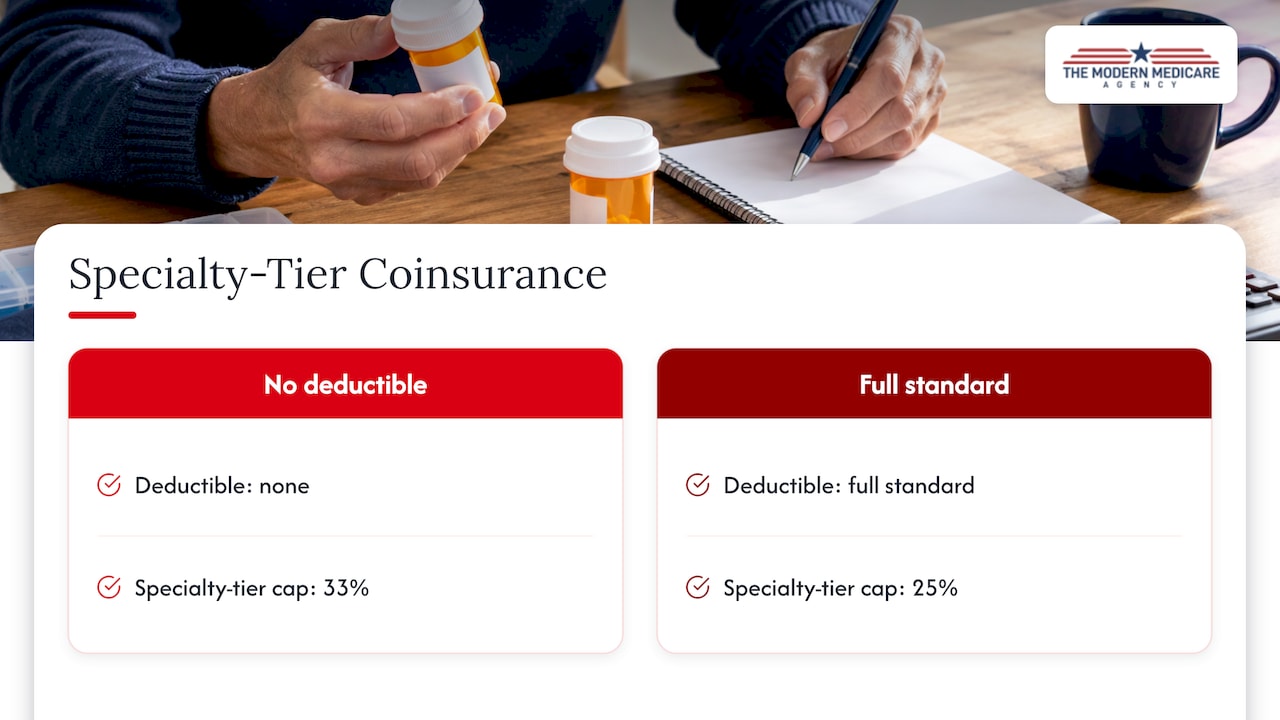
There is one rule worth knowing if you take an expensive specialty drug. Under federal regulation, the maximum specialty-tier coinsurance is 33 percent for Part D plans with no deductible, compared with 25 percent for plans with the full defined standard deductible. That is a ceiling, not a guarantee that any plan charges it, but it shows why a no-deductible plan is not automatically cheaper for high-cost drugs. Always check the specialty tier in the plan’s formulary.
Formulary and pharmacy rules
A plan only helps if it covers your drugs. Check that each medication is on the formulary, what tier it sits on, and whether the plan applies prior authorization, step therapy or quantity limits. Then check pharmacy status. Many plans charge less at preferred pharmacies, so the same prescription can cost different amounts at two stores.
Your Explanation of Benefits
Once you’re enrolled, your plan sends an Explanation of Benefits the month after the pharmacy bills it. Medicare.gov says it shows the prescriptions you filled, what your plan paid, what you paid and which coverage stage you’re in. It is the easiest way to see how close you are to the out-of-pocket cap.
Some costs also sit outside any drug plan. Tests and procedures have their own prices, which is why guides such as this one on what a DEXA scan costs with or without insurance are useful for budgeting your total health spending.
Drugs with no deductible on any plan
Some costs are shielded from the deductible whichever plan you choose. The 2026 Medicare Advantage and Part D rule keeps two protections in place: adult vaccines recommended by the advisory committee carry no deductible and no cost-sharing, and insulin has no deductible. Medicare’s drug coverage page also describes a $35 cap on a one-month supply of covered insulin that applies without meeting a deductible. Confirm the current details with Medicare or your plan.
So if you only take insulin or need vaccines, the deductible matters less than it seems. If your costs come from a handful of brand-name drugs, it matters a great deal.
Extra Help can make the deductible $0 for you
If your income and resources are limited, you may qualify for Extra Help, a federal program that lowers Part D costs. Medicare’s guide says that in 2026, with Extra Help, you pay $0 for your drug plan premium and deductible, up to $5.10 for each generic and up to $12.65 for each brand-name drug, and $0 once you reach the out-of-pocket threshold. The premium figure applies to benchmark plans, so check which plans in your area qualify.
These pages explain the program in detail:
- Who qualifies for Extra Help
- How Extra Help works for Part D
- Extra Help for beneficiaries on disability
How to choose a Part D plan when deductible matters to you
A low or zero deductible is a good filter, but it should be the first step in a comparison, not the last. Here is a process that works.
- List every medication. Include the name, dose and how often you fill it. Include insulin and any specialty drugs.
- Pick your pharmacy. Decide whether you’ll use a local pharmacy, a chain or mail order, and check whether the plan treats it as preferred.
- Price each plan’s full year. Add twelve months of premiums to your expected copays and coinsurance. Do it for several plans, with and without a deductible.
- Check the tiers of your most expensive drugs. One brand-name drug on a high tier can outweigh everything else.
- Look at the out-of-pocket cap. If your costs are high, you may reach $2,100 (2026) or $2,400 (2027) early in the year. Then the deductible and the coinsurance matter only until that point.
- Revisit every fall. Plans change premiums, formularies and deductibles each year, so last year’s best plan may not be this year’s.
A comparison table can help you frame the trade-off:
| Feature | No-deductible plan | Plan with a deductible |
|---|---|---|
| Cost at first fill | You pay copay or coinsurance only | You may pay the full price until the deductible is met |
| Monthly budgeting | More even through the year | Heavier early in the year |
| Specialty-tier coinsurance ceiling | Up to 33% | Up to 25% |
| Premium | Often compared against the plan’s cost-sharing, so check both | Varies by plan |
| Best fit | People who fill brand-name drugs early and often, or want predictable fills | People on mostly low-cost generics or with certain drugs covered before the deductible |
The last two rows are guides for your comparison and not rules. Each plan sets its own premium and tiers.
Enrollment timing: don’t let a penalty undo your savings
Part D is optional, but waiting can cost you for life. Medicare.gov says you’ll pay an extra 1% for each month, 12% a year, if you don’t join a drug plan when you first get Medicare, or if you go 63 days or more without creditable drug coverage. The penalty is based on the national base beneficiary premium, which is $38.99 in 2026.
The official calculation is 1% of that base premium, multiplied by the number of full months you went without coverage, rounded to the nearest $0.10 and added to your monthly premium for as long as you have drug coverage. So a 24-month gap leads to a 24% penalty on the base premium, each month, for life unless you qualify for Extra Help, according to Oregon’s SHIBA guide.
Creditable coverage means drug coverage that is expected to pay, on average, at least as much as Medicare drug coverage. If you’re retiring from an employer plan, ask the plan for a written creditable coverage notice before you decide.
The main windows to know are:
- Initial Enrollment Period. A seven-month window that starts three months before the month you turn 65, includes your birthday month, and runs three months after, per the Colorado Division of Insurance.
- Annual Open Enrollment. Every year from October 15 to December 7, with changes effective January 1. You can join, switch or drop a plan during this period, as the same state guide lays out.
- Medicare Advantage Open Enrollment. January 1 to March 31 each year, for people already in a Medicare Advantage plan.
Other windows exist for special situations, such as moving or losing coverage. Check the current schedule on Medicare.gov before you act. For the penalty in more detail, see our guide to the Part D late enrollment penalty.
Do the numbers change in 2027?
Yes. Medicare.gov lists the maximum deductible rising from $615 to $700 and the 25% coinsurance stage ending at $2,400 instead of $2,100 for 2027. A plan that charges no deductible now may change its design for next year, as may its premium and formulary. That is why the fall review matters: read the plan’s Annual Notice of Change before the open enrollment window closes.
Our perspective
We hear “I want a plan with no deductible” often, and it’s a reasonable place to start. Nobody likes paying the full price at the pharmacy counter in January.
But in our experience the deductible is one number among several. Two people with the same plan can pay very different amounts because of their drugs, their pharmacy and the month they fill their first prescription. We believe in education first: once you know how the three stages work, the choice becomes much clearer.
As independent agents who specialize in Medicare, we can compare Part D plans from many carriers against your actual medication list, not a generic average. Our principal agent, Paul Barrett, has been helping Medicare consumers since 2007, and we review your coverage each year so changes don’t catch you off guard.
Paul
Get your drug list compared by an independent agent
We’re an independent Medicare agency that helps people compare Medicare Part D prescription drug plans from multiple carriers. You bring your medication list and pharmacy, and we help you see which plans cover your drugs and how the deductible, premium and cost-sharing add up for you. There’s no pressure, and we’ll explain each option before you decide.

If you’d like background first, start with our Part D guide for comparing plans, then bring your questions to us.
FAQ
Does a no-deductible Part D plan mean my drugs are free?
No. You still pay your monthly premium, plus copays or coinsurance on covered drugs. Medicare notes that copayments or coinsurance may still apply when your deductible is $0. Your costs stop for covered drugs only after you reach the annual out-of-pocket cap.
Is the maximum Part D deductible the same every year?
No. It is $615 in 2026 and $700 in 2027, per Medicare.gov. Plans can charge less than the maximum, and some charge nothing, so check each plan’s deductible every year.
Can I deduct my Part D premiums on my taxes?
Possibly, if you itemize. H&R Block explains that you can include Medicare D premiums among medical expenses, and you can deduct only the unreimbursed total that exceeds 7.5% of your adjusted gross income. Ask a tax professional how this applies to you, and if you’re self-employed, ask about the separate self-employed health insurance deduction.
Is it a good idea to skip Part D if I take no medications?
It depends on whether you have creditable drug coverage. Without it, going 63 days or more without drug coverage can trigger the late enrollment penalty, as Medicare.gov explains. Many people with no current prescriptions choose a low-premium plan to avoid that penalty, and an independent agent can help you compare your options.
Sources
- How much does Medicare drug coverage cost? (Medicare.gov)
- Your Guide to Medicare Drug Coverage (Medicare.gov)
- CMS Low Income Level III guidance
- 2026 Medicare Part D Cost Sharing Chart (NCOA)
- 42 CFR § 423.104 (Cornell Law School)
- Final 2026 Medicare Advantage and Part D Rule
- Avoid late enrollment penalties (Medicare.gov)
- The Part D Late Enrollment Penalty (Medicare.gov)
- Creditable prescription drug coverage (Medicare.gov)
- 2026 Medicare Drug Insurance and You (Colorado Division of Insurance)
- 2026 Oregon Guide to Medicare Insurance Plans (SHIBA)
- Can I Claim Medical Expenses on My Taxes? (H&R Block)
- DEXA Scan Cost in 2026