




A MYGA, short for multi-year guaranteed annuity, is a contract with an insurance company. You hand over a lump sum, and the insurer guarantees a fixed interest rate for a set number of years. Your interest grows tax-deferred, and when the term ends you choose what to do next. It is often described as the insurance industry’s version of a CD, but the two differ in who backs them, how they are taxed and how you get your money out.
This guide explains how a MYGA works, what it costs you in flexibility, how it compares with a CD and with other fixed annuities, and how to decide whether one fits your plans. We are independent Medicare and senior insurance agents, and many of the people we work with are weighing safe, predictable places for retirement savings alongside their health coverage.
TL;DR
- A MYGA is a fixed annuity that pays a guaranteed rate for a chosen term, commonly 3 to 10 years, with no market index involved.
- Interest is tax-deferred until you withdraw it, while CD interest is generally taxed every year.
- A MYGA is not FDIC insured. Its guarantee rests on the insurer’s financial strength, backed by your state’s guaranty association.
- Taking out more than the free-withdrawal amount early usually triggers a surrender charge, and withdrawals before age 59½ can add an IRS penalty.
- The right term is the one that matches when you will actually need the money.
Table of Contents
- What a MYGA is, in plain terms
- How a MYGA works, step by step
- MYGA vs. CD: the differences that matter
- MYGA vs. other fixed annuities
- Fees, withdrawals and surrender charges
- What happens to a MYGA when the owner dies
- Who a MYGA tends to suit
- How MYGAs connect to Medicare planning
- Questions to ask before you buy any MYGA
- Our perspective
- Talk with an independent agent about your options
- FAQ
- Sources
What a MYGA is, in plain terms
A MYGA is a type of fixed deferred annuity. You fund it with a single lump sum, choose a guarantee period, and the insurer commits to a set rate for that whole period. Forbes Advisor notes that MYGAs are sometimes called fixed-rate annuities and that they are a type of fixed annuity. Research from the NAIC describes MYGAs as providing guaranteed returns over specified terms, similar to bank CDs or zero-coupon bonds.
Two words in the name carry the meaning:
- Multi-year: the rate is fixed for a term you pick, most often somewhere between 3 and 10 years.
- Guaranteed: the insurer sets the rate when you buy. It does not move with the stock market, an index or a participation formula.
Because there is no market index, a MYGA is among the simplest annuities to understand. You can know on day one what your contract will be worth at the end of the term, assuming you leave the money alone.
How a MYGA works, step by step
- You pick a term. Insurers typically offer several guarantee periods, such as 3, 5, 7 or 10 years. Longer terms often come with different rates and longer surrender schedules.
- You make one lump-sum deposit. The money can come from savings, a maturing CD, or a transfer from another annuity or retirement account. Ask which funding routes are allowed for the contract you are considering.
- Interest accrues at the locked rate. The rate does not change during the guarantee period, no matter what happens to interest rates elsewhere.
- Earnings grow tax-deferred. You are generally not taxed on the interest until you take it out. If you want the details, read our explainer on whether annuity earnings are taxable.
- At the end of the term, you decide. Most contracts let you cash out, renew at the rates then being offered, or move the money into another eligible annuity through a tax-free 1035 exchange.
That last step deserves attention. A renewal rate is not guaranteed to match your original rate. Mark the maturity date on your calendar and review your options a few months ahead, so the contract does not roll into a new term at a rate you did not choose.
MYGA vs. CD: the differences that matter
The comparison is natural because both products pay a fixed rate for a fixed term. The differences sit in the protection, the tax treatment and the access rules.
| Feature | MYGA | Bank CD |
|---|---|---|
| Issued by | Insurance company | Bank or credit union |
| What stands behind it | The insurer’s claims-paying ability, plus state guaranty associations | FDIC or NCUA deposit insurance |
| Taxes on interest | Deferred until you withdraw | Generally taxed each year |
| Typical terms | Often 3 to 10 years | Often a few months up to 5 years |
| Early withdrawal | Free amount each year, surrender charge beyond it | Early withdrawal penalty |
| Death of owner | Named beneficiary receives the contract value | Passes under the account’s ownership and beneficiary terms |
Protection: insurer vs. FDIC
A MYGA is not a bank deposit and is not FDIC insured. The guarantee is only as strong as the company that issues it. If an insurer fails, state guaranty associations step in, and their coverage limits vary by state. Before you buy, look up your state’s limit through your state’s guaranty association, and check the insurer’s financial strength ratings from the independent rating agencies. This is one of the main reasons to work with an independent agent who can compare several carriers rather than one.
Taxes: deferral vs. yearly bills
CD interest is generally taxed in the year it is earned, even if you roll it over. MYGA interest is deferred, so the tax bill arrives when you take money out. Forbes Advisor confirms that MYGA taxes are deferred until withdrawals begin. Deferral can help if you expect to be in a lower tax bracket later, but it is a timing difference, not a tax exemption. Withdrawals of interest are taxed as ordinary income.
Access to your money
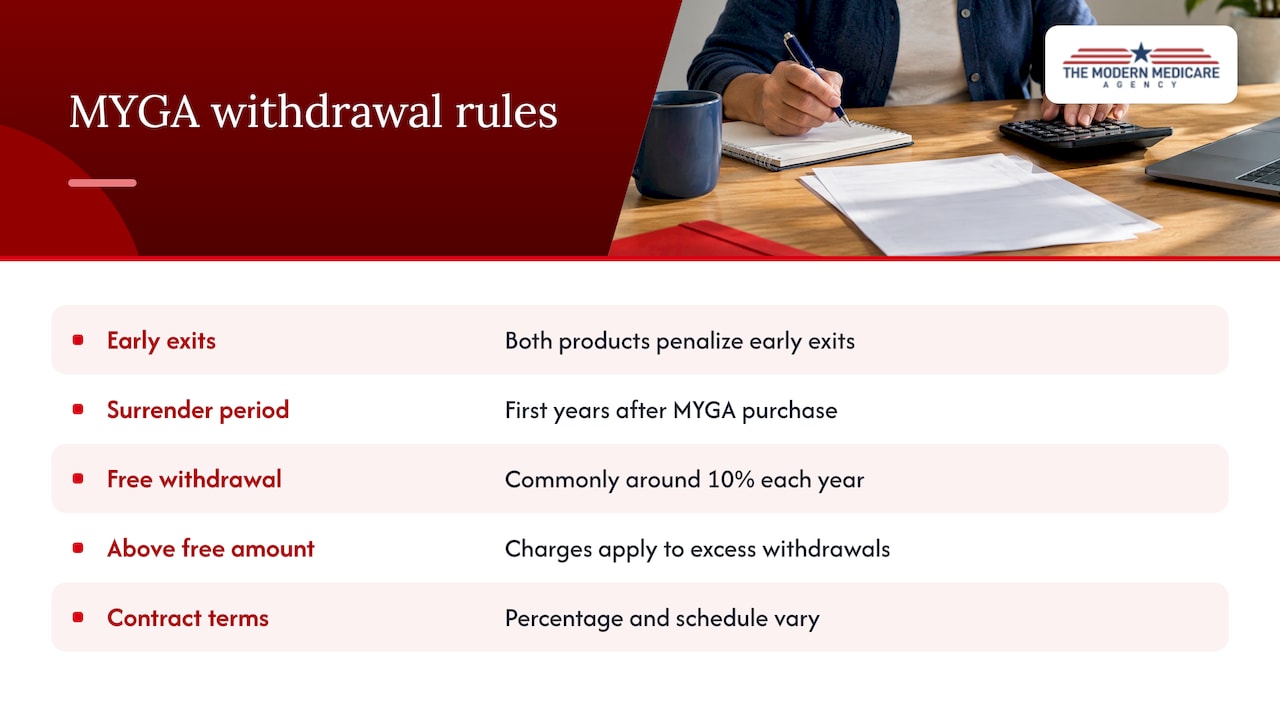
Both products penalize early exits. With a MYGA, the first years after purchase make up the surrender period. According to the NAIC buyer’s guide draft, taking money out before the surrender period ends will likely result in a surrender or withdrawal charge that can significantly reduce what you receive. Many contracts allow a free withdrawal of a set percentage each year, commonly around 10%, and charge only on amounts above it. The exact percentage and the surrender schedule are in each contract, so read them before you sign.
A worked comparison
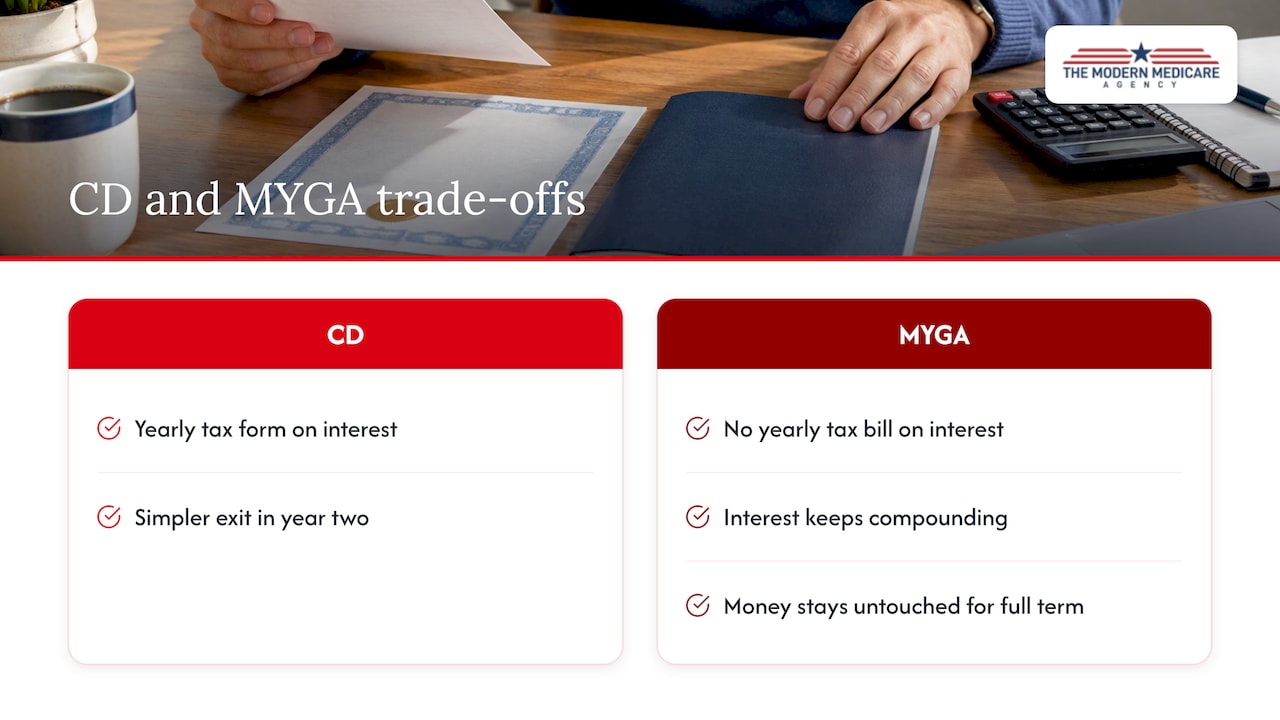
Suppose you have $100,000 and two options of the same length, one a CD and one a MYGA, both at the same stated rate. The CD sends you a tax form every year for interest you may not have spent. The MYGA lets all of that interest keep compounding with no yearly tax bill. The MYGA’s after-tax growth is likely to be ahead if you stay in your tax bracket, but only if you can leave the money untouched for the full term. If you might need a large sum in year two, the CD’s simpler exit may serve you better, and a shorter MYGA term might serve you better still. That is the reason to start with the question of when you need the money, not with the rate.
MYGA vs. other fixed annuities
“Fixed annuity” is the wider family. A MYGA is the version with a rate guaranteed for the entire term, so it is sometimes called a fixed-rate annuity. According to the NAIC buyer’s guide draft, fixed deferred annuities, including MYGAs, credit an interest rate set by the insurer rather than one tied to a market index.
Other fixed annuities may work differently:
- Fixed annuities with a renewable rate: the insurer declares a rate for a period and can change it afterward, sometimes with a minimum guaranteed rate. Ask what is guaranteed, for how long and what the minimum is.
- Immediate annuities: you convert a lump sum into income that starts right away. Our guide to immediate annuities and payment options covers that route.
- Index-linked annuities: these tie credited interest to an index formula. A MYGA has no index, no cap and no participation rate.
If you want a broader view of the category, see our fixed annuities guide for retirement income.
Fees, withdrawals and surrender charges
Most MYGAs have no annual fee, because the insurer’s margin is built into the rate it offers. The cost of a MYGA shows up in the rules around early access.
- Free withdrawal amount: many contracts let you take out about 10% of the contract value per year without a surrender charge. Some have a minimum withdrawal size.
- Surrender charge: a percentage deducted from withdrawals above the free amount, usually highest in year one and stepping down each year until the period ends.
- Market value adjustment (MVA): some contracts apply an adjustment if you withdraw above the free amount before the guarantee period ends. It can raise or lower the amount you receive, depending on interest rate movement.
- Waivers: certain withdrawals, such as required minimum distributions or amounts paid at death, are commonly exempt from surrender charges. Confirm which ones your contract waives.
- IRS penalty: withdrawals of earnings before age 59½ may carry a 10% federal penalty on top of ordinary income tax, with limited exceptions. Talk to a tax professional about your own situation before moving money.
The NAIC points out that annuities cannot be accessed as easily as a bank account during the surrender period, which is why choosing a term that fits your plans matters more than chasing the highest advertised rate.
What happens to a MYGA when the owner dies
If you name a beneficiary, the contract value generally passes directly to that person outside probate. A typical MYGA death benefit pays the account value, and surrender charges are commonly waived at death. Some contracts also allow a spouse to continue the contract rather than cash it out. These provisions differ by insurer, so confirm the death benefit terms and your beneficiary designation when you apply, and review them after major life events such as marriage, divorce or the loss of a spouse.
Who a MYGA tends to suit
A MYGA can be a fit if you:
- want a known return for a specific number of years and little exposure to market swings;
- have money you will not need for the full term, with other savings set aside for emergencies;
- are rolling over a maturing CD or other savings and want to compare tax treatment;
- are building a plan for guaranteed income and want a piece of it to be predictable.
It tends to be a poor match if you may need most of the money soon, if you have no separate emergency fund, or if you are unsure how your retirement income will be taxed. The NAIC draft notes that regulators require agents to recommend annuities only when they are in the customer’s best interest, and it lists the questions a good agent should ask: how soon you may need cash, how long you plan to keep the annuity and your tax status.
Staggering terms with a ladder
If you worry about locking everything into one term or one rate, you can split the money across several MYGAs that mature in different years. When each one matures, you can renew it or use the funds as needed. We explain the idea in our guide to building an annuity ladder. For a view of what current rates look like for retirees, see annuity rates for retirees.
How MYGAs connect to Medicare planning
Most of our clients come to us for Medicare. The two topics meet in retirement budgeting. Medicare Supplement, Medicare Advantage and Part D premiums, plus out-of-pocket costs, are recurring expenses you can plan around. Some people set aside part of their savings in a guaranteed product so that part of their retirement picture is predictable. Our guides on using annuities to cover healthcare costs and creating guaranteed income in retirement walk through that thinking.
Questions to ask before you buy any MYGA
- What is the guaranteed rate, and for exactly how many years?
- How much can I withdraw each year without a charge?
- What is the surrender schedule, year by year, and is there an MVA?
- What is the insurer’s financial strength rating, and what does my state’s guaranty association cover?
- What happens at maturity? Will the contract renew automatically, and at what rate?
- How will the interest be taxed when I take it out, and does the 59½ rule affect me?
- Who is named as beneficiary, and does the contract allow spousal continuation?
Write the answers down for every contract you consider, so you compare like with like.
Our perspective
Education comes first for us. A MYGA is a clear, simple product, but only when you understand the trade: you give up easy access in return for a rate you can count on. When the term matches the plan, that trade can work well.
What we see in practice is that people do best when they decide how long they can leave the money alone before they look at any rate. We work with more than 40 carriers, so we can lay different terms and carriers side by side instead of pointing you to one. We do not pressure anyone, and we would rather you ask every question on the list above than feel rushed.
If you are a Medicare consumer, we can also look at your whole picture: health coverage, income needs and where a guaranteed product might sit, if at all.
Paul
Talk with an independent agent about your options
If you are comparing a MYGA with a CD or another safe option, we can help you sort through the choices. Paul Barrett has helped Medicare consumers since 2007, and our team can compare carriers, explain the terms in plain language and review how a guaranteed product fits alongside your health coverage. See our annuities page to get started.

You can also reach us through the Paulbinsurance home page for help with Medicare Supplement, Medicare Advantage and Part D plans.
FAQ
Is a MYGA the same as a CD?
No. A MYGA is issued by an insurance company, while a CD is issued by a bank or credit union. Both pay a fixed rate for a set term, but MYGA interest is tax-deferred and CD interest is generally taxed yearly. MYGAs are not FDIC insured, and CDs are covered by FDIC or NCUA insurance.
How long is a typical MYGA term?
Most MYGAs offer guarantee periods from about 3 to 10 years. Common choices are 3, 5 and 7 years, though available terms depend on the insurer and sometimes on your state. Pick the term based on when you expect to need the money.
Can I lose money in a MYGA?
Your principal and interest are guaranteed by the issuing insurer, and your rate does not move with the market. You can receive less than you put in if you withdraw early beyond the free amount and surrender charges or an MVA apply. Choosing a term you can hold to maturity avoids that.
What happens when my MYGA ends?
At the end of the guarantee period you can usually take the money, renew at the rates then offered, or transfer it to another eligible annuity through a 1035 exchange. Renewal rates are not locked in at purchase, so review your options before the maturity date.
Is a MYGA a good idea for retirees?
It can suit retirees who want a predictable return on money they will not need for several years. It is less suited to funds you may need soon. An independent agent can compare carriers and terms with you, and a tax professional can advise on your tax situation.
Sources
- Forbes Advisor: Multi-Year Guaranteed Annuity (MYGA)
- NAIC: State Insurance Guaranty research paper
- NAIC buyer’s guide for deferred annuities, draft