




Medicare coverage belongs to one person, not an entire family. Getting help with Medicare for a family member starts with recognizing that their coverage and health information are personal. With their permission, you can support them while keeping decisions focused on their needs.
It’s understandable to feel unsure where to begin. Medicare has four parts, and eligibility, prescription costs, and provider rules can all affect available choices. This guide explains how permission to discuss Medicare works, what to consider when reviewing eligibility, and which programs may help with drug costs. It also covers how plan type can affect access to doctors and services, and how organized health information can make conversations clearer. These steps can help you support someone you care about with greater confidence.
Key Takeaways
- Understand what permission is needed before discussing a family member’s Medicare care, and keep their coverage decisions centered on them.
- Medicare generally serves people age 65 and older; people under 65 may qualify with a qualifying disability.
- According to the Centers for Medicare & Medicaid Services, Medicare caps insulin costs at $35 per month.
- For an eligible employee who continues working for an employer with 20 or more employees, the group health plan is generally primary coverage and Medicare is secondary, according to the Centers for Medicare & Medicaid Services.
- Keep coverage details, medications, providers, and care questions organized to make conversations about services and plan rules clearer.
Getting Medicare permission to discuss a family member’s care
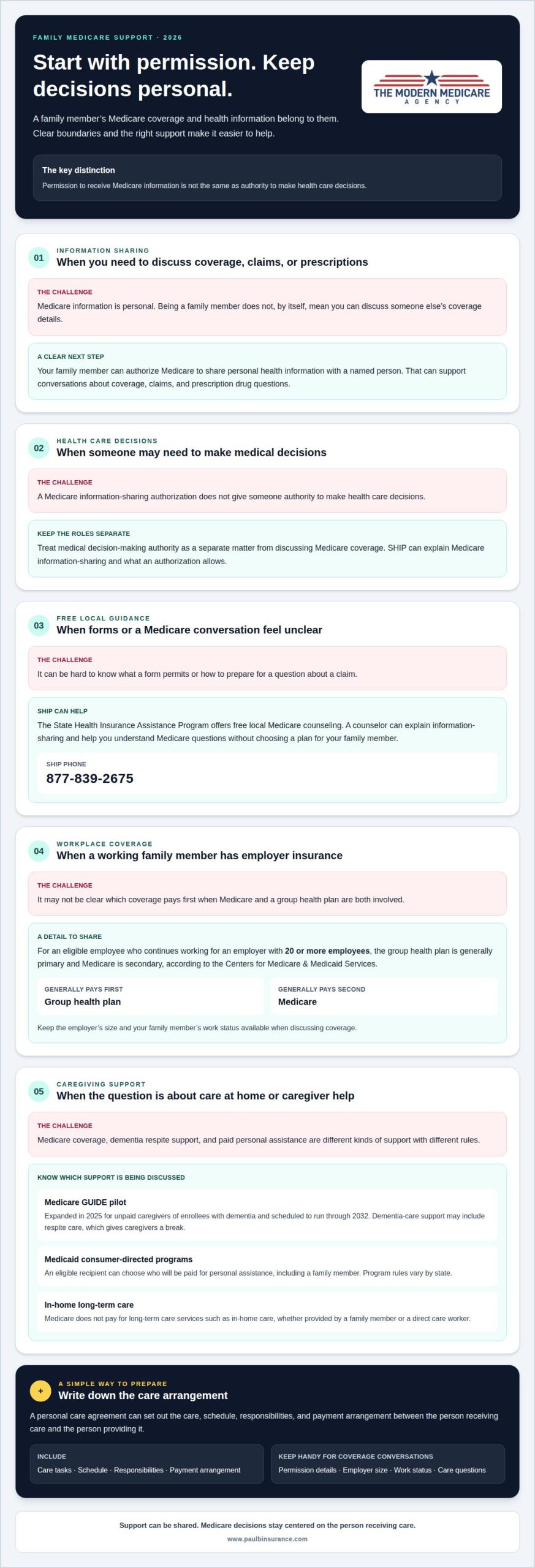
When getting help with Medicare for a family member, start by getting their permission. A family member can authorize Medicare to share personal health information with a named person. That can help you discuss coverage, claims, or prescription drug questions. Permission to receive information is different from authority to make health care decisions.
For guidance on appointing a Medicare representative or authorized representative, contact the State Health Insurance Assistance Program (SHIP). A SHIP counselor can explain Medicare information-sharing and clarify what an authorization allows. If your family member also needs someone to make medical decisions, that is separate from discussing Medicare coverage.
SHIP offers free local Medicare counseling. Caregivers can call 877-839-2675 to reach the program and ask about help in their area. A counselor can discuss Medicare questions without choosing a plan for your family member. This can be useful when you need to understand forms or prepare for a call about a claim.
Workplace coverage can affect which insurance pays first. For an employer with 20 or more employees, the group health plan is generally primary coverage and Medicare is secondary for an eligible employee who continues working, according to the Centers for Medicare & Medicaid Services. Share the employer’s size and the family member’s work status when discussing coverage.
Family caregiver support can involve more than insurance calls. The Medicare GUIDE pilot expanded in 2025 for unpaid caregivers of enrollees with dementia and is scheduled to run through 2032. Its dementia-care support may include respite care, which gives caregivers a break. Medicaid consumer-directed programs work differently: an eligible recipient can choose who will be paid for personal assistance, including a family member. Program rules vary by state.
A personal care agreement puts expectations in writing between a family member receiving care and the person providing it. It can describe the care, schedule, responsibilities, and payment arrangement. For example, it might record that a daughter provides specified home health support on agreed days. A clear document helps everyone understand what the arrangement covers. Medicare does not pay for long-term care services such as in-home care, whether provided by a family member or a direct care worker.
- Write down the care tasks and schedule being discussed.
- Separate Medicare information-sharing permission from medical decision-making authority.
- Keep the employer’s size and the family member’s work status available for coverage discussions.
- Ask about state Medicaid rules before relying on a consumer-directed care arrangement.
These distinctions can make conversations clearer and help families explain what support is needed, whether the question is about Medicare coverage, dementia respite, or paid care through Medicaid.
A family member can authorize Medicare to share personal health information with a named person. SHIP can explain the authorization and what it permits. Authority to make medical decisions is separate.
Medicare eligibility for older adults and people with qualifying disabilities
Medicare is government health insurance for people age 65 and older. A person younger than 65 may qualify for Medicare Parts A and B if they have a qualifying disability. Age alone does not answer every enrollment question. Work history, current coverage, and the person’s circumstances can affect what happens next.
A professional can help organize eligibility details and explain which questions belong with the Social Security Administration (SSA). The SSA handles Medicare Part A and Part B enrollment and can confirm whether someone meets citizenship or residency requirements. A useful review considers the person’s age, disability status, existing coverage, and enrollment situation. It can also clarify whether they are eligible now or need to understand a later enrollment opportunity.
Eligibility and plan selection are separate decisions. First, establish whether the person qualifies for Medicare and which parts they need. Then compare coverage options based on doctors, prescriptions, and expected care. Medicare Advantage is one option for people eligible for Medicare, but networks and covered services can differ by plan. Premiums and other costs also depend on the coverage selected and the person’s circumstances.
Medicaid and the Children’s Health Insurance Program (CHIP) may help family members who do not qualify for Medicare. In most states, adults under age 65 may qualify for Medicaid when household income does not exceed 138% of the federal poverty level. State rules determine eligibility, so the same household details can lead to different results across states. Contacting the state Medicaid agency is a practical way to ask about an application.
Children may qualify under different income rules. In most states, a child under age 19 may be eligible for Medicaid, subject to state requirements. CHIP also provides health insurance for children under 19. A family reviewing coverage for an older adult and a child should assess each person separately. Medicare eligibility for one household member does not establish another person’s eligibility for Medicaid or CHIP.
- Separate Medicare eligibility from choosing a plan.
- Gather age, disability, current coverage, and enrollment details for a professional review.
- Ask the SSA about Medicare enrollment and citizenship or residency requirements.
- Ask the state about Medicaid or CHIP eligibility for family members.
Once Medicare eligibility is clear, professional guidance can help compare Medicare Advantage plan options alongside the family member’s care needs and preferences.
Programs to manage prescription drug costs
In 2026, Medicare costs depend on the coverage selected and the person’s circumstances. Part A and Part B costs differ from Medicare Advantage and Part D plan costs. Medicare Advantage and Part D premiums vary by plan, so a useful review considers coverage needs alongside costs. Income may also affect eligibility for assistance programs that help with premiums or prescription expenses.
Part D plans cover prescription drugs, but covered medications and cost-sharing rules can differ. Compare your family member’s medication list with each plan’s drug coverage and pharmacy rules. Medicare Advantage plans may also include prescription drug coverage. A review can help you see whether a particular medicine is covered and whether assistance may ease its cost.
According to the Centers for Medicare & Medicaid Services, Medicare caps insulin costs at $35 per month. Extra Help is a federal program that helps eligible people with Medicare prescription drug costs. Its income limits increased in 2024 to 150% of the federal poverty level. The Social Security Administration accepts applications, and a family member can help organize the information needed.
Medicare Savings Programs address other expenses. State-run programs may help pay Part A and Part B premiums and additional Medicare costs. Contact the state to learn which programs may fit your family member’s circumstances. U.S. territories also have programs that help people with limited income and resources pay Medicare costs. These options are worth considering when prescription bills are part of wider health expenses.
Support for chronic conditions can include help beyond paying for medicines. The GUIDE pilot focuses on dementia support for unpaid caregivers and is scheduled to run through 2032. Families can consider this support alongside drug coverage, since caregiving needs and prescription costs are separate concerns.
Self-directed personal assistance programs address care support rather than medication bills. In some state Medicaid programs, a recipient can choose who receives payment for personal assistance, including a family member. State rules determine eligibility and how each arrangement works. This distinction can help families identify the right kind of assistance for each need.
- Keep an updated medicine and pharmacy list for plan comparisons.
- Ask about Extra Help and state Medicare Savings Programs.
- Consider territory assistance or Medicaid care programs separately from drug coverage.
For a focused review of prescription coverage, Medicare Part D plans can be considered alongside a family member’s medication needs.
Part A and Part B costs depend on the person’s circumstances, while Medicare Advantage and Part D costs vary by plan. Compare plans and consider whether assistance programs may help with premiums or prescription expenses.
Understanding how plan type affects providers and services
A family member’s plan can shape which doctors, providers, and suppliers are covered. Original Medicare and Medicare Advantage work differently. Medicare Advantage plans provide Part A and Part B coverage and typically include extra benefits, such as vision, hearing, and dental care. Each plan’s network and coverage rules can affect access to doctors, hospitalization, and home health care.
Original Medicare covers certain preventive services, including a yearly wellness visit and screenings. A yearlong diabetes prevention program is available to people diagnosed with prediabetes. To ask which preventive services a family member can receive and when, call Medicare at 1-800-MEDICARE. The person’s Medicare Part coverage and circumstances can affect which services apply.
Caregivers should distinguish prescription coverage, home health care, and long-term care. Prescription drug coverage depends on the person’s plan. A plan’s rules can also affect home health coverage, while Medicare does not pay for long-term care such as in-home care or adult day services, whether provided by a family member or a direct care worker.
Medicaid is a joint federal and state program that helps cover medical costs for some people with limited income and resources. Home- and community-based support may be available through state Medicaid programs, and some states let a Medicaid recipient choose a family member for paid personal assistance. Eligibility and program rules depend on the state, the person’s circumstances, and the services offered.
Respite can help caregivers take a break. Original Medicare covers substitute care under its hospice benefit for this purpose. A federally supported family caregiver program also offers information, counseling, support groups, education, training, respite care, and supplemental services. The Area Agency on Aging manages this program for caregivers of people age 60 and older, and for caregivers of people under 60 with Alzheimer’s disease or related disorders.
These differences matter when a family member needs both medical treatment and ongoing support. For example, someone receiving hospice care may have access to substitute care through the hospice benefit, while long-term help with daily activities is a separate need. Medicaid income and state rules can affect available assistance. The Social Security Administration handles Medicare Part A and Part B enrollment, while Medicare can answer questions about preventive services and plan coverage.
- Identify the plan type before asking about doctors, suppliers, or home health care.
- Separate prescription coverage from long-term care and caregiver support.
- Ask the state Medicaid agency about home- and community-based assistance.
- Ask Medicare about preventive services and hospice respite coverage.
Organizing a family member’s health and insurance information
A clear record helps a family member explain health care needs during appointments and insurance calls. Keep Medicare cards, other health insurance details, and contact information together. Add the names of doctors, clinics, pharmacies, and medical suppliers. A single, current list helps caregivers give consistent information when speaking with a provider or plan.
Medication records should include each prescription’s name, dose, schedule, and prescribing clinician. Note the pharmacy and any reported side effects or questions. If a refill is delayed, for example, your family member can quickly identify the medicine and pharmacy involved. Keep the latest list easy to update after a health care visit or prescription change.
Keep plan documents together with a short coverage summary. Record the Medicare plan name, member number, effective date, and customer-service contact details. File notices about claims, services, and payments by date. If your family member has other insurance, list that policy separately to avoid confusion during a call.
Enrollment dates belong in the same record. Medicare open enrollment for Part D and Medicare Advantage runs from October 15 to December 7 each year. New coverage selected during that period starts January 1. Mark these dates alongside the family member’s current plan and any questions about doctors, prescriptions, or services. This makes it easier to prepare for a coverage review without relying on memory.
A compact care summary can help at appointments. Include the person’s main health concerns, current providers, allergies, and questions for the next visit. Keep a separate section for insurance calls, with the date, representative’s name, and any reference number provided. If you help with conversations, keep the Medicare information-sharing authorization with these records.
- Keep Medicare and other health insurance cards in a secure, accessible place.
- Update medication and provider lists after changes in care.
- File plan notices by date and record follow-up questions.
- Keep open enrollment dates and plan review notes together.
Some states participate in Medicare-sponsored personal health record projects. Include any relevant record information in your family member’s existing care summary. For households managing several providers, a consistent file reduces repeated explanations and helps surface missing details during health care conversations.
For help connecting organized records with coverage choices, review Medicare plan options for the family member’s needs.
The Modern Medicare Agency
The Modern Medicare Agency can help turn questions about a family member’s Medicare into a clearer coverage decision. Its independent guidance helps eligible individuals compare Medicare Advantage, Medicare Supplement (Medigap), and Part D plans from over 40 carriers. That can be useful when you’re weighing provider access, prescription coverage, or how a plan fits your family member’s health care needs.
A professional plan comparison can focus on the details that matter to your family member, rather than leaving you to sort through options alone. Seek guidance when eligibility is clear and you’re ready to review available coverage choices. Bring your family member’s priorities and questions to the conversation so recommendations can reflect their needs.
For personalized Medicare guidance, contact The Modern Medicare Agency.
Take the next step with confidence
The next conversation can focus on what your family member wants from their coverage, not just what seems easiest to arrange. Invite them to share their priorities, concerns, and questions. Keeping their voice central can make each decision more manageable. If you’re getting help with Medicare for a family member, clear, respectful communication is a good place to start.
The Modern Medicare Agency helps eligible individuals compare Medicare Advantage Plans, Medicare Supplement (Medigap) Plans, and Medicare Part D Plans. A conversation can focus on your family member’s needs and the questions you’ve gathered. You can review the choices together without pressure to decide before you’re ready.
When you’re ready to discuss coverage for someone you care about, contact The Modern Medicare Agency. You’ve already taken a thoughtful step by learning how to support them. Keep moving forward at a pace that works for your family.
Frequently Asked Questions
How can a professional help enroll a family member in Medicare?
A Medicare professional can clarify coverage choices, compare plans, and assist with enrollment paperwork. The Social Security Administration handles enrollment in Medicare Part A and Part B, while an insurance professional can help with plan selection. Once your family member’s Medicare eligibility is established, a professional can help assess whether their doctors and prescriptions fit a plan’s coverage.
What are Medicare enrollment periods and deadlines?
Medicare Advantage and Part D open enrollment runs from October 15 to December 7 each year. Coverage chosen during that period starts January 1. Part A and Part B enrollment is handled by the Social Security Administration, and the applicable timing depends on the person’s situation. A professional can help identify which enrollment question to raise with Social Security.
Can I talk to Medicare or manage coverage for a family member with their permission?
Yes. A family member can give Medicare permission to share personal health information with someone they name. That permission allows discussion of Medicare matters, but it does not automatically give that person authority to make medical decisions or manage every part of the person’s affairs. Clarify what information Medicare may share and keep your family member involved in coverage decisions.
What documents should I gather for a professional helping enroll a family member in Medicare?
Gather your family member’s Medicare card, current insurance details, and notices about coverage or claims. A current list of doctors, prescriptions, and pharmacies can help a professional understand their needs. Include their questions and any upcoming care, such as a planned specialist visit. If you’ll discuss their personal Medicare information, make sure permission to share it is in place.
How can a family member get help paying Medicare premiums and out-of-pocket costs?
Ask the state about Medicare Savings Programs, which may help with Medicare premiums and other costs. The Social Security Administration handles applications for Extra Help with Medicare prescription drug costs. People in U.S. territories can also ask about programs for residents with limited income and resources. These programs address different expenses, so explain whether the concern is premiums, medical costs, or prescriptions.
How can a professional help compare Medicare Advantage and Original Medicare for a family member?
A professional can compare how each option fits your family member’s doctors, prescriptions, and expected services. Medicare Advantage plans provide Part A and Part B coverage and typically include extra benefits such as vision, hearing, and dental care. Plan networks and coverage rules also matter. A focused comparison can clarify whether provider access or particular services should carry more weight.
What happens if a family member misses their Medicare enrollment deadline?
Identify which enrollment period applies to your family member’s circumstances. Medicare Advantage and Part D have an annual open enrollment period, while the Social Security Administration handles Part A and Part B enrollment. A professional can help organize the person’s current coverage and questions, then direct the enrollment issue to the appropriate office.
How do I appoint a Medicare representative or authorized representative?
A family member can authorize Medicare to share personal health information with a named person. SHIP can explain the authorization and what it allows. Permission to receive information does not grant authority to make medical decisions.

Article by
Paul Barrett
Paul Barrett, CMIP is the founder of The Modern Medicare Agency, an independent Medicare-only brokerage based in Melville, NY. With 18 years of Medicare-exclusive experience, a CMIP designation, and more than 5,000 clients served across 37 states, Paul is one of the most credentialed independent Medicare specialists on Long Island — and one of the most direct.
He represents 40+ carriers with no quotas and no allegiances, which means his recommendations are based entirely on what fits each client's specific situation. He is the author of Medicare Mastery Unlocked and host of the Wise Guys Retirement Talk podcast. His content is grounded in primary sources, real carrier intelligence, and 18 years of watching what happens when people get Medicare right — and when they don't.
📞 631-358-5793 | paulbinsurance.com