




The plan with the biggest vision allowance may not be the best fit. What is the best vision insurance for seniors depends on whether you need routine exams and corrective lenses, care for a medical eye condition, or both. According to the Centers for Medicare & Medicaid Services, Original Medicare doesn’t cover routine eye exams for eyeglasses or contact lenses.
It’s understandable to expect one plan to cover every kind of eye care. But routine vision benefits and medical eye care are different, and exclusions can affect what you pay and where you can receive care. Medicare Advantage plans may include extra coverage for routine exams and corrective lenses, while Original Medicare may cover eye care related to a medical problem.
This guide explains how Medicare and Medicare Advantage compare with standalone vision coverage, and what to consider when weighing premiums, exams, allowances, provider access, and exclusions. Use these factors to judge whether a plan’s benefits match the care you expect to use and make a more confident choice.
Key Takeaways
- Separate routine vision benefits from medical eye care when comparing coverage; Original Medicare and Medicare Advantage work differently.
- Look beyond a plan’s provider network headline: access to preferred eye-care providers can affect how useful its benefits are.
- Compare premiums with exam costs and eyewear allowances to judge whether the benefits fit the care you expect to use.
- Read the exclusions closely so you understand which services, lenses, or treatments may not be covered.
- Use your priorities, including provider access and likely vision needs, to narrow the options that make sense for you in 2026.
Medicare and Medicare Advantage vision coverage
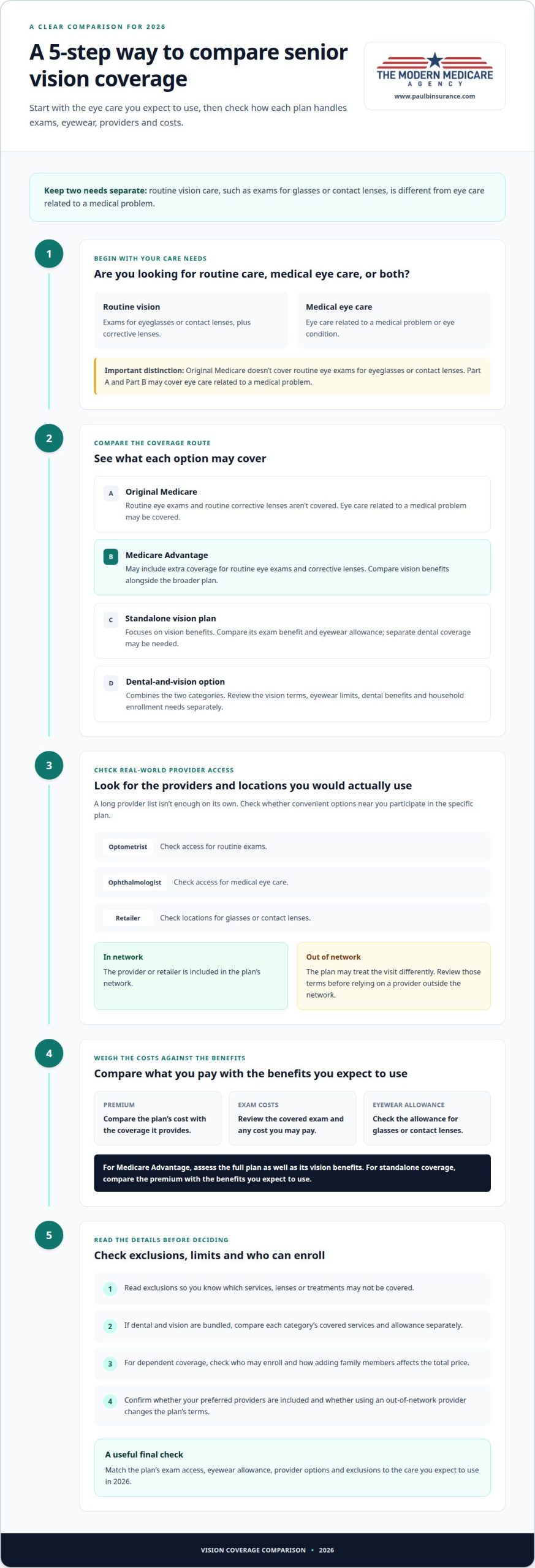
In 2026, the right choice depends on whether you need routine vision care, medical eye care, or both. Compare how each option handles exams, glasses, dental benefits, dependents, and plan costs.
Medicare Advantage Vision Coverage
Medicare Advantage, also called Part C, may include extra coverage for routine eye exams and corrective lenses. Because vision benefits are part of a broader plan, compare them alongside its other coverage. A standalone vision policy focuses on vision benefits, while a dental-and-vision option combines the two categories. The right fit depends on which services matter most to you.
Original Medicare works differently. According to the Centers for Medicare & Medicaid Services, it doesn’t cover routine eye exams for eyeglasses or contact lenses. Part A and Part B may cover eye care related to a medical problem, so routine eyewear and treatment for an eye condition are distinct needs. A plan’s stated vision benefits may help fill the routine-care gap.
Comparing and Enrolling in Coverage
During Medicare enrollment, seniors can get help comparing Medicare coverage options and understanding how vision benefits fit within them. A professional can review plan documents, compare covered exams and eyewear allowances, and guide enrollment. This differs from choosing standalone vision coverage, which centers on vision benefits rather than the broader Medicare plan. A Medicare Advantage plan guide explains the plan type.
Dental benefits may be bundled with vision coverage, but their limits can differ. Compare each category separately, including covered services and whether it has its own allowance. Spirit Dental and Vision add-on coverage is another combined option to compare. For dependent coverage, review who may enroll and how adding family members affects the total price. Don’t assume one adult’s coverage automatically extends to others.
| Coverage option | Routine eye exams | Glasses or lenses | Dental benefits | Cost comparison |
|---|---|---|---|---|
| Original Medicare | Routine exams aren’t covered | Routine corrective lenses aren’t covered | Not a dental-and-vision bundle | Consider any separate coverage needed |
| Medicare Advantage | May include routine exams | May include corrective lenses | Compare plan benefits | Assess the full plan and its vision benefits |
| Standalone vision plan | Compare its exam benefit | Compare its eyewear allowance | Separate dental coverage may be needed | Compare premium with benefits used |
| Dental-and-vision add-on | Compare its vision terms | Review its allowance and limits | Dental coverage is combined | Consider household enrollment needs |
Choose a plan by matching its exam access, eyewear allowance, dental terms, and dependent rules to the care your household expects to use.
Provider networks and out-of-network access
No single vision plan has the largest network for every senior. The practical question is which optometrists, ophthalmologists, and retailers are available where you receive care.
A network is the group of providers and locations included in a plan’s benefits. Access matters for routine exams, glasses, and contact lenses, but a long provider list alone isn’t enough. A nearby eye doctor who accepts the plan may be more useful than a larger network with few convenient locations.
In-Network Providers and Retailers
In-network access means receiving care from providers or retailers included in a plan’s network. Compare optometrists for routine exams, ophthalmologists for medical eye care, and retail locations for glasses or contact lenses. VSP is one name seniors may encounter when comparing vision coverage, but the brand alone doesn’t tell you whether a particular provider or retailer participates in a specific plan.
For example, a plan may suit someone whose eye doctor and preferred glasses retailer are both in network, but fit less well if only one is included. Compare provider type, location, and available services rather than treating every listed office as interchangeable.
Out-of-Network Access
Out-of-network access means using an eye-care provider who isn’t included in the plan’s network. The plan may treat that visit differently from in-network care, so review its out-of-network terms before relying on a provider outside the network. This can matter if you want to keep seeing an established optometrist or ophthalmologist.
For a practical comparison, consider an in-network exam at a nearby practice and an exam with a preferred doctor outside the network. Compare how each affects the plan’s benefits and your expected out-of-pocket costs. Don’t assume out-of-network care has the same terms as an in-network visit.
Network Availability
Network availability describes which participating providers and retailers serve a particular area. A plan’s name doesn’t tell you whether a convenient office is available near home or where you spend time. Check access for each relevant provider type, including optometrists, ophthalmologists, and retailers selling glasses or contact lenses.
Availability matters when household members have different needs. One person may prioritize an ophthalmologist, while another prefers a nearby optometrist or retailer. Match those priorities to the actual network, and consider whether choosing a plan means changing a current eye-care provider.
When comparing VSP plan features, focus on the specific network and the provider options available in your area, rather than assuming every plan offers identical access. A professional comparison can help weigh network access alongside Medicare plan choices; get help comparing plan options if you want support with that decision.
Vision plan premiums and allowances
In 2026, compare a vision plan’s recurring premium with the benefits you expect to use. Frame and contact lens allowances can help, but their value depends on the plan’s rules and your preferred eyewear.
Frame and Contact Lens Allowances
These figures describe different benefits, so compare them separately rather than combining them into one eyewear allowance.
For example, someone buying frames can focus on the frame allowance, while a contact lens wearer can compare the lens benefit. If you may use either, check whether the plan lets you choose one benefit or provides separate allowances. The plan’s terms determine how the benefit applies to your purchase.
Eyeglass Frame Allowances
A frame allowance contributes toward frames but may not cover the full purchase. If your frames cost more than the allowance, you pay the difference. Compare the benefit with the frames you’re likely to choose, not just the largest allowance in a plan summary.
Look for discounts or other eyewear terms that affect your total cost. A discount can reduce what you pay, but it isn’t the same as an allowance. For a clear comparison, separate the plan’s contribution from the amount you would still owe.
Contact Lens Allowances
Contact lens allowances matter most if you prefer lenses over glasses. Compare the stated benefit with the lenses you use and your usual buying pattern. A larger allowance may be less useful if the plan’s terms don’t fit your preferred type of correction or purchase.
Consider what you actually use before choosing. Someone who usually wears glasses may value a stronger frame benefit, while a regular contact lens wearer may prioritize the contact lens benefit. If you use both, compare how the plan treats each category.
Monthly premiums are only one part of the cost. Overall value depends on the premium, exam benefit, eyewear allowance, discounts, and how much of each benefit you use. Compare plans over the same time frame and include the services you expect to need, rather than judging by premium alone.
To compare plans, list your likely needs: an eye exam, frames, contact lenses, or a combination. Then compare each plan’s premium and applicable allowances against that list. The best fit is the plan whose benefits match your choices, not necessarily the one with the highest allowance.
Eye exams and copays
For seniors in 2026, compare how often a plan covers routine eye exams, what each visit costs, and whether lenses carry a separate copay. That benefit can make regular vision care easier to budget, but the exam allowance and lens costs are separate parts of the comparison.
Routine eye exams
The American Optometric Association recommends that seniors over age 65 receive a comprehensive eye examination once a year. Compare a plan’s exam schedule with that guidance, then look at the copay and provider access together. A covered annual exam is useful only if its terms fit the care you expect and a participating provider is accessible.
Routine exams differ from visits for a medical eye problem. Original Medicare generally excludes routine exams for eyeglasses or contact lenses, according to the Centers for Medicare & Medicaid Services. Medicare may cover eye care related to a medical condition, so the reason for an exam can affect which coverage applies. Routine vision benefits are not a substitute for medical care.
Exam and lens copays
Compare the exam copay with the cost of the lenses you use. For example, a plan with a low exam copay may still leave a separate charge for lenses when you need new glasses. Consider both amounts instead of judging coverage by the exam benefit alone.
That figure is a comparison point, not a promise of what a particular visit will cost. A plan’s value depends on its premium and benefits, how often you use covered exams, and what you pay for lenses or other services. Add those costs over the same period before comparing plans.
Lens enhancements can also affect the final cost. Their terms may differ from the standard lens copay, so distinguish the basic lens benefit from optional additions. When considering glasses, account separately for the exam, standard lenses, and any enhancements. This prevents a low exam copay from obscuring other expenses.
Medicare Advantage plans may include routine exams and corrective lenses, but benefits vary by plan. Compare exam frequency, copays, lens charges, and rules for enhancements in the plan details. If you expect an annual exam and new lenses, these specifics reveal more than the headline benefit. Choose based on the care you anticipate using, not just the smallest copay.
Vision insurance exclusions
In 2026, the headline benefit doesn’t tell the whole story. An exclusion or limit can change whether a vision plan helps with routine care, medical treatment, glasses, or contacts. The key is to separate routine vision benefits from medical eye care and read each benefit’s terms before comparing potential savings.
How do vision insurance plans cover cataract surgery, glaucoma testing, and diabetic eye exams? Routine benefits for exams, lenses, and contacts differ from coverage for medical eye care. Medicare may help cover regular eye exams for people with diabetes or another condition affecting the eyes, and exams for people at high risk of glaucoma. Cataract surgery is medical care, so routine eyewear benefits alone don’t explain its coverage.
Routine benefits and exclusions
Read each plan’s covered-services description alongside its exclusions. For example, a plan may describe an eye exam benefit and a separate allowance for corrective lenses. Those benefits don’t automatically include every test, lens enhancement, or treatment. Distinguish what the plan contributes toward from services it excludes or limits.
Consider a senior who uses contacts and also needs care for an eye condition. A contact lens allowance applies to corrective lenses, while medical treatment follows different coverage terms. Comparing these needs separately helps avoid counting a benefit twice or assuming routine vision coverage handles every eye-care expense.
Medical eye care and Medicare
Medicare coverage depends on whether care is routine or related to a medical problem. A diabetic eye exam and glaucoma testing for someone at high risk are examples of exams Medicare may help cover. These differ from routine exams for glasses or contact lenses. Keep the purpose of each exam clear when reviewing coverage.
Medicare Advantage plans may add routine vision benefits, but those benefits don’t replace the need to understand medical coverage. An allowance for glasses, for example, doesn’t explain the terms for cataract treatment. Compare routine benefits with medical eye-care coverage instead of treating them as one category.
Dental and hearing benefits may appear alongside vision benefits in broader coverage, but their presence doesn’t establish that a specific eye service is covered. Review each benefit separately, including any stated limits, exclusions, or conditions. This helps you judge whether expected savings apply to the care you actually need.
For a clearer comparison, organize policy details into three groups: routine exams, corrective lenses, and medical eye care. Note which services are covered, limited, or excluded in each group. This makes plan differences easier to see and helps prevent an attractive allowance from hiding an important gap.
Get help comparing Medicare plan coverage so routine vision benefits and medical eye-care needs remain clear.
The Modern Medicare Agency
The Modern Medicare Agency helps seniors compare Medicare plan options and understand how vision benefits fit into broader coverage. If you’re weighing Medicare Advantage against other Medicare choices, personalized guidance can clarify the differences without pressure.
The agency helps eligible individuals compare Medicare Advantage, Medicare Supplement (Medigap), and Medicare Part D plans. This support is useful when weighing coverage against priorities such as routine eye care, provider access, and other benefits. A conversation can focus on the coverage questions that matter most to you.
Contact The Modern Medicare Agency to discuss your Medicare plan options and get help making sense of the comparison.
Choose a path that feels right for you
In 2026, your next step is to turn the information you’ve gathered into a decision that fits your priorities. To determine what is the best vision insurance for seniors, consider which trade-offs feel acceptable and how comfortable you are with the coverage you choose. You don’t need to solve every Medicare question at once. Start with the choice that matters most to your peace of mind.
The Modern Medicare Agency offers Medicare Advantage, Medicare Supplement (Medigap), and Medicare Part D plans. Personalized guidance can help you understand how these options fit your broader coverage decisions while keeping your priorities in focus. A conversation can make a complicated comparison easier to manage.
Contact The Modern Medicare Agency to talk through your Medicare plan choices and the questions you still have.
Take it one step at a time, with a clearer sense of what you need next.
Frequently Asked Questions
Why is vision insurance a good investment for seniors?
Vision insurance can make the costs of regular eye care and corrective eyewear more predictable. Its value depends on the premium and benefits compared with the exams, glasses, or contacts you expect to use. Someone who replaces glasses regularly, for example, may value an eyewear allowance more than someone mainly seeking help with exam costs. Consider medical eye care separately, since routine vision benefits don’t replace coverage related to a health condition.
Does Medicare cover any eye care?
Yes. Original Medicare may cover eye care related to a medical problem, rather than routine vision care. For example, Medicare may help cover exams for people with diabetes or another condition affecting their eyes, and glaucoma exams for people at high risk. The reason for the visit matters: an exam for a medical concern differs from a routine check for updated glasses or contacts.
Does vision insurance cover contacts and eyeglasses?
Many vision plans include benefits for eyeglasses, contact lenses, or both, but the plan’s terms determine how each works. An allowance may contribute toward a purchase rather than cover its full cost. Contact lens wearers should review the contact lens benefit, while people choosing glasses should consider frame and lens terms separately. Discounts and limits can also affect the final amount paid.
What vision insurance plans are best for seniors in the United States?
The best vision insurance for seniors depends on the care, eyewear, and provider access that matter to each person. Compare Medicare Advantage benefits with standalone vision coverage and any combined dental-and-vision option you’re considering. Then weigh the network, exam benefit, eyewear allowance, exclusions, and premium. Someone who wants to keep a preferred eye doctor may prioritize network access, while another person may focus on contact lens benefits.
Does Medicare cover routine eye exams, glasses, or contact lenses?
According to the Centers for Medicare & Medicaid Services, Original Medicare doesn’t cover routine eye exams for eyeglasses or contact lenses. Consider routine vision needs separately from medical eye care. If a visit addresses a medical condition, Medicare may cover related care under applicable terms. An exam to update a prescription differs from one for a medical concern.
What vision benefits do Medicare Advantage plans offer, and how do they vary by location?
Medicare Advantage plans may offer extra benefits for routine eye exams and corrective lenses. Benefits and provider access vary by plan and location, so options in one area may differ from those elsewhere. Compare the local network and the plan’s exam and eyewear terms, especially if you want to continue seeing a particular optometrist or ophthalmologist.
How much do senior vision insurance plans cost per month, including premiums, copays, and deductibles?
There isn’t one monthly premium that applies to every senior vision plan. Total costs depend on the plan you choose and how its benefits match the care you use. Compare the premium with exam and eyewear copays, any deductible, and the amount the plan contributes toward purchases.
What are the annual allowances for frames, lenses, and contact lenses in popular vision plans?
These are different benefit categories, not a combined amount available for any eyewear purchase. Check whether the plan applies an allowance to frames, contacts, or both, and how it treats lenses and enhancements. The plan’s terms explain what the allowance contributes toward and which costs remain your responsibility.

Article by
Paul Barrett
Paul Barrett, CMIP is the founder of The Modern Medicare Agency, an independent Medicare-only brokerage based in Melville, NY. With 18 years of Medicare-exclusive experience, a CMIP designation, and more than 5,000 clients served across 37 states, Paul is one of the most credentialed independent Medicare specialists on Long Island — and one of the most direct.
He represents 40+ carriers with no quotas and no allegiances, which means his recommendations are based entirely on what fits each client's specific situation. He is the author of Medicare Mastery Unlocked and host of the Wise Guys Retirement Talk podcast. His content is grounded in primary sources, real carrier intelligence, and 18 years of watching what happens when people get Medicare right — and when they don't.
📞 631-358-5793 | paulbinsurance.com