




One annuity doesn’t have to do all the work. If you’re asking what an annuity ladder strategy is, it’s a way to spread annuity purchases or income start dates across time instead of committing everything at once. For example, a ladder might use annuities with 2-, 3-, and 5-year terms.
It’s understandable to want a clear picture before setting aside retirement savings. An annuity ladder strategy can spread purchases across different interest-rate environments and provide access to funds as contracts mature. But annuities aren’t CDs and don’t have FDIC protection.
This guide explains how staggered purchases, maturity dates, income starts, and payouts fit together. You’ll also see how an annuity ladder compares with CD laddering, and what to consider when deciding whether either approach suits your retirement income needs in 2026.
Key Takeaways
- An annuity ladder spreads purchases or income start dates over time, rather than relying on one contract for every need.
- Staggered maturity dates can give you periodic opportunities to access funds or decide how to use them next.
- Deferred annuities build value before payouts begin, while immediate annuities can provide income sooner.
- Compare annuity and CD ladders by looking at how each handles access to money, growth, and future income.
- Plan the ladder around the expenses you expect to cover and the income timing that would help you feel more secure.
What is an Annuity Ladder?
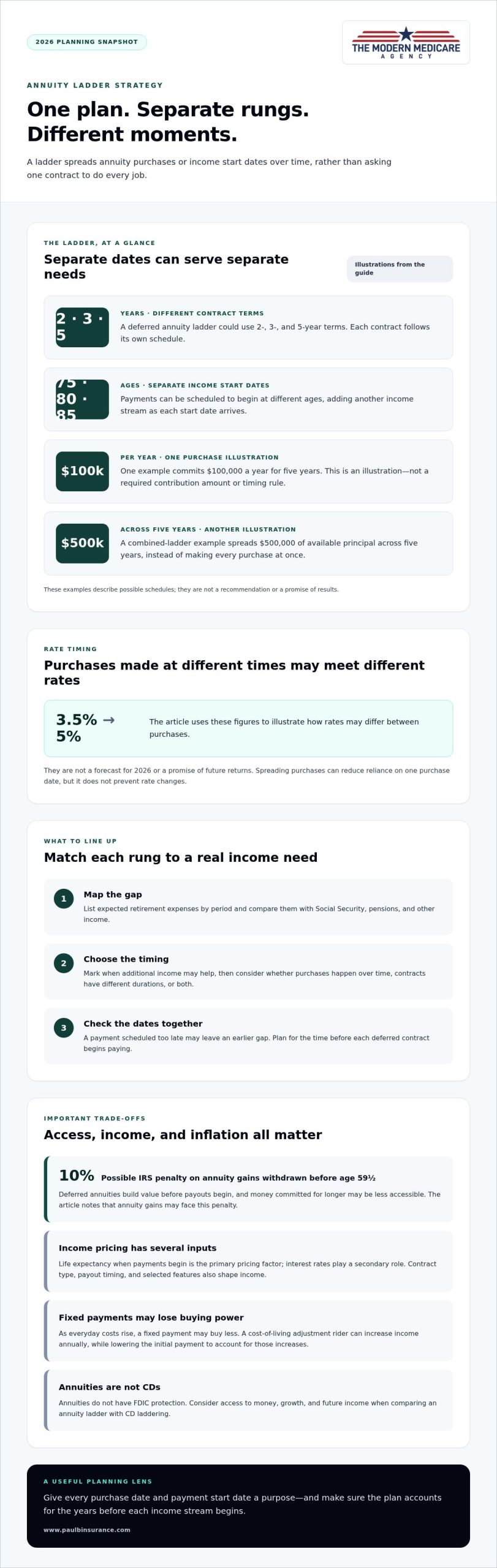
To understand what an annuity ladder strategy does, picture dividing savings among annuities with different purchase dates or terms. Instead of committing the full principal at one interest rate, you create separate portions, or “rungs,” that can mature or begin paying at different times. For example, a ladder could include deferred annuities with 2-, 3-, and 5-year terms. Each contract follows its own schedule.
This structure can reduce the pressure of choosing one interest-rate moment. If rates change, purchases made at different times may capture different rate environments. One annuity might be bought when its rate is 3.5%, while a later purchase could receive 5%. Those figures illustrate how rates may differ; they aren’t a forecast for 2026 or a promise of future returns.
A ladder can also help manage reinvestment risk, which arises when a contract matures and available interest rates are lower than before. With staggered maturity dates, only part of the ladder ends at once. You can then decide whether to use that portion or reinvest it, while the other rungs continue under their existing terms.
Interest-rate timing risk works both ways. If rates rise after you buy, a single large purchase may leave more savings earning the earlier rate. If rates fall, locking in a rate earlier may seem favorable, though future opportunities could differ. Spreading purchases over time can balance these possibilities. It doesn’t prevent rate changes, but it reduces reliance on one purchase date.
How are annuity payouts and rates determined? For income payments, life expectancy when payments begin is the primary pricing factor, while interest rates play a secondary role. Contract type, payout timing, and selected features also shape how an annuity’s value becomes income.
Inflation creates a separate concern: a fixed payment may buy less as everyday costs rise. A ladder can be arranged to start income at later ages, such as 75, 80, and 85, potentially adding payments over time. A cost-of-living adjustment rider can increase income annually, while the insurer lowers the initial payment to account for those increases.
Liquidity matters alongside rates. Deferred annuities build value before payouts begin, so money committed to a longer period may not be as accessible as savings. Annuity gains may face a 10% IRS penalty for withdrawals before age 59½, according to the Internal Revenue Service. That makes it important to match each rung’s timing to the role it serves in your income plan.
Staggering annuity purchases, maturity dates, and income start dates
Purchase timing and payout timing are separate choices. You can buy a contract now and schedule payments to begin later. Connecting each date to a retirement income need clarifies the purpose of each part of the ladder.
Scheduling Staggered Income Streams
Deferred annuities may accumulate value before payments begin, and separate contracts can be arranged to start paying at different times. This can match future income to changing expenses instead of starting every payment together. For example, a ladder might schedule income to begin at ages 75, 80, and 85, adding another stream as each start date arrives.
Start by mapping expected retirement expenses against current income sources, including Social Security, pensions, and savings. If Social Security and a pension cover regular bills early in retirement, payments that begin later could address needs in a subsequent period. Identify when a gap may appear, then align a payment start date with that period.
Staggered purchases can also spread interest-rate exposure across different purchase dates. For example, the second annuity might be purchased a year after the first, placing the contracts in different rate environments. Another possible schedule commits $100,000 a year for five years. These are illustrations, not required contribution amounts or timing rules.
Plan for the time before each deferred contract begins paying. Income scheduled to start at age 80 won’t cover an expense at age 75. A calendar of expected costs and income can reveal which periods need other resources and when later payments may provide support.
Steps for Building an Annuity Ladder
Building a ladder means matching each purchase and payout date to an income need. That matters because evenly spaced dates may not match the timing of your actual expenses.
- List expected retirement expenses by period and compare them with Social Security, pensions, and other income.
- Mark when additional income may be useful, such as at ages 75, 80, or 85.
- Choose whether to buy contracts over time or select contracts with different durations. Deferred annuities build value before payouts begin.
- Compare each contract’s start date and payment terms with the income gap it is intended to address.
A calendar of purchases and payments makes timing tradeoffs easier to see. A payment scheduled too late may leave an earlier gap; one scheduled too soon may begin before the money is needed. Reviewing the dates together keeps every contract connected to a practical purpose.
For tax purposes, annuity withdrawals are generally treated as coming from earnings first. Those gains are taxable before the original amount invested is returned.
Combining purchase and start-date ladders
A combined ladder staggers both annuity purchase dates and income start dates. These are separate choices: purchase dates determine when money enters contracts, while start dates determine when payouts are scheduled. For example, you could buy one contract first and set it to pay later, then make another purchase with a different start date.
Spreading purchases can reduce reliance on one interest-rate environment. One example allocates $500,000 of available principal across five years. Rather than making every purchase at once, the owner commits portions over time. Each purchase then reflects the contract terms available at that time. This approach can offer flexibility, though it also means the later purchases occur under future market conditions.
Pairing purchase dates with planned income starts gives each rung a role. A portion bought earlier might address an earlier income need, while a later purchase could support a later period. In one example, income starts are staggered one, two, and three years after an immediate-income portion begins. This layers payments instead of starting every stream at once.
Before choosing the number and size of purchases, map expected retirement expenses against Social Security and other income. Show which periods have an income gap and which already have support. Inflation matters too: expenses may rise over time, so later-starting income can serve a different purpose from payments needed sooner. A purchase plan and payout calendar make these needs visible together.
- Set the income purpose. Identify the expense or period each annuity is meant to support.
- Choose purchase timing. Decide whether principal will be committed gradually, as in the $500,000 example, or through contracts bought at different times.
- Match start dates to gaps. Set each payout date in relation to Social Security, other income, and expected expenses.
- Review purchase sizes. Avoid dividing principal into amounts so small that payout rates may be lower.
A useful balance considers more than the number of contracts. Each purchase adds another date and set of terms to track, while a very small premium may produce a lower payout rate. In 2026, weighing these tradeoffs means considering how much flexibility matters alongside the simplicity of fewer contracts.
Gradual purchases can leave more principal uncommitted until later, but that flexibility comes with rate uncertainty. Locking in a rate on an earlier contract can’t determine the terms available for future purchases. A combined schedule clarifies the tradeoff: each rung has a purchase date, an intended income start, and a defined place in the retirement plan.
Staggering annuity payout dates
A MYGA ladder staggers contract maturity dates so portions of a portfolio reach the end of their terms at different times. MYGA means multi-year guaranteed annuity. Each contract has its own term and interest rate, giving you separate dates to consider using or reinvesting the proceeds.
Consider a hypothetical example: $250,000 is divided among five contracts, with $50,000 in each. Terms range from three to seven years, and one contract matures each year beginning in year three. Instead of all five contracts ending together, the schedule creates periodic decision points. A maturity date does not automatically mean the proceeds become retirement income; the owner may use them or reinvest them, depending on the contract and financial plan.
The example’s rates vary by term: the three-year rung uses 5.80%, the four-year rung 5.90%, the five-year rung 6.00%, and the six-year rung 5.95%. These are illustrative figures, not a statement of rates available in 2026. The differing rates show why buying contracts with staggered terms can spread purchases across rate environments rather than locking the entire amount into one term on one date.
Values at maturity also differ in the illustration. These figures demonstrate how term length and the example’s interest assumptions affect each rung’s value.
Choose terms according to the purpose of each maturity date. A shorter rung may provide an earlier opportunity to use funds, while longer terms keep other portions in place for later. Connect the schedule to expected expenses and other income. Too many small contracts can also be less useful: splitting premiums into amounts that are too small may result in a lower payout rate.
- Set the purpose of each rung. Decide whether its maturity is meant to support spending, reinvestment, or another portfolio need.
- Compare terms and amounts. Match each contract’s duration to the date the funds may be needed.
- Review each maturity separately. At each date, consider the proceeds alongside other income and current financial needs.
A staggered schedule creates choices, not automatic payouts. In 2026, its usefulness depends on how maturity dates, contract terms, and the individual’s income needs fit together.
Annuity ladder definition and comparison to CD laddering
An annuity ladder divides savings among insurance contracts with different terms, maturity dates, or income start dates. The issuer agrees to return money through installments or a lump sum. CD laddering also staggers maturity dates, but CDs and annuities are different products: annuities aren’t CDs and don’t have FDIC protection.
The key difference is what each ladder is designed to do. A CD ladder can schedule access to portions of savings as individual CDs mature. An annuity ladder can also schedule income, including payments for a fixed period or for the buyer’s lifetime. For example, someone seeking income throughout retirement may value a payout option differently from someone focused on maturity dates and access to funds.
Contract design matters. A fixed annuity pays a fixed interest rate, while an indexed annuity ties interest to an underlying index and often includes a floor or other downside protection. A variable annuity’s payments depend on investments selected at purchase. A CD ladder doesn’t use these annuity contract structures, so compare each option by its purpose, terms, access provisions, and potential role in your income plan.
Neither approach removes every financial tradeoff. Staggering maturities can spread reinvestment decisions over time, but the rate available when a CD or annuity matures may differ from the rate at purchase. An annuity can provide income according to its contract, but its value and payout choices depend on the type selected. Diversifying annuity purchases among insurers can reduce reliance on a single insurer, but it doesn’t make the contracts identical or eliminate insurer-related risk.
How can you compare annuity providers and financial strength ratings? Compare each insurer’s financial strength ratings, then weigh contract terms, interest treatment, payout options, and access to funds. Read the rating alongside the specific contract: the insurer’s financial strength and the contract’s features answer different questions.
For a practical comparison in 2026, write down what you need the ladder to do before weighing rates. Is the priority periodic access, scheduled income, or payments that may continue for life? Then compare a CD ladder and annuity ladder against that same need. A CD may fit a plan centered on staggered maturity dates; an annuity may fit a plan that also needs contractual income. The best comparison begins with the job each portion of savings must perform.
The Modern Medicare Agency: Medicare Advantage Plans
The Modern Medicare Agency helps people compare Medicare Advantage Plans when they’re reviewing retirement coverage alongside income decisions. An annuity ladder addresses how savings may provide future payouts; Medicare coverage is a separate part of planning for healthcare costs. Keeping these decisions distinct can clarify the purpose of each choice.
If you’re weighing Medicare Advantage options, The Modern Medicare Agency can help you compare plans based on your needs. The agency also offers Medicare Supplement (Medigap) Plans, Medicare Part D Plans, and Life Insurance. Its guidance helps you understand plan choices; it doesn’t build an annuity ladder or provide financial planning.
For help comparing Medicare Advantage Plans, contact The Modern Medicare Agency.
Make Your Next Retirement Decision With Clarity
Understanding what an annuity ladder strategy can and cannot do gives you a clearer starting point for decisions about future income. Connect the schedule to your priorities: when you may need dependable income, how much flexibility matters, and what other resources you expect to use. A written plan can help you revisit those choices as your needs change.
Keep each decision focused. Annuity timing is one part of retirement planning, while Medicare coverage is another. If you’re reviewing your healthcare coverage for 2026, The Modern Medicare Agency can help you compare available options and understand what may fit your needs.
Talk with The Modern Medicare Agency about your Medicare coverage. Taking one clear step at a time can make the path ahead feel more manageable.
Frequently Asked Questions
What factors should I consider when timing my annuity purchases?
Match each purchase date to your expected expenses, other income, and need for access to savings. For 2026 planning, sketch a timeline showing when Social Security or pension income begins and when major costs may arise. Then compare that timeline with each annuity’s terms and payout start date. Also consider whether committing funds now or purchasing gradually better fits your comfort with changing interest rates.
What is an annuity ladder strategy?
An annuity ladder strategy divides annuity savings across contracts or income start dates, rather than relying on one purchase and schedule. The key planning question is what each portion is meant to do. One contract might support income later, while other savings remain available for nearer expenses. This distinction helps you judge whether a proposed ladder fits your retirement timeline.
How does an annuity ladder work, with an example?
An annuity ladder assigns different roles and dates to separate portions of retirement savings. Imagine someone expects a shortfall in everyday income before a later pension benefit begins. One annuity could be arranged for the earlier need, while a deferred contract starts later. Compare each payment schedule with the expected gap instead of treating all contracts as one interchangeable pool of money.
What types of annuities can be used in a ladder?
A ladder may use fixed, indexed, or variable annuities, and can include immediate or deferred contracts. The choice affects how value grows and when payments may begin. For example, a fixed annuity credits a set interest rate, while a variable annuity’s results depend on its selected investments. Compare each contract’s purpose, payout options, and terms with the role that portion of savings needs to fill.
How does an annuity ladder compare with a bond or CD ladder?
A CD or bond ladder centers on separate investments with different maturity dates; an annuity ladder can also be designed to provide scheduled income. Bonds may fluctuate in market value if sold before maturity, while CDs and annuities have different contract terms and protections. Compare how each option handles access, income, and changing rates. The right comparison depends on whether your priority is future cash access or structured payments.
What are the risks and downsides of an annuity ladder?
Annuity ladders can limit access to money committed under contract, and early withdrawals may reduce value or trigger tax consequences. Fixed payments may also lose purchasing power as prices rise. Each contract depends on its issuing insurer, so relying on one company concentrates that relationship. Before committing funds, consider how much savings must remain available for unexpected expenses and whether the payout schedule would still work if your needs changed.
How do inflation and interest rates affect an annuity ladder?
Inflation can make a fixed payment cover less over time, so compare expected future expenses with the income schedule. Interest rates affect the terms available when you buy or reinvest, meaning later purchases may have different rates from earlier ones. A cost-of-living adjustment can raise payments over time, but the starting payment is lower to account for those increases. Consider both purchasing power and timing in your plan.

Article by
Paul Barrett
Paul Barrett, CMIP is the founder of The Modern Medicare Agency, an independent Medicare-only brokerage based in Melville, NY. With 18 years of Medicare-exclusive experience, a CMIP designation, and more than 5,000 clients served across 37 states, Paul is one of the most credentialed independent Medicare specialists on Long Island — and one of the most direct.
He represents 40+ carriers with no quotas and no allegiances, which means his recommendations are based entirely on what fits each client's specific situation. He is the author of Medicare Mastery Unlocked and host of the Wise Guys Retirement Talk podcast. His content is grounded in primary sources, real carrier intelligence, and 18 years of watching what happens when people get Medicare right — and when they don't.
📞 631-358-5793 | paulbinsurance.com