
An annuity ladder makes sense for retirees who have a gap between essential monthly expenses and guaranteed income like Social Security. It works by splitting a lump sum across several contracts with staggered maturities, so you avoid locking all your money into one rate while still building a growing income floor. The trade-off is real: your money is less liquid than cash, and each contract carries its own carrier risk.
TL;DR:
- Building a ladder with three to four rungs typically allows rate refreshes every two to three years, reducing reinvestment risk.
- A diversified mix of MYGA, SPIA, and DIA products is recommended for flexibility and guaranteed income, with minimum investments around $10,000 to $25,000 per contract.
- It is crucial to track maturity dates carefully and request written renewal offers, setting reminders at least 90 days before each maturity.
- Laddering suits retirees with an income gap, emergency reserves, and principal of at least $75,000, but may be less suitable if immediate access to funds is required.
- Careful planning is necessary to avoid triggering higher Medicare premiums or RMDs, especially by staging income conversions and maintaining issuer diversification.
Table of Contents
- What Is an Annuity Ladder and How Does It Work?
- Which Annuity Products Belong in a Ladder?
- How Do You Build an Annuity Ladder Step by Step?
- What Do the Numbers Look Like in a Real Ladder?
- What Are the Risks, Taxes, and Medicare Implications?
- How Do You Avoid the Renewal Trap When a Rung Matures?
- Who Should (and Shouldn’t) Use an Annuity Ladder?
- A Practitioner’s View on Building Ladders for Medicare-Aged Clients
- Get Help Building a Ladder That Fits Your Medicare Timeline
- Sources
What Is an Annuity Ladder and How Does It Work?
An annuity ladder splits your principal into separate contracts, each with its own maturity date, instead of putting everything into one annuity for one term. Think of it the way you’d think of a CD ladder: instead of locking $200,000 into a single five-year CD, you split it into chunks that mature in years three, five, and seven. Each “rung” comes due at a different time, so you always have money becoming accessible on a rolling basis, and you’re never fully exposed to whatever interest rate happened to be available on the one day you bought.
That staggering is the entire point. Laddering spreads purchases across multiple annuities to stagger maturities, creating rolling liquidity and reducing the risk of locking in a single low rate. Timelines generally fall into three categories, and laddering strategies are classified by aggressive (3 to 5 years), moderate (5 to 7 years), and conservative (7 to 10 years) timelines, each with a different balance between flexibility and rate lock-in:
- Aggressive (3 to 5 years): More frequent rate refreshes, better for retirees who expect rates to rise or want shorter commitments.
- Moderate (5 to 7 years): The most common structure, balancing simplicity with periodic liquidity.
- Conservative (7 to 10 years): Fewer transactions, higher potential guaranteed rates, less flexibility if life circumstances change.
The mechanics resemble a bond or CD ladder, but annuities typically pay higher guaranteed rates than CDs of comparable term, and the interest grows tax-deferred rather than being taxed annually.
Which Annuity Products Belong in a Ladder?
A ladder isn’t one product repeated five times. It’s usually a mix, with each type playing a specific role.
- MYGA (multi-year guaranteed annuity): The workhorse of most ladders. Fixed rate, fixed term, straightforward accumulation. MYGA ladders commonly use 3, 5, and 7-year terms, which lines up with the aggressive-to-moderate timeline split above.
- SPIA (single premium immediate annuity): Converts a lump sum into guaranteed income starting almost right away. Best used for a rung you want to activate now, not later.
- DIA (deferred income annuity): Same idea as a SPIA, but payments start at a future date you choose, often used for the longevity rung.
- Fixed annuity: A broader category that includes MYGAs but sometimes carries different crediting structures; useful when a MYGA’s rigid schedule doesn’t fit.
- CD: Not an annuity at all, but often held alongside a ladder for its FDIC backing and shorter terms when you want cash truly on standby.
Most rungs are accumulation vehicles (MYGAs) until you’re ready to convert one into income. Watch surrender periods closely; most MYGAs allow free withdrawals of 10% annually, but pulling more before the term ends triggers a penalty.
How Do You Build an Annuity Ladder Step by Step?
Building a ladder is a sequence, not a single purchase decision. Skip a step and you end up with mismatched terms or too much money tied up in one carrier.
- Calculate your income gap. Subtract guaranteed income (Social Security, pension) from essential monthly expenses. The shortfall is what the ladder needs to eventually cover.
- Decide total allocation and rung count. A practical ladder usually includes two to four rungs, with three (3/5/7 years) hitting a sweet spot between simplicity and getting a rate refresh every two to three years. Most carriers set minimums around $10,000 to $25,000 per contract, so your total allocation needs to comfortably support that many rungs.
- Match terms to timing needs. If you need income activated in year three, buy a rung that matures then, not one that matures in year seven.
- Assign dollar amounts and product type per rung. Near-term rungs often stay as MYGAs for flexibility; a later rung might convert to a SPIA or DIA for guaranteed lifetime income.
- Shop rates across multiple A-rated carriers. Rates vary meaningfully between insurers even for identical terms, and reviewing current rate environments before you commit can meaningfully change your total return.
- Document everything and set reminders. Log each contract’s carrier, term, rate, and maturity date, and set a calendar alert 60 to 90 days before each maturity.
Pro Tip: Keep a single spreadsheet with one row per rung: carrier, purchase date, maturity date, rate, and surrender terms. When a maturity is six months out, that spreadsheet is the only thing standing between you and accidentally accepting a lousy renewal rate.
What Do the Numbers Look Like in a Real Ladder?
Say you have $300,000 to allocate and split it evenly across a 3-year, 5-year, and 7-year MYGA rung, $100,000 each. If those contracts credit rates in the range typical of current MYGA offerings, your 3-year rung matures first, giving you a decision point: withdraw it, reinvest at whatever rate is available then, or roll it into a new rung further out on the ladder.
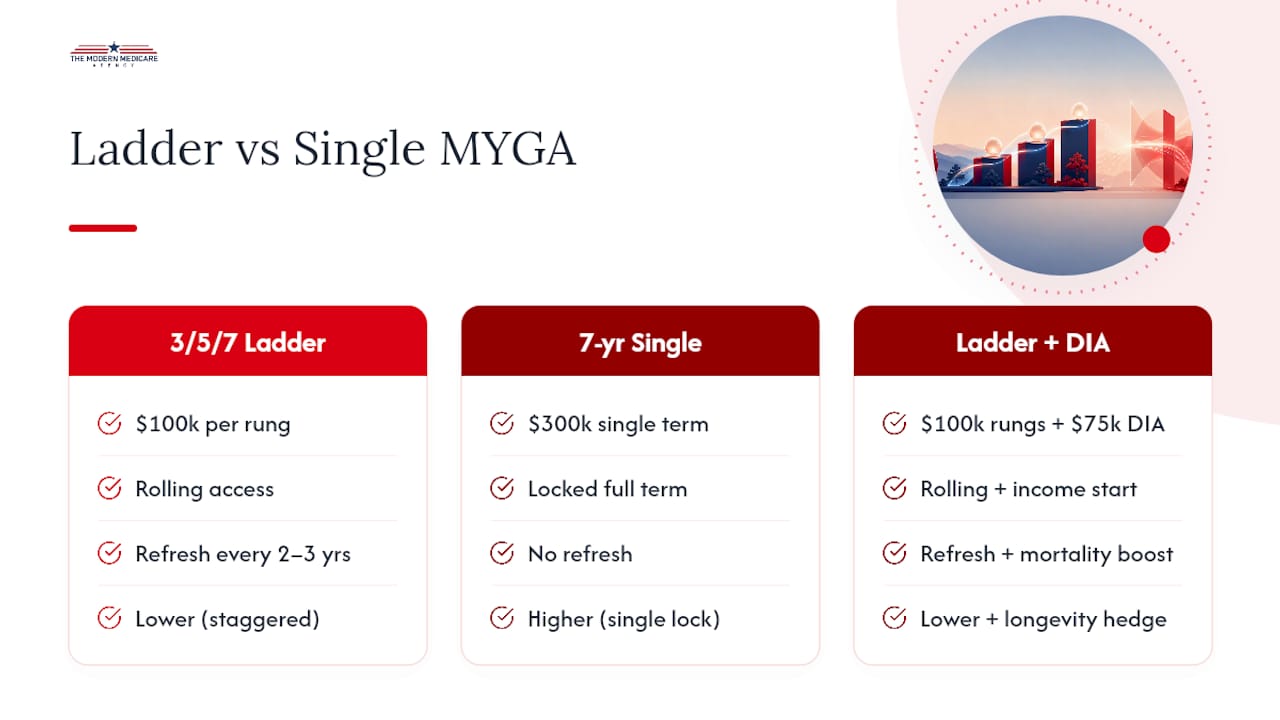
Compare that to putting the full $300,000 into a single 7-year MYGA. You’d lock in today’s rate for the entire term with zero flexibility, and if rates rise in year three, you’re stuck watching from the sidelines. The ladder trades a small amount of simplicity for that rolling access, described directly in the framing that laddering decouples income from short term market volatility while reducing both reinvestment and longevity risk.
Now add a fourth rung: instead of a fourth MYGA, put $75,000 into a DIA that begins paying lifetime income at age 80. Because that rung uses mortality credits, it produces a higher effective income per dollar than a comparable accumulation-only rung, which is the mechanism that makes longevity-rung annuities pay more than a savings account ever could for the same dollar amount.
By the numbers: A well-built three-rung MYGA ladder (3/5/7 years) typically gives you a rate refresh roughly every two to three years, compared to a single-term purchase that locks your entire balance to one rate for the full duration.
Assumptions matter here. These figures assume level rate environments and don’t account for surrender penalties if you withdraw early, so treat any specific carrier quote as the number that actually governs your decision.
What Are the Risks, Taxes, and Medicare Implications?
An annuity ladder isn’t risk-free money, and pretending otherwise does readers a disservice. FINRA’s investor guidance on annuities is worth reading before you sign anything, specifically around fees and surrender terms.
- Surrender charges: Withdraw more than the free-withdrawal allowance (usually 10% annually) before the term ends, and you’ll pay a penalty that can run several percentage points in the early years.
- Carrier credit risk: An annuity is a promise from an insurance company, not a government-backed instrument. Diversifying across multiple A-rated carriers reduces counterparty risk, since state guaranty association limits mean a single insurer failure could leave part of a large balance unprotected. Check carrier safety and state guaranty coverage before consolidating with one issuer.
- Tax treatment: MYGA interest grows tax-deferred; you owe ordinary income tax only when you withdraw. SPIA and DIA payments use an exclusion ratio, so part of each payment is treated as a tax-free return of principal.
- RMDs inside IRAs: Annuities held inside a traditional IRA are still subject to required minimum distributions starting at the applicable age, and income annuity payments generally count toward satisfying that RMD.
- IRMAA and Medicare premiums: Activating multiple income rungs in the same year can spike your modified adjusted gross income, which is what determines your Medicare Part B and Part D IRMAA surcharge tier. Staging when rungs convert to income, rather than triggering several at once, is one practical way to smooth out year-to-year MAGI swings and avoid an unwelcome premium jump.
How Do You Avoid the Renewal Trap When a Rung Matures?
A maturing MYGA doesn’t stay in limbo. If you don’t act, it automatically rolls into the carrier’s renewal rate, which is almost always lower and less competitive than what you’d get shopping fresh. Treat every maturity date as a hard shopping deadline, not a passive event.
Keep your tracking spreadsheet current, and request firm renewal offers in writing rather than relying on a phone call. Signals to pause new purchases include a sudden, sharp rate environment shift; signals to convert a rung to lifetime income include reaching an age where guaranteed payments outweigh continued accumulation.
Pro Tip: Set your calendar reminder 90 days before maturity, not 30. Insurers often need weeks to process a rollover request or a transfer to a new carrier, and waiting until the last minute can force you into the default renewal rate by default.
Who Should (and Shouldn’t) Use an Annuity Ladder?
A ladder fits a specific profile better than it fits everyone. Run through this before committing significant principal.
- You have an essential expense gap that Social Security and any pension don’t cover.
- You’ve already set aside 6 to 12 months of liquid cash reserves outside the ladder for emergencies.
- Legacy goals are secondary to guaranteed income, since money locked in annuities is less flexible for heirs than a brokerage account.
- Your total principal supports at least three rungs above typical carrier minimums, generally $75,000 to $100,000 or more in total.
If your primary goal is simply immediate lifetime income and you don’t need staged flexibility, a single SPIA might serve you better than the added complexity of a ladder.
| Consideration | Ladder fits well | Ladder fits poorly |
|---|---|---|
| Income gap | Clear monthly shortfall exists | Guaranteed income already covers expenses |
| Liquidity needs | Reserves set aside separately | No emergency cash outside the annuity |
| Principal size | $75,000+ across 3+ rungs | Below typical carrier minimums |
| Time horizon | 5+ years to let rungs mature | Need all funds accessible immediately |
Before buying anything, model how staged income affects your RMDs and IRMAA bracket, and talk to a licensed agent who understands both the annuity contracts and the Medicare premium math.
A Practitioner’s View on Building Ladders for Medicare-Aged Clients
Paul Barrett has worked with Medicare consumers since 2007, and the pattern that shows up repeatedly is retirees who build a smart annuity ladder but never connect it to their Medicare costs. Paulbinsurance treats those as one planning conversation, not two, because a rung converting to income in the wrong year can push a client into a higher IRMAA bracket without warning. A real consultation means rate shopping across carriers, checking issuer diversification, and mapping projected income against RMD and Medicare premium thresholds before a dollar moves.
— Paul
Get Help Building a Ladder That Fits Your Medicare Timeline
Paulbinsurance is the direct alternative to guessing your way through carrier brochures alone. We’re independent, so we shop rates across multiple A-rated insurers on your behalf instead of pushing one company’s product, and we fold the Medicare and IRMAA math directly into the same conversation instead of treating them as separate problems for you to sort out later.

A quick planning session covers where your income gap actually sits, how a ladder’s timing would affect your Medicare premiums down the road, and which carriers currently offer the strongest rates for the terms you need. We’ll also flag how staged annuity income interacts with your broader coverage picture, including how it might factor into Medicare Advantage plan choices if you’re weighing coverage changes at the same time. There’s no cost to sit down and run the numbers. Reach out to Paulbinsurance and get a real read on whether a ladder fits your specific retirement income picture before you commit a dollar.
This article is general information, not a substitute for advice from a qualified financial advisor. Consult a qualified financial professional about your own circumstances before acting on anything here.
Sources
- Annuity ladder strategy: How to create a steady income
- Annuity Ladder Strategies – How Laddering Annuities Works
- Annuity laddering strategy: Build a MYGA Ladder (2026)