




Entering the Medicare years should feel like a celebration of a new chapter, but for many, it feels more like being dropped into a “crazy maze” without a map. Between the looming threat of lifelong late-enrollment penalties and the overwhelming stack of mailers, it’s easy to feel anxious about making a wrong turn. Whether you’re worried about losing access to your favorite doctor or feeling confused by the differences between Advantage and Supplement plans, avoiding common medicare enrollment mistakes is the first step toward true peace of mind. You deserve a process that is straightforward and stress-free, rather than one filled with jargon and high-pressure sales tactics.
In this guide, we’re going to simplify the complexities of the 2026 season. You will learn how to identify the most expensive enrollment errors before they happen and discover a clear roadmap to secure, confident coverage. Our goal is to move you from a state of confusion to complete confidence, ensuring your medications are covered and your healthcare future is protected. Let’s take the guesswork out of the system together, providing the expert guidance you need to focus on what matters most-your health and your happiness.
Key Takeaways
- Understand the critical 7-month Initial Enrollment Period window to protect yourself from permanent late-enrollment penalties that can last a lifetime.
- Discover why the “zero-premium” lure can be deceptive and how avoiding common medicare enrollment mistakes helps you maintain access to your preferred doctors and specialists.
- Learn how to decode the Annual Notice of Change (ANOC) to prevent sudden spikes in your prescription costs and hidden shifts in your plan’s network.
- Navigate the complex transition from employer insurance by understanding the “20-Employee Rule” and the high cost of common COBRA misunderstandings.
- See how an independent broker acts as your personal advocate, offering unbiased guidance across dozens of carriers to turn Medicare confusion into total confidence.
The High Cost of Missing the Clock: Enrollment Periods and Lifelong Penalties
Navigating the “crazy maze” of the Medicare system can feel overwhelming, but the most important thing to remember is that the program runs on a very strict schedule. By avoiding common medicare enrollment mistakes related to timing, you can protect your hard-earned savings and ensure you have the peace of mind that comes with seamless coverage. Understanding Medicare starts with knowing exactly when your specific window opens and why waiting can be a costly error.
Understanding Your Initial Enrollment Period (IEP)
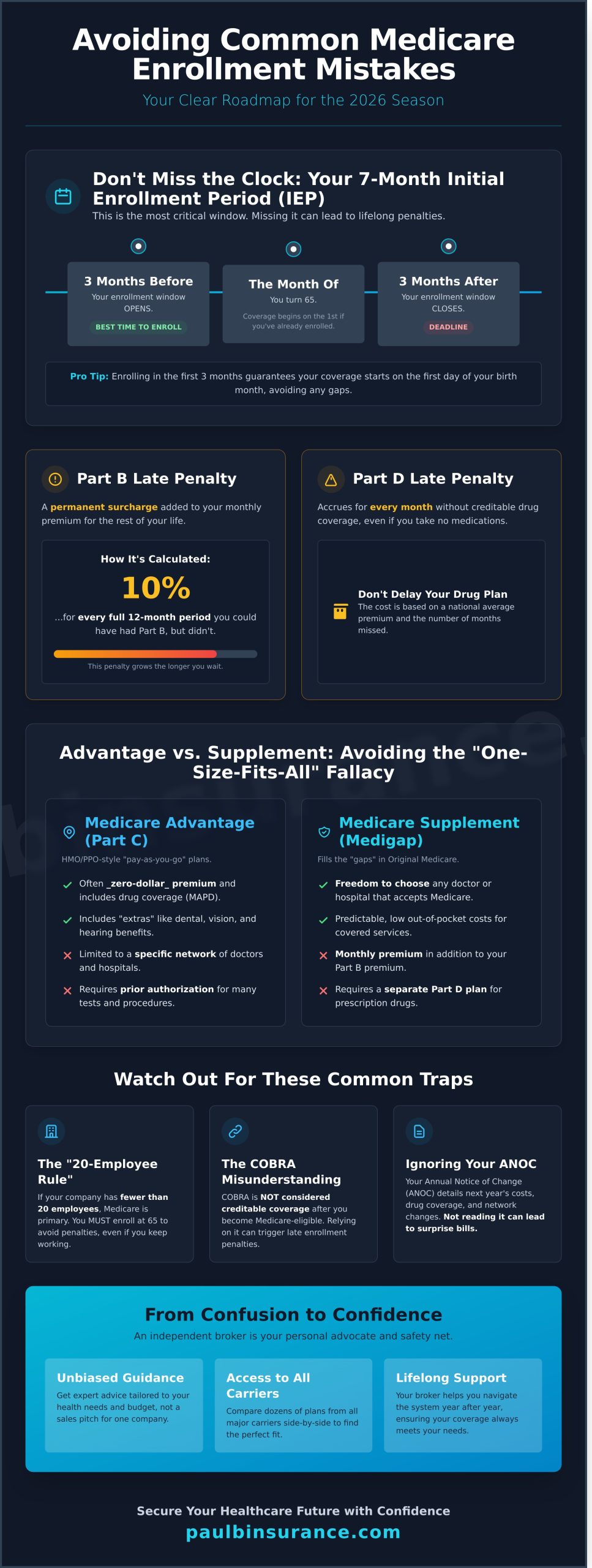
The IEP is your primary seven-month window to get your coverage started. We simplify this for our clients using the “3-1-3” rule:
- 3 months before: The window opens three months before you turn 65.
- The month of: This includes your actual birth month.
- 3 months after: The window closes three months after your 65th birthday.
While you have seven months, signing up during the first three months is critical for ensuring your coverage begins on Day 1 of your birth month. The IEP is the only time your health status is legally ignored for all plan types.
The Lifetime Cost of Late Enrollment
If you miss your initial window without having “creditable coverage,” the government applies permanent financial penalties. For Medicare Part B, you will face a 10% penalty for every full 12-month period you delayed enrollment. This isn’t a one-time fine; it is a lifelong surcharge added to your monthly premium, meaning the math works against the procrastinator forever.
When avoiding common medicare enrollment mistakes, you must also be wary of these common traps:
- The Creditable Coverage Myth: Not all employer plans are created equal. If your company has fewer than 20 employees, Medicare generally expects you to sign up at 65, regardless of your current work status.
- Part D Penalties: Even if you currently take no medications, you need a Part D plan or creditable drug coverage to avoid a late enrollment penalty that accrues for every month you go without it.
- The GEP Trap: If you miss your deadline, you may be forced to use the General Enrollment Period (January 1 – March 31). This often results in a coverage gap and significant late fees.
Special Enrollment Periods (SEP) are available if you are leaving a large employer plan, but navigating these requires precision to ensure you don’t lose your guaranteed-issue rights.
Advantage vs. Supplement: Avoiding the “One-Size-Fits-All” Fallacy
Choosing between Medicare Advantage and a Medicare Supplement plan is often the most stressful part of the “crazy maze” of healthcare. The biggest pitfall is falling for the “one-size-fits-all” trap-assuming that because a plan works for your neighbor, it will work for you. When it comes to avoiding common medicare enrollment mistakes, the choice between these two paths is the most critical decision you will make for your future peace of mind.
Many people are drawn to the “Zero-Premium” lure of Medicare Advantage. While a $0 monthly premium sounds like a win, it is important to remember that these are often “pay-as-you-go” models. You might save on monthly costs now, but a single unexpected surgery or specialist visit can lead to high out-of-pocket co-pays that far exceed the cost of a monthly premium. To truly protect your savings, you must look beyond the initial price tag and consider your long-term health history and travel lifestyle.
The Medicare Advantage (Part C) Trade-off
Medicare Advantage plans are managed care plans, similar to an HMO or PPO. While they often include “extras” like dental or vision, they come with specific trade-offs that can lead to frustration if you aren’t prepared:
- Network Restrictions: You are generally limited to a specific network of doctors. If your specialist leaves the plan, you may have to find a new one.
- Prior Authorization: These plans often require “permission” from the insurance company before you can receive certain tests or procedures, which can create delays in care.
Internal link: Medicare Advantage Plans 2026: A Simple Guide
The Medicare Supplement (Medigap) Safety Net
If you value freedom-especially if you travel frequently or see multiple specialists-a Supplement plan acts as a true safety net. These plans allow you to see any doctor in the country who accepts Medicare, without needing a referral. However, you must be wary of the “Guaranteed Issue” trap.
According to the official Medicare enrollment rules, your best time to buy a Medigap policy is during your initial six-month Open Enrollment Period. If you wait too long or try to switch from an Advantage plan back to a Supplement later, insurance companies can use medical underwriting to charge you more or deny you coverage entirely. By personalizing your choice today, you are avoiding common medicare enrollment mistakes that could limit your healthcare freedom in the years to come.
Internal link: Medicare Supplement Plan G: Is It Your Best Choice?
Overlooking the Fine Print: ANOC, Networks, and Drug Formularies
Medicare is often described as a “crazy maze,” but one of the most significant pitfalls is assuming your current plan will remain the same forever. To succeed in avoiding common medicare enrollment mistakes, you must recognize that Medicare plans are year-to-year contracts, not lifetime commitments. What worked for you last year might be a financial drain next year due to subtle shifts in the fine print.
Decoding the Annual Notice of Change (ANOC)
Every September, your current provider will mail you an Annual Notice of Change (ANOC). Many beneficiaries treat this as “junk mail,” but ignoring it is a costly error. This document is your roadmap for the coming year. When reviewing your ANOC, use this essential checklist:
- Premium and Deductible Changes: Has the monthly cost or the amount you pay before coverage kicks in increased?
- Provider Network Shifts: Is your preferred primary doctor or specialist still “in-network”?
- Drug Tier Reclassification: Plans often change their “Tier” system annually. A medication that was a $20 co-pay (Tier 2) can easily jump to $200 (Tier 4) overnight if the formulary changes.
By reviewing these details early, you move from confusion to confidence, ensuring you aren’t blindsided come January 1st.
The “Friend and Family” Recommendation Mistake
We frequently encounter the “Spouse Trap”-the assumption that because a plan works perfectly for your partner or neighbor, it is the right fit for you. Medicare is highly individual; your healthcare needs are as unique as your fingerprint. Choosing a plan based on “Extra Benefits” like gym memberships or grocery allowances while ignoring core medical coverage is a dangerous gamble.
Data from KFF indicates that nearly 7 in 10 beneficiaries are failing to compare Medicare plans during the open enrollment period. This lack of comparison is a primary factor in avoiding common medicare enrollment mistakes. Instead of following the crowd, you should focus on a “Total Cost” analysis. This means looking beyond the lowest monthly premium and evaluating the out-of-pocket maximums and specific drug formularies. An independent broker can run these personalized comparisons for you, ensuring your plan covers your specific doctors and prescriptions at the lowest possible total price.
Employment and Medicare: When to Sign Up (and When to Wait)
Deciding whether to keep your employer coverage or transition to Medicare can feel like navigating a “crazy maze.” However, avoiding common medicare enrollment mistakes starts with understanding how your current insurance coordinates with federal benefits. The rules change depending on your company size and the type of coverage you have, so it is vital to time your transition perfectly to ensure you aren’t overpaying or leaving yourself unprotected.
Working Past 65: The Coordination of Benefits
The “20-Employee Rule” is the most important factor in your decision. If your employer has 20 or more employees, your group health plan is generally “primary,” meaning it pays first. In this case, you can often delay Part B to save on monthly premiums without penalty. However, if your employer has fewer than 20 employees, Medicare is typically “primary.” If you fail to sign up for Part B, your small group plan may refuse to pay its portion of your medical bills, leaving you with massive out-of-pocket costs.
To learn more about your specific timeline, see our guide: Medicare Eligibility Explained: Who Qualifies & When.
The COBRA and Retiree Coverage Trap
The single most dangerous pitfall for seniors is the “COBRA Trap.” It is a common misconception that COBRA counts as “creditable coverage” for Part B. It does not. If you rely on COBRA and miss your initial enrollment window, you could face lifetime late enrollment penalties and a stressful gap in coverage. Furthermore, if you contribute to a Health Savings Account (HSA), you must stop all contributions at least six months before enrolling in Medicare Part A to avoid IRS tax penalties.
To move from confusion to confidence when leaving a long-term employer, follow this step-by-step guide to notify Social Security of your “Special Enrollment Period” (SEP):
- Step 1: Request Form CMS-L564 from your employer’s HR department to verify your group coverage.
- Step 2: Complete Form CMS-40B (the application for Medicare Part B).
- Step 3: Submit both forms to Social Security together. This ensures they process your enrollment as an SEP rather than a late enrollment.
Transitioning from a group plan to individual Medicare doesn’t have to be overwhelming. At Paul B Insurance, we provide the patient, expert guidance you need to steer clear of these hurdles. For personalized help with avoiding common medicare enrollment mistakes, visit paulbinsurance.com today.
From Confusion to Confidence: Why an Independent Broker is Your Safety Net
Navigating the “crazy maze” of Medicare can feel overwhelming, but you don’t have to wander through it alone. The most effective strategy for avoiding common medicare enrollment mistakes is partnering with an expert who puts your needs first. While the system is complex, the solution is straightforward: moving from confusion to confidence with the right guidance.
At Paul B Insurance, we distinguish ourselves by being independent. Unlike a “captive agent” who is employed by a single insurance company and can only offer their specific products, an independent broker represents you. We have the “40+ Carriers” advantage, allowing us to compare dozens of plans across the market to find the one that fits your unique budget, doctors, and prescriptions.
- Independent Broker: Works for you, offering unbiased comparisons of 40+ carriers.
- Captive Agent: Works for one company, limited to only their specific plans.
- The Result: More options always lead to better healthcare outcomes and lower costs.
The Power of Unbiased Guidance
As a “Modern Medicare Agency,” we leverage cutting-edge technology to compare every available plan in your specific zip code. Because independent brokers are compensated by the insurance carriers, our personalized consulting services are provided at $0 cost to you. You receive expert, patient advice without any hidden fees or high-pressure sales tactics. To understand the full scope of these benefits, read more on Why Using a Medicare Broker Is Your Smartest Move.
Your Next Steps: Moving Toward Peace of Mind
Our 5-Step Medicare Process is designed to simplify the jargon and transform a daunting task into a clear, manageable journey. We provide year-round support, meaning our relationship doesn’t end when you sign your name; we are here to help whenever your health needs or plan benefits change.
The best way to ensure you are avoiding common medicare enrollment mistakes is to schedule a “Free Medicare Plan Review.” This proactive check-up catches potential errors before they become costly financial burdens. Paul Barrett is ready to provide the professional, empathetic guidance you deserve to secure your future.
Ready to simplify your Medicare journey?
From Confusion to Confidence: Your Path to Stress-Free Medicare
Navigating the Medicare maze doesn’t have to be a source of anxiety. As we have explored, the key to a secure 2026 lies in respecting enrollment timelines to prevent lifelong penalties and looking past “one-size-fits-all” plans to find coverage that actually fits your lifestyle. By avoiding common medicare enrollment mistakes-such as misinterpreting the fine print in network changes or drug formularies-you protect both your health and your financial well-being for years to come.
At Paul B Insurance, we act as your knowledgeable mentor, leveraging over 18 years of experience and access to 40+ top-rated insurance carriers to simplify the jargon. Having served over 5,000 clients with personalized care, we understand that your situation is unique. We are here to provide the patient, unbiased guidance you deserve to ensure you feel empowered and stable in your healthcare decisions.
Take the first step toward clarity today. Schedule your free, unbiased Medicare consultation today and let us help you transition into your next chapter with total peace of mind. You have worked hard for your retirement; let’s make sure your coverage works just as hard for you.
Frequently Asked Questions
What is the most common Medicare mistake people make when they turn 65?
The most frequent error is assuming that Medicare enrollment is automatic. Unless you are already receiving Social Security benefits, you must proactively sign up during your Initial Enrollment Period. By focusing on avoiding common medicare enrollment mistakes like missing this seven-month window, you can prevent permanent late-enrollment penalties and ensures your healthcare coverage begins exactly when you need it without any stressful gaps.
Can I change my Medicare plan if I realize I made a mistake?
Yes, you are not locked into a plan forever. You can typically change your coverage during the Annual Enrollment Period, which runs from October 15 to December 7 each year. If you have a Medicare Advantage plan, you also have the option to switch during the Advantage Open Enrollment Period from January 1 to March 31. We can help you navigate these windows to find a better fit.
Will I be penalized if I keep my employer insurance instead of signing up for Medicare?
This depends on the size of your employer. If your company has 20 or more employees, your group coverage is usually considered “creditable,” allowing you to delay Part B without penalty. However, if your employer has fewer than 20 employees, Medicare generally becomes the primary payer at age 65. In that case, failing to enroll in Part B could lead to high out-of-pocket costs and lifetime late-enrollment fees.
Does Medicare cover dental and vision, or do I need a separate plan?
Original Medicare (Parts A and B) generally does not cover routine dental cleanings, fillings, or vision exams for eyeglasses. To secure this coverage, you should consider a Medicare Advantage plan that includes these extra benefits or purchase a standalone dental and vision policy. We provide straightforward guidance to help you compare these options so you can maintain your health from head to toe without unexpected expenses.
What is the difference between a Medicare broker and a Medicare agent?
A “captive” agent represents one specific insurance company and can only offer their products. In contrast, an independent Medicare broker represents many different carriers. This allows us to offer unbiased, personalized support by comparing all the plans available in your area. Our role is to act as your advocate and mentor, ensuring you find the plan that truly fits your unique health needs and budget.
How do I know if my current doctors accept the Medicare plan I am considering?
The most reliable method is to check the plan’s online provider directory or call your doctor’s office directly to confirm they are in-network for that specific plan. Because networks can change annually, this verification is a vital step in avoiding common medicare enrollment mistakes. Taking a moment to confirm this now provides peace of mind that you can continue seeing the medical professionals you trust.
Is it true that I have to stop contributing to my HSA once I start Medicare?
Yes, once you are enrolled in any part of Medicare, you can no longer make tax-free contributions to a Health Savings Account (HSA). To avoid IRS tax penalties, it is recommended to stop contributions at least six months before you apply for Medicare or Social Security. However, you can still use any existing funds in your HSA to pay for Medicare premiums, deductibles, and other qualified medical costs.
What happens if I miss my Initial Enrollment Period?
If you miss your window and don’t qualify for a Special Enrollment Period, you must wait until the General Enrollment Period, which runs from January 1 to March 31. Your coverage will then start the first of the following month. Be aware that you may also incur a lifetime late-enrollment penalty for Part B, which adds a 10% surcharge to your premium for every 12-month period you were eligible but unenrolled.