
If keeping your specialists is the priority, Original Medicare paired with a Medigap supplement is usually your strongest path. It lets you see virtually any doctor or specialist in the country who accepts Medicare, with no referrals and no network gatekeeping. That said, Medicare Advantage can be the right call when your key specialists are in-network, the plan has a stable PPO network, and the bundled benefits genuinely matter to you.
The single most useful thing you can do right now: call your specialist’s office, give them the plan name and ID you are considering, and ask two questions directly: “Do you accept this plan?” and “Do you accept Medicare assignment?” Those two answers tell you more than any brochure.
Quick summary:
- Original Medicare + Medigap gives the broadest specialist access, nationwide, with predictable costs
- Medicare Advantage (PPO or SNP) can work well if your specialists are confirmed in-network
- HMO-type Advantage plans require referrals and restrict you to network providers
- Verify every specialist before you enroll, not after
- The 2026 CMS ACCESS pilot opens a new coordinated-care pathway for chronic conditions under Original Medicare
Table of Contents
- Which Medicare path gives you the best specialist access?
- How do network types and prior authorization affect your specialist visits?
- How do you verify whether your specialist accepts a specific plan?
- What will specialist visits actually cost you under each Medicare path?
- When can you enroll or switch plans, and how does timing affect your specialist care?
- What questions should you ask agents and plans when specialist access is the priority?
- What is the CMS ACCESS pilot and what does it mean for your specialist care?
- How does an independent Medicare agent help you protect specialist access?
- Key Takeaways
- What Paul Barrett has learned about specialist access after nearly two decades in Medicare
- How Paulbinsurance helps you confirm specialist coverage and enroll with confidence
- Authoritative resources for verifying plan and provider information
Which Medicare path gives you the best specialist access?
The honest comparison comes down to one question: how much do you need to control who you see and when?
Original Medicare vs. Medicare Advantage is not a close call when specialist access is the deciding factor. Original Medicare (Parts A and B) is accepted by the vast majority of physicians and specialists across the United States. Add a Medigap supplement and you cover most of the 20% coinsurance Medicare leaves behind, which means your out-of-pocket costs become predictable regardless of how many specialists you see or how often.
Medicare Advantage plans bundle everything into one plan, often at a $0 monthly premium, and frequently include dental, vision, and Part D drug coverage. The tradeoff is network restriction. You are limited to the plan’s contracted providers, and depending on the plan type, you may need a referral from a primary care physician before you can see a specialist at all.
Geographic variation adds another layer. CMS enrollment data shows that Medicare Advantage availability and network footprints differ significantly by ZIP code. A PPO plan in a major metro may include most of the specialists in your city. The same carrier’s plan in a rural county may have a fraction of that network.
How each path handles specialist visits
| Factor | Original Medicare + Medigap | Medicare Advantage (HMO) | Medicare Advantage (PPO) |
|---|---|---|---|
| Specialist choice | Any Medicare-accepting provider | In-network only | In-network preferred; out-of-network at higher cost |
| Referral required | No | Usually yes | Usually no |
| Prior authorization | Rare | Common | Common for some services |
| Out-of-pocket predictability | High (Medigap covers most gaps) | Moderate (copays vary) | Moderate to low |
| Network size | Nationwide | Local/regional | Regional, sometimes broader |
| Monthly premium | Higher (Medigap adds cost) | Often $0 | Low to moderate |
| Bundled extras (dental/vision) | No | Yes | Yes |
Pros of Original Medicare + Medigap for specialist access:
- No network restrictions; see any specialist who accepts Medicare
- No referrals needed; you book directly
- Medigap plans reduce financial variability, covering coinsurance and sometimes excess charges
- Consistent coverage when you travel or split time between states
- No prior authorization delays for most specialist services
Cons:
- Medigap premiums add monthly cost, sometimes significantly
- Medigap does not include drug coverage; you need a separate Part D plan
- Specialists who do not accept Medicare assignment can charge up to 15% above the Medicare-approved amount, per Consumer Reports
Pros of Medicare Advantage for specialist access:
- Lower or $0 monthly premiums free up cash
- Bundled drug, dental, and vision coverage in one plan
- Special Needs Plans (SNPs) can coordinate care specifically for chronic conditions
- Out-of-pocket maximums cap your annual exposure
Cons:
- Network restrictions mean your preferred specialist may not be covered
- Prior authorization requirements can delay or block specialist visits
- Provider networks are not static; doctors can leave mid-year
- Plan quality varies sharply by region
Star ratings matter, but not the way most people think. CMS star ratings published on Medicare.gov measure member experience, complaint rates, and chronic-condition management. A 5-star plan is genuinely better run. But a high star rating does not guarantee the plan’s local network includes your cardiologist or oncologist. Always verify the specific provider, not just the plan score.
How do network types and prior authorization affect your specialist visits?
The plan type printed on your insurance card determines almost everything about how you access a specialist. Medicare.gov defines four main structures for Medicare Advantage plans, and each one handles specialist access differently.
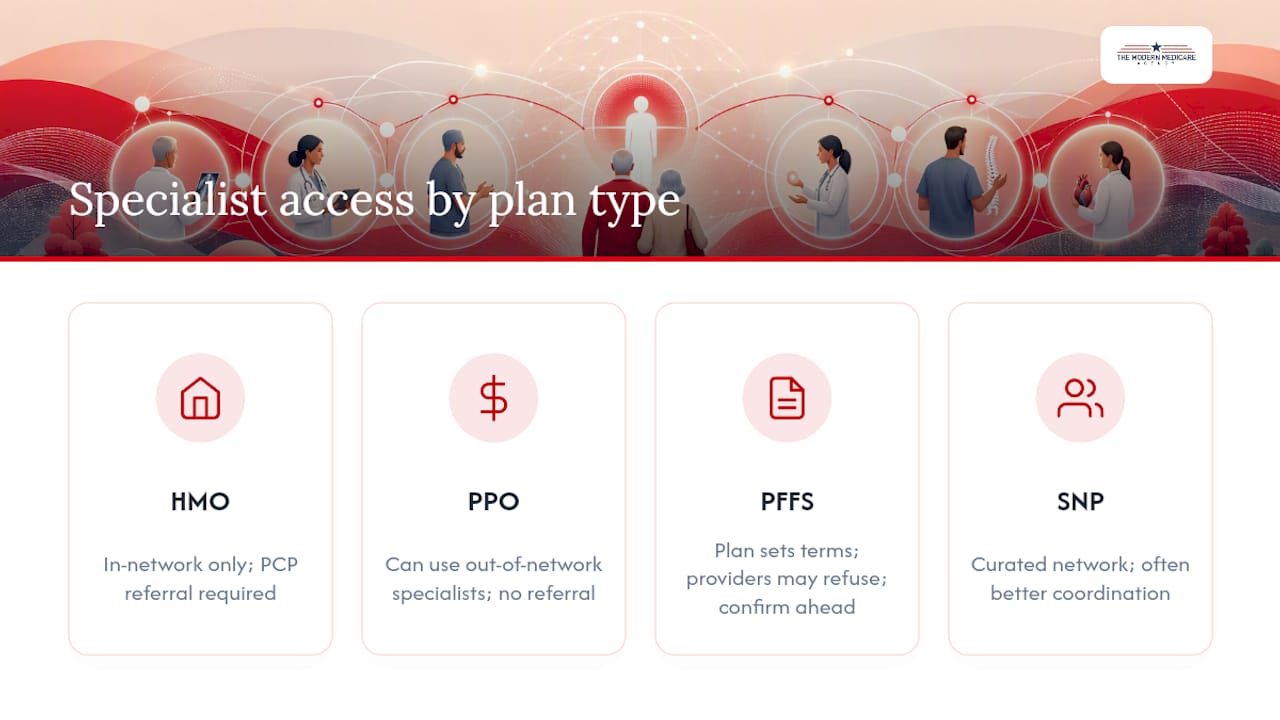
HMO (Health Maintenance Organization): You must use in-network providers except in emergencies. Seeing a specialist almost always requires a referral from your primary care physician. If your specialist is not in the plan’s network, you pay the full cost out of pocket. HMOs tend to have the lowest premiums but the tightest access restrictions.
PPO (Preferred Provider Organization): You can see out-of-network specialists, but you pay more for the privilege. No referral is typically required. PPOs offer a middle ground: some network flexibility at a higher cost than HMOs. For someone who sees multiple specialists, a PPO is usually the better Advantage option.
PFFS (Private Fee-for-Service): The plan sets its own payment terms, and any Medicare provider who agrees to those terms can treat you. PFFS plans can offer broader access than HMOs, but providers are not obligated to accept the plan’s terms, so you need to confirm acceptance before each visit.
SNP (Special Needs Plan): Designed for people with specific chronic conditions, dual Medicare/Medicaid eligibility, or institutional care needs. D-SNPs (Dual Eligible SNPs) and C-SNPs (Chronic Condition SNPs) can actually improve specialist coordination for the right beneficiary, because the plan is built around managing those conditions. They still have network restrictions, but the network is often curated for the relevant specialty care.
Prior authorization: the hidden gatekeeper
Prior authorization is the process where a plan must approve a specialist visit, procedure, or test before it happens. Under Medicare Advantage, prior authorization is common for specialist referrals, imaging, and surgical procedures. Under Original Medicare, it is rare for most outpatient specialist care.
When a plan denies prior authorization, your appointment does not happen until you appeal or find an alternative. That delay can matter enormously for someone managing cancer, heart disease, or a neurological condition.
Pro Tip: Before switching to any Medicare Advantage plan, call the plan directly and ask: “Does this plan require prior authorization for visits to [your specialist’s specialty]?” Get the answer in writing or note the representative’s name and the date. Plans can and do change authorization requirements at the start of each plan year.
One more thing worth knowing: plans can change their provider networks during the year. A specialist who is in-network in January may not be in-network in July. If you are mid-treatment, that creates real disruption. Choosing a plan with a historically stable local network, something an independent agent familiar with your area can help you assess, reduces that risk considerably.
How do you verify whether your specialist accepts a specific plan?
Do not rely on the plan’s website alone. Provider directories are notoriously out of date. The verification process that actually protects you involves three sources: the plan’s directory, the specialist’s office, and your own records.
Step-by-step verification checklist:
-
Gather your specialist’s details. You need the provider’s full name, the practice name, the clinic address, and their National Provider Identifier (NPI). You can look up any provider’s NPI at the Medicare.gov provider directory or through the CMS NPI registry.
-
Search the plan’s provider directory. Every Medicare Advantage plan and Medigap carrier publishes a directory. Search by the specialist’s NPI, not just their name, to avoid matching the wrong provider. Confirm the specific location is listed, not just the practice group.
-
Call the specialist’s office. Ask: “Do you accept [plan name and ID]?” and “Are you currently accepting new patients on this plan?” Also ask: “Do you accept Medicare assignment?” That last question matters even under Original Medicare. Specialists who do not accept assignment can legally bill up to 15% above the Medicare-approved rate.
-
Call the plan. Give them the specialist’s NPI and ask: “Is this provider currently in-network for my plan?” Ask specifically about the location you plan to visit, since a provider may be in-network at one address but not another.
-
Document everything. Record the date of each call, the name of the representative you spoke with, any confirmation number they provide, and the exact answer given. Save screenshots of the provider directory showing the specialist listed. Consumer advocacy guidance consistently recommends this documentation as your first line of defense if a claim is later disputed, per Consumer Reports.
-
Request written confirmation when the stakes are high. If you are mid-treatment or about to start an expensive course of care, ask the plan to send written confirmation that the provider is in-network and that the planned services are covered. Plans are required to respond to written coverage inquiries.
Questions to ask the specialist’s office:
- “Do you accept [plan name] for [your condition or procedure]?”
- “Do you accept Medicare assignment?”
- “Has anything changed with your network participation in the last 90 days?”
- “Are there any services you provide that this plan does not cover?”
Questions to ask the plan:
- “Is NPI [number] in-network at [address] for my plan ID [number]?”
- “Does my plan require prior authorization for visits to this specialty?”
- “What is the process if this provider leaves the network while I am in treatment?”
Pro Tip: Medicare.gov’s Plan Finder tool lets you compare plans side by side and check provider participation. Your State Health Insurance Assistance Program (SHIP) offers free, unbiased counseling and can help you interpret what you find. Contact information for your state’s SHIP program is available through HHS.gov.
What will specialist visits actually cost you under each Medicare path?
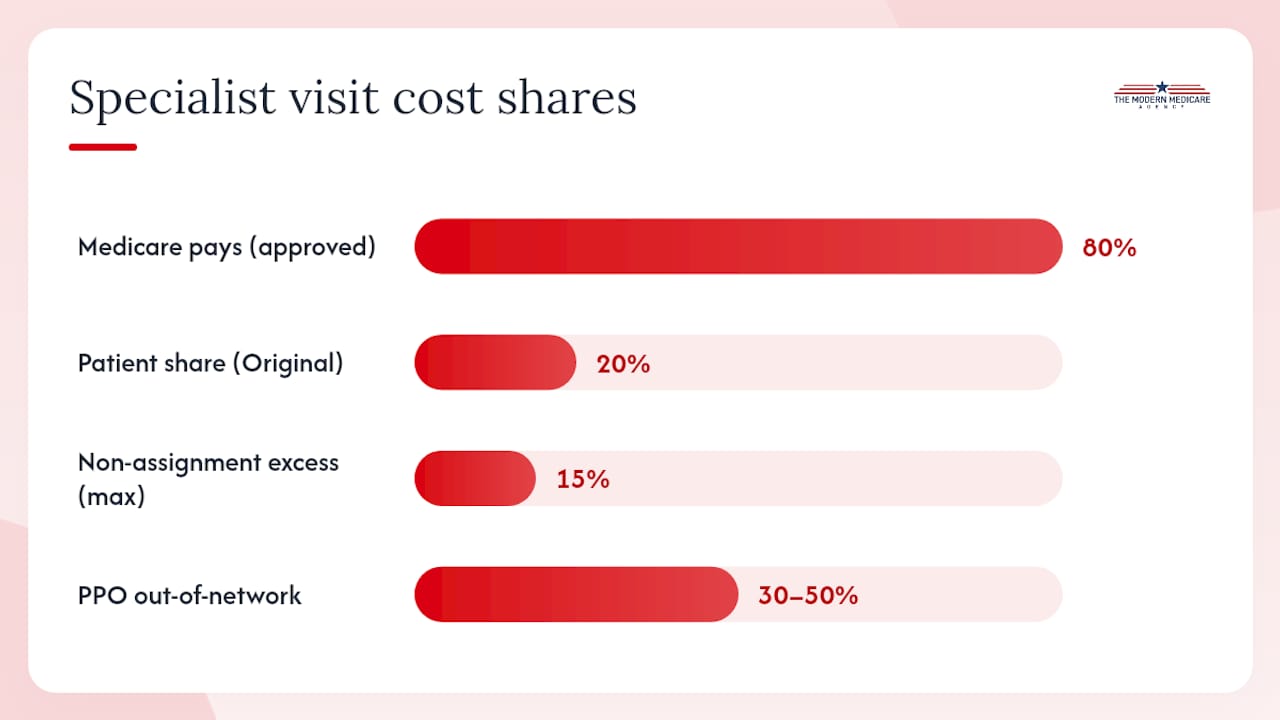
Cost predictability is where Original Medicare plus Medigap has its clearest advantage. Under Original Medicare, Medicare pays 80% of the approved amount for most specialist services after you meet the Part B deductible. A Medigap plan (Plan G is the most popular for new enrollees) covers most or all of that remaining 20%, so your out-of-pocket exposure for a specialist visit is close to zero beyond the deductible.
The complication is assignment. Specialists who accept Medicare assignment agree to bill only the Medicare-approved amount. Those who do not accept assignment can charge up to 15% more than that approved amount, and Medigap Plan G covers those excess charges. Medigap Plan N does not, which means you could owe that 15% excess out of pocket. Verifying assignment status before your first visit is as important as confirming the provider accepts Medicare at all.
Under Medicare Advantage, specialist costs depend on the plan’s cost-sharing structure. A typical HMO or PPO plan charges a fixed copay per specialist visit, often in the $30–$50 range for in-network visits, though this varies by plan and region. Out-of-network visits under a PPO can trigger coinsurance of 30–50% of the plan’s allowed amount, with no cap until you hit the annual out-of-pocket maximum.
Cost scenarios worth thinking through:
- You see a cardiologist six times a year under Original Medicare + Plan G: your cost after the annual Part B deductible is typically $0 per visit, regardless of how many times you go.
- You see the same cardiologist under an HMO Advantage plan where they are in-network: you pay a copay each visit, but costs are predictable.
- Your cardiologist leaves the Advantage plan’s network mid-year: your next visit is out-of-network, and you may owe coinsurance with no prior warning.
- A specialist does not accept assignment under Original Medicare without a Medigap plan that covers excess charges: you owe the 15% excess on top of the 20% coinsurance.
Surprise billing risk is real under Medicare Advantage. If a plan requires prior authorization for a procedure and you proceed without it, the plan can deny the claim entirely. Always confirm authorization before any specialist procedure, not after.
One practical step before any specialist visit: ask the specialist’s billing department for an estimate of what your plan will be billed and what your expected share is. That conversation takes five minutes and eliminates most billing surprises.
When can you enroll or switch plans, and how does timing affect your specialist care?
Enrollment timing can either protect or disrupt an ongoing specialist relationship. The key windows are:
- Initial Enrollment Period (IEP): A 7-month window around your 65th birthday (3 months before, the month of, and 3 months after). This is when most people first choose between Original Medicare and Advantage.
- Annual Election Period (AEP): October 15 through December 7 each year. Changes take effect January 1. This is the main window to switch plans, add or drop coverage, or move between Original Medicare and Advantage.
- Medicare Advantage Open Enrollment Period (OEP): January 1 through March 31. If you enrolled in an Advantage plan during AEP and want to switch to a different Advantage plan or return to Original Medicare, this is your window.
- Special Enrollment Periods (SEPs): Triggered by qualifying life events such as losing employer coverage, moving out of a plan’s service area, or a plan losing its contract. SEPs allow changes outside the standard windows.
Switching plans mid-treatment carries real risk. If you move from Original Medicare to a Medicare Advantage plan, your new plan’s network applies immediately on the effective date. A specialist you were seeing under Original Medicare may not be in the new plan’s network.
Steps to protect ongoing specialist care when switching:
- Confirm your specialist is in the new plan’s network before the switch takes effect
- Ask the new plan about transition-of-care protections, which may allow you to continue seeing an out-of-network provider temporarily at in-network rates
- Notify your specialist’s office of the plan change and ask them to verify their participation
- Transfer any active prior authorizations to the new plan before coverage begins
- Check whether any prescriptions need to be reauthorized under the new plan’s formulary
- Understand what switching back to Original Medicare involves if an Advantage plan’s network no longer serves your needs
Transition-of-care protections are not automatic. You must request them, and the plan must approve them. Document that request in writing.
What questions should you ask agents and plans when specialist access is the priority?
Most people ask the wrong questions when shopping for Medicare. They ask about premiums and star ratings. Those matter, but they do not tell you whether your rheumatologist will still be covered in March.
Decision checklist, ranked by what matters most for specialist access:
- Is my named specialist currently in-network, confirmed by NPI and location?
- Does the plan require prior authorization for visits to this specialty?
- What is the out-of-network cost if my specialist leaves the network?
- Does the plan have a continuity-of-care policy for mid-year network changes?
- What is the plan’s prior authorization denial rate for this specialty? (Plans are required to report this data to CMS.)
- How stable has this plan’s local provider network been over the past two years?
- What is the plan’s star rating, and what drove any deductions from 5 stars?
Exact questions to ask a plan representative:
- “Is NPI [number] in-network at [address] under plan ID [number], effective [date]?”
- “Does this plan require prior authorization for [specific specialty or procedure]?”
- “What is your continuity-of-care policy if a provider leaves the network while I am in active treatment?”
- “Can you send me written confirmation of this provider’s in-network status?”
Exact questions to ask an agent:
- “Have you verified this specialist’s network participation directly with the plan?”
- “How do you monitor network changes for clients after enrollment?”
- “What is your process if a client’s specialist leaves the network mid-year?”
- “Are you independent, and do you represent multiple carriers?”
Red flags that should disqualify a plan for someone who needs regular specialist care:
- The plan cannot confirm your specialist’s NPI in their directory
- The representative cannot answer questions about prior authorization requirements
- The plan has no written continuity-of-care policy
- Star ratings show high complaint rates or poor chronic-condition management scores
- The plan’s network has had significant provider turnover in your area
- The agent cannot tell you which carriers they represent or how they are compensated
A plan with a 4.5-star rating but a thin local specialist network is worse for you than a 3.5-star plan that includes your oncologist, cardiologist, and neurologist. Comparing Medicare Advantage plans on specialist-specific criteria takes more work than comparing premiums, but it is the only comparison that actually protects your care.
What is the CMS ACCESS pilot and what does it mean for your specialist care?
The ACCESS model is a 10-year CMS Innovation Center pilot designed to improve outcomes for Medicare beneficiaries with chronic conditions through technology-supported, coordinated care. It is currently available only to people enrolled in Original Medicare, not Medicare Advantage.
The conditions ACCESS targets affect more than two-thirds of Medicare beneficiaries. CMS estimates that roughly 7 in 10 beneficiaries qualify for at least one ACCESS track. Enrollment happens directly with participating providers, not through a plan change.
A key practical detail: the ACCESS Directory, which will allow beneficiaries to find participating providers, is scheduled to launch in July 2026. Until then, the best way to find ACCESS-participating organizations is to ask your primary care provider directly or contact your local SHIP counselor.
What ACCESS changes for specialist-focused chronic care:
- Participating providers receive technology support and outcome-based payments, which creates an incentive to coordinate specialist referrals more actively
- Care pathways under ACCESS are designed to reduce fragmentation, meaning your primary care provider and specialists are expected to communicate more systematically
- Beneficiaries in ACCESS tracks may experience fewer gaps between primary and specialty care, particularly for conditions like diabetes, heart failure, and chronic kidney disease
- Because ACCESS operates under Original Medicare, beneficiaries can pair it with a Medigap plan for financial predictability while still benefiting from coordinated care
Who benefits most from ACCESS:
- Beneficiaries managing two or more chronic conditions who currently navigate specialist care without coordination
- People who have experienced gaps or delays in specialist referrals under their current coverage
- Those already on Original Medicare who want a more structured care pathway without switching to Advantage
| ACCESS Feature | Detail |
|---|---|
| Model type | 10-year CMS Innovation Center pilot |
| Eligibility | Original Medicare beneficiaries with qualifying chronic conditions |
| Enrollment method | Directly with participating providers |
| Directory launch | July 2026 |
| Specialist impact | Improved referral coordination; outcome-based care pathways |
| Medicare Advantage compatibility | Not currently available to Advantage enrollees |
Pro Tip: When the ACCESS Directory launches in July 2026, search it by your ZIP code and ask your primary care provider whether they are participating or plan to. If you have a chronic condition and are on Original Medicare, ACCESS participation by your care team could meaningfully improve how your specialist referrals are handled. For chronic-condition coverage options in the meantime, this guide to Medicare coverage for chronic illness covers your current options.
Some Medicare Advantage plans, particularly C-SNPs built around specific chronic conditions, may align their care management programs with ACCESS-style coordination principles even though they are not formally part of the pilot. Ask any plan you are considering whether their chronic-care management program coordinates specialist referrals in a structured way.
How does an independent Medicare agent help you protect specialist access?
An independent agent does something a plan’s website cannot: they verify your specific situation against real plan data and stay involved after enrollment.
What a good independent agent does for specialist access:
- Confirms your named specialists are in-network by NPI and location before you enroll, not just by searching a directory
- Checks whether prior authorization is required for your specific specialty and condition
- Reviews the plan’s local network stability and flags carriers with high provider turnover in your area
- Documents all verifications with dates, representative names, and confirmation numbers
- Monitors network changes after enrollment and alerts you if a key provider leaves
- Helps you file appeals when prior authorization is denied or a claim is disputed
- Coordinates transition-of-care requests when you switch plans mid-treatment
- Explains how Medicare Advantage plan options compare for your specific specialist needs
The difference between an independent agent and a large online marketplace is accountability. A marketplace shows you plans and lets you enroll. An independent agent knows your situation, knows the local carrier landscape, and is reachable when something goes wrong.
On the question of conflicts of interest: independent agents are paid commissions by carriers when you enroll. A trustworthy agent discloses this upfront, represents multiple carriers, and recommends the plan that fits your needs, not the one with the highest commission. Ask any agent directly: “How many carriers do you represent?” and “Are you paid differently for recommending one plan over another?” The answers tell you a lot.
Some plans also partner with pharmacy and telehealth services to support chronic-care coordination. Telehealth annual wellness visits through plan-aligned providers can complement specialist care, particularly for beneficiaries managing ongoing conditions between in-person appointments.
Key Takeaways
Original Medicare paired with a Medigap supplement gives the broadest, most reliable specialist access for most Medicare beneficiaries, while Medicare Advantage PPO or SNP plans can work when your specific specialists are confirmed in-network and the plan’s network is stable.
| Point | Details |
|---|---|
| Original Medicare + Medigap wins on access | No network restrictions, no referrals, and predictable costs make it the strongest path for specialist-dependent beneficiaries. |
| Verify by NPI before you enroll | Call both the specialist’s office and the plan; confirm in-network status by NPI number and document the date, rep name, and confirmation number. |
| Prior authorization delays are a real risk | HMO-type Advantage plans require authorization for many specialist visits; confirm requirements before switching and get them in writing. |
| ACCESS pilot opens in July 2026 | Original Medicare beneficiaries with chronic conditions can enroll directly with participating providers for coordinated specialist care. |
| Paulbinsurance verifies specialists for you | As independent agents since 2007, the Paulbinsurance team confirms provider networks, documents coverage, and monitors changes after enrollment. |
What Paul Barrett has learned about specialist access after nearly two decades in Medicare
Most people come to Medicare shopping on price. That is understandable. A $0-premium plan sounds like a win. But the beneficiaries who end up in the most difficult situations are the ones who enrolled in a plan without confirming their specialists were covered, then discovered the problem when they needed care most.
The conventional wisdom says star ratings are the best proxy for plan quality. They are useful, but they measure the wrong thing for someone who needs a specific cardiologist or oncologist. A 5-star plan with a thin local network is a worse choice for that person than a 3-star plan that covers their entire care team. The rating reflects how the plan is administered nationally. Your specialist access is a local question.
What I have seen consistently since 2007 is that the beneficiaries who fare best are the ones who treat plan selection like a verification exercise, not a shopping exercise. They confirm providers before they enroll. They document everything. They work with someone who knows the local carrier landscape and will pick up the phone when something changes mid-year.
The 2026 ACCESS pilot is genuinely worth watching for anyone managing chronic conditions on Original Medicare. Outcome-based, coordinated care under Original Medicare, with the freedom to pair it with a Medigap plan, is a meaningful combination. The directory launches in July 2026. If you have qualifying conditions, ask your primary care provider now whether they are participating.
The choice between Original Medicare and Advantage is not one-size-fits-all. But the verification process is. Whoever you are and whatever plan you are considering, confirm your specialists before you sign anything.
How Paulbinsurance helps you confirm specialist coverage and enroll with confidence
Paulbinsurance is the alternative to guessing. As a team of independent agents with more than 18 years helping Medicare consumers, the agency does the verification work that most people skip: confirming your named specialists by NPI, checking prior authorization requirements for your specific conditions, and documenting everything before you enroll.

The service covers Medicare supplements (Medigap), Medicare Advantage plans, Part D drug plans, dental, hospital indemnity, and more. Paulbinsurance represents multiple carriers, which means the recommendation you get is based on your situation, not on which plan pays the highest commission. That independence is stated upfront, every time.
After enrollment, the team monitors network changes and reaches out if a provider leaves your plan’s network. If a prior authorization is denied, they help you appeal. If you need to switch plans, they coordinate the transition to protect your ongoing care.
To get started, visit paulbinsurance.com or call directly to request a specialist verification and plan comparison. The conversation is free, and you will come away knowing exactly which plans cover your doctors and what your costs will be.
Authoritative resources for verifying plan and provider information
These are the primary sources you should use when checking plans, providers, and enrollment rules:
- ACCESS for Primary Care Providers and Referring Clinicians | CMS
- Compare types of Medicare Advantage Plans
- medicare.gov
- Best Medicare Advantage Plans — NerdWallet
- hhs.gov
For disputes or denied claims, Medicare’s formal appeals process starts with a redetermination request to the plan. If that is denied, escalation goes to a Qualified Independent Contractor, then to the Office of Medicare Hearings and Appeals. SHIP counselors can walk you through each step at no cost.
This article provides general information about Medicare plan options and is not a substitute for personalized advice from a licensed insurance professional or legal counsel. Medicare rules, plan availability, and costs change annually. Verify current details with Medicare.gov or a licensed agent before making enrollment decisions.
Recommended
- Medicare Advantage Plans 2026: A Clear and Simple Guide to Your Options
- Best Medicare Plan for Someone With Chronic Illness: Your 2026 Buying Guide
- Best Medicare Advantage Plans for Seniors in 2026: A Clear, Unbiased Guide – The Modern Medicare Agency
- Finding the Best Medicare Advantage Plans: A Simple 2026 Guide – The Modern Medicare Agency