
Last Tuesday, a neighbor named Margaret called us because she was terrified her heart procedure from earlier this year would block her from changing her coverage for 2026. She spent hours worrying, “can I be denied a medigap plan because of my health history?” It’s a heavy burden to carry when you just want to protect your savings from rising medical costs. We know the Medicare system often feels like a maze designed to trip you up, especially when you’re facing confusing enrollment deadlines and prying health questions.
You deserve to feel secure in your choices without the anxiety of a rejection letter hanging over your head. We’re here to simplify the jargon and give you the facts you need for the 2026 plan year. In this guide, we explain exactly when insurance companies can say no to your application and how you can protect your right to coverage. We’ll walk you through the specific windows where you’re safe from medical underwriting and what to do if you don’t have guaranteed issue rights. Our goal is to lead you from confusion to confidence so you can enjoy your retirement with total peace of mind.
Key Takeaways
- Learn why timing is the most important factor in 2026 and how private insurance companies review your health history before offering coverage.
- Discover the specific “Golden Windows” where you never have to worry about the question can I be denied a medigap plan because your acceptance is legally guaranteed.
- Understand your options if you have been turned down, including how we scan over 40 different carriers to find a path forward for your unique situation.
- See how our simple 5-step process takes the stress out of Medicare planning, moving you from confusion to total confidence in your 2026 coverage.
The Short Answer: Yes, You Can Be Denied a Medigap Plan (But Timing is Everything)
If you are asking yourself, “can I be denied a medigap plan,” the honest answer is yes. We know this might feel unsettling. Most of us are used to the rules of the Affordable Care Act, which ensures we can’t be turned away for health issues. However, those specific protections do not apply to Medigap. These plans are sold by private companies; in most states, these companies can look at your medical history before they decide to cover you.
As we move through 2026, staying on top of these rules is vital. With the Medicare Part B deductible reaching an estimated $270 this year, the gaps in Original Medicare are more expensive than ever. We want to help you move from confusion to confidence by explaining how you can protect yourself from a denial. The primary shield you have is called “Guaranteed Issue Rights.” When you have these rights, a company cannot ask you health questions or deny you a policy. Timing your application correctly is the secret to a stress-free experience.
Why Medigap Rules Are Different from Other Insurance
We often see clients who are surprised that Medigap (also called Medicare supplement insurance) works differently than the employer coverage they had for years. This insurance is designed to pay for the “gaps” that Medicare leaves behind, like the 20 percent coinsurance for doctor visits. While Medicare Advantage plans must accept you regardless of health, Medigap providers can use a process called medical underwriting. We want you to avoid the stress of a surprise denial by understanding that your health history matters unless you apply during a protected window. You can learn more about how these plans stabilize your budget on our Medicare Supplement Insurance page.
What Does it Mean to Be ‘Denied’ Coverage?
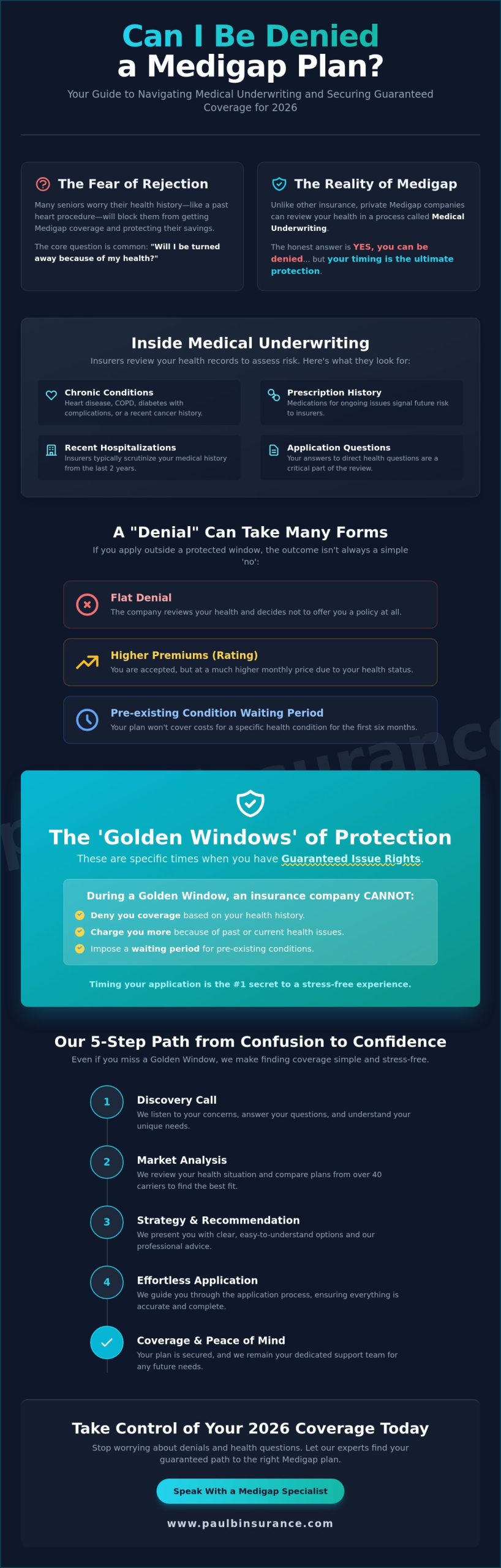
When we talk about being denied, it can happen in a few different ways. It isn’t always a flat “no” from the insurance company. Here is what a denial or a restricted offer might look like in 2026:
- A Flat Denial: The company reviews your records and decides your health risks are too high to offer any coverage.
- Rating (Higher Premiums): The company accepts you but charges a much higher monthly price based on your health history.
- Waiting Periods: You get the plan, but the company refuses to pay for costs related to a pre-existing condition for the first six months.
We have seen almost every health situation imaginable. Even if you think your medical history will get you rejected, we can often find a path forward. Our goal is to ensure you never feel rushed or pressured as we look for the right fit for your needs.
Understanding Medical Underwriting: How Companies Review Your Health
Medical underwriting is the process where insurance companies review your health history to decide if they will offer you coverage and at what price. We know this sounds intimidating. It feels like a stranger is judging your life’s history based on a digital spreadsheet. Our goal is to remove that anxiety. We act as your advocate to ensure you understand exactly what the insurers see when they look at your file.
By 2026, insurance companies have shifted toward using highly sophisticated data analytics to scan your records. They can now access pharmacy databases and medical history reports almost instantly. This technology makes the process faster, but it also makes the margin for error much smaller. If you are wondering, “can I be denied a medigap plan,” the answer often lies in how these algorithms interpret your past health events. We simplify the jargon so you can approach the application with total peace of mind.
Common Questions on the Medigap Application
When you fill out an application, you will see questions about your medical history over the last 2 years. Insurers specifically look for hospitalizations, major surgeries, or chronic conditions like heart disease and COPD. Your prescription drug history is also a major factor. If you take certain medications for chronic issues, the insurer views that as a sign of future risk. Medical underwriting is a risk-assessment tool used by private insurers. Because of this, many seniors are denied a Medigap policy if they have a pre-existing condition when they apply outside of a protected enrollment window. We help you review these questions in advance so you aren’t caught off guard by a surprise denial.
The ‘Look-Back’ Period Explained
The look-back period is the specific window of time that an insurance company examines. Usually, this covers the past 6 months to 2 years of your medical records. It’s vital to understand the difference between a “treated” condition and a “diagnosed” condition. A diagnosis is a permanent part of your record, while treatment refers to the active care or medication you’ve received recently. Insurers care most about recent treatments because they predict upcoming costs. Being 100% honest on your application is the only way to ensure your coverage remains valid. If an insurer discovers an omission later, they can rescind your policy, leaving you without protection. We guide you through this process to ensure every detail is accurate. If you want to see how different plans handle these reviews, you can compare Medigap options with our help.
The ‘Golden Windows’: When You Cannot Be Denied Coverage
We know that the biggest fear for many seniors is the idea of being stuck without the coverage they need. You might ask, can I be denied a medigap plan if I wait too long to sign up? The answer depends entirely on timing. There are specific “Golden Windows” where insurance companies must accept you, regardless of your health history. We act as your guide to ensure you step through these doors while they are wide open.
Your Initial Medigap Open Enrollment Period
This is your most important window. It’s a six month period that starts the very first day of the month you’re both 65 or older and enrolled in Medicare Part B. It’s your one time “get out of jail free” card. In 2026, we see more people working past 65 than ever before. If that’s you, remember that your clock doesn’t start until you actually sign up for Part B. We help you track this date so you don’t lose this protection. You can learn more about these plans on our Medigap information page. If you miss this window, you might be denied a Medigap policy if they have a pre-existing condition later on.
Guaranteed Issue Rights: The Safety Net
Sometimes life changes, and the law steps in to protect you. These are called Guaranteed Issue (GI) rights. You might wonder, can I be denied a medigap plan if my employer stops offering retiree health benefits? The answer is no. This is a common GI event we navigate for our clients every day. Other situations where companies are forced to accept you include:
- Moving out of your Medicare Advantage plan’s service area.
- Your current plan stops providing coverage or leaves the Medicare program entirely.
- Using your “Trial Right” if you joined a Medicare Advantage plan for the first time and want to switch back to Original Medicare within the first 12 months.
The ‘Birthday Rule’ and State Exceptions
Your zip code is often the most important piece of info for your strategy. In 2026, more states are moving toward consumer friendly rules. If you live in New York, Connecticut, Massachusetts, or Maine, you have year round or annual protections that other states don’t offer. Some states use a “Birthday Rule” which lets you switch plans around your birthday without health questions. We stay on top of these shifting 2026 trends so you always have the most current advice. Our goal is to move you from confusion to confidence by ensuring you never miss these critical dates. We simplify the jargon so you know exactly how it works for your specific location.
What to Do if You’ve Been Denied or Face High Premiums
If you just received a denial letter or a quote with a sky-high premium, take a deep breath. It feels personal, but it’s really just a business calculation by one specific company. We work with over 40 different carriers in 2026, and we have seen this situation many times before. One company’s “no” is often another company’s “yes.” The question can I be denied a medigap plan usually comes up when you’re applying outside of your initial six-month window. While it’s true that companies can look at your health history, every carrier uses a different set of rules to decide who they will cover.
Alternative Coverage Options
Medicare Advantage Plans offer a robust alternative if a Medigap plan isn’t available to you right now. These plans operate differently because they do not use medical underwriting. In 2026, a Medicare Advantage plan must accept you regardless of your health status or pre-existing conditions. This includes people with end-stage renal disease, as the rules changed to allow full access to these plans. To create a total coverage package, we also help you select a Medicare Part D plan to manage your prescription costs. This combination ensures you have a predictable cap on your annual spending.
Appealing a Decision or Shopping Around
We often find that shopping around is the most effective way to move from confusion to confidence. Different insurance companies have different “risk appetites.” For example, one carrier might be wary of a recent diabetes diagnosis, while another carrier might accept you if your A1C levels have been stable for the last 12 months. As independent brokers, we check multiple carriers to find the one that is the most “friendly” toward your specific condition. We always tell our clients to never cancel their current coverage until the new plan is officially approved and in writing. This protects you from any gaps in your healthcare.
If you don’t qualify today, we can wait for a qualifying life event. Moving to a new state or losing your current employer group coverage can trigger a special right to buy a plan. We also utilize the “Trial Right” strategy for many clients. If you joined a Medicare Advantage plan for the first time when you turned 65, you have a 12-month window to test it out. If you decide it’s not for you within that first year, you have a legal right to switch to a Medigap plan without any health questions at all. If you’re feeling stuck, chat with our team of experts to explore your options.
How We Help You Navigate the Medigap Maze with Confidence
Medicare in 2026 often feels like a complex puzzle with pieces that don’t quite fit. You might be asking yourself, can I be denied a medigap plan if my health history is less than perfect? It’s a valid concern that causes a lot of unnecessary stress for seniors. We are here to tell you that you don’t have to solve this alone. We aren’t just agents; we are your advocates. We work for you, not the insurance companies, which means our loyalty stays with you through every step of the process.
Our team uses a proven 5-step process to move you from confusion to confidence. We start by listening to your specific health needs and budget goals for 2026. Then, we compare options across 40+ carriers to find the right fit. We educate you on the “unwritten” underwriting rules that companies use to evaluate applications. After that, we handle the enrollment paperwork to ensure everything is accurate. Finally, we provide year-round support so you’re never left wondering about your coverage.
The Advantage of an Independent Broker
There’s a big difference between a captive agent and an independent broker. A captive agent works for one specific insurance company and can only offer you their products. This limits your choices and might lead you to a plan that doesn’t actually meet your needs. We take an unbiased approach, scanning the entire market to find the best value. This helps you steer clear of costly enrollment mistakes and late penalties that can follow you for years. To learn more about why this matters, read our Medicare Broker: Your Complete Guide. We know which carriers in 2026 are more lenient with certain health conditions, helping you find a “yes” when others might say “no.”
Schedule Your 2026 Strategy Session
When you book your first call with us, you can expect a conversation that is never rushed and never pressured. We speak your language, not insurance jargon. We’ll answer your most pressing questions, including can I be denied a medigap plan based on my current medications or recent procedures? We provide clear, honest answers so you can make an informed decision for your future. Our commitment doesn’t end when you sign up. We stay by your side throughout the year to help with any claims or questions that arise. You don’t have to face the crazy maze of Medicare alone. Let us provide the guidance and peace of mind you deserve.
Secure Your Coverage and Your Peace of Mind
Understanding the rules of 2026 Medicare doesn’t have to feel like a second job. The most important thing to remember is that while the question can I be denied a medigap plan is a valid concern, your timing determines your protection. If you apply during your initial enrollment period or a guaranteed issue window, companies cannot turn you away. Outside of those times, medical underwriting comes into play, but it isn’t the end of the road. We simplify this process by looking at plans from more than 40 carriers to find the one that fits your specific health profile.
We’re licensed in 34 states, including New York, Florida, and California, and we provide expert guidance with zero pressure. Our team is here to ensure you avoid late penalties and find a plan that lets you see your favorite doctors without worry. You deserve a clear path from confusion to confidence. Schedule a Call With Paul to Find Your Best Medigap Option today. We’ll handle the heavy lifting and the jargon so you can focus on enjoying your retirement with the security you’ve earned.
Frequently Asked Questions
Can I be denied Medigap if I have cancer or a heart condition?
Yes, you can be denied coverage if you apply after your initial enrollment window has closed. In 2026, most insurance companies use medical underwriting to review your health history. If you have a history of cancer or heart issues, they may decline your application. We suggest checking your eligibility early so you don’t lose your chance to get covered and protected.
What is the 6-month Medigap Open Enrollment Period?
This 6-month window is your best chance to get coverage because the answer to can I be denied a medigap plan is a firm no during this time. It starts the month you’re 65 and enrolled in Part B. During these 180 days, insurers must sell you a policy at the best available rate. They can’t look at your medical records or charge you more for chronic conditions.
Can I switch Medigap plans if I have a pre-existing condition in 2026?
Switching is possible, but it’s often difficult if you have serious health issues. In 2026, unless you live in one of the 12 states with Birthday or Anniversary rules, you must pass a health check to change plans. If your condition is serious, the new company might refuse to cover you. We can review your local state laws to see if you qualify for a safe switch.
Are there any states where I can’t be denied a Medigap plan?
Yes, four states provide special protections that prevent insurers from turning you away. Connecticut, Massachusetts, New York, and Vermont have laws that allow you to get a plan regardless of your health. In these 4 states, we can help you find a policy year-round. Other states like California and Oregon offer limited windows around your birthday to switch plans without a health exam.
What happens if I miss my Medigap Open Enrollment window?
Missing this window changes everything, and the question of can I be denied a medigap plan becomes a real concern. You lose your federal protection against medical underwriting. You can still apply, but over 90 percent of insurers will likely ask about your prescriptions and past surgeries. If you have health risks, the company can turn you down or charge a much higher monthly premium.
Does Medicare Advantage have the same medical underwriting as Medigap?
No, Medicare Advantage plans don’t use the same health checks. You can’t be denied an Advantage plan based on your health, even if you have a serious illness. This is a big contrast to Medigap, where companies often ask detailed questions. We explain these differences clearly so you can choose the path that offers you the most confidence and fits your budget.
Can an insurance company charge me more for Medigap because of my health?
Insurance companies can charge you more if you don’t have a guaranteed issue right. If you apply late, they might use your medical history to justify a higher monthly cost. Some people see their premiums increase by 25 percent or more due to health risks. We focus on getting you enrolled during your protected periods to keep your costs predictable and low for the long term.
What are Guaranteed Issue rights for Medicare Supplement plans?
Guaranteed Issue rights are legal protections that ensure you aren’t denied coverage during specific life events. For example, if your employer group health plan ends in 2026, you usually have 63 days to buy a Medigap policy. During this time, companies must accept you and cover your pre-existing conditions. We guide you through these rules to make sure you never lose your coverage or pay too much.

Article by
Paul Barrett
Paul Barrett, CMIP is the founder of The Modern Medicare Agency, an independent Medicare-only brokerage based in Melville, NY. With 18 years of Medicare-exclusive experience, a CMIP designation, and more than 5,000 clients served across 37 states, Paul is one of the most credentialed independent Medicare specialists on Long Island — and one of the most direct.
He represents 40+ carriers with no quotas and no allegiances, which means his recommendations are based entirely on what fits each client's specific situation. He is the author of Medicare Mastery Unlocked and host of the Wise Guys Retirement Talk podcast. His content is grounded in primary sources, real carrier intelligence, and 18 years of watching what happens when people get Medicare right — and when they don't.
📞 631-358-5793 | paulbinsurance.com