
Imagine you’ve finally reached your 65th birthday, only to be told your health history makes you a risk for the coverage you were counting on. It’s a frightening thought, isn’t it? If you’re asking yourself, can I be denied a medigap policy, you aren’t alone. Many seniors feel a deep sense of anxiety when they start looking into Medicare Supplement plans. You’ve worked hard your whole life, and the last thing you want is to be stuck with a $1,736 Part A deductible or high out-of-pocket costs because of a past diagnosis.
I’m here to show you that you have more control than you might think. You’ll learn exactly when you’re protected from denial and how to navigate health questions to secure the coverage you deserve. We’ll walk through the 2026 rules for enrollment windows and guaranteed issue rights so you can move forward with total certainty. By the end, you’ll know how to protect your health and your savings without the stress of the unknown. Let’s start by clearing up the confusion and finding you the peace of mind you’ve earned.
Key Takeaways
- Understand how medical underwriting works in 2026 and why your health history doesn’t always have to be a barrier to coverage.
- Discover why your enrollment timing is the most powerful tool you have to answer the question, can I be denied a medigap policy, with a confident no.
- Learn how an independent broker can pre-screen your health details to find a carrier that welcomes your application.
- Identify the specific federal protections and “golden ticket” windows that guarantee you a policy regardless of your medical past.
- Explore how to move from a state of uncertainty to a clear path toward covering the gaps in Original Medicare.
Understanding Medigap Denials and Your Right to Coverage
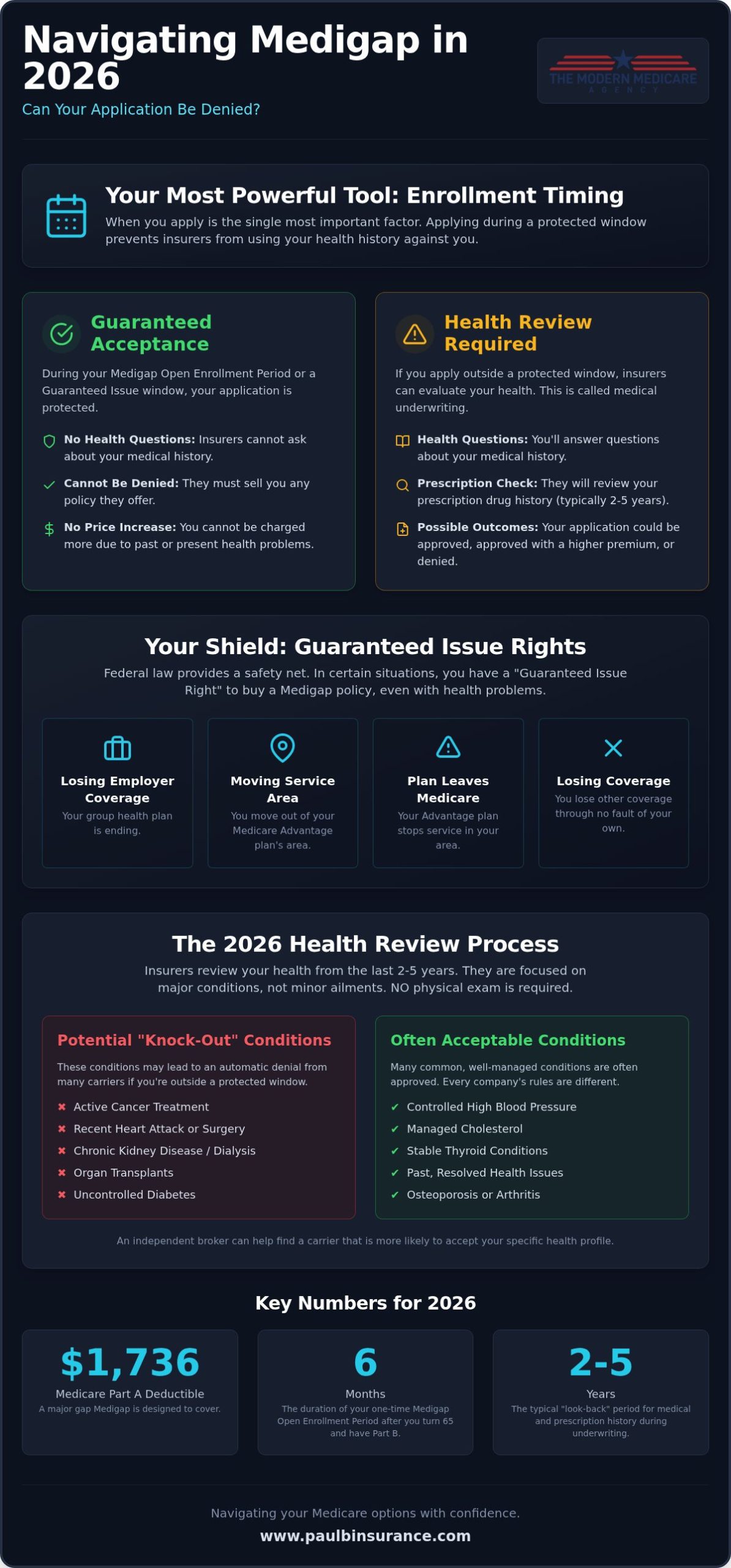
If you’ve been worrying about your health history, the question “can I be denied a medigap policy” has likely kept you up at night. To put it simply, a Medigap denial happens when a private insurance company reviews your medical records and decides not to sell you a plan. It feels personal and stressful. However, this isn’t a dead end. In 2026, many people who fear a denial are actually fully protected by federal rules. While Medigap plans are sold by private companies, they have to follow strict guidelines about when they can and cannot turn you away.
It’s helpful to remember that Medigap works differently than Medicare Advantage. Most Advantage plans don’t ask about your health history at all during enrollment. Medigap, on the other hand, often uses a process called medical underwriting. This sounds technical, but it just means the company looks at your past health to decide if they’ll cover you. The good news? There are specific times when they are legally forbidden from asking these questions. Knowing when these windows open is the key to your peace of mind.
What are Guaranteed Issue Rights?
Think of these rights as your primary shield against being turned down. When you have a “Guaranteed Issue Right,” federal law forces insurance companies to sell you a policy. They can’t look at your medical records, and they can’t charge you more because of a past illness. You don’t have to worry about the question, can I be denied a medigap policy, because the answer is legally required to be no. In 2026, common situations that trigger these rights include:
- Losing health coverage from an employer or union.
- Your Medicare Advantage plan leaving your area or stopping service.
- Moving out of your current plan’s service area.
- Losing coverage through no fault of your own.
These protections ensure you aren’t left stranded without coverage when your life circumstances change. They take the “maybe” out of the application process.
The Difference Between ‘May’ and ‘Must’
The biggest source of confusion is the difference between when a company “must” cover you and when they “may” cover you. During your initial enrollment or a protected window, they must say yes. Outside of those times, they may choose to look at your health. It’s a common mistake to assume a health check leads to an automatic “no.” Many people with managed conditions still get the coverage they need. To get a better handle on the basics, you can read more about What Is Medicare Supplement Insurance? to see how these plans fit into your overall care. We’re here to help you find the “yes” even when the system feels like it’s built to say “no.”
How Medical Underwriting Works in 2026
It is natural to feel a bit exposed when an insurance company asks to look at your medical history. Medical underwriting is simply the process where a carrier evaluates your health to decide if they can offer you a plan. In 2026, this process is much faster than it used to be. Most companies now use automated systems to review your data in real time. However, you don’t need to worry about a physical exam. There are no needles and no doctor visits required for this process. Instead, it usually involves a straightforward health questionnaire and a review of your records.
The goal of underwriting is to see if you have certain health conditions that might lead to high medical costs. If you’re applying outside of your Medigap Open Enrollment Period, the carrier wants to understand their risk. While the idea of being “rated” or “denied” is stressful, remember that every company has different rules. One company might say no, while another is happy to have you as a client. If you are feeling stuck, you can always reach out for a friendly chat to see which carriers are the best fit for your situation.
Common Questions on a 2026 Health Application
When you fill out an application, the insurer will look at a specific window of time called a look-back period. In 2026, this is typically the last two to five years of your medical life. They aren’t looking for every cold or minor scrape. They are looking for “knock-out” conditions. These are major health events like recent heart surgery, active cancer treatment, or chronic kidney disease. On the other hand, many managed conditions are perfectly fine. If you take medication for high blood pressure or cholesterol and your numbers are stable, many carriers will still approve your application without a second thought.
The Role of Prescription History
In 2026, your prescription drug history is often the most important part of your application. Insurers use your Part D data as a window into your health. They look at what you’re treating rather than just what you’ve been diagnosed with. Sometimes, a specific medication can trigger a denial even if the condition feels minor to you. For example, some drugs used for “off-label” purposes might look like a red flag to an automated system. This is where the question, can I be denied a medigap policy, gets complicated. A broker can help you pre-screen your medications before you apply. This protects your record and ensures you only apply to companies where you’re likely to get a yes.
The Critical Timing of Your Medigap Open Enrollment Period
Think of your Medigap Open Enrollment Period as your “golden ticket” to health security. This is a one-time, six-month window that starts the very first month you are 65 or older and enrolled in Medicare Part B. During this specific time, the answer to the question, can I be denied a medigap policy, is a firm and legally protected no. Federal law prohibits private insurance companies from using your health history to deny you coverage or charge you higher premiums. It’s the most powerful protection you’ll ever have in the Medicare system.
This window is truly a once-in-a-lifetime opportunity. Once those six months pass, the door to guaranteed acceptance often swings shut. In 2026, with medical costs continuing to rise, securing this coverage early ensures you aren’t left vulnerable later. You don’t have to worry about a “knock-out” condition or a past surgery. You simply pick the plan that fits your needs, and the company must accept your application. It’s a rare moment of absolute certainty in a complex process.
Why You Shouldn’t Wait to Apply
Many people consider waiting a few years to save on premiums, but this is a risky path. If you miss this initial boat, you’ll likely face medical underwriting for any future application. Your health in 2026 might be perfect, but an unexpected diagnosis in 2027 could make you uninsurable for a Medigap plan later. We also see many neighbors trying to switch from Medicare Advantage back to Original Medicare. Unless you’re in a special trial period, you might find it difficult to add a Medigap policy if your health has changed. Acting now protects your future self from high out-of-pocket costs and the stress of a potential denial.
State-Specific Protections in 2026
While federal rules provide the baseline, some states offer even more kindness to their residents. In 2026, states like California and Oregon continue to use “Birthday Rules.” These allow you to switch to a different Medigap plan of equal or lesser coverage around the time of your birthday without any health questions. If you live in New York or Connecticut, you’re in an even more unique position; these states have year-round open enrollment, meaning you can rarely be denied based on your health. Every state has its own rhythm, so it’s always a good idea to check the specific 2026 regulations in your area with a broker who understands the local landscape. We can help you see if your state offers these extra layers of peace of mind.
Options if You Face a Medigap Denial or Health Issues
Receiving a rejection letter from an insurance company can feel like a heavy blow. It’s natural to feel a sense of panic about how you’ll cover your medical bills. However, if you’ve been asking, can I be denied a medigap policy, and you just received a “no,” please take a deep breath. A denial from one insurance carrier is not a final verdict for all of them. Every company has what we call a different “risk appetite.” This means that while one company might be very strict about a certain health condition, another company might be perfectly comfortable offering you a plan.
In 2026, the insurance market is more diverse than ever. We often see situations where a client is turned down by a major name-brand carrier but finds an ideal home with a smaller, highly-rated company. My job is to help you look past the first “no” and find the “yes” that gives you the protection you need. You aren’t stuck; you just need a guide who knows which doors are still open for you.
The ‘Trial Right’ Safety Net
There is a specific federal protection called a “Trial Right” that many people don’t know exists. This is a 12-month window for people who are trying a Medicare Advantage plan for the first time. If you joined an Advantage plan when you were first eligible for Medicare and you decide within that first year that you’d rather have Medigap, you can switch back. During this trial period, you have guaranteed issue rights. This means you can’t be denied a policy, regardless of your health. It is a vital safety net that allows you to change your mind without being penalized for your medical history. Just make sure you track your start date carefully so you don’t miss this exit ramp.
When Medicare Advantage is the Right Move
If Medigap is truly out of reach because of your health and you’re outside of a protected window, a Medicare Advantage plan is your most reliable fallback. These plans do not use medical underwriting. They cannot deny you coverage or charge you more because of a pre-existing condition. While they work differently than a supplement, they still provide essential benefits and, most importantly, a limit on your annual out-of-pocket spending. Before you make a final decision, it’s helpful to compare Advantage vs. Supplement plans to see which one fits your lifestyle and budget in 2026.
You don’t have to figure this out by yourself. We are here to help you navigate these choices and find a plan that brings you peace of mind. If you’re feeling stuck or confused, contact us for a personalized plan review and let’s find your path to coverage together.
How an Independent Broker Helps You Secure Coverage
When you start asking, can I be denied a medigap policy, the answer often depends on who you’re asking. If you speak with a captive agent, someone who only represents one insurance company, their answer is limited by a single set of rules. If that company’s automated system says no, that agent has nowhere else to take you. An independent broker, however, acts as your personal advocate. We don’t work for the insurance companies; we work for you. Our goal is to look past a single “no” and find the “yes” that gives you the security you’ve been looking for.
One of the most important things we do is protect your medical record through a careful pre-screening process. In 2026, insurance companies share more data than ever before. If you submit an application and get denied, that record can sometimes make it harder to apply elsewhere. We prevent this by checking your health history and medications against the internal guidelines of different carriers before any official paperwork is signed. This methodical approach ensures we only apply to companies where you have the highest chance of success, keeping your record clean and your stress levels low.
The Power of Choice with 40+ Carriers
The 2026 landscape is constantly shifting. For example, we’ve seen major carriers like UnitedHealthcare adjust their underwriting rules and restrict certain plans in many states. Keeping track of these changes is a full-time job. Because we have access to over 40 different insurance carriers, we can compare the fine print across the entire market. We know which companies are “health-friendly” for specific conditions like diabetes or heart health. This variety is essential for anyone with a medical history because it turns a narrow path into a wide field of options. Best of all, our guidance and support typically come at no extra cost to you, as the carriers compensate us for helping you find the right fit.
Your Journey from Confusion to Certainty
Our mission is to take the anxiety out of the Medicare process and replace it with clarity. You shouldn’t have to spend your days worrying about fine print or “knock-out” conditions. We handle the heavy lifting, from the initial research to the final paperwork, so you can focus on enjoying your retirement. We invite you to join us for a personalized, unbiased consultation where we can look at your specific needs together. Let us help you find the right Medigap plan today and move you from a state of uncertainty to a state of total peace of mind.
Take Control of Your Health Security Today
Navigating the Medicare system doesn’t have to be a source of constant stress. We have explored how the right timing, like your initial enrollment window, acts as a powerful shield for your coverage. You now know that while the question, can I be denied a medigap policy, is a valid concern, there are many paths to a “yes.” Whether it’s through federal protections or the flexibility of state-specific rules in 2026, you have options to protect your savings from high out-of-pocket costs.
You don’t have to make these decisions alone. At The Modern Medicare Agency, we provide the expert guidance of Paul Barrett and access to over 40 top-rated insurance carriers. With unbiased support across 34 states, we’re here to ensure you find a plan that fits your life perfectly. Secure your peace of mind; speak with a Medigap expert at The Modern Medicare Agency today. We’re ready to help you move forward with confidence and clarity. Your future health security is worth the conversation, and we’re honored to be your guide.
Frequently Asked Questions
Can I be denied Medigap if I have a pre-existing condition?
Yes, if you apply outside of a protected enrollment period. During your initial six-month Medigap Open Enrollment Period or a Guaranteed Issue situation, companies cannot deny you. However, outside these times, carriers use medical underwriting to review your history. They may deny coverage for serious conditions like active cancer or chronic kidney disease. It’s why timing your application is so vital for your peace of mind and long-term health security.
What is the best time to apply for a Medigap policy to avoid denial?
The best time is during your six-month Medigap Open Enrollment Period. This window starts the month you are 65 and enrolled in Medicare Part B. During this time, you have a legal right to buy any policy sold in your state. You won’t face health questions, and you won’t have to worry about the question, can I be denied a medigap policy. It’s your golden ticket to guaranteed coverage regardless of your medical history.
Do all Medigap companies have the same health questions in 2026?
No, every carrier has its own unique health questionnaire and risk appetite. In 2026, we see companies like UnitedHealthcare implementing stricter underwriting changes for current policyholders who want to switch plans. While most look at major health events from the last few years, some are more lenient with specific managed conditions. This variety is why working with a broker who compares 40+ carriers is a strategic advantage for your health security.
What happens if I am denied a Medigap policy?
A denial from one company doesn’t mean you’re out of options. You can try applying with a different carrier that may have more flexible underwriting guidelines. If Medigap remains unavailable due to your health, a Medicare Advantage plan is a reliable alternative. These plans cannot deny you based on your medical history. We can help you navigate these fallback options to ensure you aren’t left without the protection you deserve in 2026.
Can a Medigap company cancel my policy if I get sick later?
No, as long as you pay your premiums on time, your policy is guaranteed renewable. This means the insurance company cannot cancel your coverage or change your benefits just because your health declines. Even if you develop a chronic illness or face a major surgery in 2026, your Medigap plan stays with you. This protection is one of the primary reasons seniors value these plans for reliable, long-term security and peace of mind.
Is there a way to get Medigap without a health questionnaire?
Yes, you can skip the health questions during your initial enrollment period or if you qualify for a Guaranteed Issue Right. These rights are often triggered by losing employer coverage or if your current plan leaves your service area. Additionally, some states have specific laws that allow you to switch plans at certain times of the year without any medical underwriting. We can help you identify if you qualify for these special protections today.
How do state ‘Birthday Rules’ work for Medigap in 2026?
In states like California and Oregon, the Birthday Rule allows you to switch to a different Medigap plan around your birthday. You can typically move to a plan with equal or lesser benefits without answering health questions. This prevents you from being locked in to a plan if premiums rise. It’s a wonderful way to maintain flexibility and protect your budget even if your health has changed since you first signed up for Medicare.
Can I switch from Medicare Advantage to Medigap if I have health issues?
Switching can be difficult if you have health issues, but it isn’t impossible. If you are in a Trial Right period, your first year on an Advantage plan, you can switch back to Medigap with guaranteed acceptance. Outside of that window, you will likely have to pass medical underwriting. If you’re asking, can I be denied a medigap policy during this switch, the answer is yes, unless a special state protection or rule applies to you.

Article by
Paul Barrett
Paul Barrett, CMIP is the founder of The Modern Medicare Agency, an independent Medicare-only brokerage based in Melville, NY. With 18 years of Medicare-exclusive experience, a CMIP designation, and more than 5,000 clients served across 37 states, Paul is one of the most credentialed independent Medicare specialists on Long Island — and one of the most direct.
He represents 40+ carriers with no quotas and no allegiances, which means his recommendations are based entirely on what fits each client's specific situation. He is the author of Medicare Mastery Unlocked and host of the Wise Guys Retirement Talk podcast. His content is grounded in primary sources, real carrier intelligence, and 18 years of watching what happens when people get Medicare right — and when they don't.
📞 631-358-5793 | paulbinsurance.com