




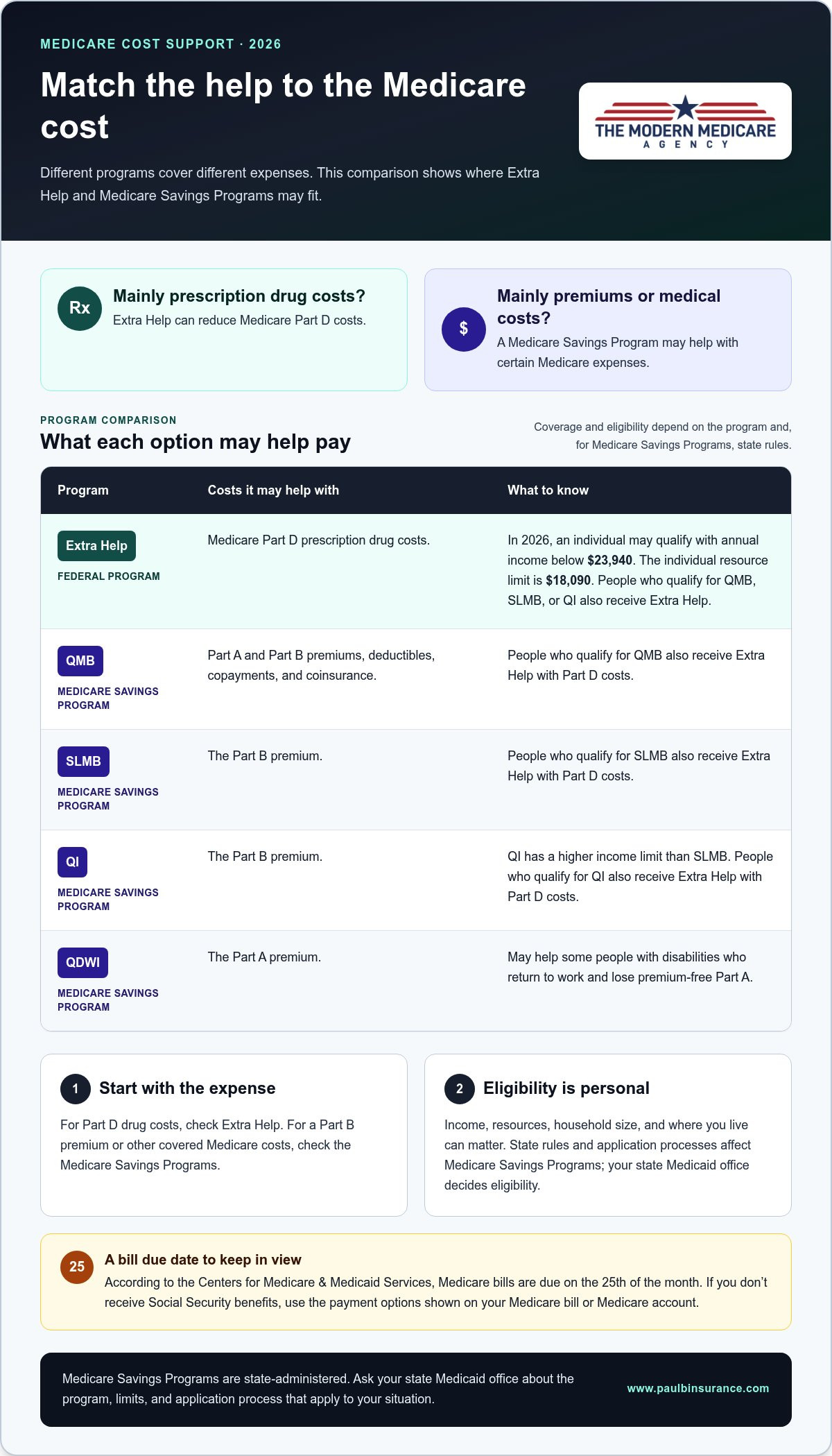
If you’re wondering what to do if you can’t afford your Medicare premiums, check whether you qualify for Extra Help or a Medicare Savings Program. In 2026, an individual may qualify for Extra Help with annual income below $23,940, according to the Social Security Administration. Extra Help can reduce Medicare Part D prescription drug costs, while Medicare Savings Programs may help with Part A or Part B premiums and other Medicare expenses.
It’s understandable to feel stressed when premiums and prescription costs compete with everyday expenses. Eligibility depends on factors such as income, resources, and where you live, and state rules can affect how Medicare Savings Programs work. This guide explains the assistance available, the 2026 eligibility limits, and where to turn to learn about applying, so you can focus on the next practical step with greater clarity.
Key Takeaways
- Extra Help may lower Medicare Part D drug costs, and some people qualify through other assistance programs.
- Medicare Savings Programs can help with certain premiums and other Medicare costs; your state Medicaid office determines eligibility.
- Income and resource limits vary by program, so review the 2026 rules before deciding whether applying may be worthwhile.
- If a premium bill is hard to manage, understand the due date and what may happen during a plan’s grace period.
- Medicaid offices and SHIP counselors can help you explore eligibility and find support with Medicare questions and applications.
Is there financial help for Medicare Part D coverage?
Yes. Extra Help can reduce Medicare Part D prescription drug costs, while Medicare Savings Programs may help pay premiums and other expenses. In 2026, these programs offer different routes to savings based on income, resources, and coverage.
Medicare Savings Program Support
Medicare Savings Programs are state-administered programs that help eligible people pay certain Medicare costs. QMB can help cover Part A and Part B premiums, deductibles, copayments, and coinsurance. SLMB and QI help pay Part B premiums, while QDWI may help some people with disabilities pay Part A premiums.
These programs can ease more than the monthly premium burden. People who qualify for QMB, SLMB, or QI also receive Extra Help with Part D costs. This may be especially useful if prescription expenses make it difficult to maintain drug coverage alongside medical coverage.
State Assistance With Medicare Costs
State programs can lower Medicare expenses for people with limited income and resources. Medicaid is a joint federal and state program that helps cover medical costs for some people. Each state’s Medicaid office determines eligibility for Medicare Savings Programs, so state rules and application processes matter.
If you don’t receive Social Security benefits, use the payment options shown on your Medicare bill or Medicare account. You don’t need benefit deductions to pay a premium. According to the Centers for Medicare & Medicaid Services, Medicare bills are due on the 25th of the month.
Plans That May Lower Costs
Medicare-approved health plans can differ in their coverage and cost-sharing. A Medicare Advantage Plan may include medical coverage and, in some cases, prescription drug coverage. A standalone Medicare Part D plan covers prescription drugs. Compare covered medicines and plan costs to see whether coverage fits your needs.
A plan change doesn’t replace financial assistance, but it may help address costs tied to coverage. Review the plan’s drug coverage and expected out-of-pocket expenses before making a decision. For details about how prescription coverage works, explore Medicare Part D plans.
Extra Help is a federal program that lowers Medicare Part D costs for eligible people. In 2026, an individual may qualify with annual income below $23,940, according to the Social Security Administration. The individual resource limit is $18,090. People who qualify for a Medicare Savings Program through QMB, SLMB, or QI also receive Extra Help.
First identify whether your biggest expense is a Part D drug cost, a Part B premium, or both. Then look into the relevant assistance: Extra Help focuses on drug costs, while Medicare Savings Programs can help with certain premiums and medical expenses. Apply for a Medicare Savings Program through your state Medicaid office.
How do Medicare Savings Programs help with Medicare costs?
Medicare Savings Programs can help eligible people manage Medicare expenses through state Medicaid programs. Yes, Medicaid may help pay Medicare Part B premiums through programs such as SLMB and QI. Medicaid also helps cover medical costs for some people with limited income and resources, though covered services depend on the state.
Eligibility and Applying for Savings Programs
Eligibility for a Medicare Savings Program depends on income, resources, and state rules. Your state Medicaid office decides eligibility, so application procedures and limits can vary. One program may reduce a specific expense, while another may help with broader Medicare costs.
Contact your state Medicaid office and ask for a Medicare Savings Program application. Explain which Medicare costs are difficult to manage, such as the Part B premium or medical copayments. Keep a copy of your completed application and any notices. If the office requests more information, respond promptly so it can continue reviewing your eligibility.
Medicare Savings Programs have different categories for different needs. QMB helps with Part A and Part B premiums and certain out-of-pocket costs. SLMB and QI help pay Part B premiums. QDWI may help people with disabilities who return to work and lose premium-free Part A. The state decides which program, if any, fits your circumstances.
Medicaid Help With Part B Premiums
Medicaid-related Medicare Savings Programs can pay Part B premiums for eligible people. SLMB pays the Part B premium, as does QI, which has a higher income limit than SLMB. This assistance can leave more money available for other household needs.
Medicaid is a joint federal and state program, not a Medicare insurance plan. It helps cover medical costs for some people with limited income and resources. Depending on state rules and eligibility, Medicaid may provide health coverage beyond premium assistance. Ask your state Medicaid office which services apply to your situation.
If your Medicare Savings Program ended unexpectedly, read the termination notice and contact the state Medicaid agency promptly. If you believe the state ended coverage improperly, you can appeal, seek reinstatement, or reapply. Keep the notice and related correspondence together, and follow the agency’s instructions to address the issue and reduce the risk of a coverage gap.
A change in income, resources, or other circumstances can affect program eligibility. Tell your state Medicaid office if your financial situation changes and ask how it affects your assistance. If your application is denied, read the notice carefully and follow its review or appeal instructions. Keeping clear records makes it easier to explain your circumstances and track the decision.
Income and asset limits
Medicare Savings Program eligibility depends on income, resources, household size, and state rules. In 2026, federal limits can help you identify which program may fit.
In 2026, the federal QMB income limit in the continental United States is $1,350 per month for one person, according to the Centers for Medicare & Medicaid Services. The federal QMB asset limit for a couple is $14,910. For most Medicare Savings Programs, the federal asset limit is $9,950 for an individual, according to the Centers for Medicare & Medicaid Services.
Other programs have different income thresholds. In the continental United States, the 2026 federal SLMB income limit is $1,616 per month for one person and $2,184 per month for a couple. The Qualified Individual, or QI, program has limits of $1,816 per month for one person and $2,455 per month for a couple.
QDWI serves a different group: people with disabilities who return to work and lose premium-free Part A. Its 2026 federal income limit is up to $5,405 per month for one person and $7,299 per month for a couple. Its asset limit is $4,000 for an individual and $6,000 for a couple. These thresholds show why checking each program matters, even if one limit seems too low.
Can you appeal a Medicare premium amount or seek help after an income drop? If you believe a past-due premium amount is incorrect, ask about the process for disputing it. If your income is lower, apply for a Medicare Savings Program through your state Medicaid office; eligibility depends on state rules.
Income limits are only part of the eligibility picture. Your state Medicaid office decides Medicare Savings Program eligibility, and state rules can affect how income and resources are counted. If your household size or financial situation changes, ask the office to assess your current circumstances rather than relying on a past decision.
Supplemental Security Income, or SSI, is a Social Security program for certain people with lower incomes. Receiving SSI may indicate that your income is limited, but it does not replace applying for a Medicare Savings Program. Contact your state Medicaid office to ask how SSI affects your application and what information to provide.
Before applying, gather income records, information about resources, household details, and any Social Security notices to clarify your finances. Review the requirements for QMB, SLMB, QI, and QDWI. Even if your income seems close to a limit, ask the state office to review your application because rules can vary by state.
Late payments and risk of losing coverage
A missed payment can result in a past-due balance, notices, and possible coverage problems. The next step depends on whether the bill is for a Medicare premium or a plan premium.
Medicare plans must provide a grace period of at least 2 calendar months for unpaid plan premiums, according to the Centers for Medicare & Medicaid Services. During that time, pay the amount due or contact the plan about the balance. A plan must send a bill showing the amount and due date, along with written notice explaining the risk of disenrollment.
If plan premiums remain unpaid after the grace period, the plan may disenroll you as of the first day of the following month. For example, a February premium due February 1, followed by an unpaid February-March grace period, may lead to disenrollment effective April 1. A Part D plan may require payment of outstanding premiums before accepting a new enrollment request. Re-enrollment after losing drug coverage for nonpayment isn’t retroactive.
Part D-IRMAA is separate from your plan premium. You pay this income-related amount directly to the government, not to your drug plan. Medicare provides an initial grace period before disenrollment for unpaid Part D-IRMAA. If you receive a notice, check who is owed and what the payment covers before responding.
For past-due Medicare premiums billed by Social Security, ask about an installment plan. The Social Security Administration can set payments as low as $15 per month when the arrears total $630 or less. Payments must repay the debt within 42 months. Call 1-800-772-1213 or contact a local Social Security office to request a plan.
A hardship waiver may help when paying past-due premiums would create financial hardship. Request one using SSA Form 632. You can request an installment plan and hardship waiver at the same time. If you disagree with an advance notice about past-due premiums, you have 60 days from receiving it to appeal. Use SSA-561 to challenge an incorrect amount.
Act quickly when a bill says “Delinquent Bill,” because the full amount must be paid to avoid losing Medicare coverage. If you can’t pay in full, contact Social Security promptly about available options. Medicare advises submitting payments at least 5 business days before the due date so they arrive on time. Keep payment records and copies of notices together, especially when multiple monthly bills are involved.
Prescription coverage gaps can create another concern. Going 63 days or more without Medicare drug coverage or other creditable prescription coverage may lead to a Part D late enrollment penalty when you join a new plan. If coverage ends, review your enrollment options and act promptly to avoid an unnecessary gap.
Ways to check eligibility and find assistance
Start with the agency that handles the assistance you need. Your state Medicaid office determines Medicare Savings Program eligibility, while the Social Security Administration handles Extra Help. SHIP counselors can help people with low incomes with Medicare questions and applications.
To apply for a Medicare Savings Program, contact your state Medicaid office. Medicaid is a joint federal and state program that helps cover medical costs for some people with limited income and resources. The office can explain its application process and assess your situation under state rules.
For Extra Help with Part D costs, use the Social Security Administration’s Extra Help information and application process. Gather details about your income, resources, Medicare coverage, and household circumstances before applying. Having them ready can make it easier to answer questions accurately and understand the application.
A SHIP counselor can explain program choices and help you work through Medicare-related application questions. Bring any notices or bills that prompted your search, along with details about your coverage and current expenses. A counselor can help identify which agency handles your issue and what questions to ask.
Separate benefit eligibility from plan enrollment. Assistance programs may help with premiums or other Medicare costs, while plan enrollment concerns the coverage itself. Most people with Medicare can make coverage changes each year from October 15 through December 7, unless they qualify for a Special Enrollment Period. Review whether your concern is financial assistance, plan coverage, or both.
If a notice concerns Medicare premiums, keep it nearby when seeking help. For Medicare billing questions, call 1-800-MEDICARE at 1-800-633-4227. Explain what the notice says, which premium it concerns, and whether you’re asking about an amount due or available payment options. That distinction helps direct the question to the right place.
Use this simple checklist before contacting an office:
- Identify whether you need help with Part D costs, Medicare premiums, or medical expenses.
- Gather relevant Medicare, Social Security, and state Medicaid notices.
- Ask the state Medicaid office about Medicare Savings Program eligibility and applications.
- Ask the Social Security Administration about Extra Help.
- Contact a SHIP counselor for support understanding Medicare choices and applications.
If your application was denied or assistance ended, read the notice closely and contact the agency named in it. State Medicaid offices handle Medicare Savings Program eligibility, while Social Security handles Extra Help. Ask what information the decision considered and what options the notice describes. Keep copies of your application and correspondence so you can explain your situation clearly.
The Modern Medicare Agency: Medicare Advantage Plans
If you’re reviewing coverage after exploring assistance programs, The Modern Medicare Agency can help you compare Medicare Advantage Plans. It also helps eligible individuals compare Medicare Supplement (Medigap) and Medicare Part D Plans, with guidance tailored to their needs.
Plan guidance is separate from applying for public assistance. State Medicaid offices determine Medicare Savings Program eligibility, and the Social Security Administration handles Extra Help. Once you understand those options, comparing plan coverage can help you see how benefits and costs fit together.
If you’re weighing Medicare plan choices, contact The Modern Medicare Agency to discuss your options.
Take One Clear Next Step
If you’re still weighing what to do if you can’t afford your Medicare premiums, start with the step you can take today. Keep your questions, recent notices, and current coverage details together. These give you a clear starting point when you discuss your needs and budget.
Public assistance and insurance choices serve different purposes. As you explore available help, review whether your current coverage still matches the care and prescriptions you need. Comparing your options carefully can help you decide with confidence, without rushing into a change.
The Modern Medicare Agency can help you understand plan options and compare coverage. Contact The Modern Medicare Agency to talk through your next step. You deserve clear information and space to choose what works for you.
Frequently Asked Questions
Do I qualify for financial assistance programs with Medicare?
You may qualify if your income and resources meet a program’s eligibility rules. If you’re asking what to do if I can’t afford my Medicare premiums, first identify which cost is hardest to manage. Your state Medicaid office handles Medicare Savings Program eligibility, while the Social Security Administration handles Extra Help applications. Prescription costs may point to Extra Help; Part B premiums may make a Medicare Savings Program relevant.
What Medicare Savings Programs help pay Medicare premiums in 2026?
In 2026, QMB, SLMB, QI, and QDWI address different Medicare expenses. QMB can help with Part A and Part B premiums and certain out-of-pocket costs. SLMB and QI help pay Part B premiums. QDWI may help eligible people with disabilities who return to work and lose premium-free Part A. Your state Medicaid office determines whether you qualify and which program fits your circumstances.
What are the 2026 income and asset limits for Medicare Savings Programs by state?
Federal limits provide a starting point, but states may use different rules or higher limits. For example, the 2026 federal QMB income limit in the continental United States is $1,350 per month for one person, according to the Centers for Medicare & Medicaid Services. The federal asset limit for most programs is $9,950 for an individual. Ask your state Medicaid office how its rules apply to your household.
How do I apply for a Medicare Savings Program through my state?
Apply through the Medicaid office in the state where you live. Ask for a Medicare Savings Program application and explain which Medicare expenses are difficult to manage. Gather information about your income, resources, household, and Medicare coverage before applying. If you receive Social Security or SSI, keep relevant notices nearby. The state office reviews your application and determines eligibility under its rules.
How can I get Extra Help paying Medicare Part D premiums and drug costs?
Apply for Extra Help through the Social Security Administration, which reviews eligibility. In 2026, an individual may qualify with annual income below $23,940, according to the Social Security Administration. The individual resource limit is $18,090. If you qualify for QMB, SLMB, or QI, you also receive Extra Help. Keep prescription information handy to explain which drug expenses are creating difficulty.
What happens if I miss a Medicare premium payment or have unpaid premiums?
A missed payment can create a past-due balance, which Medicare may add to your next bill. If you’re wondering what to do if I can’t afford my Medicare premiums, first identify whether the bill comes from Medicare or a plan. For premiums billed through Social Security, ask about an installment arrangement or hardship waiver. Keep notices together and follow appeal instructions if you believe the amount is wrong.
Are there state pharmaceutical assistance programs or Medicare premium assistance programs near me?
State assistance varies, so contact your state Medicaid office to ask which Medicare cost programs are available where you live. A SHIP counselor can also help with Medicare questions and applications. Have your state, Medicare coverage details, and any recent premium or prescription notices ready. This information can focus the discussion on the drug expenses, premiums, or other medical costs you need help managing.
What other options can reduce Medicare costs, including Medicare Advantage plans or Medigap?
Comparing coverage can show how plans handle benefits, prescription drugs, and expected expenses. Medicare Advantage plans provide Medicare coverage through a private plan, while Medigap supplements Original Medicare. Part D plans cover prescription drugs. Before changing plans, list your medicines and care needs, then compare how each option addresses them. Public assistance and plan selection are separate decisions, so consider both.

Article by
Paul Barrett
Paul Barrett, CMIP is the founder of The Modern Medicare Agency, an independent Medicare-only brokerage based in Melville, NY. With 18 years of Medicare-exclusive experience, a CMIP designation, and more than 5,000 clients served across 37 states, Paul is one of the most credentialed independent Medicare specialists on Long Island — and one of the most direct.
He represents 40+ carriers with no quotas and no allegiances, which means his recommendations are based entirely on what fits each client's specific situation. He is the author of Medicare Mastery Unlocked and host of the Wise Guys Retirement Talk podcast. His content is grounded in primary sources, real carrier intelligence, and 18 years of watching what happens when people get Medicare right — and when they don't.
📞 631-358-5793 | paulbinsurance.com