




Yes, Medicare covers cardiac rehab. Part B pays for a supervised program of exercise, education and counseling if you have one of a specific list of heart conditions, and it generally covers up to 36 sessions. You usually pay 20% of the Medicare-approved amount after your Part B deductible, or a hospital copayment if the program runs in a hospital outpatient department. Below is who qualifies, what the program includes, what it costs, and where Medicare Advantage plans work differently.
TL;DR
- Original Medicare Part B covers cardiac rehab after a qualifying event or diagnosis, such as a heart attack in the last 12 months, bypass surgery, stable angina, valve repair or replacement, angioplasty or stenting, a heart or heart-lung transplant, or stable chronic heart failure.
- The standard limit is 36 sessions over up to 36 weeks. A second block of 36 can be approved when your doctor documents medical need.
- In most settings you pay 20% of the Medicare-approved amount after the Part B deductible. In a hospital outpatient department you pay a copayment instead.
- Medicare Advantage plans must cover the same Part B services, but they can limit you to a network and may require referrals or prior approval.
- Check your plan type before you pick a program. The right program location can save you money and a denied claim.
Table of Contents
- What cardiac rehab is and why it matters
- Which conditions qualify for Medicare cardiac rehab
- What Medicare-covered cardiac rehab includes
- How many sessions Medicare covers
- What you pay
- Do you need a referral?
- Original Medicare vs. Medicare Advantage for cardiac rehab
- Perspective: why we tell clients to check coverage before a heart event
- How to get started, step by step
- Make sure your coverage fits your heart care
- FAQ
- Sources
What cardiac rehab is and why it matters
Cardiac rehabilitation is a structured program for people recovering from a heart event or procedure. Medicare describes it as exercise, education and counseling for people who have had a heart attack, heart failure or certain other heart problems. It is not a gym membership. A team of professionals, including doctors, nurses and pharmacists, works together to help you take charge of the choices, lifestyle and habits that affect your heart.
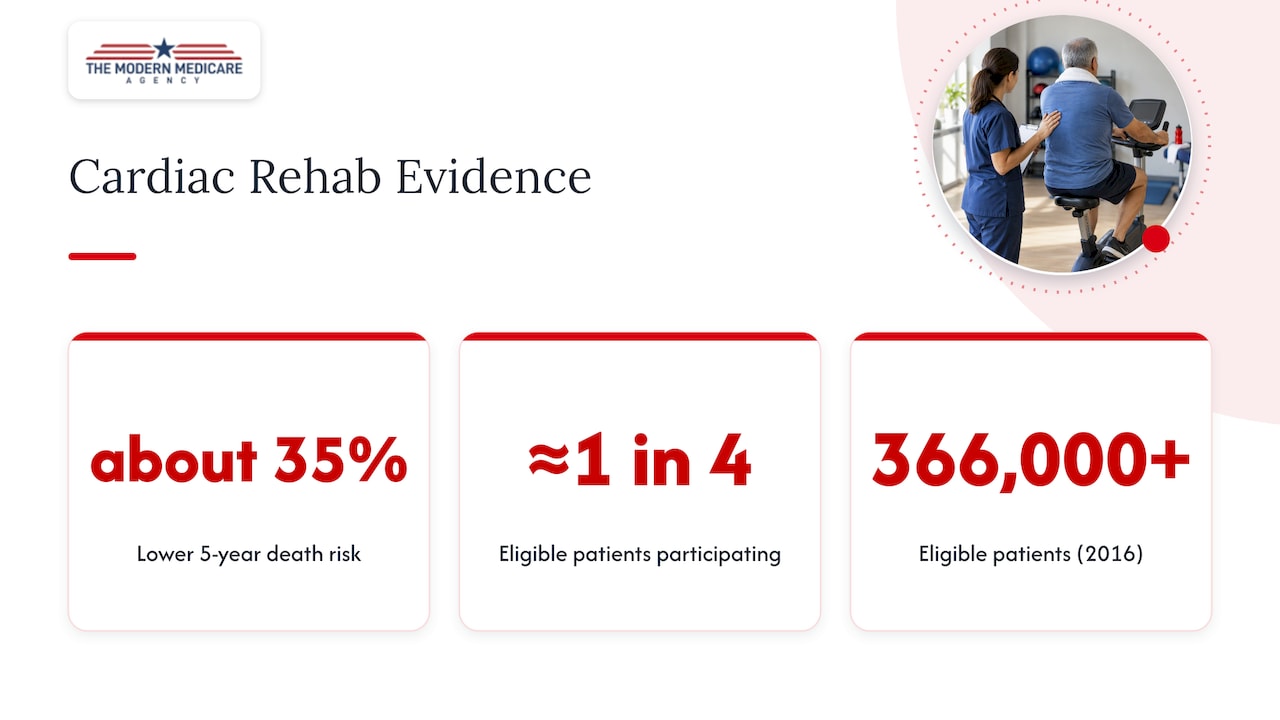
The payoff is real. The CDC reports that studies show cardiac rehab can lower the risk of death in the five years after a heart attack or bypass surgery by about 35%. The National Heart, Lung, and Blood Institute adds that a program can give you confidence that you can exercise safely after a cardiac event.
Despite those benefits, many eligible people never start. A review of more than 366,000 Medicare patients who were eligible for outpatient cardiac rehab in 2016 found that only about one in four took part. Cost worries, unclear referrals and not knowing the benefit exists are common reasons. This guide is meant to remove the second and third of those.
Which conditions qualify for Medicare cardiac rehab
Medicare does not cover cardiac rehab for general heart health or for prevention. You need a documented diagnosis or procedure from this list. According to Medicare’s coverage page, Part B covers cardiac rehab if you have had:
- A heart attack within the last 12 months
- Coronary artery bypass surgery
- Stable angina pectoris (chest pain)
- Heart valve repair or replacement
- Coronary angioplasty or stenting
- A heart or heart-lung transplant
- Stable chronic heart failure
This structure goes back to the national coverage decision. In 2006, CMS concluded that cardiac rehab was reasonable and necessary only for patients with a documented diagnosis of a listed condition. The Medicare coverage provisions took effect on January 1, 2010.
Heart failure and the word “stable”
Two words in the list trip people up: “stable” angina and “stable” chronic heart failure. Your doctor has to document that your condition is stable, not newly worsening or in need of urgent treatment. If you are living with heart failure and wondering where you fit, our guide on whether people with heart failure qualify for Medicare benefits walks through eligibility in more detail.
If your condition is not on the list
High blood pressure, high cholesterol, atrial fibrillation on its own, or a family history of heart disease do not qualify by themselves. If you have one of those and no listed event, ask your cardiologist what else Medicare may cover, such as counseling and screening. Do not assume a program will be paid for just because your doctor recommends it.
What Medicare-covered cardiac rehab includes
Federal rules define what a covered program must contain. Under 42 CFR 410.49, a cardiac rehab program includes:
- Physician-prescribed exercise, usually on treadmills, bikes or other equipment with monitoring.
- Cardiac risk factor modification, meaning education, counseling and behavioral help with things like diet, blood pressure, smoking and stress.
- Psychosocial assessment, which looks at how you are coping emotionally after a heart event.
- Outcomes assessment, so the team can measure your progress.
- An individualized treatment plan, which a physician must sign every 30 days.
The monitoring matters. The Mayo Clinic notes there is a small risk of heart-related complications during rehab exercise, and that regular monitoring lowers that risk. That is one reason to do this in a supervised program rather than on your own right after surgery.
Intensive cardiac rehab
Medicare also recognizes a second, more structured tier called intensive cardiac rehabilitation (ICR). To be approved, ICR programs must show through peer-reviewed research that they improve cardiovascular disease outcomes, such as slowing the progression of coronary heart disease or reducing the need for bypass surgery or coronary interventions. Not every community offers one, so ask programs near you directly whether they run ICR and how its schedule differs.
Sleep, rest and recovery
Rehab is not only about the hour on the treadmill. How you sleep affects how you recover, and the link between the two is well documented. If your nights have been rough since your heart event, this overview of how poor sleep affects heart health is worth reading before you raise it with your care team.
How many sessions Medicare covers
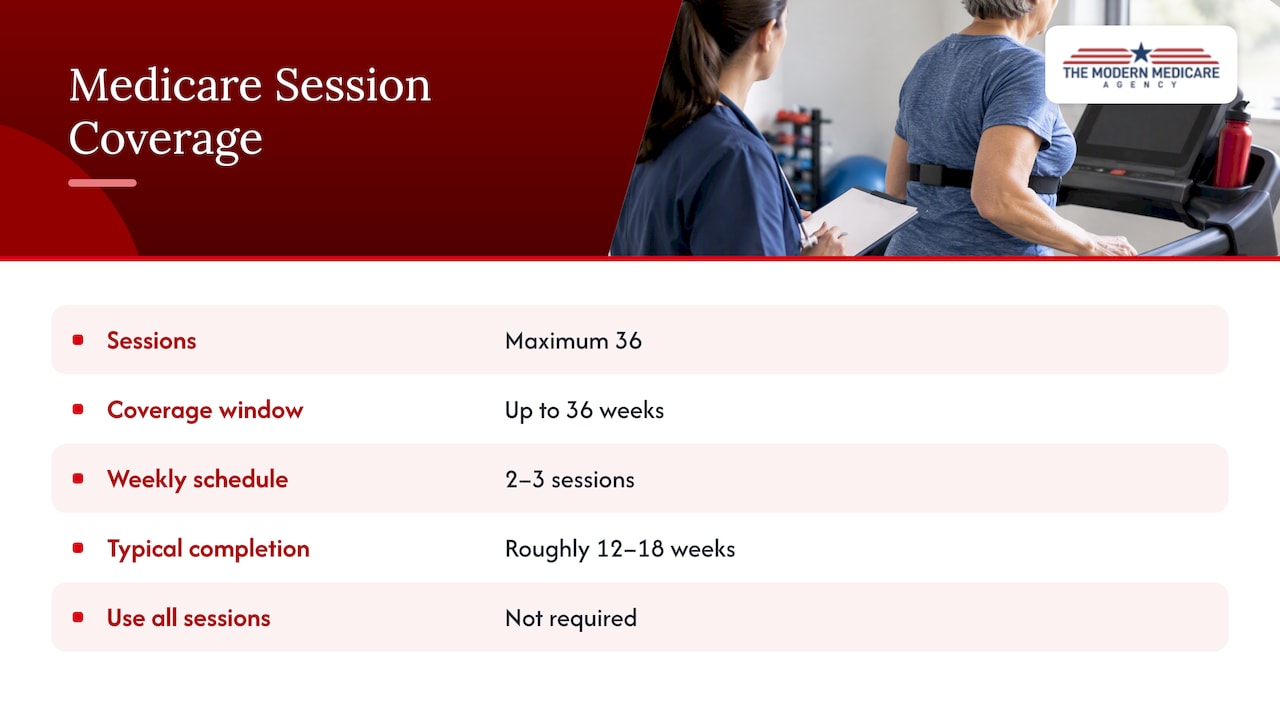
The standard benefit is a maximum of 36 sessions over a period of up to 36 weeks. Most programs schedule two or three sessions a week, so many people finish 36 sessions in roughly 12 to 18 weeks. You do not have to use all 36.
Getting more than 36
Coverage can extend. Up to 36 additional sessions may be allowed when all of these are true, according to the same CMS billing and coding article:
- A significant illness or comorbidity came up during your first 36 sessions.
- You have not yet met the program’s exit criteria.
- Your medical record documents the need.
The extra sessions are decided case by case, and the paperwork is on the program and your doctor. If you think you may need more time, say so early. A clear note from your cardiologist in your chart is what makes the difference.
What you pay
Under Original Medicare, you typically pay 20% of the Medicare-approved amount after your Part B deductible for services in a doctor’s office. In a hospital outpatient setting, you pay a copayment instead. The current deductible and premium are published each year by Medicare, so check the amounts for the year you are being treated.
Three practical points follow from that:
- Location changes the bill. Ask the program whether it bills as a physician office or a hospital outpatient department, then ask what your share per session will be.
- Sessions add up. A small per-session share multiplied by up to 36 visits becomes a real number. Ask for an estimate before you commit.
- A Medigap plan can absorb it. If you have a Medicare Supplement plan, it may pay some or all of the Part B coinsurance. Coverage depends on the plan letter, so confirm with your carrier.
A worked example
Say a program charges a Medicare-approved amount per session and you have already met your Part B deductible for the year. Your share is 20% of each approved amount, and 36 sessions means 36 of those bills. With a Medigap plan that covers Part B coinsurance, your share could be much smaller. Without one, you are paying out of pocket or relying on a retiree plan. This is the main reason people review their supplemental coverage after a heart event, not before.
Do you need a referral?
The exercise portion of a program must be prescribed by a physician, and a physician signs your treatment plan every 30 days. In practice, that means your cardiologist or the doctor who treated your heart event orders the program. A program will not enroll you on a walk-in basis.
What changes is the plan type:
- Original Medicare lets you go to any provider that accepts Medicare, and you generally do not need a referral to see a specialist.
- Medicare Advantage plans may restrict coverage to in-network providers and might require referrals for specialist services, according to the Medicare & You handbook.
Original Medicare vs. Medicare Advantage for cardiac rehab
Both types of plans must cover services that Part B covers, so cardiac rehab is a covered benefit either way. What differs is the road to the program and the cost.
| Original Medicare (Part B) | Medicare Advantage | |
|---|---|---|
| Covered for listed conditions | Yes | Yes, required to cover Part B services |
| Choice of program | Any provider that accepts Medicare | Usually plan network only |
| Referral or prior approval | Physician order; no network referral | May be required, depending on plan |
| Your cost | 20% after deductible, or hospital copayment | Set by your plan; copays are common |
| Supplement possible | Yes, Medigap | No, Medigap does not pair with Advantage |
The network is where problems start. A program near your home may be out of network, and a closer one may have a long waiting list. If you are on Advantage and worried about your doctors and facilities, our article on solving Medicare Advantage network problems covers your options, and tips for selecting a Medicare Advantage plan explains what to check before you enroll.
Perspective: why we tell clients to check coverage before a heart event
Most people look at their Medicare plan when they are healthy and shopping on price. A heart attack or stent changes what matters. Suddenly you care whether your cardiologist is in network, how much a 36-session program will cost, and whether you have a safety net for the 20% share.
We have helped Medicare consumers since 2007, and the same pattern keeps showing up. A plan that looks inexpensive in the monthly premium column can cost more once you add a series of outpatient visits. A plan with higher premiums but predictable cost-sharing can be cheaper for someone who knows heart care is ahead. Neither choice is wrong. The mistake is making it without understanding what each option does when you need it.
Our approach is education first. If you are new to Medicare, or you are not happy with what you have, we compare your options side by side and show you what rehab, hospital stays and specialist visits would look like under each. If you have a heart condition, say so up front. It changes which questions matter. The comparison of Medicare Advantage and supplement plans is a good place to start on your own.
— Paul
How to get started, step by step
- Confirm your qualifying diagnosis or procedure. Ask your cardiologist to document it, and whether your condition counts as stable.
- Get the physician order. Your doctor prescribes the exercise program and signs your plan of care.
- Check your plan. On Original Medicare, find a program that accepts Medicare. On Advantage, call the number on your card and ask about network, referral and prior approval.
- Ask each program about cost. Request your per-session share and whether the program bills as a hospital outpatient department.
- Plan for the full course. Choose days and times you can keep for several weeks. Consistency matters more than intensity.
- Ask about extension early. If you expect a complication or a slow recovery, talk to your doctor before session 36.
If your recovery will also involve physical therapy, our pages on physical rehab benefits and Medicare coverage for rehab after knee replacement show how Medicare treats those services, which follow different rules from cardiac rehab.
Make sure your coverage fits your heart care
If you are choosing, or reconsidering, how you cover Part B costs, we can help. We are independent agents with access to 40+ carriers, so we compare Medicare Supplement plans that may help with Part B coinsurance against Medicare Advantage plans and their networks. There is no pressure and no obligation, and we keep checking in with an annual coverage checkup.

If prescriptions are part of your recovery, we can also review Medicare Part D drug plans so that your heart medications are covered at a price you can plan around. For a deeper read on this benefit, see our page on Medicare cardiac rehab coverage.
FAQ
Does Medicare cover cardiac rehab?
Yes. Part B covers cardiac rehab if you have a qualifying condition, such as a heart attack within the last 12 months, bypass surgery, stable angina, valve repair or replacement, angioplasty or stenting, a transplant, or stable chronic heart failure. You typically pay 20% of the Medicare-approved amount after the Part B deductible, or a copayment in a hospital outpatient setting.
How many cardiac rehab sessions will Medicare pay for?
The standard limit is 36 sessions over up to 36 weeks. A further 36 may be approved if a significant illness or comorbidity arises during the first 36, you have not met exit criteria, and your record supports it.
Do I need a referral for cardiac rehab?
You need a physician to prescribe the program and sign your treatment plan. On Original Medicare, you do not need a separate network referral. On a Medicare Advantage plan, you may need a referral or prior approval, and you may have to use an in-network program, so call your plan first.
Does Medicare cover cardiac rehab with a Medicare Advantage plan?
Yes, Advantage plans must cover everything Part B covers. Your costs and your choice of program depend on the plan, so check copays and the network before you start.
Sources
- Cardiac Rehabilitation Program Coverage, Medicare.gov
- What is Cardiac Rehabilitation? American Heart Association
- How Cardiac Rehabilitation Can Help Heal Your Heart, CDC
- Heart Treatments, NHLBI
- CMS decision memo, Cardiac Rehabilitation Programs (CAG-00089R)
- CMS transmittal on cardiac rehabilitation funding
- 42 CFR 410.49, eCFR
- Cardiac rehabilitation, Mayo Clinic
- CMS billing and coding article: Frequency and Duration
- Medicare & You handbook 2026
- How poor sleep affects heart health