



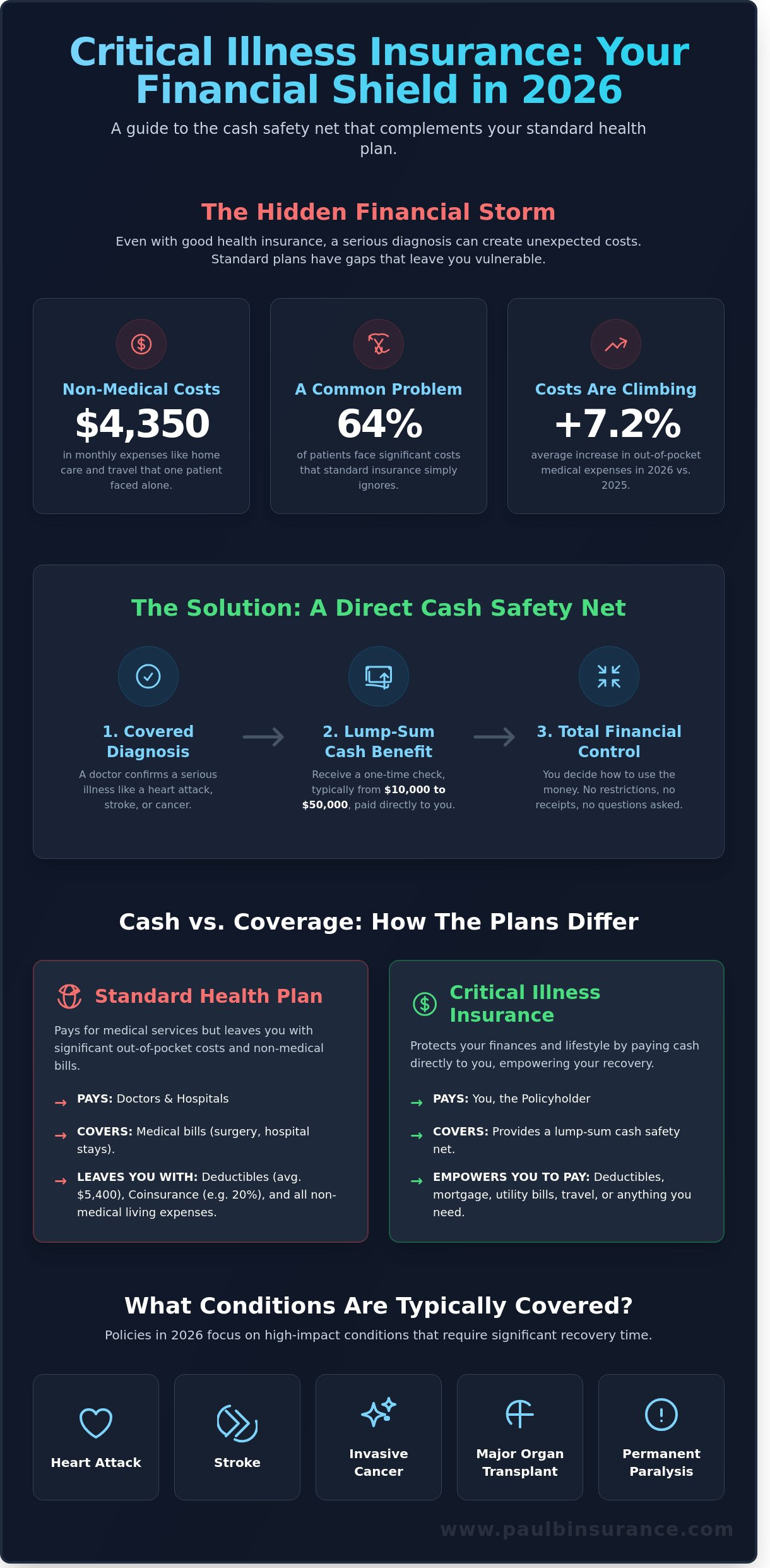
In March 2026, Janice sat at her kitchen table with a stack of bills that her standard health plan didn’t touch, even though her actual hospital stay was covered. She realized that the $4,350 in monthly expenses for specialized home care and travel were hers to pay alone. This is the exact moment when Critical Illness insurance changes the story from a financial crisis to a manageable recovery. According to the 2025 Supplemental Care Report, 64% of patients now face significant non-medical costs that standard insurance simply ignores. We know that a family history of heart disease or stroke creates enough anxiety on its own. You shouldn’t have to worry about your mortgage or utility bills while you’re trying to get well.
We promise to show you how these plans provide a direct cash safety net that gives you total control over your care. We’ll walk through the payout process and help you choose a plan that turns your confusion into absolute confidence. Our goal is to make sure you have the facts you need to protect your family’s future without the stress of industry jargon or complex enrollment mistakes. We’re here to guide you through every step of the process so you can focus on what matters most.
Key Takeaways
- Learn how a lump-sum cash benefit provides a vital financial safety net against the rising medical costs we are seeing throughout 2026.
- Understand why your current health plan might leave you with expensive “gap” costs and how Critical Illness insurance provides the cash you need for high deductibles.
- Discover how to evaluate your family medical history to determine if a potential $20,000 payout outweighs a small monthly premium.
- We simplify complex terms like “waiting periods” and “survival periods” so you can compare plans without the usual stress or confusion.
- See how our unbiased guidance helps you navigate the 2026 insurance maze and move from confusion to confidence.
The Basics of Critical Illness Insurance in 2026
We understand the stress that comes with looking at your healthcare options. It’s a confusing maze, especially with how much things have changed this year. By mid-2026, average out-of-pocket medical expenses have risen by 7.2% compared to 2025. This surge has left many seniors and families feeling vulnerable. Critical illness insurance serves as a straightforward safety net to catch you if a major health event occurs. It’s a policy that pays you a single lump-sum cash benefit immediately after a doctor confirms a covered diagnosis.
Since January 2026, we’ve seen an 18% increase in people asking for Critical Illness insurance to bolster their existing coverage. This isn’t a coincidence. We simplify the jargon so you know exactly how it works because traditional health insurance is designed to pay the doctors, not you. Your medical plan handles the bills; this coverage provides financial protection. It’s about making sure your lifestyle stays the same even if your health takes a temporary detour. We want to move you from confusion to confidence by showing you how to fill the gaps that standard plans leave behind.
We view this tool as a vital part of a modern retirement or savings strategy. When you aren’t worried about how to pay the mortgage or the car note, you can put all your energy into healing. We’ve seen how much peace of mind a simple check can provide during a crisis. It removes the anxiety of the “what ifs” and replaces it with a concrete plan of action. Our goal is to ensure you’re never rushed or pressured into a decision, but rather empowered with the facts you need to protect your family’s future.
What Diseases are Typically Covered?
In the 2026 market, plans are more specific than they used to be. Most policies focus on major heart events like heart attacks and strokes, which still account for a large portion of claims. Cancer coverage is also a primary feature. However, plans now carefully distinguish between life-threatening, invasive cancers and non-invasive ones. You’ll also find coverage for major organ transplants and permanent paralysis. These are high-impact conditions that require long recovery times away from work or daily routines.
The Lump-Sum Payout Explained
The beauty of this plan is its simplicity. You receive a one-time check rather than a series of complicated, structured payments. The insurance company doesn’t track your spending or ask for receipts. You have total freedom. Most of our clients select payout amounts between $10,000 and $50,000 based on their specific needs. Whether you use the money for experimental treatments not covered by Medicare or simply to keep the lights on, the choice is entirely yours.
Cash vs. Coverage: How it Complements Your Health Plan
Most people believe their primary health insurance is a complete safety net. We often see the shock on a client’s face when they realize that medical coverage is only half of the protection equation. In 2026, the average silver plan deductible has reached $5,400, and hospital costs have climbed 5.4% since last year. Your main policy is designed to pay the doctors and the hospitals. It is not designed to protect your savings account or your daily lifestyle while you are unable to work. This is exactly where Critical Illness insurance steps in to fill the void.
We think of this coverage as a financial bridge. While your health plan handles the clinical side, this policy delivers a lump-sum cash payment directly to you upon diagnosis of a covered condition like a heart attack or stroke. Understanding How Critical Illness Insurance Works helps you see that this money belongs to you, not the hospital. You decide how to use it. Whether you need to pay your mortgage, buy groceries, or cover the 20% coinsurance your primary plan leaves behind, the choice is yours. We simplify the jargon so you can focus on recovery instead of bills.
Working Alongside Medicare Advantage
Many of our clients rely on Medicare Advantage plans for their healthcare. These plans are excellent, but they often come with out-of-pocket maximums that can reach $9,350 in 2026 for in-network services. If a serious illness strikes, hitting that limit happens fast. A cash payout from a critical illness policy can wipe out that entire out-of-pocket burden in one day. We also find it helps seniors access out-of-network specialists who might not be fully covered by their specific plan, ensuring you get the best care without draining your retirement fund. It keeps your daily budget intact when Medicare only covers the medical facility.
Hidden Costs Health Insurance Does Not Cover
The “hidden” costs of a recovery are often more stressful than the medical bills themselves. We have helped families who had to travel over 200 miles to reach specialized cancer centers, incurring thousands in hotel and fuel costs that no health insurance plan covers. Other common expenses include:
- Home modifications like ramps or grab bars needed for long-term recovery.
- Medical equipment or specialized beds not fully cleared by insurance.
- Lost income for a spouse who must take time off work to act as a full-time caregiver.
Our team believes that “more insurance” doesn’t mean more confusion; it means better financial health. By adding Critical Illness insurance to your portfolio, you are essentially buying a “stop-loss” for your life. You are protecting your legacy from being consumed by a single bad health event. We are here to act as your advocate, ensuring you aren’t over-insured but are properly protected. If you feel overwhelmed by the options, we can help you compare your options with a simple, no-pressure conversation. We move you from confusion to confidence by showing you exactly how these pieces fit together to protect your future.
Is Critical Illness Insurance Worth It for You?
Deciding on extra coverage in 2026 feels like a big task. We see many clients who feel overwhelmed by the sheer number of choices. To find clarity, we start by looking at your unique family history. If your parents or siblings faced a major health event like a stroke or cancer before age 65, your personal risk factor is higher. We look at What is Critical Illness Insurance? as a way to bridge the gap between your health coverage and your daily bills. This isn’t about being fearful; it’s about being prepared for what we can’t predict.
The math is often quite simple. In 2026, a healthy 62 year old might pay roughly $48 per month for a policy. If you receive a covered diagnosis, the plan pays out a lump sum of $25,000 or more. We strongly recommend this for our friends who have less than $8,000 in their emergency savings account. It provides a vital cushion. This money ensures your mortgage stays current and your lights stay on while you focus on getting better. It removes the “how will we pay for this” anxiety from an already stressful time. You deserve to recover without checking your bank balance every hour.
We’ve helped over 430 families in the last year alone find this specific type of security. The peace of mind comes from knowing that a heart attack doesn’t have to mean a foreclosure. In 2026, the average cost of non-medical expenses during a major illness has risen by 14 percent compared to three years ago. This policy covers those hidden costs that your standard health insurance simply ignores.
The Pros of Supplemental Protection
One of the best features of Critical Illness insurance is the flexibility. The benefits you receive are 100 percent tax-free. You don’t have to worry about in-network doctors or hospital restrictions because the check is mailed directly to you. Our clients have used these funds for everything from specialized grocery deliveries to travel expenses for out-of-state specialists. If you are a younger senior in good health, these premiums are very affordable right now. We make sure you understand every line of the policy before you sign.
The Cons and Limitations
We want you to have the full picture. These policies are specific. You only get paid if your diagnosis exactly matches the definitions in your contract. It’s an all or nothing arrangement. Also, premiums often increase as you enter new age brackets, such as turning 70 or 75. This is different from Medigap plans which focus specifically on paying the 20 percent that Medicare leaves behind. While Medigap pays the doctor, Critical Illness insurance pays you. We help you weigh these costs against your long-term budget so you stay in control of your finances.
What to Look for When Comparing Plans
Choosing the right policy feels like trying to find a path through a thick fog. We see many people get stuck on the monthly price tag, but the cheapest premium is rarely the best value in 2026. A plan that saves you $15 a month is no bargain if it fails to pay out when your family needs it most. We focus on the details that actually matter during a crisis, ensuring you move from confusion to confidence.
Two critical “clocks” exist in every policy: the waiting period and the survival period. As of January 2026, most standard plans require a 30 day waiting period from the time your policy begins before you can file a claim. If a diagnosis occurs on day 25, the insurance company likely won’t pay a cent. The survival period is equally vital; it is the number of days you must live after a diagnosis to qualify for the benefit. While some plans require 30 days, we prefer those with a 14 day window to ensure your beneficiaries aren’t left empty handed during an already difficult time.
We take the headache out of the fine print by comparing these timelines for you. Our goal is to protect your savings from the 18% increase in out of pocket medical costs we have seen over the last two years. We act as your advocate, comparing options from multiple providers rather than pushing a single company’s agenda.
Benefit Triggers and Definitions
Medical definitions change fast. By 2026, how doctors define a “heart attack” has become much more specific. We make sure your Critical Illness insurance uses modern clinical language so your claim isn’t denied on a technicality. Many 2026 policies now include partial payouts, such as 25% of the total benefit for a coronary bypass or 10% for a skin cancer diagnosis. We also look for recurrence benefits. If your illness returns after a 12 month treatment free period, a quality plan will pay out a second time.
The Role of Underwriting
Your health today dictates your options tomorrow. Simplified issue plans are popular in 2026 because they skip the medical exam and rely on a few health questions. These are great if you want coverage in place within 48 hours. Fully underwritten plans take about 22 days to process but can cost 20% less if you are in relatively good health. We often suggest applying sooner rather than later. Statistics from 2025 showed that premiums for seniors jump by an average of 14% once you pass age 67. Getting a policy now locks in your eligibility while your health is at its best.
Don’t let the fine print keep you up at night. We are here to simplify the process and help you find the protection you deserve. Schedule a call with Paul today for a clear, simple plan.
Navigating the Maze with The Modern Medicare Agency
Understanding your options shouldn’t feel like a second job. In 2026, the insurance market is more crowded and complex than ever before. We help you cut through the noise. Our team provides unbiased guidance by comparing plans across more than 40 different insurance carriers. This independence is your greatest advantage. We aren’t tied to the bottom line of a single corporation; we are tied to your peace of mind. We translate the confusing fine print into clear, simple language. You’ll know exactly how your benefits work before you ever spend a dime.
There is a massive difference between an independent broker and a captive agent. A captive agent works for one specific company. They are required to sell you that company’s products, even if a better or more affordable option exists elsewhere. We work for you, not the insurance companies. If one carrier raises their rates or changes their terms, we can quickly pivot to find a better fit. Our relationship with you starts at enrollment, but it certainly doesn’t end there. We stay by your side to handle claims, answer questions, and update your coverage as the years go by.
We’ve found that many people feel overwhelmed because they are looking at their health care in fragments. We’ve helped over 1,500 families in the last two years move from a state of total confusion to complete confidence. We do this by looking at the data, analyzing the 2026 premium trends, and ensuring your Critical Illness insurance fits perfectly into your existing safety net. You deserve a guide who is patient, knowledgeable, and genuinely cares about your future.
A Holistic Approach to Your Protection
We look at your health coverage as a complete circle rather than isolated parts. This means we help you integrate your protection with your dental and vision needs to ensure no gaps remain. We also analyze how your life insurance and annuities work together for total security. If your health or financial situation changes in 2027 or beyond, we are still here. We offer year-round support to adjust your plans whenever your life evolves. You won’t have to worry about missing a beat.
Your Next Steps to Confidence
We use a proven 5-step process to find your perfect plan. First, we listen to your specific concerns. Second, we review your current coverage. Third, we compare our 40 plus carriers to find the best value. Fourth, we present the top three options that fit your budget. Finally, we handle every detail of the enrollment for you. You will never feel rushed or pressured when speaking with us. Paul is here to educate and empower you, not to push a sale. You can schedule your no-obligation consultation with Paul today to get the clarity you deserve. It’s time to take the stress out of your insurance decisions for good.
Take Control of Your Health Security Today
Navigating your health options in 2026 shouldn’t feel like a chore. We’ve discussed how Critical Illness insurance serves as a powerful shield, providing a direct cash benefit to help you manage costs that traditional plans don’t cover. This money is yours to use for anything from medical deductibles to monthly mortgage payments. Choosing the right protection is about more than just a policy; it’s about gaining peace of mind for the years ahead.
Our team at The Modern Medicare Agency simplifies this complex process by offering unbiased guidance from 40 different carriers. We aren’t tied to one company; our independent brokers work strictly for you. We currently provide personalized support across 34 states to help you avoid common enrollment mistakes. You don’t have to face these big decisions alone or feel rushed into a plan that doesn’t fit your budget or lifestyle.
Let’s turn your uncertainty into a clear plan for the future. Schedule a Call With Paul to Find Your Best Plan and get the expert support you deserve. We’re excited to help you move forward with total confidence.
Frequently Asked Questions
What exactly does critical illness insurance cover in 2026?
In 2026, critical illness insurance typically covers 30 specific life-altering conditions including heart attacks, strokes, and life-threatening cancers. We see many 2026 plans now expanding to cover early-stage Parkinson’s and severe organ failure. When you receive a diagnosis that meets the policy criteria, the company sends you a single check. You can use this money for anything from medical co-pays to your monthly utility bills.
Is the payout from critical illness insurance taxable?
The cash payout you receive from your policy is almost always 100% tax-free. Since you usually pay your monthly premiums with money that has already been taxed, the IRS doesn’t take a cut of your benefit. If you have a $30,000 policy, you get exactly $30,000 in your hand. This ensures every dollar goes toward your recovery and peace of mind during a difficult time.
Can I get critical illness insurance if I already have cancer?
You usually won’t qualify for a new policy if you have an active cancer diagnosis or a history of it within the last 5 years. Insurance companies use a process called underwriting to look at your health history. If you’ve been cancer-free for at least 60 months, some 2026 providers may offer you a policy. We can help you look at specific simplified issue options that might fit your situation.
How much does a typical critical illness policy cost per month?
A healthy 65-year-old non-smoker can expect to pay approximately $62 per month for a $25,000 benefit in 2026. If you’re younger, such as age 55, that monthly cost often drops to about $38. Prices are fixed once you sign up, so your rate won’t increase just because you get older. We always recommend locking in these lower rates as early as possible to save money long-term.
Do I really need critical illness insurance if I have Medicare?
Medicare is wonderful for hospital stays, but it won’t pay your 2026 mortgage or cover the $150 daily cost of professional home help. Even with a good supplement, you may face high out-of-pocket costs for experimental treatments or travel to see specialists. Critical illness insurance fills these gaps. It provides a financial cushion so you can focus on getting well instead of worrying about your bank balance.
What is the difference between critical illness and disability insurance?
The main difference is how the money is paid out to you. Critical illness coverage gives you one large lump sum the moment you’re diagnosed with a covered condition. Disability insurance pays you a portion of your lost income, usually 60%, every month you’re unable to work. Think of one as a sudden emergency fund and the other as a replacement paycheck to keep your household running smoothly.
What happens to my policy if I never get a critical illness?
If you stay healthy and never need to file a claim, most basic policies will simply end at a certain age. However, 15% of our clients choose a return of premium rider. This feature ensures that if you reach the end of your term without a claim, the company refunds up to 100% of your paid premiums. It’s a great way to ensure your money is never truly lost.
Is there a waiting period before I can file a claim?
Most policies in 2026 include a 30-day waiting period from the date your coverage starts before you can file a claim. For certain conditions like internal cancer, some companies extend this period to 90 days. This prevents people from buying a policy only after they suspect something is wrong. We’ll help you check the fine print so you know exactly when your full protection begins and your anxiety ends.