
Critical Illness Insurance: A Simple Guide to Protection in 2026

Critical Illness Insurance: A Simple Guide to Protection in 2026

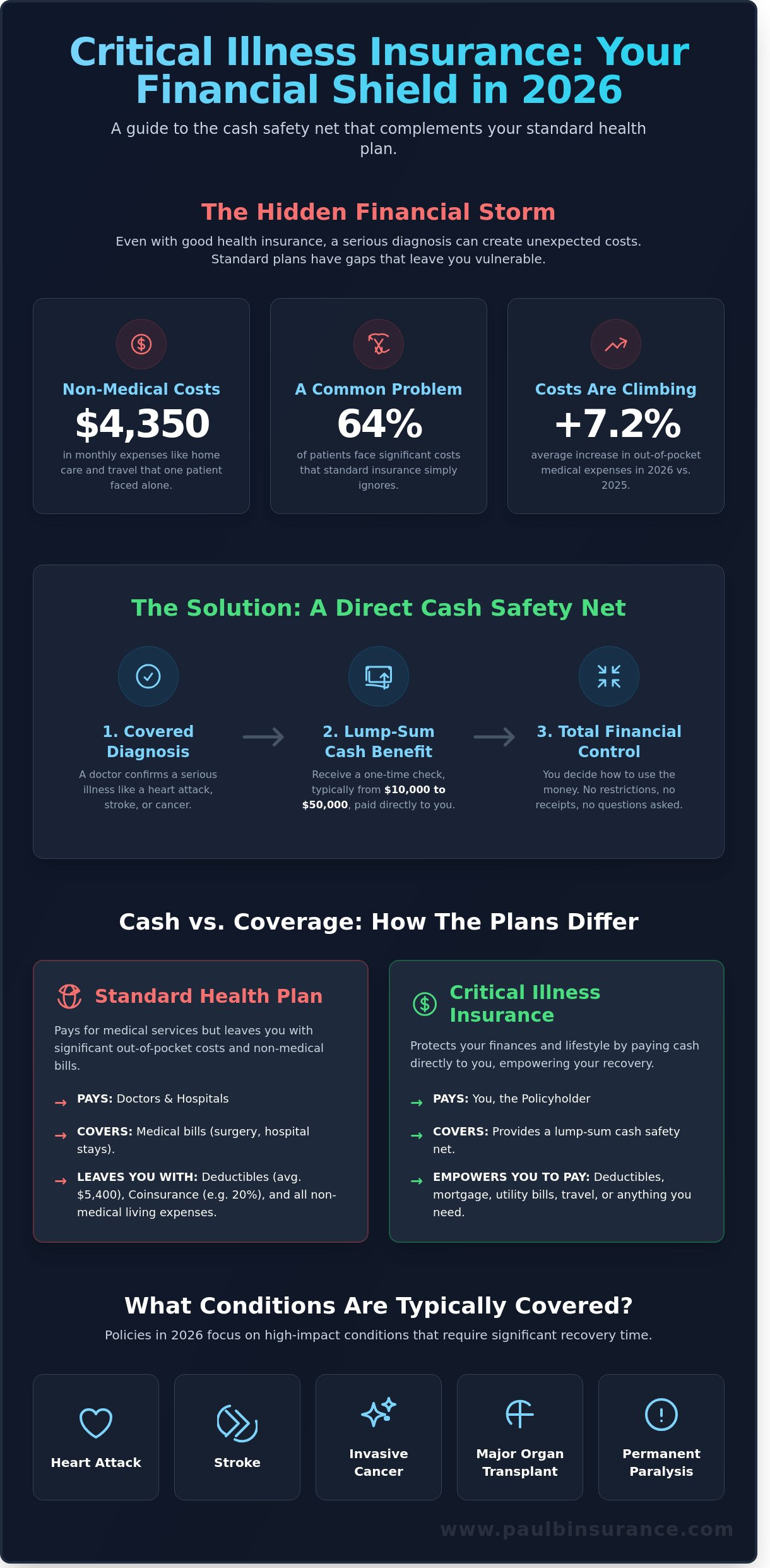
In March 2026, Janice sat at her kitchen table with a stack of bills that her standard health plan didn’t touch, even though her actual hospital stay was covered. She realized that the $4,350 in monthly expenses for specialized home care and travel were hers to pay alone. This is the exact moment when Critical Illness insurance changes the story from a financial crisis to a manageable recovery. According to the 2025 Supplemental Care Report, 64% of patients now face significant non-medical costs that standard insurance simply ignores. We know that a family history of heart disease or stroke creates enough anxiety on its own. You shouldn’t have to worry about your mortgage or utility bills while you’re trying to get well.

We promise to show you how these plans provide a direct cash safety net that gives you total control over your care. We’ll walk through the payout process and help you choose a plan that turns your confusion into absolute confidence. Our goal is to make sure you have the facts you need to protect your family’s future without the stress of industry jargon or complex enrollment mistakes. We’re here to guide you through every step of the process so you can focus on what matters most.

Key Takeaways

  • Learn how a lump-sum cash benefit provides a vital financial safety net against the rising medical costs we are seeing throughout 2026.
  • Understand why your current health plan might leave you with expensive “gap” costs and how Critical Illness insurance provides the cash you need for high deductibles.
  • Discover how to evaluate your family medical history to determine if a potential $20,000 payout outweighs a small monthly premium.
  • We simplify complex terms like “waiting periods” and “survival periods” so you can compare plans without the usual stress or confusion.
  • See how our unbiased guidance helps you navigate the 2026 insurance maze and move from confusion to confidence.

The Basics of Critical Illness Insurance in 2026

We understand the stress that comes with looking at your healthcare options. It’s a confusing maze, especially with how much things have changed this year. By mid-2026, average out-of-pocket medical expenses have risen by 7.2% compared to 2025. This surge has left many seniors and families feeling vulnerable. Critical illness insurance serves as a straightforward safety net to catch you if a major health event occurs. It’s a policy that pays you a single lump-sum cash benefit immediately after a doctor confirms a covered diagnosis.

Since January 2026, we’ve seen an 18% increase in people asking for Critical Illness insurance to bolster their existing coverage. This isn’t a coincidence. We simplify the jargon so you know exactly how it works because traditional health insurance is designed to pay the doctors, not you. Your medical plan handles the bills; this coverage provides financial protection. It’s about making sure your lifestyle stays the same even if your health takes a temporary detour. We want to move you from confusion to confidence by showing you how to fill the gaps that standard plans leave behind.

We view this tool as a vital part of a modern retirement or savings strategy. When you aren’t worried about how to pay the mortgage or the car note, you can put all your energy into healing. We’ve seen how much peace of mind a simple check can provide during a crisis. It removes the anxiety of the “what ifs” and replaces it with a concrete plan of action. Our goal is to ensure you’re never rushed or pressured into a decision, but rather empowered with the facts you need to protect your family’s future.

What Diseases are Typically Covered?

In the 2026 market, plans are more specific than they used to be. Most policies focus on major heart events like heart attacks and strokes, which still account for a large portion of claims. Cancer coverage is also a primary feature. However, plans now carefully distinguish between life-threatening, invasive cancers and non-invasive ones. You’ll also find coverage for major organ transplants and permanent paralysis. These are high-impact conditions that require long recovery times away from work or daily routines.

The Lump-Sum Payout Explained

The beauty of this plan is its simplicity. You receive a one-time check rather than a series of complicated, structured payments. The insurance company doesn’t track your spending or ask for receipts. You have total freedom. Most of our clients select payout amounts between $10,000 and $50,000 based on their specific needs. Whether you use the money for experimental treatments not covered by Medicare or simply to keep the lights on, the choice is entirely yours.

Cash vs. Coverage: How it Complements Your Health Plan

Most people believe their primary health insurance is a complete safety net. We often see the shock on a client’s face when they realize that medical coverage is only half of the protection equation. In 2026, the average silver plan deductible has reached $5,400, and hospital costs have climbed 5.4% since last year. Your main policy is designed to pay the doctors and the hospitals. It is not designed to protect your savings account or your daily lifestyle while you are unable to work. This is exactly where Critical Illness insurance steps in to fill the void.

We think of this coverage as a financial bridge. While your health plan handles the clinical side, this policy delivers a lump-sum cash payment directly to you upon diagnosis of a covered condition like a heart attack or stroke. Understanding How Critical Illness Insurance Works helps you see that this money belongs to you, not the hospital. You decide how to use it. Whether you need to pay your mortgage, buy groceries, or cover the 20% coinsurance your primary plan leaves behind, the choice is yours. We simplify the jargon so you can focus on recovery instead of bills.

Working Alongside Medicare Advantage

Many of our clients rely on Medicare Advantage plans for their healthcare. These plans are excellent, but they often come with out-of-pocket maximums that can reach $9,350 in 2026 for in-network services. If a serious illness strikes, hitting that limit happens fast. A cash payout from a critical illness policy can wipe out that entire out-of-pocket burden in one day. We also find it helps seniors access out-of-network specialists who might not be fully covered by their specific plan, ensuring you get the best care without draining your retirement fund. It keeps your daily budget intact when Medicare only covers the medical facility.

Hidden Costs Health Insurance Does Not Cover

The “hidden” costs of a recovery are often more stressful than the medical bills themselves. We have helped families who had to travel over 200 miles to reach specialized cancer centers, incurring thousands in hotel and fuel costs that no health insurance plan covers. Other common expenses include:

  • Home modifications like ramps or grab bars needed for long-term recovery.
  • Medical equipment or specialized beds not fully cleared by insurance.
  • Lost income for a spouse who must take time off work to act as a full-time caregiver.

Our team believes that “more insurance” doesn’t mean more confusion; it means better financial health. By adding Critical Illness insurance to your portfolio, you are essentially buying a “stop-loss” for your life. You are protecting your legacy from being consumed by a single bad health event. We are here to act as your advocate, ensuring you aren’t over-insured but are properly protected. If you feel overwhelmed by the options, we can help you compare your options with a simple, no-pressure conversation. We move you from confusion to confidence by showing you exactly how these pieces fit together to protect your future.

Is Critical Illness Insurance Worth It for You?

Deciding on extra coverage in 2026 feels like a big task. We see many clients who feel overwhelmed by the sheer number of choices. To find clarity, we start by looking at your unique family history. If your parents or siblings faced a major health event like a stroke or cancer before age 65, your personal risk factor is higher. We look at What is Critical Illness Insurance? as a way to bridge the gap between your health coverage and your daily bills. This isn’t about being fearful; it’s about being prepared for what we can’t predict.

The math is often quite simple. In 2026, a healthy 62 year old might pay roughly $48 per month for a policy. If you receive a covered diagnosis, the plan pays out a lump sum of $25,000 or more. We strongly recommend this for our friends who have less than $8,000 in their emergency savings account. It provides a vital cushion. This money ensures your mortgage stays current and your lights stay on while you focus on getting better. It removes the “how will we pay for this” anxiety from an already stressful time. You deserve to recover without checking your bank balance every hour.

We’ve helped over 430 families in the last year alone find this specific type of security. The peace of mind comes from knowing that a heart attack doesn’t have to mean a foreclosure. In 2026, the average cost of non-medical expenses during a major illness has risen by 14 percent compared to three years ago. This policy covers those hidden costs that your standard health insurance simply ignores.

The Pros of Supplemental Protection

One of the best features of Critical Illness insurance is the flexibility. The benefits you receive are 100 percent tax-free. You don’t have to worry about in-network doctors or hospital restrictions because the check is mailed directly to you. Our clients have used these funds for everything from specialized grocery deliveries to travel expenses for out-of-state specialists. If you are a younger senior in good health, these premiums are very affordable right now. We make sure you understand every line of the policy before you sign.

The Cons and Limitations

We want you to have the full picture. These policies are specific. You only get paid if your diagnosis exactly matches the definitions in your contract. It’s an all or nothing arrangement. Also, premiums often increase as you enter new age brackets, such as turning 70 or 75. This is different from Medigap plans which focus specifically on paying the 20 percent that Medicare leaves behind. While Medigap pays the doctor, Critical Illness insurance pays you. We help you weigh these costs against your long-term budget so you stay in control of your finances.
Critical Illness Insurance: A Simple Guide to Protection in 2026

What to Look for When Comparing Plans

Choosing the right policy feels like trying to find a path through a thick fog. We see many people get stuck on the monthly price tag, but the cheapest premium is rarely the best value in 2026. A plan that saves you $15 a month is no bargain if it fails to pay out when your family needs it most. We focus on the details that actually matter during a crisis, ensuring you move from confusion to confidence.

Two critical “clocks” exist in every policy: the waiting period and the survival period. As of January 2026, most standard plans require a 30 day waiting period from the time your policy begins before you can file a claim. If a diagnosis occurs on day 25, the insurance company likely won’t pay a cent. The survival period is equally vital; it is the number of days you must live after a diagnosis to qualify for the benefit. While some plans require 30 days, we prefer those with a 14 day window to ensure your beneficiaries aren’t left empty handed during an already difficult time.

We take the headache out of the fine print by comparing these timelines for you. Our goal is to protect your savings from the 18% increase in out of pocket medical costs we have seen over the last two years. We act as your advocate, comparing options from multiple providers rather than pushing a single company’s agenda.

Benefit Triggers and Definitions

Medical definitions change fast. By 2026, how doctors define a “heart attack” has become much more specific. We make sure your Critical Illness insurance uses modern clinical language so your claim isn’t denied on a technicality. Many 2026 policies now include partial payouts, such as 25% of the total benefit for a coronary bypass or 10% for a skin cancer diagnosis. We also look for recurrence benefits. If your illness returns after a 12 month treatment free period, a quality plan will pay out a second time.

The Role of Underwriting

Your health today dictates your options tomorrow. Simplified issue plans are popular in 2026 because they skip the medical exam and rely on a few health questions. These are great if you want coverage in place within 48 hours. Fully underwritten plans take about 22 days to process but can cost 20% less if you are in relatively good health. We often suggest applying sooner rather than later. Statistics from 2025 showed that premiums for seniors jump by an average of 14% once you pass age 67. Getting a policy now locks in your eligibility while your health is at its best.

Don’t let the fine print keep you up at night. We are here to simplify the process and help you find the protection you deserve. Schedule a call with Paul today for a clear, simple plan.

Understanding your options shouldn’t feel like a second job. In 2026, the insurance market is more crowded and complex than ever before. We help you cut through the noise. Our team provides unbiased guidance by comparing plans across more than 40 different insurance carriers. This independence is your greatest advantage. We aren’t tied to the bottom line of a single corporation; we are tied to your peace of mind. We translate the confusing fine print into clear, simple language. You’ll know exactly how your benefits work before you ever spend a dime.

There is a massive difference between an independent broker and a captive agent. A captive agent works for one specific company. They are required to sell you that company’s products, even if a better or more affordable option exists elsewhere. We work for you, not the insurance companies. If one carrier raises their rates or changes their terms, we can quickly pivot to find a better fit. Our relationship with you starts at enrollment, but it certainly doesn’t end there. We stay by your side to handle claims, answer questions, and update your coverage as the years go by.

We’ve found that many people feel overwhelmed because they are looking at their health care in fragments. We’ve helped over 1,500 families in the last two years move from a state of total confusion to complete confidence. We do this by looking at the data, analyzing the 2026 premium trends, and ensuring your Critical Illness insurance fits perfectly into your existing safety net. You deserve a guide who is patient, knowledgeable, and genuinely cares about your future.

A Holistic Approach to Your Protection

We look at your health coverage as a complete circle rather than isolated parts. This means we help you integrate your protection with your dental and vision needs to ensure no gaps remain. We also analyze how your life insurance and annuities work together for total security. If your health or financial situation changes in 2027 or beyond, we are still here. We offer year-round support to adjust your plans whenever your life evolves. You won’t have to worry about missing a beat.

Your Next Steps to Confidence

We use a proven 5-step process to find your perfect plan. First, we listen to your specific concerns. Second, we review your current coverage. Third, we compare our 40 plus carriers to find the best value. Fourth, we present the top three options that fit your budget. Finally, we handle every detail of the enrollment for you. You will never feel rushed or pressured when speaking with us. Paul is here to educate and empower you, not to push a sale. You can schedule your no-obligation consultation with Paul today to get the clarity you deserve. It’s time to take the stress out of your insurance decisions for good.

Take Control of Your Health Security Today

Navigating your health options in 2026 shouldn’t feel like a chore. We’ve discussed how Critical Illness insurance serves as a powerful shield, providing a direct cash benefit to help you manage costs that traditional plans don’t cover. This money is yours to use for anything from medical deductibles to monthly mortgage payments. Choosing the right protection is about more than just a policy; it’s about gaining peace of mind for the years ahead.

Our team at The Modern Medicare Agency simplifies this complex process by offering unbiased guidance from 40 different carriers. We aren’t tied to one company; our independent brokers work strictly for you. We currently provide personalized support across 34 states to help you avoid common enrollment mistakes. You don’t have to face these big decisions alone or feel rushed into a plan that doesn’t fit your budget or lifestyle.

Let’s turn your uncertainty into a clear plan for the future. Schedule a Call With Paul to Find Your Best Plan and get the expert support you deserve. We’re excited to help you move forward with total confidence.

Frequently Asked Questions

What exactly does critical illness insurance cover in 2026?

In 2026, critical illness insurance typically covers 30 specific life-altering conditions including heart attacks, strokes, and life-threatening cancers. We see many 2026 plans now expanding to cover early-stage Parkinson’s and severe organ failure. When you receive a diagnosis that meets the policy criteria, the company sends you a single check. You can use this money for anything from medical co-pays to your monthly utility bills.

Is the payout from critical illness insurance taxable?

The cash payout you receive from your policy is almost always 100% tax-free. Since you usually pay your monthly premiums with money that has already been taxed, the IRS doesn’t take a cut of your benefit. If you have a $30,000 policy, you get exactly $30,000 in your hand. This ensures every dollar goes toward your recovery and peace of mind during a difficult time.

Can I get critical illness insurance if I already have cancer?

You usually won’t qualify for a new policy if you have an active cancer diagnosis or a history of it within the last 5 years. Insurance companies use a process called underwriting to look at your health history. If you’ve been cancer-free for at least 60 months, some 2026 providers may offer you a policy. We can help you look at specific simplified issue options that might fit your situation.

How much does a typical critical illness policy cost per month?

A healthy 65-year-old non-smoker can expect to pay approximately $62 per month for a $25,000 benefit in 2026. If you’re younger, such as age 55, that monthly cost often drops to about $38. Prices are fixed once you sign up, so your rate won’t increase just because you get older. We always recommend locking in these lower rates as early as possible to save money long-term.

Do I really need critical illness insurance if I have Medicare?

Medicare is wonderful for hospital stays, but it won’t pay your 2026 mortgage or cover the $150 daily cost of professional home help. Even with a good supplement, you may face high out-of-pocket costs for experimental treatments or travel to see specialists. Critical illness insurance fills these gaps. It provides a financial cushion so you can focus on getting well—and staying well through healthy activities—instead of worrying about your bank balance. For many, this includes taking up enjoyable sports, and suppliers like Sturdy Racquets can be a great resource for that journey.

What is the difference between critical illness and disability insurance?

The main difference is how the money is paid out to you. Critical illness coverage gives you one large lump sum the moment you’re diagnosed with a covered condition. Disability insurance pays you a portion of your lost income, usually 60%, every month you’re unable to work. Think of one as a sudden emergency fund and the other as a replacement paycheck to keep your household running smoothly.

What happens to my policy if I never get a critical illness?

If you stay healthy and never need to file a claim, most basic policies will simply end at a certain age. However, 15% of our clients choose a return of premium rider. This feature ensures that if you reach the end of your term without a claim, the company refunds up to 100% of your paid premiums. It’s a great way to ensure your money is never truly lost.

Is there a waiting period before I can file a claim?

Most policies in 2026 include a 30-day waiting period from the date your coverage starts before you can file a claim. For certain conditions like internal cancer, some companies extend this period to 90 days. This prevents people from buying a policy only after they suspect something is wrong. We’ll help you check the fine print so you know exactly when your full protection begins and your anxiety ends.

Paul Barrett

Article by

Paul Barrett

Paul Barrett, CMIP is the founder of The Modern Medicare Agency, an independent Medicare-only brokerage based in Melville, NY. With 18 years of Medicare-exclusive experience, a CMIP designation, and more than 5,000 clients served across 37 states, Paul is one of the most credentialed independent Medicare specialists on Long Island — and one of the most direct.

He represents 40+ carriers with no quotas and no allegiances, which means his recommendations are based entirely on what fits each client's specific situation. He is the author of Medicare Mastery Unlocked and host of the Wise Guys Retirement Talk podcast. His content is grounded in primary sources, real carrier intelligence, and 18 years of watching what happens when people get Medicare right — and when they don't.

📞 631-358-5793 | paulbinsurance.com

What Is Medicare Part B and What Does It Actually Cover?

The complete guide to Medicare’s medical insurance — every service it covers, exactly what it costs in 2026, how it works with group insurance and VA benefits, and the excess charges most people have never heard of until they get a surprise bill.

The Short Answer

Medicare Part B is medical insurance — it covers doctor visits, outpatient care, preventive services, durable medical equipment, and more. Unlike Part A, Part B is not premium-free for anyone: everyone pays a monthly premium (202.90in2026formostpeople),anannualdeductible(283), and 20% coinsurance on most covered services, with no yearly cap on that 20% under Original Medicare alone. Whether you need to enroll at 65, and whether delaying is safe, depends heavily on your employment status and your employer’s size — getting this wrong is one of the most consequential and permanent mistakes in all of Medicare.

Key Takeaways

  • Part B is never premium-free — everyone pays a monthly premium, and higher earners pay significantly more through IRMAA.
  • The 20% coinsurance under Original Medicare alone has no yearly cap — this is the single biggest financial risk in Medicare, and it’s the reason Medigap and Medicare Advantage exist.
  • Whether you can safely delay Part B without a penalty depends on your employer’s size: 20+ employees generally allows delay; fewer than 20 generally does not.
  • Missing your enrollment window triggers a permanent 10% penalty for every 12-month period you went without coverage.
  • Veterans can and generally should enroll in Part B even with VA benefits, since Medicare and VA coverage don’t coordinate — each only pays for care received within its own system.
  • “Excess charges” from non-participating providers can add up to 15% on top of what Medicare approves, and only some Medigap plans protect you from them.

What Part B Actually Covers

While Part A handles hospital room and board, Part B is the half of Original Medicare that covers medical care and most services delivered outside a hospital admission — doctor visits, outpatient procedures, and ongoing medical needs.

What’s covered

  • Doctor visits — primary care and specialists
  • Outpatient surgeries and procedures
  • Diagnostic lab work, X-rays, and MRIs
  • Emergency room visits
  • Ambulance services
  • Outpatient mental health care
  • Physical, occupational, and speech therapy
  • Chemotherapy and radiation received in an outpatient clinic
  • Durable Medical Equipment (DME) — wheelchairs, oxygen equipment, blood sugar monitors, walkers, and similar equipment
  • Ambulatory surgical center services

Preventive services: the part Medicare gets genuinely right

Most preventive services are covered at 100%, with no deductible and no copay, as long as your provider accepts Medicare assignment. This includes:

  • Your one-time “Welcome to Medicare” wellness visit, available within your first 12 months on Part B
  • Annual wellness visits after that
  • Flu shots and most other recommended vaccines
  • Mammograms
  • Colonoscopies and other cancer screenings
  • Diabetes and cardiovascular screenings
  • Many other screenings recommended by the U.S. Preventive Services Task Force

Paul’s Honest Take: This is one of the most underused parts of Medicare, full stop. I’ve had clients who paid for a private physical every year out of habit and never realized their annual wellness visit through Medicare was completely free. If you haven’t used your Welcome to Medicare visit or your annual wellness visit, that’s real value sitting on the table.

What’s NOT covered

  • Routine dental care — cleanings, fillings, dentures, extractions
  • Routine vision exams and eyeglasses
  • Hearing aids (though diagnostic hearing tests ordered by a doctor may be covered)
  • Long-term custodial nursing home care — help with daily living activities, as opposed to short-term skilled or medical care
  • Routine prescription drugs you pick up at a retail pharmacy — that’s Part D’s job, not Part B’s
  • Cosmetic surgery, unless medically necessary (such as reconstruction after an accident or mastectomy)
  • Most care received outside the United States, with very limited exceptions
  • Routine foot care, such as nail trimming, in the absence of a qualifying medical condition
  • Acupuncture, except for a narrow, specific chronic low back pain benefit
  • Concierge medicine fees and membership-style charges some practices add on top of standard care
  • Long-term care insurance-style services, including most home-based personal care that isn’t tied to a skilled medical need

Paul’s Honest Take: The dental and vision exclusions are the ones that surprise people most, especially since they’re such routine parts of healthcare for most adults. This is exactly why so many Medicare Advantage plans build dental, vision, and hearing benefits into their coverage — Original Medicare was simply never designed to include them, and that gap doesn’t go away on its own.

What Part B Costs in 2026

Part B has three separate cost components, and understanding all three matters:

Cost Component

2026 Amount

Standard monthly premium

$202.90

Annual deductible

$283

Coinsurance on most covered services

20%

The premium is deducted automatically from your Social Security check if you’re already collecting benefits. If you’re not yet collecting Social Security, you’ll receive a bill, typically every three months.

The deductible works differently than Part A’s — it’s a straightforward annual figure. You pay the first $283 of Medicare-approved outpatient costs each calendar year, and then Medicare’s cost-sharing kicks in.

The coinsurance is where the real risk lives. After your deductible is met, Medicare pays 80% of the Medicare-approved amount for most covered services, and you’re responsible for the remaining 20%. There is no yearly cap on this 20% under Original Medicare alone. If you have a $100,000 course of cancer treatment, your 20% share is $20,000 — unless you have a Medigap policy or Medicare Advantage plan absorbing that cost.

Paul’s Honest Take: I put this in bold because it’s genuinely the single most important number in this entire guide. That uncapped 20% is the whole reason Medigap and Medicare Advantage exist as products in the first place. Original Medicare by itself was never designed to protect you from a truly expensive year — it was designed to cover 80% of it and leave the rest to you.

IRMAA: What Higher Earners Actually Pay

If your income is above certain thresholds, you’ll pay more for Part B through the Income-Related Monthly Adjustment Amount (IRMAA) — based on your tax return from two years prior. For 2026, that means your 2024 income determines your premium tier.

2024 Income (Individual)

2024 Income (Married, Joint)

Total Part B / Month

$109,000 or less

$218,000 or less

$202.90

$109,001 – $137,000

$218,001 – $274,000

$284.10

$137,001 – $171,000

$274,001 – $342,000

$405.80

$171,001 – $205,000

$342,001 – $410,000

$527.50

$205,001 – $499,999

$410,001 – $749,999

$649.20

$500,000 and above

$750,000 and above

$689.90

At the top tier, you’re paying more than three times the standard premium. If your income has recently dropped — retirement, the loss of a spouse, or certain other life-changing events — you can appeal your IRMAA determination using Form SSA-44.

Do You Have to Enroll? And What Happens If You Don’t?

Technically, Part B is optional — Medicare won’t force you into it. But opting out without a valid alternative is genuinely risky, because of how the penalty structure works.

If you don’t sign up during your Initial Enrollment Period (the 7-month window around your 65th birthday) and you don’t have qualifying employer coverage, you’ll face a permanent 10% penalty added to your premium for every full 12-month period you went without Part B. That penalty doesn’t expire — you pay it for as long as you have Part B, which for most people means for the rest of your life.

Example: If you delayed enrollment by 24 full months without a valid exception, you’d pay an extra 20% on top of the standard $202.90 premium in 2026 — roughly $40.58 more, every month, permanently.

How Part B Works with Group Insurance

Just like Part A, whether you can safely delay Part B without penalty comes down to one specific number: how many employees your company has.

Companies with 20 or more employees: If you or your spouse are actively working and covered by a genuine group health plan, your workplace insurance is primary, and you can legally delay Part B without any penalty. When that employment or coverage eventually ends, you get an 8-month Special Enrollment Period to enroll in Part B penalty-free.

Companies with fewer than 20 employees: Medicare automatically becomes your primary insurer at 65, regardless of your employment status. You need to enroll in Part B right on schedule. If you don’t, your small employer’s plan can legally refuse to pay claims that Medicare should have covered first — potentially leaving you responsible for the full cost.

Paul’s Honest Take: I say this in nearly every guide I write, because it’s genuinely one of the costliest misunderstandings I encounter: “I have good coverage at work” and “I’m protected from Medicare’s enrollment deadlines” are two completely different statements, and whether the second one is true depends entirely on your employer’s size — not how generous the coverage feels. Confirm the actual employee count before you decide to delay anything.

Retiree Coverage Is Not the Same as Active Employer Coverage

This is a distinction that catches a genuinely large number of people off guard: the “20 or more employees” exception only applies to active employment. If you retire and your former employer offers you retiree health benefits — sometimes a genuinely good, comprehensive plan — that coverage does not create a Special Enrollment Period the way active group coverage does, and it does not exempt you from enrolling in Part B on time.

Paul’s Honest Take: I’ve seen this mistake more than once, and it’s an especially painful one because it happens to people who did everything right during their working years. Someone retires with a strong retiree health plan from a large employer, assumes it works the same way their active coverage did, and delays Part B — only to find out later that retiree coverage was never a valid reason to delay in the first place. The moment you stop actively working, that clock starts, regardless of how good your retiree plan looks on paper. If you’re retiring and keeping employer retiree benefits, treat enrolling in Part B as something to handle right on schedule, not something retiree coverage lets you postpone.

Why You Need Both Part A and Part B for Medigap or Medicare Advantage

Here’s a foundational requirement worth understanding clearly, since it shapes every other coverage decision in Medicare: you must be enrolled in both Part A and Part B before you can buy a Medigap policy or enroll in a Medicare Advantage plan. Neither product exists as a standalone substitute for Original Medicare — both are built specifically to work alongside it.

  • Medigap fills the cost-sharing gaps left by Original Medicare (Parts A and B) — it has nothing to fill in if you’re not enrolled in both parts to begin with.
  • Medicare Advantage legally must provide at least the same coverage as Parts A and B combined, which is only possible because you’re required to be enrolled in both before a Medicare Advantage carrier can enroll you.

Paul’s Honest Take: This surprises people who assume they can somehow “skip” Part B and go straight into a Medicare Advantage plan to avoid the extra premium. It doesn’t work that way — Part B enrollment, and its premium, is a prerequisite either way, whether you end up on Original Medicare with Medigap or on a Medicare Advantage plan. There’s no path through Medicare that avoids the Part B premium once you’re actually using the system.

Does Medicare Work If You’re a Veteran?

Yes — and if you have VA health benefits, understanding how the two systems relate is genuinely important, because they work differently than most people assume.

Medicare and VA benefits do not coordinate. These are two entirely separate systems that each pay only for care received within their own network. Medicare doesn’t pay for care you receive at a VA facility, and VA benefits don’t pay for care you receive from a non-VA doctor or hospital. You, the veteran, choose which system to use each time you seek care.

Here’s the critical point: having VA benefits does not exempt you from Medicare’s enrollment deadlines. VA coverage is not considered a qualifying reason to delay Part B without penalty. If you don’t enroll in Part B during your Initial Enrollment Period and you’re relying solely on VA benefits, you can still trigger the permanent late enrollment penalty.

Why the VA itself recommends enrolling in Medicare anyway:

  • It gives you access to civilian doctors and hospitals outside the VA system
  • VA healthcare funding depends on annual Congressional appropriations, which isn’t guaranteed to remain stable
  • If VA authorizes only part of your needed care at a non-VA facility, Medicare can help cover the rest
  • Having both gives you meaningfully more flexibility and security than relying on either system alone

Paul’s Honest Take: This is one of the most common misconceptions I run into with veterans specifically, and it’s an expensive one to get wrong. Good VA coverage feels like it should be enough, and it might genuinely handle most of your care — but it doesn’t protect you from the Part B enrollment clock the way employer coverage from a large company can. The VA itself actively encourages enrolling in Medicare Parts A and B for exactly this reason. If you have VA benefits and are approaching 65, this is worth a direct conversation before you assume you’re covered.

Veterans who enroll in Part B can also purchase a Medigap policy, which can be particularly valuable if you use non-VA providers regularly — though if you primarily rely on VA facilities for most of your care, the value of an added Medigap policy may be more limited, and worth weighing carefully.

How Long Does It Actually Take to Get Part B Approved?

This is one of the most practical, and most overlooked, pieces of planning — especially if you’re leaving a job after 65 and coordinating your Part B start date around the end of your employer coverage. Applying isn’t instant, and the timeline depends heavily on which enrollment window you’re using.

Enrollment Situation

Typical Processing Time

When Coverage Actually Starts

Initial Enrollment Period (around 65)

2–4 weeks, sometimes up to 6

1st of your birthday month (if applied in the 3 months before) or 1st of the month after you apply (if applied during or after your birthday month)

Special Enrollment Period (leaving employer coverage)

4–8 weeks, sometimes longer

1st of the month after your application is submitted

General Enrollment Period (Jan 1–Mar 31, missed window)

4–6 weeks

1st of the month after you apply

Why the Special Enrollment Period takes longer: applying after leaving employer coverage requires two forms, not one — Form CMS-40B (the actual Part B application) and Form CMS-L564 (Request for Employment Information), which your employer needs to complete to verify you had qualifying coverage. Social Security has to manually review both, which is exactly why this route consistently takes longer than a standard Initial Enrollment Period application.

Paul’s Honest Take: This timeline question comes up constantly with clients who are retiring or leaving a job after 65, and it deserves real attention — not just because of the penalty risk we’ve already covered, but because a slow approval can leave you with an actual gap in coverage if you time it too tightly. My standard advice: start this process at least 2 to 3 months before you need Part B to actually begin, not the week your employer coverage ends. If your former employer is slow to complete their portion of Form CMS-L564, that alone can hold up the entire application — so it’s worth following up with your HR or benefits department directly rather than assuming it’s been submitted.

Practical tips to avoid delays

  • Apply online through SSA.gov whenever possible. It’s consistently the fastest method — mailed or faxed forms are more prone to getting lost or delayed.
  • If you’re on a Special Enrollment Period, submit Form CMS-L564 alongside Form CMS-40B, not separately. They need to arrive together, and one incomplete form can stall the whole application.
  • Expect a short intake lag even with online applications. It can take several business days for an online submission to actually appear on a local Social Security agent’s screen — don’t panic if you call shortly after applying and they say they don’t see it yet.
  • Once approved, you don’t have to wait for your physical card. Your Medicare Beneficiary Identifier typically appears in your online Social Security or Medicare.gov account within a day or two of approval, and you can print a temporary card from there — the physical card generally arrives by mail within about 30 days.

Excess Charges: The Cost Almost Nobody Knows to Ask About

Here’s a detail that surprises even people who’ve been on Medicare for years: not every doctor who accepts Medicare agrees to accept Medicare’s approved amount as full payment.

Providers fall into three categories:

  • Participating providers accept Medicare assignment, meaning they agree to accept the Medicare-approved amount as payment in full. This covers the vast majority of providers — roughly 98% of doctors nationally.
  • Non-participating providers still accept Medicare patients but haven’t agreed to accept the standard rate. They can charge an excess charge of up to 15% above the Medicare-approved amount.
  • Opted-out providers have left the Medicare system entirely and can charge whatever they want under a private contract — Medicare pays nothing at all for care from these providers, except in emergencies.

How excess charges actually work: if the Medicare-approved amount for a service is $300 and you see a non-participating provider, they can legally charge up to an additional $45 (15%) on top, for a total bill of $345 — and that excess amount doesn’t count toward your Part B deductible.

Eight states currently prohibit or limit excess charges entirely: Connecticut, Massachusetts, Minnesota, New York, Ohio, Pennsylvania, Rhode Island, and Vermont. If you live in one of these states, you’re generally shielded from excess charges from providers within your state — though you could still face them if you receive care from a non-participating provider elsewhere.

Paul’s Honest Take: This is exactly why Medigap Plan G matters so much for people who want maximum flexibility. Plan G covers excess charges in full — Plan N does not. If you’re the kind of person who wants the freedom to see any doctor without worrying about billing surprises, that distinction is worth understanding clearly before you pick between the two. And regardless of which plan you choose, it’s always worth asking a new provider directly whether they accept Medicare assignment before your first appointment.

The HSA Rule: Part B Closes the Door Too

If you’re hoping to keep contributing to a Health Savings Account, know this clearly: enrolling in Part B — or any part of Medicare — ends your ability to make new HSA contributions. This isn’t unique to Part B; it applies the moment you enroll in Medicare in any form, including premium-free Part A.

If keeping your HSA active matters to you, the only way to legally delay both Part A and Part B is through qualifying employer coverage — which, as covered above, generally requires an employer with 20 or more employees. And because Part A enrollment can be backdated up to 6 months once you do enroll, it’s smart to stop HSA contributions 6 months before you plan to sign up for Medicare or file for Social Security, whichever comes first.

Frequently Asked Questions

Is there a cap on what I’ll pay for Part B services in a year? Not under Original Medicare alone — the 20% coinsurance has no yearly limit. A Medigap policy or Medicare Advantage plan is what actually caps your exposure.

What happens if I don’t sign up for Part B on time? You’ll generally face a permanent 10% penalty on your premium for every 12-month period you went without coverage, unless you qualify for a Special Enrollment Period through active employer coverage.

Do I need Part B if I have good coverage through a small employer? Almost certainly yes. If your employer has fewer than 20 employees, Medicare becomes your primary insurer at 65 regardless of your job coverage, and not enrolling can leave you exposed to unpaid claims and a lifelong penalty.

Do veterans need Medicare Part B if they have VA benefits? Generally, yes. Medicare and VA benefits don’t coordinate — each only pays for care within its own system — and VA coverage doesn’t exempt you from Medicare’s enrollment deadlines or penalties.

What is a Part B excess charge? An additional charge, up to 15% above the Medicare-approved amount, that a non-participating provider can legally bill you. It doesn’t count toward your deductible, and only Medigap Plan G (among current plans) covers it in full.

Can I keep contributing to my HSA if I enroll in Part B? No. Enrolling in any part of Medicare, including Part B, ends your HSA contribution eligibility going forward.

How long does it take to get approved for Part B? It depends on the enrollment window. Initial Enrollment Period applications typically process in 2–4 weeks. Special Enrollment Period applications, used when leaving employer coverage, generally take 4–8 weeks since Social Security must manually verify your prior coverage using Form CMS-L564. Start the process at least 2–3 months before you need coverage to begin, especially when coordinating around a job ending.

The Bottom Line

Part B is the half of Medicare that covers your everyday medical care — and it’s also where the real financial exposure of Original Medicare lives, thanks to that uncapped 20% coinsurance. Whether you should enroll at 65, whether you can safely delay, and how much of that exposure you’re carrying all depend on details specific to your situation: your employer’s size, your income, your VA status, and which doctors you actually see.

If you want help sorting out exactly how Part B applies to your specific circumstances — or want to understand how Medigap or Medicare Advantage could close that uncapped coinsurance gap — that’s exactly the conversation I have with clients every day, at no cost to you.

Call 631-358-5793 or visit paulbinsurance.com to set up a time to talk it through.

Paul Barrett, CMIP, is the founder of The Modern Medicare Agency, based in Melville, NY, and has spent 18+ years exclusively helping people navigate Medicare — never life insurance, never annuities, just Medicare. He’s licensed in 37 states, represents more than 40 carriers, and has personally helped over 5,000 clients choose coverage that actually fits their lives.

Figures current as of 2026 and sourced from CMS, Medicare.gov, and the Social Security Administration. Individual circumstances vary, especially around employer coverage, VA benefits, and income-based premiums — always verify your specific situation before making enrollment decisions.

Sources

Related Post

Scroll to Top

Request a Callback with
Paul Barrett

Fill out the form below, and we'll call you within 24 hours.