
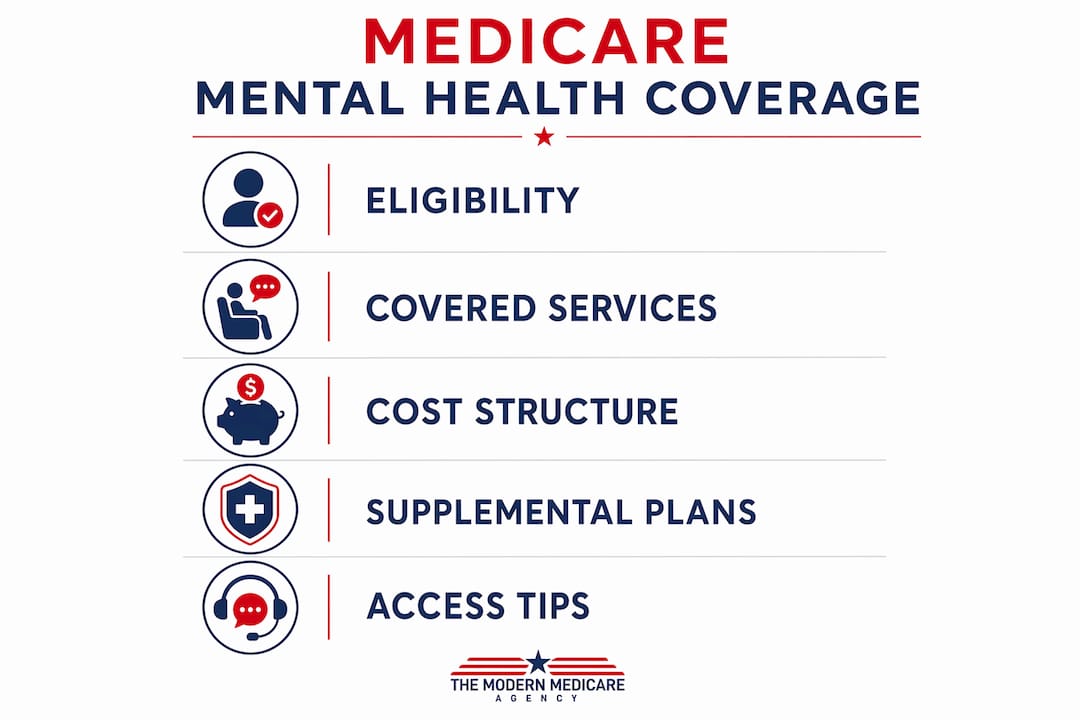
Medicare’s mental health coverage for people with disabilities is defined as federally funded insurance that pays for medically necessary outpatient and inpatient psychiatric services once specific eligibility requirements are met. Most people under 65 qualify through Social Security Disability Insurance (SSDI), administered by the Social Security Administration (SSA). The Centers for Medicare and Medicaid Services (CMS) oversees what gets covered, how providers bill, and what you pay out of pocket. Understanding disability Medicare mental health coverage before you need it puts you in a much stronger position when a mental health need arises.
Who qualifies for disability Medicare mental health coverage?
Eligibility for Medicare mental health benefits follows a clear timeline for most people with disabilities. The rules differ based on your diagnosis, so knowing which category applies to you matters.
-
SSDI recipients (most disabilities). You become eligible for Medicare after a 24-month waiting period from the date your SSDI benefits begin. The clock starts with your first SSDI payment, not your disability onset date.
-
ALS (Lou Gehrig’s disease). Medicare coverage begins immediately upon SSDI approval. There is no waiting period for ALS, which reflects the rapid progression of the disease.
-
End-Stage Renal Disease (ESRD). Like ALS, ESRD triggers immediate Medicare eligibility without the standard 24-month delay.
-
Automatic enrollment. Once you hit the 24-month mark, Medicare Parts A and B enroll you automatically. You receive your Medicare card by mail before your coverage start date.
-
Confirming your start date. Contact the SSA or log into your Medicare account to verify your exact coverage start date. Missing this step can lead to gaps in care or unexpected billing surprises.
The 24-month rule catches many people off guard. Knowing your start date lets you plan for mental health appointments, find enrolled providers, and avoid paying full price for services that Medicare would otherwise cover.
What mental health services does Medicare cover for people with disabilities?

Medicare covers a broad range of mental health services across both outpatient and inpatient settings. The scope expanded significantly in 2024 and remains strong through 2026.
Outpatient mental health services (Part B)
Part B covers the mental health services most people use regularly. Covered services include individual therapy, group therapy, psychiatric evaluations, and medication management. The list of eligible providers is wide.
- Psychiatrists
- Psychologists
- Licensed clinical social workers
- Nurse practitioners
- Physician assistants
- Licensed marriage and family therapists (as of january 1, 2024)
- Licensed mental health counselors (as of january 1, 2024)
As of 2024, marriage and family therapists and licensed mental health counselors can bill Medicare independently. They bill at 75% of the clinical psychologist rate. This expansion means you have more provider options than ever before.
Inpatient psychiatric care (Part A)
Part A covers psychiatric hospital stays and psychiatric units inside general hospitals. The rules differ by setting.
| Setting | Coverage limit |
|---|---|
| Freestanding psychiatric hospital | 190-day lifetime maximum |
| Psychiatric unit in a general hospital | No lifetime cap |
The 190-day cap applies only to freestanding facilities. If you receive inpatient psychiatric care inside a general hospital, Medicare places no lifetime limit on covered days.
Telehealth and audio-only sessions
Telehealth mental health visits, including audio-only phone sessions, are covered through at least december 2027. This matters enormously for people with disabilities who face transportation barriers or mobility limitations. Audio-only sessions count as covered visits when the provider documents the reason for not using video.
Pro Tip: Ask your therapist or psychiatrist whether they offer audio-only sessions before your first appointment. Many providers do not advertise this option, but it is fully covered under current Medicare rules.
How much does disability Medicare mental health coverage cost?
Cost sharing under Medicare follows a predictable structure, but the numbers add up quickly for people who attend therapy regularly.
Outpatient costs (Part B)
The 2026 Part B deductible is $283 per year. After you meet that deductible, you pay 20% coinsurance on every outpatient mental health visit. On a $150 therapy session, that means you pay roughly $30 per visit out of pocket. Medicare has no annual cap on outpatient therapy sessions, which is good news for access. The downside is that the 20% coinsurance applies to every visit, so frequent therapy users face real cumulative costs.
Inpatient costs (Part A)
The Part A deductible in 2026 is $1,736 per benefit period. After that deductible, cost sharing works as follows:
- Days 1–60: no daily coinsurance
- Days 61–90: $434 per day
- Days 91–150 (lifetime reserve days): $868 per day
- Beyond 150 days: you pay all costs
These figures apply to inpatient psychiatric care in general hospitals. The same structure applies to freestanding psychiatric hospitals, subject to the 190-day lifetime cap.
Pro Tip: Track your benefit periods carefully. Each new benefit period resets the Part A deductible, so a second hospitalization in the same year can trigger another $1,736 charge.
A person attending weekly therapy sessions pays roughly $1,560 per year in coinsurance alone, assuming a $150 session rate and no supplemental coverage. That number makes a strong case for pairing Original Medicare with a supplemental plan.
How do Medicare Advantage and Medigap plans affect mental health coverage?
Original Medicare covers the basics well, but two supplemental options can reduce your costs or expand your benefits: Medicare Advantage and Medigap.
Medicare Advantage (Part C)
Medicare Advantage plans often include extra mental health benefits that Original Medicare does not cover. CMS notes that these extras can include grief counseling, expanded telehealth access, and additional behavioral health services. You can review Medicare Advantage plan options to see which plans in your area offer mental health extras.
The trade-off is network restrictions. Medicare Advantage plans require you to use in-network providers in most cases. If your current therapist is not in the plan’s network, you may need to switch providers or pay higher out-of-network rates. Reviewing the pros and cons of Medicare Advantage before enrolling helps you weigh those trade-offs clearly.
Medigap (Medicare Supplement)
Medigap covers Part B coinsurance, which directly reduces your per-session therapy costs. The challenge for people under 65 with disabilities is that Medigap availability varies by state. Many states do not require insurers to sell Medigap policies to people under 65, and when plans are available, premiums are often significantly higher than for those who enroll at 65.
| Factor | Medicare Advantage | Medigap |
|---|---|---|
| Extra mental health benefits | Yes, plan-dependent | No |
| Covers Part B coinsurance | Partially, varies | Yes, most plans |
| Under-65 availability | Generally available | Limited by state |
| Network restrictions | Yes | No (use any Medicare provider) |
| Grief counseling coverage | Some plans | No |
The right choice depends on your state, your provider relationships, and how often you use mental health services. A cost comparison between Medigap and Medicare Advantage in 2026 can clarify which option saves you more money based on your actual usage.
How to access mental health services and get the most from your benefits
Getting the most from your Medicare mental health benefits requires a few deliberate steps. Skipping any of these can result in denied claims or unexpected bills.
- Confirm provider enrollment. Your therapist or psychiatrist must be enrolled in Medicare to bill for your sessions. Ask directly: “Are you enrolled in Medicare?” A provider who accepts Medicare but is not enrolled cannot bill on your behalf.
- Understand assignment. Providers who accept Medicare assignment agree to charge no more than the Medicare-approved amount. Providers who do not accept assignment can charge up to 15% above that amount.
- Add Part D for medications. Mental health treatment often involves prescription medications. Medicare Part D drug coverage covers psychiatric medications including antidepressants, antipsychotics, and mood stabilizers. Enrolling in Part D at your first opportunity avoids late enrollment penalties.
- Review your Medicare Summary Notice. Medicare sends this document quarterly. It lists every billed service and what Medicare paid. Reviewing it catches billing errors and confirms your mental health visits were processed correctly.
- Use Medicare’s provider finder. The Medicare.gov provider search tool filters by specialty and shows whether a provider accepts Medicare assignment.
Pro Tip: If you see a charge on your Medicare Summary Notice that does not match a service you received, call 1-800-MEDICARE immediately. Billing errors are more common than most people realize, and you have the right to dispute them.
Key Takeaways
Medicare covers a wide range of mental health services for people with disabilities, but managing costs requires pairing Original Medicare with the right supplemental plan.
| Point | Details |
|---|---|
| Eligibility timeline | Most SSDI recipients wait 24 months; ALS and ESRD patients get immediate coverage. |
| Outpatient cost sharing | The 2026 Part B deductible is $283, then 20% coinsurance applies to every therapy visit. |
| Provider access expanded | As of 2024, marriage and family therapists and mental health counselors bill Medicare independently. |
| Telehealth covered through 2027 | Audio-only mental health sessions count as covered visits when the provider documents the reason. |
| Supplemental plans reduce costs | Medigap covers coinsurance; Medicare Advantage may add grief counseling and telehealth extras. |
What I’ve learned after years of helping disabled Medicare beneficiaries
People with disabilities face a specific challenge that most Medicare guides gloss over: the under-65 Medigap problem. In many states, insurers are not required to sell you a Medigap policy before age 65. When they do sell one, the premiums can be two or three times higher than what a 65-year-old pays for the same coverage. I have seen clients pay $400 or more per month for a Medigap plan that a 65-year-old neighbor buys for $130.
My honest advice is this: do not assume Medigap is your best path just because it covers coinsurance cleanly. Run the numbers on Medicare Advantage first, especially if your state limits Medigap access under 65. Some Medicare Advantage plans in 2026 offer $0 premiums with meaningful mental health extras. That combination can be far more affordable than a high-premium Medigap plan.
The other thing I see constantly is people waiting too long to enroll in Part D. They figure they are not taking any medications right now, so they skip it. Then a psychiatrist prescribes an antipsychotic or a mood stabilizer, and they are hit with a late enrollment penalty that follows them for years. Enroll in Part D when you first become eligible, even if you are not currently taking psychiatric medications.
Mental health care is not optional for many people with disabilities. Treating it as a secondary concern when planning your Medicare coverage is a mistake that costs real money.
— Paul
How Paulbinsurance helps you get the mental health coverage you need
Navigating Medicare’s mental health benefits is straightforward once you know the rules. Choosing the right supplemental plan to control your costs is where most people need a second set of eyes.

Paulbinsurance specializes in Medicare for people with disabilities, including plan comparisons between Medicare Advantage and Medigap options tailored to your state and your mental health needs. Paul Barrett has been helping Medicare beneficiaries make these decisions since 2007. Whether you are approaching your 24-month SSDI milestone or already enrolled and looking to reduce therapy costs, the team at Paulbinsurance can walk you through your options. Start with a full review of Medicare Advantage plans explained to see what expanded mental health benefits may be available in your area.
FAQ
Who qualifies for Medicare mental health coverage with a disability?
Most people with disabilities qualify for Medicare after 24 months of SSDI benefits. People with ALS or ESRD qualify immediately upon SSDI approval.
Does Medicare cover therapy sessions for disabled individuals?
Yes. Medicare Part B covers individual therapy, group therapy, psychiatric evaluations, and medication management with enrolled providers. You pay 20% coinsurance after the $283 annual deductible.
Can I use telehealth for mental health therapy under Medicare?
Medicare covers telehealth mental health sessions, including audio-only visits, through at least december 2027. Your provider must document the reason for using audio-only instead of video.
What is the lifetime limit for inpatient psychiatric care under Medicare?
Medicare limits inpatient stays in freestanding psychiatric hospitals to 190 days lifetime. Psychiatric units inside general hospitals have no lifetime cap.
Does Medigap cover mental health costs for people under 65?
Medigap covers Part B coinsurance, which reduces per-session therapy costs. However, availability varies by state for people under 65, and premiums are often much higher than for those who enroll at 65.