




Original Medicare generally doesn’t cover hearing aids or the exams used to fit them. So, does Medicare cover hearing aids? Under Original Medicare, no. Part B may cover certain diagnostic hearing or balance tests when a doctor orders them.
That difference can be confusing, especially when a hearing test is covered but the hearing aids it recommends aren’t. In 2026, some Medicare Advantage plans offer hearing benefits, but the amount of coverage and what you pay depend on the plan. This guide explains what Original Medicare and Medicare Advantage may cover, which factors affect your out-of-pocket costs, and what more affordable care options may be available. You’ll have a clearer way to understand your benefits and compare the choices that fit your needs.
Key Takeaways
- Original Medicare generally excludes hearing aids and fitting exams, but some diagnostic hearing or balance tests may be covered.
- Medicare Advantage hearing benefits differ by plan, so compare the details that shape your coverage and out-of-pocket costs.
- Understand how the Part B deductible and cost-sharing can affect what you pay for covered tests in 2026.
- Explore over-the-counter hearing aids and other affordability options to see which may fit your hearing needs and budget.
- Learn how hearing benefits may help lower costs and what to consider when comparing Medicare coverage.
Does Medicare cover hearing aids?
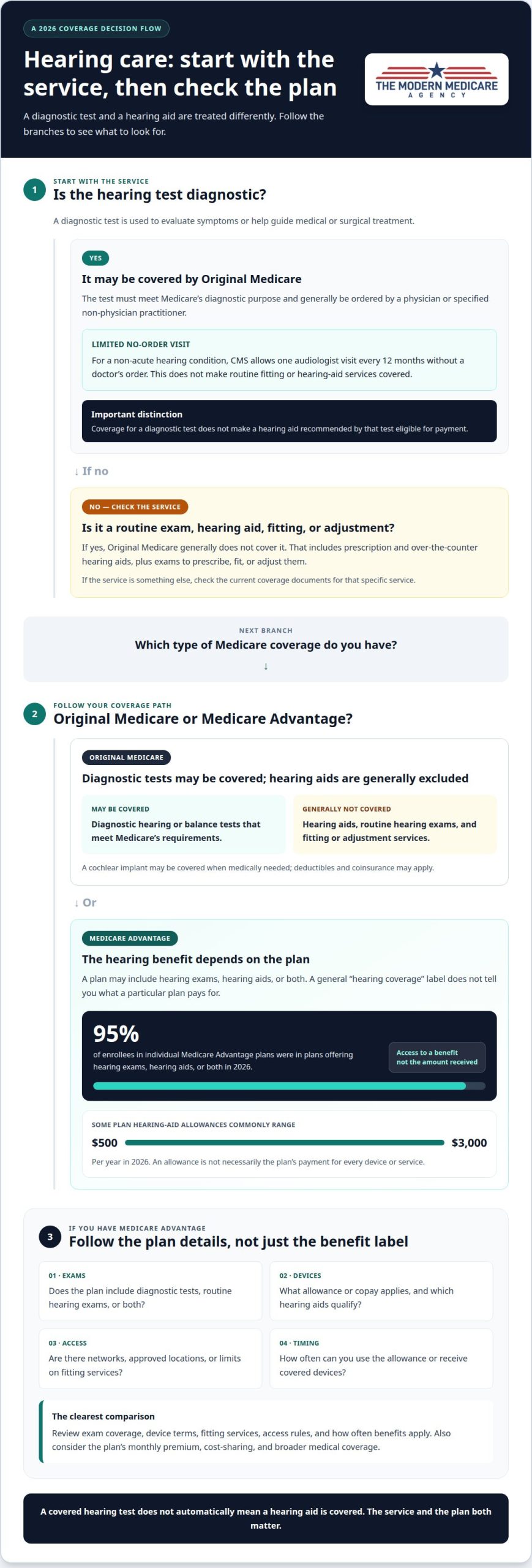
Original Medicare generally doesn’t pay for hearing aids or routine hearing exams for adults. It may cover diagnostic tests to investigate a medical concern, so the purpose of the exam matters.
Original Medicare Hearing Aid Coverage
Original Medicare doesn’t cover hearing aids, whether prescription devices or over-the-counter models. It may cover diagnostic hearing or balance exams to evaluate symptoms or guide medical treatment.
This distinction matters if a test leads to a hearing-aid recommendation. Coverage for a diagnostic exam doesn’t make the device itself eligible for payment. Medicare may also cover a cochlear implant when medically needed, though deductibles and coinsurance may apply. Other hearing devices don’t automatically qualify just because they support hearing.
Hearing Aid Exclusions and Related Services
Original Medicare excludes hearing aids and exams to prescribe, fit, or adjust them. It also doesn’t cover services provided for hearing-aid evaluation and fitting, regardless of how they’re billed.
A routine hearing exam to select or adjust a device is different from a diagnostic exam for a medical issue. People with Original Medicare pay the full cost of non-covered hearing aids and fitting exams. Original Medicare also doesn’t cover over-the-counter hearing aids, so buying one directly doesn’t change the coverage rule.
Hearing Exams, Referrals, and Fitting
Medicare may cover diagnostic audiology when an audiologist performs testing after an order from a physician or specified non-physician practitioner. The test must help evaluate symptoms or guide medical or surgical treatment. A hearing-aid fitting exam remains excluded.
For non-acute hearing conditions, the Centers for Medicare & Medicaid Services allows one audiologist visit every 12 months without a doctor’s order. This limited visit doesn’t turn routine fitting or device services into covered care. Diagnostic hearing and balance tests may also help investigate dizziness or vertigo.
Checking Medicare Plan Coverage
To find out whether your plan helps pay for hearing aids, identify whether you have Original Medicare or Medicare Advantage, then review the plan’s current coverage documents. Look separately for diagnostic exams, routine hearing exams, device allowances, fitting services, and any limits on where you can receive care.
Compare your plan’s hearing benefits with the specific service or device you need, since exam coverage doesn’t necessarily include hearing aids. If you have Original Medicare, expect to pay for excluded devices and fitting services yourself. For Medicare Advantage, the written benefit terms explain how hearing coverage works.
Medicare Advantage hearing benefits
Unlike Original Medicare, a Medicare Advantage plan may include hearing benefits. These plans are offered by private insurers and combine Medicare coverage with plan-specific rules. Hearing benefits may include exams, hearing aids, or both, but coverage differs across plans. In 2026, 95% of enrollees in individual Medicare Advantage plans were in plans offering hearing exams, hearing aids, or both. That figure describes access to a benefit, not the amount each person receives.
Look closely at what the hearing benefit pays for. An exam may be covered while devices have a separate allowance, copay, or limit. Some Medicare Advantage hearing aid allowances commonly range from $500 to $3,000 per year in 2026. A stated allowance is not necessarily the plan’s payment for every device or service, so read the benefit terms for eligible devices and covered fitting services.
Plan costs involve more than the hearing allowance. Compare the monthly premium, cost-sharing for covered care, and what you may pay for services outside the benefit. A plan with a hearing allowance can still leave you with costs for devices or related care. Consider how its hearing terms fit your needs alongside its other medical coverage.
For a practical comparison, review these details in each plan’s documents:
- Exam coverage: Does the plan include diagnostic tests, routine hearing exams, or both?
- Device benefit: What allowance or copay applies, and which hearing aids qualify?
- Access rules: Are there plan networks, approved locations, or limits on fitting services?
- Benefit timing: How often can you use the allowance or receive covered devices?
These details can affect what you pay, even when two plans both advertise hearing coverage. One plan may emphasize exams, while another provides a device allowance. Compare the exact benefit descriptions rather than relying on a general label such as “hearing coverage.” Also weigh the plan’s broader medical costs and coverage, since hearing benefits are only one part of the decision.
When choosing a plan for hearing aids, start with covered exam and device services. Then compare the allowance, cost-sharing, access rules, and how often benefits apply. This side-by-side review helps show which plan’s hearing benefit better suits your needs.
If you’re weighing hearing benefits alongside broader coverage, a Medicare Advantage plan guide can help you understand the plan choices.
Factors that affect out-of-pocket costs
Your total depends on whether you need a hearing aid, a diagnostic test, or both. In 2026, Medicare coverage and plan benefits determine which costs you pay yourself.
Hearing Aid Costs Without Insurance
Without hearing coverage, you pay for the hearing aids yourself, along with excluded fitting services. The final cost can depend on the device’s features, technology, and brand, as well as services included with the purchase. Ask for a breakdown of device and fitting charges to compare the full cost.
Prescription Hearing Aid Costs
Prescription devices are fitted to a person’s hearing needs, and their cost can vary with technology and features. A basic model and a high-tech model may have different prices, even when both address hearing loss. Original Medicare doesn’t pay for hearing aids. A Medicare Advantage plan may offer an allowance or other hearing benefit, but its terms determine how much that benefit reduces your costs.
Diagnostic tests have different cost rules. For a hearing or balance test covered by Part B, beneficiaries generally pay 20 percent of the Medicare-approved amount and the Part B deductible. The Centers for Medicare & Medicaid Services sets Medicare Part B’s deductible at $283 in 2026. Your share applies to covered diagnostic testing, not to a hearing aid excluded from coverage.
The amount due for a covered test can also depend on other insurance, the doctor’s charge, whether the doctor accepts assignment, the facility type, and where you receive care. The same diagnostic service may leave different out-of-pocket amounts depending on the provider or facility. A doctor may also recommend a service Medicare doesn’t cover, or one provided too often, which can add costs.
Before scheduling care, separate expected expenses into these categories:
- Diagnostic testing: Confirm whether the test investigates a medical concern and meets Part B coverage rules.
- Hearing aid: Include the device price, since Original Medicare doesn’t cover it.
- Fitting: Account for fitting or adjustment services, which Medicare excludes when provided for hearing aids.
- Plan benefit: Review whether Medicare Advantage plans cover exams, devices, or both, and how their allowance or cost-sharing applies.
This breakdown distinguishes covered medical testing from device and fitting expenses. Comparing each line item makes your likely payment easier to understand before care begins.
OTC hearing aids and affordability options
Over-the-counter hearing aids give adults with mild to moderate hearing loss another way to explore hearing support. In 2026, affordability also depends on whether Medicaid, state assistance, or VA benefits apply.
Hearing Aid Affordability Options
Adults with perceived mild-to-moderate hearing loss can buy them without a medical exam, prescription, or professional fitting. The FDA regulates this category for adults. Compare the device’s features and technology with your needs, since higher-tech models often cost more than basic ones.
Other programs can help lower costs for eligible people. Medicaid hearing coverage for adults age 21 and older varies by state, and some states provide little or no adult hearing-aid coverage. Medicaid may cover services Medicare excludes for people enrolled in both programs. Some states also offer financial assistance based on income or other requirements.
Veterans enrolled in VA health care who meet medical criteria can receive hearing aids at no charge. Hearing-aid coverage requirements can vary depending on the type of plan and where you live. These options have different eligibility rules, so the relevant program and your circumstances shape the help available.
Hearing Aid Adoption and Affordability
Cost can influence whether someone gets hearing support. A survey reported that 64% of people with the most serious hearing loss said they couldn’t afford a hearing aid. The U.S. Government Accountability Office reported that as many as 17% of Medicare beneficiaries may be unable to afford devices costing $500 or more.
To compare options, first identify the kind of support you need. OTC devices are intended for adults with mild-to-moderate hearing loss; more complex hearing concerns call for a different approach. Then compare the full device cost, fitting needs, and any available Medicaid, state, VA, or private insurance benefits. Each option has distinct eligibility criteria and coverage limits.
Affordability can also depend on the type of hearing care involved. Medicare may cover a medically needed cochlear implant, though deductibles and coinsurance may apply. That differs from routine hearing support, so separate implant-related care from hearing-aid costs when reviewing your options.
Make a short comparison before choosing:
- Device type: Match OTC models to mild-to-moderate hearing loss.
- Potential assistance: Consider Medicaid, state programs, VA eligibility, or private coverage.
- Total expense: Include the device and any fitting or care costs.
This comparison can help you focus on options that fit your hearing needs and budget.
Potential Medicare savings from hearing care coverage
Hearing care coverage can reduce some expenses, but savings depend on the service and plan. In 2026, distinguish diagnostic care from hearing aids before estimating your out-of-pocket costs.
Original Medicare and Medicare Advantage handle hearing benefits differently. Original Medicare may cover diagnostic testing for a medical concern, while Medicare Advantage plans may include hearing exams or device benefits. When a plan pays toward eligible hearing care, that benefit can reduce what you pay directly. Savings apply only to services and devices covered under the plan’s rules.
Plan limits matter. A 2021 KFF analysis found that only 1% of Medicare Advantage plans paid for hearing aids without a dollar or frequency limit. That finding shows why an advertised hearing benefit alone doesn’t reveal its full value. A plan may limit the payment amount, how often the benefit applies, or which services qualify.
Medicare Part B may also help with costs tied to diagnosis. A physician-ordered test to investigate hearing symptoms or balance concerns may be covered, while a routine exam for hearing-aid fitting is excluded. Keeping these purposes separate helps you estimate which bill may be covered and which expenses remain yours.
To assess potential savings, compare these costs and benefits side by side:
- Diagnostic testing: Identify whether the exam addresses a medical condition or only evaluates hearing-aid fit.
- Device benefit: Review the plan’s payment limit, frequency rules, and eligible hearing aids.
- Related services: Separate covered exams from fitting, adjustment, or other excluded services.
- Other coverage: Account for Medicaid or another insurance benefit that may pay for services Medicare excludes.
For example, a plan that helps pay for an eligible device may lower your direct device expense, but fitting charges may remain separate. Another plan may cover diagnostic exams without offering a device allowance. Compare both the benefit and its restrictions for a clearer picture than the plan premium alone provides.
Older adults can also consider whether Medicaid, state assistance, or VA eligibility changes what they pay. Medicaid coverage varies by state, and VA hearing aids are available at no charge to enrolled veterans who meet medical criteria. These options can affect the remaining cost after Medicare or a private plan pays.
For a clearer comparison of plan benefits, explore Medicare Advantage plan options alongside your expected hearing expenses.
The Modern Medicare Agency: Medicare Advantage Plans
The Modern Medicare Agency helps you compare Medicare Advantage Plans when hearing benefits are part of your decision. Its independent guidance can help you review plan details, including hearing exams, device allowances, limits, and other coverage that matters to you. The agency helps eligible individuals compare and select plans from over 40 carriers, with recommendations based on their needs.
Medicare Advantage benefits vary, so looking beyond a hearing-benefit label can clarify your choices. You can also discuss how Medicare Supplement (Medigap) Plans and Medicare Part D Plans fit into your broader Medicare coverage. Compare options with both your hearing needs and the rest of your coverage in mind.
Visit paulbinsurance.com to explore your Medicare options.
Take the Next Step Toward Clearer Coverage
Choosing hearing care is personal. A focused conversation can help you prioritize what matters most: access to care, help with hearing expenses, or coverage that works alongside your other needs. Write down your questions and the plan details you want to understand. That can make a complicated decision feel more manageable.
Whether Medicare covers hearing aids is only one part of the bigger coverage picture. The Modern Medicare Agency can help you compare Medicare Advantage Plans, Medicare Supplement (Medigap) Plans, and Medicare Part D Plans based on your needs. Book a free Medicare consultation to discuss how these options fit into your overall Medicare decisions and the hearing care that prompted your questions.
If you’re ready to talk through your options, contact The Modern Medicare Agency. A clear next step can help you move forward with greater confidence.
Frequently Asked Questions
How much do hearing aids cost without insurance?
Treat that as a reference point, not a quote: what you pay depends on the device and what the purchase includes. Before deciding, compare the total for the pair and ask whether the stated amount includes fitting or related services. This makes different offers easier to compare.
Where can I get help paying for hearing aids and tests?
Medicaid, state assistance, VA health care, and some private insurance plans may help, depending on eligibility and location. A national study cited in the research found that 32 states covered adult hearing aids through Medicaid in some form. Maine’s mandate covers up to $3,000 per hearing aid every 36 months. These examples show why local rules and personal eligibility matter when looking for assistance.
Does Original Medicare cover hearing aids or hearing aid exams?
No. Original Medicare doesn’t pay for hearing aids or exams intended to prescribe, fit, or adjust them. The key distinction is the purpose of the service, not simply whether the appointment takes place in an audiology office. If your visit includes both medical testing and device-related services, keep those items distinct in your records so you can understand which charges fall under each coverage rule.
Which Medicare Part B services cover hearing loss diagnosis and treatment?
Part B may cover audiologic diagnostic testing that helps a physician assess a hearing, tinnitus, or balance concern and decide on appropriate medical or surgical care. The symptoms and reason for testing matter. For example, a diagnostic evaluation can be relevant when a person reports tinnitus or a change in balance. The test’s purpose determines whether it fits the diagnostic benefit, rather than the eventual device recommendation.
Do Medicare Advantage plans cover hearing aids?
Some Medicare Advantage plans include a hearing-aid benefit. If you’re considering a plan change, review the available benefit documents during the annual enrollment period, October 15 through December 7. People already enrolled in Medicare Advantage may also make one plan change from January 1 to March 31. These dates can help you time a plan comparison, but the specific hearing benefit still depends on the plan.
What hearing aid benefits do Medicare Advantage plans typically include, including dollar limits?
Benefits can include exams, hearing aids, or both, and plans may set payment or frequency limits. A 2021 KFF analysis found that plans with dollar limits had an average hearing-aid limit of $960. This is historical data, not a description of every 2026 plan. Use a plan’s current benefit materials to see how its limit applies to your devices and any covered services.
How much do hearing aids cost without Medicare coverage?
What you pay depends on the device, its features, and whether related services are included. If Medicare doesn’t pay toward the hearing aid, focus on the full amount due rather than assuming a separate exam benefit reduces the device charge. Compare the expected payment for the device and any fitting separately. That gives you a clearer personal budget without treating a survey average as your individual price.

Article by
Paul Barrett
Paul Barrett, CMIP is the founder of The Modern Medicare Agency, an independent Medicare-only brokerage based in Melville, NY. With 18 years of Medicare-exclusive experience, a CMIP designation, and more than 5,000 clients served across 37 states, Paul is one of the most credentialed independent Medicare specialists on Long Island — and one of the most direct.
He represents 40+ carriers with no quotas and no allegiances, which means his recommendations are based entirely on what fits each client's specific situation. He is the author of Medicare Mastery Unlocked and host of the Wise Guys Retirement Talk podcast. His content is grounded in primary sources, real carrier intelligence, and 18 years of watching what happens when people get Medicare right — and when they don't.
📞 631-358-5793 | paulbinsurance.com