




Could a 30-minute therapy visit appear as just two billable units? Yes, and that difference can be unsettling when you’re trying to understand a statement. The key is that Medicare’s 8-minute rule counts timed therapy services in units. It doesn’t decide whether Medicare covers the care.
If you’re wondering, “does medicare cover physical therapy,” it helps to separate those questions. Coverage depends on Medicare’s eligibility and medical-necessity requirements, while the 8-minute rule is a billing method for calculating units for timed outpatient therapy. That distinction can explain why the time you spent in a session doesn’t always match the units listed on a bill.
This guide explains how the rule works, how timed minutes can add up to billable units in 2026, and what to ask if a statement or care plan doesn’t make sense. You’ll also learn which coverage and cost-sharing details are separate from unit counting, so you can review your therapy information with more confidence.
Key Takeaways
- Does medicare cover physical therapy? Learn what determines coverage and why the 8-minute billing rule is a separate question.
- See how Medicare’s timed-minute ranges can translate a therapy visit into billable units.
- Understand why timed and untimed services may appear differently on a therapy statement.
- Use a simple checklist to compare service dates, timed minutes, billed units, and statement explanations.
- Know what to clarify about your 2026 coverage and costs, and which questions can make a therapy bill easier to understand.
Does Medicare cover physical therapy, and what does the 8-minute rule mean?
Yes, Medicare Part B may cover medically necessary outpatient physical therapy when applicable Medicare requirements are met. But coverage and billing are separate questions. The 8-minute rule is a billing method used to calculate units for eligible timed outpatient therapy services. A unit on a claim doesn’t, by itself, prove that the care meets Medicare’s coverage requirements or guarantee payment.
Coverage eligibility determines whether Medicare may pay for care; the 8-minute rule helps calculate how eligible timed services are reported. Keeping these questions separate can make a statement easier to understand. If you’re asking, “does medicare cover physical therapy,” the answer depends on the coverage rules for your situation, not simply on the number of units billed.
What does the Medicare 8-minute rule count?
The calculation concerns qualifying minutes of timed therapy services. It doesn’t automatically count every minute you’re at the clinic. An appointment may include time spent checking in, changing clothes, resting, or receiving services billed under different rules. Don’t assume those minutes count as timed treatment minutes.
A billing unit is a standardized way to report certain services on a claim. Under the 8-minute rule, the provider uses qualifying timed-service minutes to determine how many units may be billed. The rule doesn’t apply to every therapy service or every care setting, so the visit’s total length alone may not explain the number of units shown. To understand the calculation, first identify which minutes qualify and how they’re counted.
How does therapy coverage differ from unit billing?
Coverage asks whether the therapy meets the applicable requirements for Medicare payment. Unit billing asks how qualifying timed services are represented on a claim. The questions are related because the claim describes care for which payment is sought, but they aren’t interchangeable. A correctly calculated unit count doesn’t establish medical necessity, and appointment length alone doesn’t determine whether care is eligible.
For people with Original Medicare, Part B may cover medically necessary outpatient physical therapy, subject to applicable rules. Medicare includes different parts with different roles; the general Medicare (United States) overview offers background on how the program is structured. Coverage details can differ for people enrolled in Medicare Advantage, so the plan’s terms matter. This Medicare Advantage guide can help explain how these plans fit into Medicare choices.
If a bill surprises you, don’t assume the unit count alone means the care was covered or denied. Review the service description and the coverage explanation separately. For questions about the timed-minute calculation, ask the therapy provider to explain the minutes and units reported. For questions about whether your Medicare coverage applies, review the relevant Medicare or plan explanation. Separating the two questions gives you a clearer place to start.
How does Medicare calculate 8-minute therapy units?
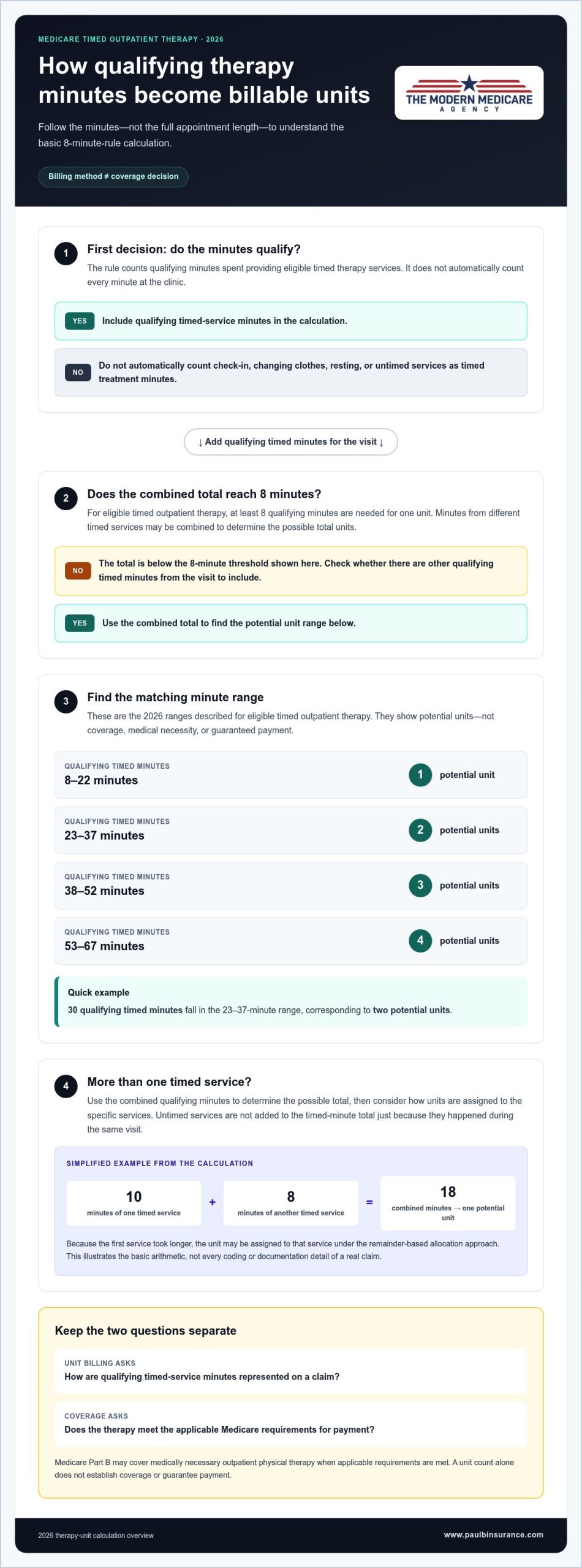
For eligible timed outpatient therapy services, Medicare generally adds the qualifying minutes for the visit, divides by 15, then uses the remainder to determine whether another unit can be counted. In 2026, at least 8 minutes of a timed service are needed for one unit. This is a billing calculation, not a promise that Medicare will cover or pay for the service.
- Identify qualifying timed minutes. Count the minutes spent providing eligible timed services. Don’t automatically include the full appointment, waiting time, or untimed services.
- Add the timed minutes. Combine the qualifying minutes for the visit to find the total used in the calculation.
- Apply the minute ranges. Use the total to determine the possible number of units, then consider how units are allocated among the services provided.
What are the verified minute ranges for each unit?
The 2026 Medicare 8-minute-rule ranges commonly used for eligible timed outpatient therapy are shown below. This is a billing explanation only. The ranges don’t establish coverage, medical necessity, or payment for a claim.
| Qualifying timed minutes | Potential units |
|---|---|
| 8-22 | 1 |
| 23-37 | 2 |
| 38-52 | 3 |
| 53-67 | 4 |
For example, 30 qualifying timed minutes fall in the 23-37-minute range, which corresponds to two units. The practical takeaway is simple: for eligible timed outpatient therapy, at least 8 qualifying minutes can support one unit, while the total qualifying minutes help determine the overall count.
How are minutes from different timed services handled?
When a visit includes more than one timed service, both the combined total and the minutes spent on each service matter. Medicare first uses the total timed minutes to determine the possible units. The units then need to be assigned to the specific services reported. Untimed services aren’t added to the timed-minute total simply because they happened during the same visit.
Here’s a simplified example, not an actual claim: a visit includes 10 minutes of one timed service and 8 minutes of another. The combined total is 18 minutes, which falls in the one-unit range. Because the first service took longer, the unit may be assigned to that service under the remainder-based allocation approach. A real claim can involve additional coding and documentation details, so this example illustrates only the basic arithmetic.
If you’re reviewing care under a Medicare Advantage plan, unit arithmetic is separate from understanding your plan’s coverage terms. This overview of Medicare Advantage plans can help you learn how these plans fit into your Medicare choices.
Which therapy services and situations use the 8-minute rule?
The 8-minute rule isn’t a universal way to count every service on a therapy statement. It applies to eligible timed services in outpatient therapy billing, where qualifying treatment minutes help determine reported units. Other services may be billed under different rules, and the place where care is delivered can affect which billing approach applies.
Setting and service type can change which billing rules apply, so don’t assume every therapy visit or statement line follows the 8-minute rule. That distinction matters when a session includes several kinds of care. One appointment can include services counted by time and others reported differently.
How are timed and untimed services different?
A timed service is reported in units based on qualifying treatment minutes under the applicable billing method. An untimed service is reported according to its applicable code and billing rules, rather than by applying the 8-minute thresholds to its duration. The label on a statement and the service description can help you see which billing method is being used.
This is why the appointment’s total length may not match the timed units listed. Minutes spent waiting or receiving an untimed service shouldn’t automatically be added to timed treatment minutes. If a statement includes multiple lines, review each one separately instead of applying the same minute calculation to every item.
Does the rule work the same in every Medicare setting?
This guide focuses on Original Medicare outpatient therapy billing. Physical therapy delivered during an inpatient hospital stay, in an outpatient setting, and at home isn’t automatically billed in the same way. The setting and circumstances of care matter, so don’t apply the outpatient timed-unit explanation to an inpatient statement without checking the rules that govern that care.
Related outpatient therapy disciplines, such as occupational therapy and speech-language pathology, may also be subject to Medicare therapy billing guidance. That doesn’t mean every service in each discipline is timed or uses identical billing treatment. The service code and setting still matter.
Medicare Advantage adds another layer. These plans provide Medicare benefits through private plans, and plan processes and billing arrangements may differ. This Medicare Advantage guide offers context on how these plans fit into the broader Medicare picture. For a statement question, focus on the exact service, setting, and plan shown on the paperwork.
So, does medicare cover physical therapy, and does the 8-minute rule apply? Those are separate questions. Coverage depends on the applicable Medicare requirements and, for Medicare Advantage, the plan’s terms. The timed-unit method applies only where the service and billing situation qualify. If a line on your statement seems inconsistent with the visit, ask the billing office which services were timed and how each line was reported. A clear explanation can help you distinguish a unit-count question from a coverage question.
How can you check a therapy bill using the 8-minute rule?
A therapy statement can be hard to read when the minutes you remember don’t seem to match the units listed. Start by comparing the details rather than assuming something is wrong. The 8-minute rule applies to eligible timed outpatient services, and a difference you notice is a reason to ask for an explanation, not proof of a billing error.
In 2026, use this checklist to organize what you see:
- Match the service dates. Compare each date on the statement with your appointment calendar or other records.
- Review the services listed. Check whether the descriptions match the care you recall receiving. A visit may include timed and untimed services, which aren’t necessarily counted the same way.
- Compare timed minutes and units. Look at the timed minutes documented for the visit and the units reported for each timed service. Don’t assume all time at the clinic counts as treatment time.
- Read the explanation. Keep the statement, any accompanying coverage explanation, and your notes together. They may answer different questions about billing and payment.
What details should you compare on a therapy statement?
Focus on the service date, description, documented timed minutes, and units shown for each timed service. If the statement doesn’t show the minutes, make a note of that too. Your recollection can help you identify what to ask about, but it may not include every detail recorded during treatment. A difference is a prompt to clarify, not a conclusion about whether the claim was billed correctly.
What questions can you ask about a unit calculation?
Keep your questions specific and neutral. For example: “Which timed minutes were included?” “Were any services treated separately?” and “Can you walk me through how the Medicare billing method was applied to these minutes?” A plain-language explanation can help you compare the calculation with the statement without having to make a billing judgment yourself.
If the provider’s explanation still leaves you unsure, write down what remains unclear and keep a copy of the statement. For questions about whether a service is covered or how your cost-sharing applies, contact Medicare or your Medicare Advantage plan, as appropriate. Those are coverage questions, not simply unit-count questions. If you’re trying to understand how Medicare Advantage fits into your options, an independent broker can explain plan choices. Learn more about your Medicare options at Paul B Insurance.
What should you know about Medicare physical therapy coverage in 2026?
The 8-minute rule helps determine how eligible timed outpatient therapy services are reported. It doesn’t decide whether your care meets Medicare’s coverage requirements or tell you what you’ll ultimately owe. Those questions depend on your Medicare coverage, the care you receive, and the details of your claim.
If you’re asking, “does medicare cover physical therapy,” Medicare Part B may cover medically necessary outpatient physical therapy when applicable requirements are met. Coverage and billing are separate parts of the picture. A unit count alone can’t confirm that care is covered, show whether a claim has been processed, or calculate your final cost-sharing.
What coverage details should be verified for 2026?
For Original Medicare, check current Part B coverage and cost-sharing information directly with Medicare. In 2026, the standard Part B deductible is $283. After you’ve met it, you typically pay 20% of the Medicare-approved amount for most covered services. Your situation and the service matter, so use Medicare’s current guidance and claim information rather than relying on a prior-year figure or a general example.
Keep these questions separate as you review paperwork:
- Coverage: Does the care meet the applicable Medicare requirements?
- Billing: How were the timed services and units reported?
- Cost-sharing: What amount does the processed claim say you may owe?
A therapy statement may show services and units, while a Medicare Summary Notice or plan explanation can provide information about how a claim was processed. Read the documents together, but don’t treat the number of units as the amount due. If you have Medicare Advantage, consult your plan’s current 2026 materials or contact the plan for details about its coverage and cost-sharing. Plan terms can differ, so don’t assume Original Medicare figures apply to every plan.
When might a Medicare plan review help?
A plan review can be useful if you’re weighing broader Medicare choices or want to understand how Original Medicare and Medicare Advantage differ. It won’t determine whether a specific therapy service was billed correctly. The provider can explain the calculation, while Medicare or your plan can address coverage questions about your claim.
Paul B Insurance, operating as The Modern Medicare Agency, is an independent Medicare broker, not a therapy provider or Medicare plan carrier. If you’d like help understanding Medicare plan options, you can book a free Medicare review. The review can help you explore plan choices. Questions about a therapy bill should go to the provider, Medicare, or your plan, depending on what you need clarified.
Take your next Medicare question one step at a time
A confusing statement doesn’t mean you have to figure everything out at once. Start with the question you need answered: your therapy provider can explain its billing calculation, while Medicare or your plan can clarify coverage. If you’re still wondering, “does medicare cover physical therapy,” focus on the coverage rules that apply to your own Medicare arrangement.
If a broader review of your Medicare choices would help, Paul B Insurance is an independent Medicare broker with 18 years of experience, 5,000+ clients served, and access to 40+ carriers. The initial consultation and Medicare review are free, giving you a comfortable place to discuss plan options without confusing that guidance with therapy billing advice.
Book a free Medicare review to discuss your Medicare plan options and take your next step with greater clarity.
Frequently Asked Questions
Does Medicare cover physical therapy in 2026?
Yes, Original Medicare Part B may cover medically necessary outpatient physical therapy when applicable requirements are met. Whether a particular visit qualifies depends on your circumstances and Medicare’s coverage rules. Medicare Advantage plans have their own plan terms and processes, so check your plan documents or ask the plan about your coverage. A therapy bill’s units alone can’t confirm whether a claim is covered or what you’ll owe.
Does the 8-minute rule mean Medicare covers eight minutes of physical therapy?
No. The 8-minute rule concerns billing eligible timed outpatient therapy. It isn’t a promise that Medicare covers an eight-minute appointment or pays for a set amount of treatment. For example, eight qualifying minutes may count toward a timed-service unit under the applicable billing method. Coverage still depends on the Medicare requirements that apply to your care, and the claim’s final processing determines your share.
Does the 8-minute rule apply to Medicare Advantage plans?
Don’t assume every Medicare Advantage plan handles therapy billing exactly like Original Medicare. The 8-minute rule is associated with Medicare outpatient therapy billing, but a specific plan’s claims process and coverage terms can affect how your visit is handled. Check your plan materials for coverage questions. If you’re reviewing a statement, the therapy provider can explain how it calculated the units submitted for that service.
Are all physical therapy services counted under the 8-minute rule?
No. The rule applies to eligible timed services in the relevant outpatient billing situation, not automatically to every service or every line on a statement. A visit can include services reported under different billing methods. For instance, a listed service may not be counted by treatment minutes. Review each line and its description instead of adding every appointment minute to the timed-service calculation.
Can two different therapy services be combined when calculating units?
Qualifying minutes from different timed services may be combined to calculate the total units for a visit under the applicable Medicare method. The time spent on each service also matters when units are assigned to the services reported. Don’t add untimed services to the timed total simply because they occurred during the same appointment. If the statement’s allocation is unclear, ask the provider to explain the calculation for each service.
What should I do if my physical therapy bill seems inconsistent with the minutes?
Start by comparing the statement’s dates and service descriptions with your records. Then ask the therapy provider which timed minutes were included and how the units were calculated. A difference you notice is a reason to ask, not proof of an error. For questions about coverage or your share of the cost, contact Medicare or your Medicare Advantage plan, as appropriate, and have the statement available when you call.

Article by
Paul Barrett
Paul Barrett, CMIP is the founder of The Modern Medicare Agency, an independent Medicare-only brokerage based in Melville, NY. With 18 years of Medicare-exclusive experience, a CMIP designation, and more than 5,000 clients served across 37 states, Paul is one of the most credentialed independent Medicare specialists on Long Island — and one of the most direct.
He represents 40+ carriers with no quotas and no allegiances, which means his recommendations are based entirely on what fits each client's specific situation. He is the author of Medicare Mastery Unlocked and host of the Wise Guys Retirement Talk podcast. His content is grounded in primary sources, real carrier intelligence, and 18 years of watching what happens when people get Medicare right — and when they don't.
📞 631-358-5793 | paulbinsurance.com