




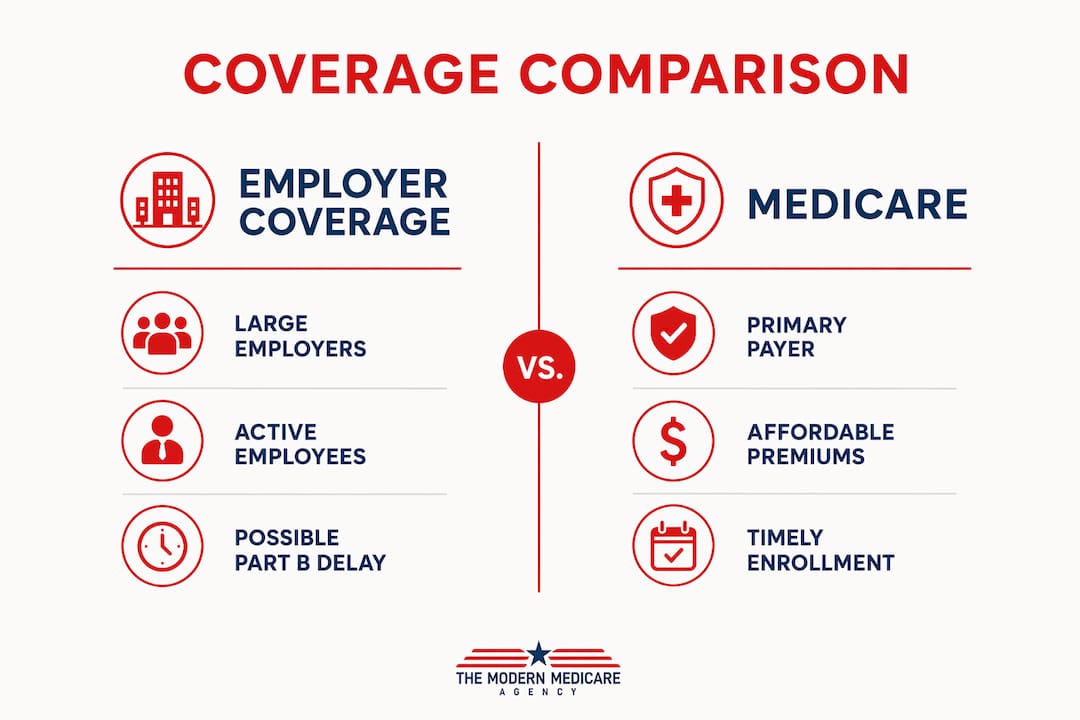
Switching from employer health insurance to Medicare is one of the most consequential decisions you’ll make at 65, and the rules are less forgiving than most people expect. The single most important factor is your employer’s size. If your employer has 20 or more employees, Medicare acts as the secondary payer and you can legally delay Part B enrollment without penalty, as long as you remain actively employed. Drop below that threshold, and Medicare becomes primary, meaning your job-based plan may pay little or nothing if you haven’t enrolled. Once employment or coverage ends, you get an 8-month Special Enrollment Period to sign up for Medicare without a late penalty. Miss that window and you could face a monthly Part B penalty that lasts for life.
Key rules to keep in mind:
- Employer size matters: 20+ employees means Medicare is secondary; fewer than 20 means Medicare must be primary.
- The 8-month SEP clock starts the month after employment or group coverage ends, whichever comes first.
- COBRA does not extend your SEP. Electing COBRA after leaving work does not restart or pause that 8-month window.
- Retiree plans are not active employer coverage. They do not qualify you to delay Medicare enrollment.
- Part D penalties are permanent if you go 63 or more consecutive days without creditable drug coverage after your Initial Enrollment Period.
- Sign up for Part B the month before your employer coverage ends if you want zero gap in coverage.
How Medicare eligibility works when you have employer coverage
The coordination rules between Medicare and employer plans come down to one federal framework: the Medicare Secondary Payer provisions of the Social Security Act. Under those rules, if your employer has 20 or more employees and you are actively working, your group health plan pays first and Medicare pays second. That arrangement lets you delay Part B enrollment without penalty for as long as you remain employed.
The 20-employee threshold is not a suggestion. Federal regulations under 42 CFR § 411.172 spell out that Medicare is secondary only when the group health plan covers you by virtue of current employment status at an employer with at least 20 employees. If your employer falls below that count, your job-based plan is not required to pay before Medicare, and many small-employer plans simply won’t cover services if you haven’t enrolled in both Part A and Part B.
“Most retiree and small employer plans — those with fewer than 20 employees — require people to sign up for Part A and Part B as soon as they’re eligible. If someone doesn’t sign up for Part B when first eligible, they may have to pay late enrollment penalties for as long as they have Part B.”
— CMS, Medicare Enrollment Guidance for Employers
Retiree coverage is a different animal. Once you retire, any coverage your former employer offers is retiree coverage, not active employer coverage. That distinction is critical because retiree plans do not qualify you to delay Medicare enrollment. You must enroll in Parts A and B on time, and the retiree plan typically wraps around Medicare rather than replacing it.
| Coverage Type | Medicare Payer Status | Can You Delay Part B? |
|---|---|---|
| Active employer, 20+ employees | Secondary | Yes, while actively employed |
| Active employer, under 20 employees | Primary | No, enroll at 65 |
| Retiree plan | Secondary (wraps Medicare) | No, enroll on time |
| COBRA | Primary (not current employment) | No, SEP clock already running |
| Spouse’s employer, 20+ employees | Secondary | Yes, while spouse is employed |
Drug coverage coordination follows a parallel rule. If your employer plan includes prescription drug coverage that is “creditable,” meaning it pays at least as well as standard Medicare Part D, you can delay Part D enrollment without penalty. Your employer or plan administrator must provide written confirmation of creditable status each year. Keep that letter. You will need it if you later enroll in Part D through a Special Enrollment Period.
Employer wellness programs, gym reimbursements, and health savings account contributions do not affect your Medicare enrollment obligations. They are supplemental perks, not coverage that coordinates with Medicare.
How to enroll in Medicare when you’re leaving employer coverage
The enrollment process has two distinct paths depending on whether you are signing up for the first time or adding Part B to existing Part A coverage. Most people who worked past 65 already have Part A (which is premium-free for those with sufficient work history) and need to add Part B when they retire.
Enrollment steps
- Confirm your employer’s size and coverage status. Ask your HR or benefits administrator in writing whether your plan qualifies as current employment coverage under Medicare rules. Get the answer in writing.
- Identify your enrollment window. If you are newly turning 65, your Initial Enrollment Period runs from three months before your birthday month through three months after. If you are already past 65 and retiring, your Special Enrollment Period begins the month after employment or coverage ends.
- Sign up for Part B the month before your coverage ends if you want no gap. Coverage starts the month after Social Security receives your completed forms.
- Apply through Social Security. You can apply online at SSA.gov, by phone at 1-800-772-1213, or in person at your local Social Security office.
- Complete the extra form. When enrolling via SEP, Social Security requires proof that you had job-based coverage during the delay period. Pay stubs, W-2s, or employer letters all work. Have them ready before you apply.
- Notify your employer plan. Once Medicare is active, inform your employer’s benefits administrator so coordination of benefits records are updated.
- Evaluate supplemental coverage. After Parts A and B are active, you have a guaranteed-issue window to enroll in a Medigap plan or choose a Medicare Advantage plan without medical underwriting.
If your spouse’s employer provides your coverage, the same rules apply based on the spouse’s employer size and employment status. Your SEP starts when the spouse stops working or the coverage ends, not when you turn 65.
- If you lose job-based coverage before your spouse retires, you still get an 8-month SEP from the date coverage ends.
- Consider enrolling in Part B the month before your spouse plans to leave their job to avoid any gap.
Pro Tip: Don’t rely on verbal confirmation from HR. Request a written letter on company letterhead stating that your coverage qualifies as current employment coverage under Medicare Secondary Payer rules. That letter protects you if a dispute arises later.

How to avoid coverage gaps and coordinate benefits effectively
Coverage gaps happen most often when people mistime their Medicare enrollment relative to when employer coverage ends. The fix is straightforward: sign up for Part B the month before your employer plan ends. That one-month overlap means Medicare is active on day one of your coverage change.
COBRA is the most common trap. Under the Consolidated Omnibus Budget Reconciliation Act, you can continue your employer group plan for up to 18 months after leaving a job, but you pay up to 102% of the total premium cost. More critically, COBRA is not considered current employment coverage. Your 8-month SEP clock starts running the day your employment ends, regardless of whether you elect COBRA. If you spend those 8 months on COBRA and then drop it, you have no SEP left and must wait for Medicare’s General Enrollment Period (january through march each year), with coverage starting july 1 and a permanent Part B penalty attached.
| Factor | COBRA | Medicare Parts A + B |
|---|---|---|
| Premium cost | Up to 102% of full plan cost | Part A often $0; Part B standard premium |
| Enrollment window | 60 days after coverage ends | 8-month SEP after employment ends |
| Delays Medicare SEP? | No | N/A |
| Network continuity | Same as prior employer plan | Nationwide, any Medicare-accepting provider |
| Late penalty risk | None for COBRA itself | Permanent monthly penalty if SEP missed |
The math usually favors Medicare. COBRA premiums for employer-sponsored family coverage can run well above what Medicare costs, and network differences can disrupt care continuity if you move or your providers change. That said, COBRA can make sense for a short bridge, particularly if you are within a few months of Medicare eligibility and want to stay on a familiar network.
When Medicare is primary and secondary: If you work for a small employer (under 20 employees) and haven’t enrolled in Medicare, your employer plan may deny or reduce claims. Once you enroll, Medicare pays first and the employer plan pays the remainder. For large employers, the reverse applies while you are actively employed. After retirement, Medicare becomes primary and any retiree or supplemental plan pays second.
Pro Tip: Call your employer’s benefits administrator at least 90 days before your planned retirement date. Ask specifically: “Will my coverage end on my last day of work, or does it run through the end of the month?” That answer changes which month you need to submit your Medicare enrollment forms.

Medicare drug coverage when you leave employer insurance
Part D enrollment follows its own timeline, and the penalties for missing it are permanent. If your employer plan included creditable drug coverage and you are leaving that plan, you have a two-month Special Enrollment Period to join a Medicare Part D plan without penalty. That window starts the month your employer drug coverage ends.
Creditable coverage means your employer plan’s drug benefit is expected to pay, on average, at least as much as standard Medicare Part D. Your employer must notify you in writing each year whether your coverage meets that standard. If it does, you can delay Part D enrollment for as long as you remain on that plan without accruing a penalty.
Key action items for prescription drug coverage during your transition:
- Get written confirmation of your employer plan’s creditable coverage status before you leave. Keep the annual notice you receive each fall.
- Enroll in Part D within two months of losing creditable drug coverage to avoid the late enrollment penalty.
- Compare standalone Part D plans using Medicare’s Plan Finder tool at Medicare.gov, which lets you enter your specific medications to find the lowest-cost plan.
- Consider a Medicare Advantage plan with drug coverage (called MA-PD) as an alternative to standalone Part D, particularly if you want consolidated coverage.
- Check retiree plan drug coverage separately. If your former employer offers retiree drug coverage, confirm whether it is creditable before deciding to enroll in Part D. Enrolling in a standalone Part D plan may cause you to lose retiree drug benefits.
- Document the gap carefully. If you had a period without creditable coverage, be prepared to explain it when enrolling. Undocumented gaps trigger automatic penalty calculations.
The Part D late enrollment penalty adds 1% of the national base beneficiary premium for every month you went without creditable coverage, and it is added to your premium permanently. A two-year gap translates to a 24% permanent surcharge on your Part D premium.
Expert insights on getting the employer coverage to Medicare transition right
Paul Barrett has been helping Medicare consumers since 2007, and the same mistake shows up repeatedly: people assume their HR department has the full picture on Medicare coordination. They often don’t.
That advice lines up directly with CMS guidance, which explicitly warns that misunderstanding an employer plan’s status as current employment coverage is the leading cause of late Medicare enrollment penalties among people working past 65. The fix is not complicated: ask your benefits administrator in writing whether your coverage qualifies as current employment coverage under Medicare Secondary Payer rules. If the answer is no, or if you get a vague response, treat it as a signal to enroll in Medicare immediately.
A practical example: a 66-year-old retiring from a company with 25 employees has been on the group plan for two years past 65. She retires in june. Her employer coverage ends june 30. She submits her Part B enrollment forms in may, coverage starts july 1 with no gap and no penalty. She also receives written confirmation that her employer drug plan was creditable, so she enrolls in a standalone Part D plan in june, effective july 1. Clean transition, zero penalties.
Contrast that with someone who retires, elects COBRA, and waits. Eight months pass. COBRA ends. Now there is no SEP, a General Enrollment Period wait, and a permanent Part B penalty. The COBRA premiums paid during those months provided no protection against that outcome.
Start the conversation early. Paulbinsurance recommends beginning your Medicare transition planning at least six months before your planned retirement date. That gives you time to confirm employer plan status, gather documentation, compare supplemental coverage options, and submit enrollment forms without rushing.
Key Takeaways
Transitioning from employer coverage to Medicare requires confirming your employer’s size, timing your Part B enrollment to the month before coverage ends, and never relying on COBRA to extend your Special Enrollment Period.
| Point | Details |
|---|---|
| Employer size is the first rule | Employers with 20+ employees allow Medicare to act as secondary payer; smaller employers require Medicare as primary. |
| The SEP is 8 months, not unlimited | Your Special Enrollment Period starts the month after employment or coverage ends, regardless of COBRA election. |
| COBRA does not pause the SEP clock | Electing COBRA after leaving work does not extend or restart your 8-month Medicare enrollment window. |
| Retiree plans require timely enrollment | Retiree coverage does not qualify as active employer coverage, so Medicare Parts A and B enrollment cannot be delayed. |
| Part D penalties are permanent | Going 63+ days without creditable drug coverage after your Initial Enrollment Period triggers a lifelong monthly surcharge. |
Ready to plan your Medicare transition?

The rules around employer coverage and Medicare are specific, and the cost of getting them wrong follows you for life. At Paulbinsurance, Paul Barrett and his team of independent agents have guided Medicare consumers through this process since 2007. Whether you need help comparing Medicare Supplement plans to fill gaps after employer coverage ends, or you want a side-by-side look at Medicare Advantage options, the team puts education first so you can make confident decisions. Reach out to Paulbinsurance before your employer coverage ends, not after.