




Extra Help is a federal subsidy program that reduces prescription drug costs for Medicare Part D enrollees with limited income and resources. Known formally as the Low-Income Subsidy (LIS), this program is administered by the Social Security Administration and covers a significant portion of what most seniors pay out of pocket each month. If you are 65 or older and struggling with drug costs, extra help medicare part d explained clearly can change how you approach your coverage. The savings are real, the eligibility rules are specific, and far too many qualifying seniors never apply.
What benefits does Extra Help provide for Medicare Part D enrollees?
Extra Help delivers four concrete financial benefits that stack on top of your Part D prescription coverage. Each benefit directly reduces what you pay at the pharmacy counter.
- No deductible. Qualified enrollees pay $0 deductible in 2026, while the standard Part D deductible runs several hundred dollars per year. That alone saves most seniors money before they fill a single prescription.
- Subsidized premiums. Extra Help pays your premium up to a regional benchmark amount set by Medicare each year. If your plan costs more than the benchmark, you pay only the difference.
- Capped copayments. In 2026, copays are capped at $5.10 for generic drugs and $12.65 for brand-name drugs. These caps apply regardless of what the drug actually costs.
- Catastrophic coverage at zero cost. Once you reach the out-of-pocket spending limit, Extra Help reduces your costs to $0. Standard Part D enrollees still pay a percentage of drug costs at that stage.
The copay caps deserve special attention. A senior taking three brand-name medications monthly would pay no more than $37.95 in copays. Without Extra Help, those same drugs could cost hundreds of dollars depending on the plan and the drug tier.
Pro Tip: If your current Part D plan costs more than the regional benchmark, you can switch to a benchmark plan during the Annual Enrollment Period and pay $0 in monthly premiums.

Who qualifies for Extra Help and what are the 2026 income and resource limits?
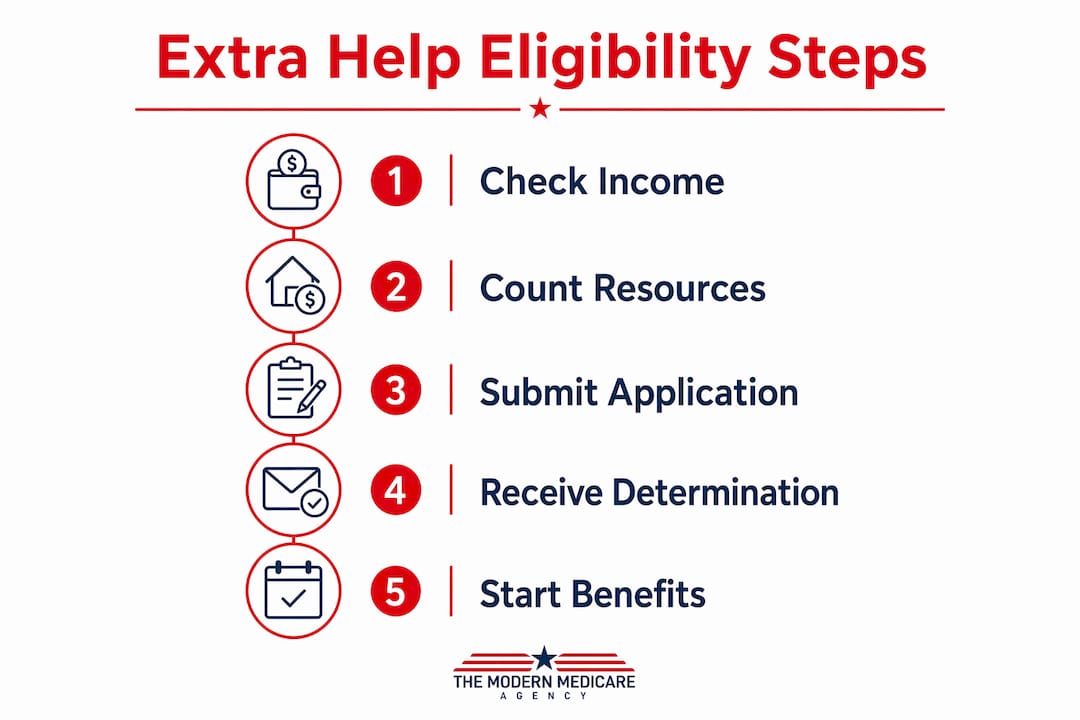
Eligibility for Extra Help depends on two factors: your income and your countable resources. Both must fall below federal thresholds for 2026.
Income limits for 2026
The 2026 income limits are approximately $23,940 per year for individuals and $32,460 per year for married couples. These figures represent 150% of the Federal Poverty Level. That threshold is higher than many seniors expect, which means more people qualify than realize it.
Resource limits for 2026
| Household size | Resource limit |
|---|---|
| Individual | $16,590 |
| Married couple | $33,100 |
Countable resources include bank accounts, stocks, bonds, and mutual funds. Your primary home, one car, personal belongings, and life insurance policies with limited cash value are generally excluded from the count.
Automatic enrollment categories
Three groups qualify for Extra Help automatically and do not need to file a separate application:
- People enrolled in full Medicaid
- People enrolled in a Medicare Savings Program
- People receiving Supplemental Security Income (SSI)
The Social Security Administration confirms that many applicants misunderstand these automatic paths and miss benefits they already earned. If you receive any of the three benefits above, your Extra Help enrollment is triggered without any additional paperwork.
One critical nuance: SSA applies a $20 monthly income disregard when calculating your countable income. That means your reported income is effectively reduced by $20 before SSA compares it to the limit. A senior with $23,960 in annual income is not automatically disqualified because of that disregard.
Pro Tip: Apply even if your income looks slightly above the limit. State-specific disregards and asset exclusions can bring your countable income or resources below the threshold.
How to apply for Extra Help and what to expect
The Social Security Administration processes all Extra Help applications. Medicare itself and your drug plan do not handle these applications. That distinction matters because many seniors contact the wrong agency and experience unnecessary delays.
You have three ways to apply:
- Online. Visit SSA.gov and complete the Extra Help application directly. The process takes roughly 15–20 minutes if you have your financial documents ready.
- By phone. Call SSA at 1-800-772-1213. Representatives can walk you through the application and answer questions about your specific situation.
- In person. Visit your local SSA office. Bring all financial documents with you to avoid a follow-up visit.
There is no fee to apply. Processing times vary, but SSA typically sends a decision letter within a few weeks. You can call SSA to check your application status at any time.
Gather these documents before you apply:
- Recent bank statements for all accounts
- Investment account balances, including mutual funds and IRA/401(k) balances
- Social Security award letter or most recent benefit statement
- Any pension or annuity income documentation
Failing to report all financial assets is the most common reason applications get delayed or denied. SSA counts IRAs and 401(k) balances as resources, which surprises many applicants. Report everything accurately upfront.
Pro Tip: If SSA sends a request for more information, respond within the stated deadline. Missing that window restarts the process and delays your benefits.
How does Extra Help relate to Medicare Savings Programs and other assistance?
Extra Help and Medicare Savings Programs are separate programs that serve different purposes. Confusing them is one of the most common mistakes seniors make when seeking Medicare financial assistance.
Medicare Savings Programs (MSPs) help with Part A and Part B costs, such as premiums, deductibles, and coinsurance. Extra Help strictly covers Part D prescription drug costs. They operate under different income and resource rules, and different agencies administer them at the state level for MSPs versus the federal level for Extra Help.
The connection between the two programs works in one direction. If you qualify for an MSP, you automatically qualify for Extra Help. The reverse is not true. A senior who qualifies for Extra Help based on income may not qualify for an MSP if their income falls in a different range.
Key distinctions to keep in mind:
- MSPs are administered by your state Medicaid agency. Extra Help is administered by SSA.
- You may need to apply separately for each program if automatic enrollment does not apply.
- Some seniors qualify for both programs simultaneously, which creates the most complete cost reduction across all parts of Medicare.
- A senior enrolled in the Qualified Medicare Beneficiary (QMB) program, one type of MSP, automatically receives Extra Help for their drug costs.
If you are unsure whether you qualify for an MSP, contact your state Medicaid office. Paulbinsurance can also help you identify which programs apply to your situation and walk you through the Medicare eligibility process.
What practical tips help applicants avoid common Extra Help mistakes?
Most Extra Help problems are preventable. The issues that delay or derail applications follow predictable patterns.
- Check for automatic qualification first. If you receive Medicaid, SSI, or participate in an MSP, you already qualify. Applying separately wastes time you do not need to spend.
- Report every financial account. SSA counts mutual funds, IRAs, and 401(k) balances as resources. Omitting them triggers a request for more information and delays your benefits.
- Use the $20 income disregard. SSA subtracts $20 from your monthly countable income automatically. Factor that in before assuming you earn too much to qualify.
- Reapply after a denial. A denial is not permanent. If your income or resources change, or if you believe SSA made an error, you can appeal or reapply.
- Review your status annually. Extra Help eligibility is reviewed each year. If your income or resources change significantly, your benefit level may change too.
Pro Tip: If you are denied and believe you qualify, request a formal appeal in writing within 60 days of receiving the denial letter. SSA must review the decision.
Key takeaways
Extra Help is the most direct way for low-income Medicare enrollees to reduce Part D drug costs, and qualifying is more achievable than most seniors expect.
| Point | Details |
|---|---|
| Core benefit | Extra Help eliminates the Part D deductible and caps copays at $5.10 for generics and $12.65 for brand-name drugs in 2026. |
| 2026 income limits | Individuals earning up to $23,940 and couples earning up to $32,460 per year may qualify. |
| Automatic enrollment | Full Medicaid, Medicare Savings Program, and SSI recipients qualify automatically without a separate application. |
| Apply through SSA | The Social Security Administration processes all Extra Help applications, not Medicare or your drug plan. |
| Report all assets | Mutual funds, IRAs, and 401(k) balances count as resources and must be disclosed to avoid delays. |
What I have learned after nearly two decades of helping seniors with Extra Help
After helping Medicare consumers since 2007, I can tell you the single biggest problem with Extra Help is not the program itself. The problem is that eligible seniors do not apply.
I have sat across from clients who were paying $300 or more per month in drug costs when they qualified for Extra Help the entire time. They assumed they earned too much. They assumed the paperwork was too complicated. They assumed someone would have told them if they qualified. None of those assumptions were correct.
The income limits are higher than most people expect. The $20 monthly income disregard alone can push someone under the threshold who thought they were over it. State-specific rules add more flexibility on top of that. The application itself takes less than 30 minutes.
What I tell every client is this: apply first, then decide. SSA will tell you if you do not qualify. You have nothing to lose by submitting the application, and potentially hundreds of dollars per month to gain. I have seen Extra Help transform a senior’s financial situation more than almost any other single benefit available to them.
The other mistake I see regularly is people confusing Extra Help with Medicare Savings Programs and giving up when they hear they do not qualify for one. These are different programs with different rules. Qualifying for one does not determine whether you qualify for the other. Always check both.
If you are not sure where to start, that is exactly what Paulbinsurance is here for.
— Paul
How Paulbinsurance helps you get the most from Medicare Part D
Paulbinsurance is a team of independent Medicare specialists who have been helping seniors understand their options since 2007. Education comes first. You cannot make a good decision about your coverage without understanding what is available to you.

If you are trying to figure out whether you qualify for Extra Help, which Part D plan fits your medications, or how to combine Extra Help with other Medicare benefits, Paulbinsurance can walk you through it step by step. Start with a clear picture of your Part D options and build from there. For a broader look at your Medicare coverage choices, the Medicare eligibility guide is a strong starting point. Reach out to Paulbinsurance directly for personalized guidance at no cost to you.
FAQ
What is Extra Help for Medicare Part D?
Extra Help, also called the Low-Income Subsidy (LIS), is a federal program that reduces Medicare Part D prescription drug costs for enrollees with limited income and resources. It covers premiums up to a benchmark, eliminates the deductible, and caps copays at $5.10 for generics and $12.65 for brand-name drugs in 2026.
How do I qualify for Extra Help in 2026?
Your income must fall below approximately $23,940 per year as an individual or $32,460 as a married couple, and your resources must stay under $16,590 or $33,100 respectively. Receiving full Medicaid, SSI, or a Medicare Savings Program automatically qualifies you without a separate application.
Who processes Extra Help applications?
The Social Security Administration processes all Extra Help applications. Your Medicare drug plan and Medicare itself do not handle these applications, so contact SSA directly online, by phone, or in person.
Does Extra Help cover all my drug costs?
Extra Help does not cover 100% of all drug costs in every case. It eliminates the deductible, subsidizes premiums up to the regional benchmark, and caps copays. After reaching the out-of-pocket limit, your costs drop to $0 under catastrophic coverage.
Can I qualify for both Extra Help and a Medicare Savings Program?
Yes. These are separate programs with separate eligibility rules. Enrolling in a Medicare Savings Program automatically qualifies you for Extra Help, but qualifying for Extra Help alone does not guarantee MSP eligibility. Check both programs independently through SSA and your state Medicaid office.
Recommended
- Medicare Part D Explained: Your Simple Guide to Prescription Drug Plans – The Modern Medicare Agency
- Medicare Part D Drug Coverage Guide: Clear Steps to Compare Plans and Save on Prescriptions – The Modern Medicare Agency
- What Is Medicare Extra Help Program for Prescriptions: A Guide to Assistance with Drug Costs – The Modern Medicare Agency