Does the thought of choosing a Medicare prescription drug plan for 2026 leave you feeling completely overwhelmed? If you’re staring at a long list of options, confused by terms like ‘formulary’ and the ‘donut hole,’ you are not alone. This process can be incredibly stressful, and the fear of choosing the wrong coverage-and paying far too much for your essential medications-is very real. We believe finding the best medicare part d plans shouldn’t feel like navigating a maze blindfolded.
This simple guide is your clear path forward. We are here to provide the trusted guidance you deserve, moving you from confusion to confidence. We will break down the 5 critical factors for comparing prescription drug plans, explained in simple terms. Our promise is to empower you with the knowledge to confidently choose the right coverage for your specific needs, ensuring you get your medications at the lowest possible cost and avoid any costly mistakes. Let’s begin.
Key Takeaways
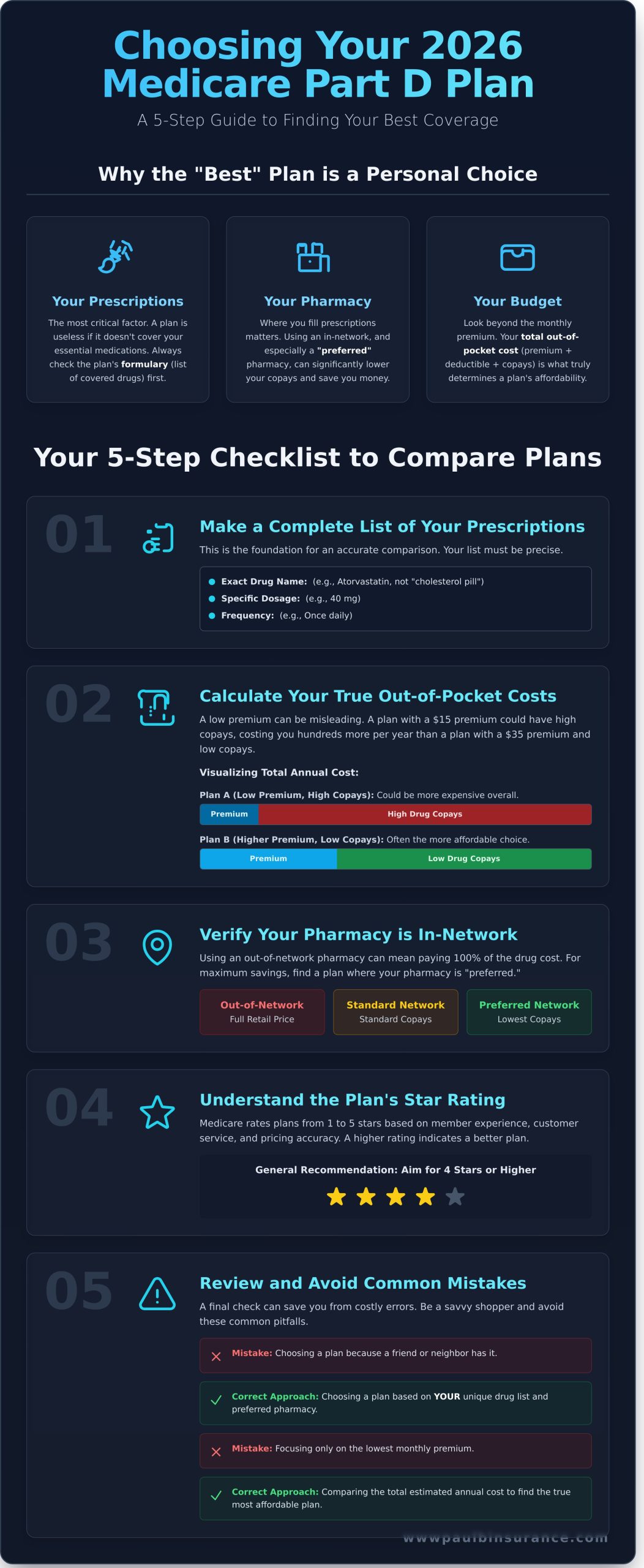
- Discover why the “best” Part D plan is always a personal choice based on your specific prescriptions, pharmacy, and budget.
- Follow a simple 5-step checklist to confidently compare options and find the best Medicare Part D plans for your unique needs.
- Learn to recognize and avoid the most common and costly mistakes people make when choosing their prescription drug coverage.
- Get a clear, unbiased overview of the major insurance carriers so you can understand the landscape without the sales pressure.
Why the ‘Best’ Part D Plan Is Always a Personal Choice
Have you ever heard a friend or neighbor rave about their Medicare plan? It’s tempting to think that what works for them will work for you. But when it comes to prescription drug coverage, that assumption can be a costly mistake. Finding the best medicare part d plans isn’t about chasing the one with the best national rating; it’s about finding the one that perfectly matches your unique health needs.
The entire decision rests on three personal pillars:
- Your Prescriptions: The specific medications you take today.
- Your Pharmacy: Where you prefer to pick up your prescriptions.
- Your Budget: Your total out-of-pocket costs, not just the monthly premium.
The goal is to find the plan that is built for your medicine cabinet. This starts with understanding the basics. A standalone Medicare Part D Plan (PDP) is a private insurance policy designed to help cover the cost of prescription drugs. If you’re enrolled in Original Medicare (Parts A and B), with or without a Medigap plan, you will need to enroll in a PDP to get drug coverage. For a deeper dive into the program’s history and structure, you can explore this overview of What is Medicare Part D? from a trusted source.
The Formulary: Your Personal Drug List is #1
Every Part D plan has a formulary, which is simply its list of covered prescription drugs. This is the single most important factor in your decision. Before you even look at the premium, you must confirm that all of your essential medications are on the plan’s formulary. Choosing a plan that doesn’t cover your daily medication is like buying a car with no engine-it won’t get you where you need to go.
Total Costs vs. Monthly Premiums
It’s easy to be drawn to a plan with a very low monthly premium. However, the premium is only one piece of the cost puzzle. You must also consider the plan’s deductible, copayments, and coinsurance. A plan with a $15 premium might charge you a $47 copay for a key medication, while a $35 premium plan might only charge a $12 copay for the same drug. The “cheaper” plan could cost you hundreds more over the year.
Your Pharmacy Network Matters
Part D plans contract with a network of pharmacies to offer better pricing. Using an out-of-network pharmacy can mean paying the full retail price for your drugs. Even within the network, plans often have “preferred” pharmacies where your copays will be significantly lower than at a “standard” in-network pharmacy. Checking that your local, trusted pharmacy is “preferred” in a plan’s network can lead to substantial savings and convenience.
Your 5-Step Checklist to Compare Part D Plans Like a Pro
Navigating the world of prescription drug coverage can feel like a maze, leaving you stressed and uncertain. But it doesn’t have to be that way. We’ve created this simple, step-by-step checklist to remove the guesswork. By following these steps, you can confidently compare your options and find one of the best Medicare Part D plans that truly fits your health needs and budget.
Step 1: Make a Complete List of Your Prescriptions
This is the single most important step. Before you can compare plans, you need a perfect snapshot of your medication needs. Gather all your prescription bottles and create a detailed list. Be sure to include:
- The exact drug name (e.g., Atorvastatin, not just “cholesterol pill”)
- The specific dosage (e.g., 40 mg)
- How often you take it (e.g., once daily)
This list is the foundation for an accurate and personalized comparison.
Step 2: Calculate Your True Out-of-Pocket Costs
The monthly premium is only one piece of the puzzle. To understand the true financial impact of a plan, you must look at the total estimated cost for the year. This includes the monthly premium, the annual deductible, and your estimated copays for all your specific medications. You can do this by entering your drug list into the official Medicare Plan Finder tool or by working with a trusted, independent broker who can run these comparisons for you.
Step 3: Verify Your Pharmacy is In-Network
Using an out-of-network pharmacy can lead to paying the full retail price for your drugs. Always check a plan’s pharmacy directory to confirm your local pharmacy is included. For the lowest costs, check if your pharmacy is a preferred location, as your copays will often be lower there. Also, consider if a plan offers a mail-order pharmacy option, which can be a convenient and cost-effective way to get your maintenance medications.
Step 4: Understand the Plan’s Star Rating
Medicare uses a simple 1-to-5-star rating system to measure the quality and performance of Part D plans. These ratings are based on real member experiences and cover areas like customer service, accuracy of pricing, and how well the plan handles appeals. A higher star rating is a strong indicator of a better overall experience. As a general rule, we advise clients to focus on plans with 4 stars or higher whenever possible.
Who Are the Major Part D Providers in 2026?
As you begin your search for the best Medicare Part D plans, you will quickly notice a handful of major insurance carriers that seem to be everywhere. It can feel overwhelming, with each company claiming to offer the best coverage. It’s important to remember that this is not a ranking. The “best” plan for your neighbor might be a costly mistake for you, depending entirely on your prescriptions, preferred pharmacy, and location.
Think of this as a simple introduction to the names you’ll likely encounter. Our goal is to cut through the noise and give you clarity. The most effective way to compare these options side-by-side is with the help of an unbiased, independent broker who works for you, not the insurance company.
Wellcare, Humana, and Aetna
These three companies are national powerhouses in the Part D market. You will often find they offer a wide variety of plans, some with very competitive monthly premiums. They typically have large, national pharmacy networks, which provides flexibility. However, it’s crucial to look beyond the premium and check the specific formulary, deductible, and copay details for the exact plan available in your service area.
AARP / UnitedHealthcare
Many people recognize the AARP brand, which lends its name to prescription drug plans administered by UnitedHealthcare (UHC). Their strong brand recognition and widespread availability make them a popular choice. When you see analyses of the major Part D providers, UHC is consistently mentioned. Just remember to treat them like any other option-diligently compare their drug formulary and costs to ensure they truly cover your specific medications affordably.
Navigating Your Local and Regional Options
Don’t overlook the smaller players. In many states, regional insurance carriers offer highly competitive Part D plans that can be an excellent fit. These local companies sometimes provide outstanding value, more personalized customer service, or networks tailored to your community. Comparing these lesser-known gems against the national giants is a critical step in finding the right coverage.
Feeling overwhelmed by the options? That’s completely normal, but you don’t have to do this alone. Let us do the comparison for you, for free. We simplify the process so you can move from confusion to confidence.
Common Mistakes to Avoid When Choosing Your Part D Plan
Navigating the options to find the best medicare part d plans can feel overwhelming, but you can move forward with confidence by avoiding a few common pitfalls. We’ve seen these simple errors cost people hundreds, even thousands, of dollars each year. The good news? They are entirely preventable with the right guidance.
Here are three frequent mistakes and, more importantly, how to steer clear of them.
Mistake #1: The Low-Premium Trap
It’s natural to gravitate toward the plan with the lowest monthly premium, but this is often a costly oversight. A plan with a $15 monthly premium might look appealing, but it could have a high deductible and steep copays for your specific medications. In contrast, a $40 premium plan could cover your drugs with much lower out-of-pocket costs, saving you a significant amount over the year.
The Right Way: Always look at the bigger picture. Calculate your total estimated annual cost, which includes your monthly premiums, the annual deductible, and all your prescription copayments.
Mistake #2: Forgetting to Check the Formulary
Imagine going to the pharmacy in January only to discover your new plan doesn’t cover a critical medication you take every day. This stressful and expensive situation is completely avoidable. A plan’s formulary-its official list of covered drugs-is the most important document to check before you enroll.
The Right Way: Before committing to a plan, you must verify that every single one of your prescriptions is on its formulary. Also, check which “tier” your drugs fall into, as this determines your copay amount.
Mistake #3: Missing Your Enrollment Period
When you first become eligible for Medicare, you have a 7-month Initial Enrollment Period to sign up for Part D. If you miss this window and don’t have other creditable drug coverage, you could be charged a Late Enrollment Penalty. This isn’t a one-time fee; it’s a permanent addition to your monthly premium for as long as you have Part D coverage.
The Right Way: Be proactive and understand your personal deadlines. If you feel unsure about your timeline or want to ensure you get it right, working with a trusted expert can provide the clarity and peace of mind you deserve. We help our clients steer clear of costly mistakes so they can enroll with complete confidence. To see how we can help, visit us at www.paulbinsurance.com.
From Part D Confusion to Total Confidence
As we’ve explored, the right prescription drug plan is never a one-size-fits-all solution-it’s the one that perfectly matches your medications and budget. By following a clear checklist and steering clear of common pitfalls, you can navigate your options with far less stress. You don’t have to sort through the best medicare part d plans on your own.
If you’re ready to trade complexity for clarity, we are here to help. We offer trusted, unbiased advice on plans from over 40 top carriers, providing the personalized support you need to avoid costly mistakes. Our goal is simple: to give you the peace of mind that comes from making a truly informed decision.
Let us help you find your perfect fit with confidence. Schedule a free, no-obligation call to find the best Part D plan for you.
Frequently Asked Questions About Medicare Part D
What is the Medicare Part D ‘Donut Hole’ or Coverage Gap?
The ‘Donut Hole’ is a term for the Medicare Part D coverage gap. This phase begins after you and your plan have spent a certain amount on covered drugs. While in the gap, you are responsible for paying a higher portion of your medication costs, typically 25%. Once your out-of-pocket spending reaches a specific limit, you leave the gap and enter the ‘Catastrophic Coverage’ phase, where your drug costs are significantly reduced for the rest of the year.
Can I change my Medicare Part D plan if I’m unhappy with it?
Yes, you can absolutely change your plan, but only during designated enrollment periods. The main opportunity is the Annual Enrollment Period, which runs from October 15 to December 7 each year. This is the ideal time to review your current coverage and ensure you have one of the best medicare part d plans for your needs. Certain life events, such as moving, may also qualify you for a Special Enrollment Period to make a change outside of this window.
Do I need to enroll in Part D if I don’t currently take any prescriptions?
We strongly advise enrolling in a low-premium Part D plan even if you don’t currently take medications. If you wait to enroll and don’t have other creditable drug coverage, you will likely face a permanent Late Enrollment Penalty. This penalty is added to your monthly premium for as long as you have Part D. Securing a plan when you are first eligible is a simple, proactive step to avoid future costs and give you peace of mind.
Are prescription drug plans included with Medicare Advantage plans?
Most Medicare Advantage (Part C) plans do include prescription drug coverage. These are known as Medicare Advantage Prescription Drug (MA-PD) plans and bundle your health and drug benefits together for simplicity. However, not all Medicare Advantage plans include this benefit, so it is crucial to verify the details of any plan you consider. You cannot be enrolled in a standalone Part D plan and a Medicare Advantage plan that includes drug coverage at the same time.
What is the Part D Late Enrollment Penalty and how is it calculated?
The Late Enrollment Penalty is a fee added to your monthly premium if you go without creditable prescription drug coverage for 63 consecutive days or more after you’re first eligible for Medicare. The penalty is calculated as 1% of the national base beneficiary premium for each full month you were without coverage. This amount is then added to your monthly Part D premium permanently. We help our clients understand the rules to avoid this costly and unnecessary penalty.
How do I know if I qualify for ‘Extra Help’ with my Part D costs?
‘Extra Help’ is a federal program designed to help people with limited income and resources pay for their Medicare Part D costs, including premiums, deductibles, and co-pays. The easiest way to see if you qualify is to apply directly through the Social Security Administration’s website or by phone. If you are already enrolled in other programs like Medicaid or Supplemental Security Income (SSI), you may automatically qualify for this valuable assistance. It is always worth checking your eligibility.