




Yes, disabled individuals can hold hospital indemnity insurance, and for many, it pays out exactly when a hospital stay would otherwise wreck the household budget. Being on SSDI, SSI, Medicare, or Medicaid does not disqualify you from buying or keeping a hospital indemnity plan. These policies pay a fixed cash benefit directly to you, not to a hospital or doctor, and you can spend that money on anything: rent, a co-pay, gas money for a family member driving in from out of town, or groceries while you’re out of work.
Two facts matter before you go any further. First, Medicare does not typically pay hospital indemnity benefits itself, because indemnity coverage is a separate, voluntary product that pays you, not a claim Medicare processes. Second, many employer group plans offer a guaranteed-issue window when you first become eligible, meaning you can enroll without medical underwriting, which matters a lot if you have a chronic condition tied to your disability.
Here’s what to do right now if you’re weighing this decision:
- Pull your current certificate of coverage if you already have hospital indemnity through work, retirement, or a private policy.
- Check whether you’re inside a guaranteed-issue enrollment window (usually tied to a new job, open enrollment, or a qualifying life event).
- Ask specifically about the waiting period before benefits start and any preexisting-condition exclusion.
- Gather admission and discharge paperwork templates now, before you need them, so a claim moves faster later.
- Confirm whether the policy includes a premium-waiver rider if you become totally disabled.
A quick checklist for the undecided reader:
- Do you already have a Medigap or Medicare Advantage plan with hospital cost-sharing you can’t fully absorb?
- Would a $100 to $300 daily cash payment meaningfully offset your deductible or lost income during a hospital stay?
- Is your household running on a fixed disability income where a $2,000 hospital bill would cause real strain?
Key Takeaways
Hospital indemnity insurance pays a fixed cash benefit to disabled individuals for covered hospital events, and it works alongside Medicare, Medicaid, SSDI, SSI, and VA benefits rather than replacing them.
| Point | Details |
|---|---|
| Coverage eligibility | Being on SSDI, SSI, Medicare, or Medicaid does not block you from buying hospital indemnity insurance. |
| Cash goes to you | Benefits pay the policyholder directly and can cover deductibles, travel, lodging, or lost income. |
| Watch the waiting period | Most plans impose a 30 to 90 day wait and a 12-month preexisting-condition exclusion. |
| Best for acute events | Indemnity pays off most clearly for sudden inpatient stays, not chronic outpatient management. |
| Get expert coordination | Paulbinsurance helps disabled clients compare hospital indemnity against Medigap and Medicare Advantage options before choosing a plan. |
Table of Contents
- Hospital Indemnity Benefits Disabled Individuals Need to Understand First
- Coordinating Hospital Indemnity With Medicare, Medicaid, SSDI, SSI, and VA Benefits
- What Hospital Indemnity Actually Pays: Real Numbers to Expect
- Enrollment Windows, Waiting Periods, and Whether You Can Keep the Plan
- Filing a Hospital Indemnity Claim Step by Step
- Weighing the Pros and Cons for Disabled Buyers
- Choosing a Plan and the Questions Worth Asking Your Agent
- An Agent’s View on Hospital Indemnity for Disabled Clients
- How Paulbinsurance Can Help You Compare Hospital Indemnity Options
- Sources
Hospital Indemnity Benefits Disabled Individuals Need to Understand First
Hospital indemnity insurance pays a fixed cash amount when a covered event happens, like a hospital admission, rather than reimbursing a provider for actual charges. Michigan’s state benefits office describes it plainly: it’s a voluntary benefit meant to help cover out-of-pocket expenses tied to a hospital stay, and the payment goes to the insured person, not the hospital.
That distinction is the whole point of the product. Major medical insurance, Medicare, and Medicaid pay providers according to contracted rates and cost-sharing rules. Hospital indemnity coverage skips that process entirely and cuts you a check.
Most plans build benefits around a handful of common triggers:
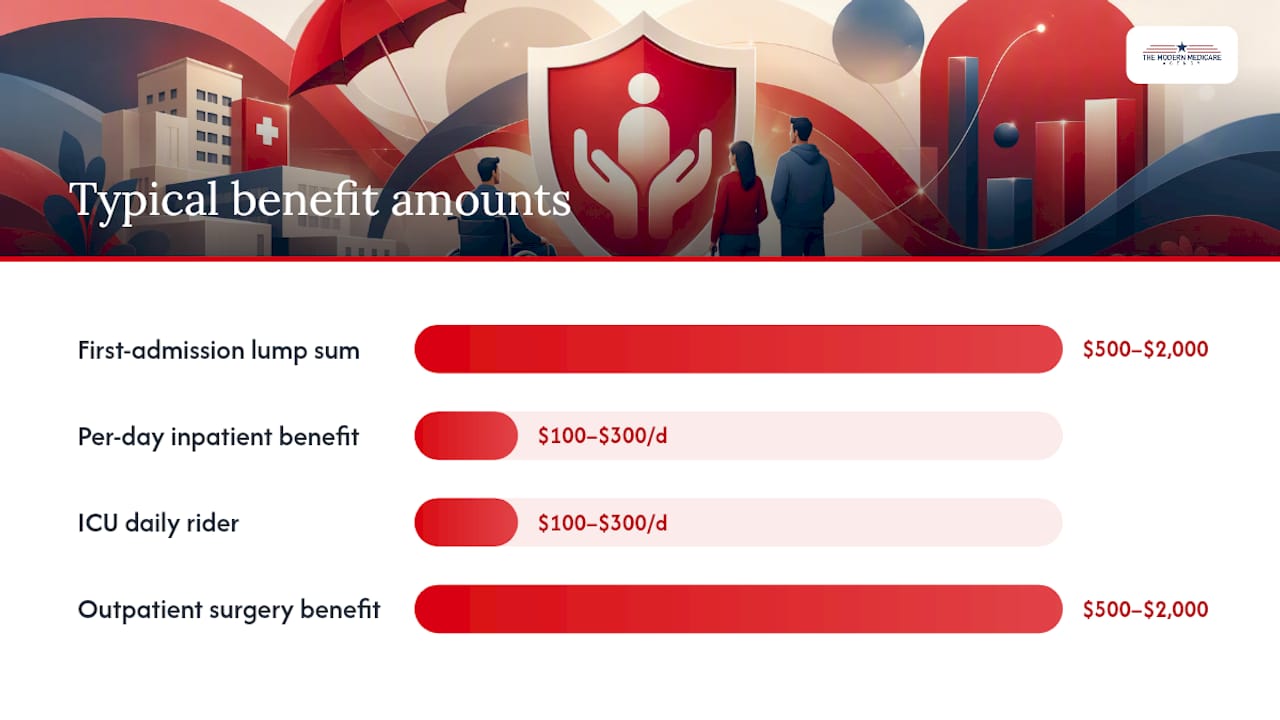
- First-admission lump sum: a one-time payment, often $500 to $2,000, triggered the moment you’re admitted as an inpatient.
- Per-day inpatient benefit: a daily cash payment, commonly $100 to $300, for each day you stay in the hospital.
- ICU rider: an enhanced daily benefit, sometimes double the standard rate, for time spent in intensive or critical care.
- Outpatient surgery benefit: a smaller fixed payment for scheduled procedures that don’t require an overnight stay.
- Ancillary or surgical benefits: added payments for anesthesia, diagnostic testing, or specific surgical categories listed in the policy.
A stay typically has to meet a minimum threshold of inpatient admission of about a day before the per-day benefit kicks in. Once it does, you decide where the money goes.
A cash indemnity benefit doesn’t care what your actual hospital bill says. If your policy pays $150 a day and you’re admitted for four days, you get $600, whether your real out-of-pocket cost was $300 or $3,000.
That flexibility cuts both ways. It’s generous when your actual costs are low, and it can fall short if your hospitalization runs long or expensive, which is why indemnity works best as a supplement, not a replacement for major medical coverage.
Coordinating Hospital Indemnity With Medicare, Medicaid, SSDI, SSI, and VA Benefits
Disabled individuals juggle more moving pieces than most buyers: Medicare eligibility timing, Medicaid asset rules, SSDI waiting periods, and sometimes VA health benefits on top of it all. Hospital indemnity coordinates with each of these differently, and understanding those seams is where most confusion happens.

Medicare and Medicaid. Enrolling in Medicare or Medicaid does not block you from buying hospital indemnity insurance. Because indemnity pays cash directly to you rather than duplicating a claim, it doesn’t conflict with how Medicare or Medicaid processes hospital charges. The health care law also guarantees that Marketplace plans must cover preexisting conditions from day one of coverage and can’t impose annual or lifetime dollar limits, which matters if you’re weighing Marketplace coverage alongside a supplemental indemnity policy while waiting out a disability-related Medicare waiting period.
SSDI and SSI timing. People approved for SSDI generally face a 24-month wait before Medicare coverage begins. During that window, a hospital indemnity plan purchased earlier, say through an employer, often keeps paying benefits regardless of your SSDI status, as long as premiums stay current. If your plan is portable, meaning you can carry it after leaving the job that offered it, that continuity becomes especially valuable while you wait for Medicare eligibility to catch up with your disability determination. Readers navigating this specific gap should look at how Medicare options work for disabled individuals under 65 before assuming Medicare solves everything on day one.
VA and veteran-specific coordination. The VA publishes its own copay schedule and notes that some veterans are exempt from copays depending on service connection and eligibility category. For veterans who do owe copays, or who need to cover costs the VA doesn’t pay at all, like travel to a VA medical center or lodging for a family member during a long stay, hospital indemnity insurance can fill that specific gap. It’s a nonmedical cash cushion sitting alongside whatever VA health care already covers, not a replacement for it.
Before enrolling, confirm five things with your agent or HR representative:
- Whether you qualify for guaranteed-issue enrollment given your disability status.
- The exact length of the waiting period before benefits activate.
- Whether a preexisting-condition exclusion applies to your specific diagnosis.
- Whether the plan is portable if you leave your current job.
- Whether a waiver-of-premium rider applies if you become totally disabled after enrolling.
Guaranteed issue at a job-based enrollment is often the easiest door into hospital indemnity coverage a disabled person will ever walk through. Miss that window, and you may face medical underwriting later.
What Hospital Indemnity Actually Pays: Real Numbers to Expect
Benefit amounts vary by carrier and plan tier, but industry brochures give a useful range. A typical entry-level plan pays a smaller daily benefit with a lower premium; a higher-tier plan pays more per day and costs more monthly. Plan documents commonly show a 12-month preexisting-condition limitation and a premium-waiver rider for total disability as standard features, according to one widely used group plan brochure.
Here’s how three common scenarios play out:
- A three-day hospitalization for pneumonia. A plan paying a typical first-admission benefit plus a moderate per-day amount covers three days with a meaningful lump sum and daily benefit combined. That can cover a Medicare Advantage plan’s inpatient copay and leave money left over for transportation and missed grocery runs.
- A scheduled outpatient surgery. A plan with an outpatient benefit pays a flat amount regardless of the procedure’s actual billed cost, which helps offset anesthesia fees or a facility copay that Medicare Part B coinsurance doesn’t fully cover.
- A ten-day ICU stay following a stroke. A plan with a higher first-admission benefit, a substantial daily rate, and an enhanced ICU rider pays a combined amount that can cover significant expenses during a prolonged hospitalization. That kind of payout can cover a household’s rent and utilities for a month while a disabled policyholder’s SSDI check is delayed or reduced by the disruption.
| Benefit type | Typical range | What it commonly offsets |
|---|---|---|
| First-admission lump sum | $500 to $2,000 | Deductibles, immediate travel or lodging costs |
| Per-day inpatient benefit | $100 to $300 per day | Lost income, household bills during a stay |
| ICU daily rider | $100 to $300 per day | Higher-intensity care costs, extended family travel |
| Outpatient surgery benefit | $500 to $2,000 | Copays, anesthesia fees, facility charges |
Higher daily benefits mean higher monthly premiums, so the math is a trade-off. A policy paying $300 a day will cost noticeably more each month than one paying $100 a day. Employer benefit guides increasingly pair hospital indemnity with short-term disability coverage specifically because the two products cover different gaps: one replaces a portion of income, the other pays a fixed hospital-related cash benefit on top of it.
Enrollment Windows, Waiting Periods, and Whether You Can Keep the Plan
Most people access hospital indemnity through one of three doors: employer voluntary benefits enrollment, an individual market purchase, or an association or membership plan. Employer enrollment is usually the friendliest path for disabled applicants because it frequently comes with guaranteed issue, meaning no health questions, no medical exam, during the initial eligibility window.
Waiting periods and exclusions follow a fairly predictable pattern across the industry:
- A waiting period of 30 to 90 days often applies before any benefit becomes payable, even for a covered accident or illness.
- A preexisting-condition limitation, commonly a “12/12” rule, excludes benefits tied to conditions treated in the 12 months before your effective date, for the first 12 months of the policy.
- State variation is real: some states cap preexisting exclusion periods more tightly than others, and a few restrict how insurers can define “preexisting” at all.
- Portability determines whether you keep the policy if you leave the job that offered it. Some voluntary plans are fully portable at the same premium; others terminate the moment employment ends.
Here’s your enrollment action list:
- Ask directly: “Is this plan guaranteed issue for someone with my disability history, or will I face medical underwriting?”
- Get the exact waiting period in writing, not verbally summarized.
- Ask how the preexisting-condition clause defines your specific diagnosis.
- Confirm portability terms before you count on the plan long term.
- Request the full certificate of coverage, not just a benefits summary flyer, and read the exclusions section.
That certificate of coverage is the actual contract. Benefits summaries handed out during open enrollment simplify things for speed, but the certificate spells out every exclusion that could affect a claim later.
Filing a Hospital Indemnity Claim Step by Step
Getting paid after a hospital stay comes down to paperwork discipline more than anything complicated. Here’s the process most carriers follow:
- Notify the insurer or your HR benefits contact as soon as reasonably possible after admission or discharge.
- Request and complete the claim form, either through an online portal or a paper form mailed by the carrier.
- Attach hospital admission and discharge records showing dates of service and the reason for admission.
- Submit an itemized bill if the carrier requires proof of specific charges, though many indemnity claims don’t need this since the benefit is fixed, not cost-based.
- Follow up within two weeks if you haven’t received confirmation that the claim was received and is being processed.
Your document checklist before you submit:
- Hospital admission and discharge summary with exact dates.
- Government-issued proof of identity matching the policyholder name.
- Completed and signed claim form.
- Policy or certificate number.
- Physician statement, if the carrier’s form requires one for the specific benefit triggered.
Most straightforward claims pay out within two to four weeks once complete documentation arrives. Delays almost always trace back to one of three causes: missing discharge paperwork, a preexisting-condition question that requires medical records review, or a mismatch between the dates on the claim form and the dates on the hospital records.
Pro Tip: Ask the hospital’s discharge planner for a printed admission and discharge summary before you leave. Getting it on the spot saves you a follow-up call to medical records later, and it’s often the single document that determines how fast your claim gets paid.
Weighing the Pros and Cons for Disabled Buyers
Hospital indemnity insurance isn’t automatically the right move for every disabled person, and it helps to be honest about where it shines and where it falls short.
| Factor | Where indemnity helps | Where it falls short |
|---|---|---|
| Cash flexibility | Pays you directly, usable for any expense | Fixed amount, unrelated to actual bill size |
| Cost for short stays | Strong value for one to three day admissions | Weak value for extended, complex hospitalizations |
| Coordination | Works alongside Medicare, Medicaid, VA, SSDI | Does not reduce your major medical cost-sharing |
| Enrollment access | Guaranteed issue common at group enrollment | Individual market plans may require underwriting |
| Chronic conditions | Helps with acute flare-ups requiring admission | Limited help for ongoing outpatient management |
A broker-focused knowledge base frames hospital indemnity as an affordable supplemental layer that stabilizes household finances during a hospitalization, and that framing holds up for most disabled buyers facing acute, short-term events. It holds up less well for someone managing a chronic condition through frequent outpatient visits rather than inpatient admissions.
Red flags worth checking before you sign anything:
- No portability clause, meaning the coverage disappears the day you leave your job.
- A preexisting-condition exclusion longer than 12 months.
- Coverage that only pays for inpatient events, leaving chronic outpatient management completely uncovered.
- No premium-waiver rider despite marketing that targets disabled buyers specifically.
If your real risk is ongoing outpatient costs rather than occasional hospital admissions, a Medicare Supplement plan built for people under 65 on disability or a dedicated emergency savings fund may do more for you than an indemnity policy. Indemnity earns its premium during acute, sudden hospitalizations, not chronic day-to-day care.
Choosing a Plan and the Questions Worth Asking Your Agent
Comparing hospital indemnity plans comes down to five factors that matter more than any marketing brochure:
- Daily and first-admission benefit amount: higher payouts cost more, but they close a bigger gap during a real stay.
- Monthly premium: weigh it against how likely you are to actually use inpatient care given your specific health history.
- Waiting period: a 90-day wait means no benefit if you’re hospitalized in month two.
- Preexisting-condition rules: get the exact exclusion language for your diagnosis in writing.
- Portability: confirm whether the plan survives a job change, since disability status sometimes forces unpredictable work transitions.
Bring these questions to whoever is helping you enroll:
- “Can I see the actual certificate of coverage, not just the benefits summary?”
- “Does this policy include a waiver-of-premium rider if I become totally disabled?”
- “How does this plan interact with my Medicare, Medicaid, or VA coverage specifically?”
- “Can you walk me through a real claim example for someone with my type of condition?”
- “What happens to this policy if I leave my current job or my income changes?”
Think in breakeven terms. If your premium runs $25 a month, that’s $300 a year. One three-day hospital stay paying out $1,450, as in the earlier pneumonia example, covers nearly five years of premiums in a single claim. For someone whose disability carries a real chance of at least one inpatient admission over the next several years, that math tends to favor buying the coverage. For someone whose condition rarely, if ever, leads to hospitalization, the calculation looks different, and the premium dollars might work harder elsewhere, in a Medicare Advantage plan with built-in extra benefits, for instance.
An Agent’s View on Hospital Indemnity for Disabled Clients
Clients on SSDI who ask me about hospital indemnity usually fall into one of two camps: people who’ve already had one unexpected hospital stay and felt the financial gap firsthand, or people who are still healthy enough on disability that a hospitalization feels theoretical. I recommend indemnity coverage more readily to the first group, because they already know what a surprise admission costs when Medicare cost-sharing, transportation, and missed income all hit at once.
For clients managing a chronic condition through frequent outpatient visits rather than inpatient stays, I usually steer the conversation toward strengthening Medigap coverage or building a dedicated cash reserve instead, since indemnity’s design rewards acute events, not steady outpatient management. The plan that looks best on paper isn’t always the plan that pays out when it matters, which is why I ask every disabled client to bring me their actual certificate of coverage, not a benefits flyer, before we talk numbers.
If you’re weighing this decision, start by pulling together whatever coverage documents you already have. A short review conversation, grounded in your real diagnosis and your real Medicare or Medicaid status, beats guessing based on a brochure.
How Paulbinsurance Can Help You Compare Hospital Indemnity Options
Paulbinsurance approaches hospital indemnity the way it should be approached for a disabled client: as one piece of a coordinated plan, not a standalone purchase. We help you weigh a hospital indemnity policy against your existing Medicare, Medicaid, or VA coverage so you’re not paying for overlap you don’t need, or worse, leaving a real gap uncovered.

Bring your current certificate of coverage, your Medicare card if you have one, and a rough sense of your monthly budget, and we’ll walk through whether hospital indemnity, a stronger Medigap plan, or some combination fits your situation best. Our review is free, and since Paul Barrett has specialized in Medicare consumer education since 2007, you’re getting a comparison built around your actual coverage, not a single carrier’s sales script. Reach out today to schedule a plan review and find out exactly where your current coverage leaves you exposed.
Sources
- Coverage options for people with disabilities
- Hospital Confinement Indemnity Insurance Plans
- VA copay rates
- 2026 Guide to Hospital Indemnity Insurance for Veterans
This article is general information, not a substitute for advice from a qualified financial advisor. Consult a qualified financial professional about your own circumstances before acting on anything here.