




Before choosing an annuity, start with a practical question: When might you need the money? “How do deferred annuities work?” is easier to answer when you understand the timeline. Money goes into a contract, may accumulate value over time, and can later be paid out under the contract’s terms. The details matter because growth, risk, and access to your money depend on the contract.
A deferred annuity has an accumulation phase and a payout phase. You generally choose when to move from one to the other, subject to the contract’s terms. The type of contract also matters: fixed, variable, and fixed index annuities handle growth and market risk differently.
This guide explains both phases, when payments may begin, and how the main contract types compare. You’ll also learn why an annuity isn’t the same as a savings account, what withdrawal restrictions may apply, and which contract details and tax questions to review before deciding whether one fits your goals in 2026.
Key Takeaways
- Understanding how deferred annuities work starts with separating the period when money may accumulate from the period when you may receive payments.
- Compare fixed, variable, and fixed index annuities by how they handle growth and how much variability you’re comfortable with.
- Before choosing, consider your income timeline, how you’ll fund the contract, access to money, and preferred payout option.
- Review the contract’s withdrawal terms, charges, and tax considerations so you understand potential trade-offs before committing.
- The Modern Medicare Agency is an independent insurance brokerage that offers annuities.
What Is a Deferred Annuity, and When Does Its Income Begin?
Retirement-income products can feel complicated because they combine insurance terms, growth options, and future payment choices. The basic idea is straightforward: a deferred annuity is designed to hold money for a period before you begin taking distributions. Start by understanding the timeline, then compare the contract details in 2026.
A deferred annuity is an insurance contract that delays distributions until a later time, with an accumulation phase followed by a payout phase. During accumulation, the contract operates according to its terms. The payout phase begins when you take distributions or arrange available income payments. This describes the timing, not a promise that the money will grow or provide a particular amount of future income. Those details depend on the contract and its structure.
So, how do deferred annuities work at the most basic level? You put money into an insurance contract with income intended for a later date. That delay is the defining feature. It doesn’t tell you by itself how the value will change, whether it can rise or fall, or what income options will be available. To answer those questions, review the specific terms.
The deferred annuity overview also describes the broad accumulation and distribution phases. Use it as background, then refer to the contract for its actual dates, options, and conditions.
How Is a Deferred Annuity Different From an Immediate Annuity?
The intended start of income is the main distinction. A deferred contract is generally designed for payments later, after a period of accumulation. An immediate annuity is intended to begin payments sooner. “Sooner” doesn’t mean every immediate contract starts on the same date, and a deferred contract’s start date isn’t universal either. The contract determines the timing and available choices.
This distinction helps focus your comparison: do you need income to begin now, or are you considering income for a later stage? Once you know the timeline you have in mind, compare the contract terms rather than assuming a product label sets an exact payment date.
Who Might Explore a Deferred Annuity?
A deferred annuity may be worth exploring if you’re considering future income rather than needing a new payment stream now. For example, someone planning around a later retirement date might compare a contract’s timeline with other expected resources. That example isn’t a recommendation. Whether an annuity makes sense depends on your goals, time horizon, the contract terms, and the other resources available to you.
Before deciding, consider when you might want access to income and whether setting money aside for a future purpose fits your broader needs. A deferred annuity isn’t automatically right for every retiree or saver. Its usefulness depends on the contract and how it fits the role you want it to play.
How Do the Accumulation and Payout Phases Work?
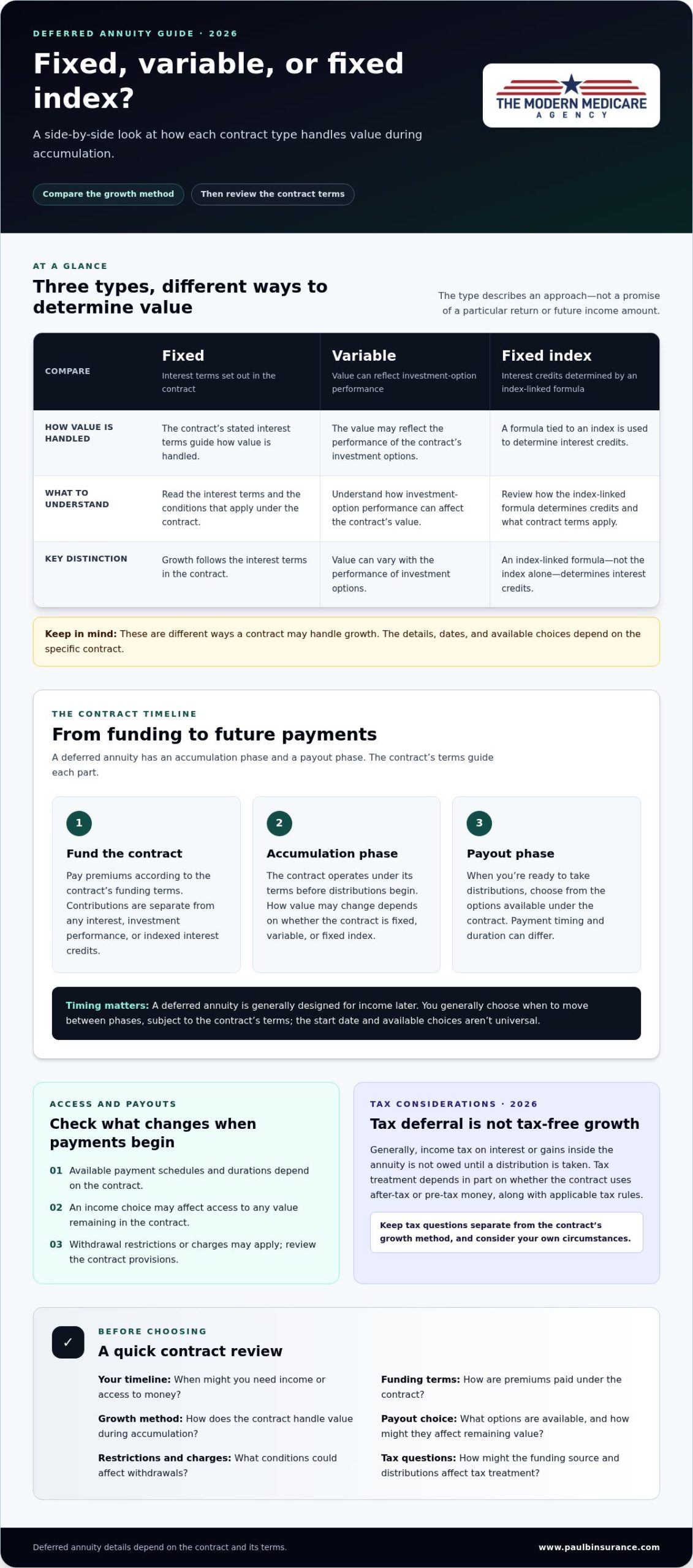
Once you understand the timeline, the process is easier to picture. How do deferred annuities work from the first contribution to future income? Think of three steps: fund the contract according to its terms, let it operate under its rules, then choose an available payout option when you’re ready to take distributions.
- Fund the contract. You pay premiums according to the contract’s funding terms. These contributions are separate from any interest, investment performance, or indexed interest credits the contract may provide.
- Follow the contract terms. During accumulation, the contract’s value is handled according to its structure. The amount and timing of any growth depend on that structure and its terms.
- Choose an available payout option. When you’re ready to receive distributions, the contract’s available choices determine how payments can be arranged. Review how each choice affects access to any remaining value.
What Happens During the Accumulation Phase?
The accumulation phase is the period when money is held in the annuity contract and its value is handled under the contract’s terms, before distributions begin. How the value may change depends on the type of annuity. A fixed annuity uses interest terms set out in the contract. A variable annuity’s value can reflect the performance of its investment options. A fixed index annuity uses a formula tied to an index to determine interest credits. These are different approaches, not interchangeable promises of a particular return.
In 2026, tax deferral generally means you don’t owe income tax on interest or gains inside the annuity until you take a distribution. It doesn’t mean the money grows tax-free. The tax treatment of a distribution depends in part on whether the contract is funded with after-tax or pre-tax money, as well as applicable tax rules. Keep tax questions separate from the contract’s growth method, and review them based on your circumstances.
What Changes When Payments Begin?
When distributions begin, some or all of the contract value may be paid out under the terms you select. Available options may differ in payment schedule and duration, depending on the contract. Don’t assume every annuity offers the same choices or that your preferred start date is automatically available. Read the contract provisions that explain the choices and when you can make them.
There’s an important trade-off to understand: choosing an income option may affect whether and how you can access any value remaining in the contract. The effect depends on the option and contract terms. Before selecting one, consider how predictable payments, flexibility, and access to remaining value fit your needs. Paul B Insurance is an independent insurance brokerage that offers annuities. Learn about Paul B Insurance and its insurance options.
Fixed, Variable, or Fixed Index: How Do Deferred Annuities Compare?
Once you understand the timeline, the next question is how the contract handles growth. Fixed, variable, and fixed index annuities use different approaches. Comparing them side by side can help you identify what matters most: contract-defined interest terms, investment-linked movement, or interest credits calculated using an index-based formula.
Fixed annuities use contract-defined interest terms, variable annuities link value to investment options, and fixed index annuities use a contract formula tied to an index. That distinction is a useful starting point, not a prediction of your results. The label alone doesn’t establish the full contract terms, charges, guarantees, or an individual’s outcome.
| Type | Growth approach | Variability | Questions to investigate |
|---|---|---|---|
| Fixed | Interest or other values are determined by terms in the contract. | Growth follows the contract’s stated terms, subject to its conditions. | What values are defined, for how long, and under what conditions can they change? |
| Variable | Value is linked to investment options selected within the contract. | Value can rise or fall as those options perform. | Which investment options are available, and what charges and risks apply? |
| Fixed index | A contract-defined formula uses changes in an index to calculate interest credits. | Crediting depends on the formula and terms, rather than direct investment in the index. | How does the formula work, and what limits or conditions affect interest credits? |
What Does a Fixed Deferred Annuity Do?
A fixed deferred annuity uses contract terms that define how interest or other promised values are determined. The word “fixed” doesn’t answer every question about how long the terms apply or what conditions affect them. Read the contract to understand what is guaranteed, who makes the guarantee, and when it applies. Don’t rely on a category label or summary alone.
How Do Variable and Fixed Index Deferred Annuities Differ?
With a variable annuity, contract value is connected to investment options, so it can fluctuate with their performance. A fixed index annuity works differently: it uses a contract-defined formula tied to an index to calculate interest credits. The money isn’t directly invested in that index, and index-linked crediting doesn’t mean market gains are guaranteed.
When comparing options in 2026, focus on the mechanics and trade-offs, not just the type name. Find out how value is calculated, what charges apply, what terms can change, and how the contract treats a period of weak investment performance or limited index growth. For a fixed index contract, review the formula and any caps, spreads, or participation rates stated in the contract. For a variable contract, understand how investment choices affect risk and value. This makes “how do deferred annuities work” a more useful question: how does this contract fit your goals and comfort with uncertainty?
What Should You Check Before Choosing a Deferred Annuity?
A deferred annuity is easier to assess when you compare its written terms with the job you want it to do. Use this checklist to identify the details you need to understand. The answers can help you assess whether the contract’s timeline, risks, and access rules fit your needs in 2026.
- Income timing: When might you want income to begin, and does the contract’s timing fit that plan?
- Funding approach: How will you fund the contract, and are the payment terms clear?
- Risk comfort: If the contract’s value can change, how would you feel about that variability?
- Access to money: Could you need to withdraw funds before payments begin? Find the contract’s withdrawal rules and any limits or charges.
- Payout preferences: Which payment schedules or durations are available, and what happens to any value left in the contract?
How Could Fees, Withdrawals, and Access Affect You?
Look in the contract documents for withdrawal provisions, any surrender period, and charges that may apply if you take money out or end the contract early. These terms vary, so don’t assume a standard time period, charge, or penalty-free withdrawal amount. Check how the rules apply to your contract and circumstances. Access matters: money committed to a contract may not be as readily available as money in a savings account.
Tax treatment is a separate question. Under 2026 federal rules, earnings in an annuity generally grow tax-deferred, not tax-free. For a nonqualified annuity funded with after-tax money, withdrawals are generally treated as earnings first, then principal. For a qualified annuity funded with pre-tax money, withdrawals are generally taxable as ordinary income. A 10% federal tax penalty may also apply to the taxable portion of certain withdrawals before age 59½, subject to exceptions. Confirm how current tax rules apply to you with a qualified tax professional.
Which Questions Help Match a Contract to Your Timeline?
Ask yourself: When might I need this income? Could I need earlier access to the money? If the contract’s value can fluctuate, am I comfortable with that? What payout choices are available, and how could my selection affect access to remaining value? Then compare your answers with the written contract, not just a summary or product label.
An insurance professional can help explain an insurance contract, its terms, and available options. Tax questions belong with a qualified tax professional, while investment questions may call for an appropriately qualified investment professional. Paul B Insurance is an independent insurance brokerage that offers annuities. Explore annuity options with Paul B Insurance as you review what a contract is designed to do.
Where Can You Get Help Understanding Deferred Annuity Options?
Even after learning how deferred annuities work, contract language can leave you with questions. A conversation can help you identify which terms matter to your goals, without turning an insurance discussion into a promise about future income or investment results. In 2026, it’s important to distinguish general contract education from tax, legal, or investment advice.
Paul B Insurance operates as an independent insurance brokerage and offers annuities. The agency is not an annuity carrier and does not provide financial planning services. Its role is to help people discuss insurance options and understand relevant contract questions, not to predict how an annuity will perform or provide tax or investment advice.
What Can an Independent Insurance Broker Help You Understand?
An insurance broker can help explain how an annuity contract is structured, what its written terms say, and which questions to consider as you compare options. An independent broker can offer guidance on insurance choices, while tax, legal, and investment questions may require a professional qualified in those areas.
Make the conversation more useful by bringing the contract or materials you’re reviewing and pointing to specific terms that feel unclear. For example, ask how the contract describes its growth approach, what income choices it outlines, or where it explains access to value. The goal is to understand the insurance terms, not to expect a guaranteed result or a one-size-fits-all answer.
What Is a Simple Next Step?
Start with your priorities. Before a conversation, jot down when you may want income, whether you might need access to the money sooner, and which parts of the contract you want explained. You don’t need to arrive with every answer. A short list can keep the discussion focused on what matters to you.
Paul B Insurance offers a free initial consultation to discuss insurance questions. You can use it to talk through your goals and the contract details you’re considering. If a question calls for tax, legal, or investment advice, seek guidance from an appropriately qualified professional in that area.
There’s no need to rush. Review the written terms at your own pace, note what remains unclear, and decide what guidance would be useful. Talk through your insurance options in a low-pressure conversation.
Make Your Next Step a Clear One
You don’t have to settle every question at once. Start by writing down what you want your future income to support and which details you still need to understand. Clear priorities can make it easier to weigh your options without feeling rushed.
Knowing how deferred annuities work gives you a foundation for asking focused questions. As you review your choices, consider how each one fits into your broader retirement picture and which trade-offs you’re comfortable with. Taking time to decide can help you focus on what matters to you.
Keep your notes and contract documents together as you compare options. If something isn’t clear, mark it for follow-up before making a commitment. Careful questions can turn a complicated decision into a more confident next step.
Frequently Asked Questions
How long does a deferred annuity take to start paying?
There’s no single waiting period that applies to every deferred annuity. The contract sets out when distributions may begin and what options are available. If you’re planning around a retirement date, compare the contract’s permitted start date with when you expect to need income. Also look for any notice or election deadlines, so you know what steps may be required before payments can start.
Can you lose money in a deferred annuity?
Yes, depending on the contract type and its terms. A variable annuity’s value can decline when its investment options perform poorly. For any type, read the contract’s language about how values are determined and what conditions apply. Consider how a lower value would affect your plans rather than relying on the annuity’s label to predict your outcome.
What happens if you withdraw money from a deferred annuity early?
An early withdrawal can affect the contract’s value and may involve charges or tax consequences. Before requesting money, identify the specific withdrawal provision and ask for an estimate based on the amount and timing you’re considering. Compare that estimate with your expected income needs. A qualified tax professional can help explain the tax impact for your circumstances before you act.
Are deferred annuity earnings tax-free?
No. In 2026, tax-deferred means taxes are generally postponed, not erased. Before taking a distribution, gather the contract, records showing how it was funded, and details of any earlier withdrawals. These documents can help a qualified tax professional assess the tax treatment and reporting for your situation. Avoid estimating the taxable amount from the account balance alone, since funding history and contract status can matter.
Can you add money to a deferred annuity over time?
Sometimes, but it depends on the contract’s funding terms. Some contracts are designed for a single premium, while others may allow additional contributions under stated rules. If you expect to add money later, look for written terms explaining whether further payments are accepted, when they can be made, and how they’re handled. Don’t assume a contract accepts additional contributions just because it’s still in its accumulation period.
What happens to a deferred annuity when the owner dies?
What happens depends on the contract, the named beneficiary, and whether payments have begun. Review the beneficiary designation alongside the contract’s provisions for the owner’s death, and update the information after major life changes such as marriage or divorce. If income payments have already started, the selected payout arrangement may affect what happens next. A qualified tax professional can explain possible tax considerations for a beneficiary.
Is a deferred annuity the same as a retirement account?
No. A deferred annuity is an insurance contract, while a retirement account is an account arrangement that may hold different assets. An annuity can also be held within a qualified retirement account, such as an IRA. To understand what you own, check the account statement and contract together. The account registration and the annuity’s terms answer different questions, so don’t treat one document as a substitute for the other.

Article by
Paul Barrett
Paul Barrett, CMIP is the founder of The Modern Medicare Agency, an independent Medicare-only brokerage based in Melville, NY. With 18 years of Medicare-exclusive experience, a CMIP designation, and more than 5,000 clients served across 37 states, Paul is one of the most credentialed independent Medicare specialists on Long Island — and one of the most direct.
He represents 40+ carriers with no quotas and no allegiances, which means his recommendations are based entirely on what fits each client's specific situation. He is the author of Medicare Mastery Unlocked and host of the Wise Guys Retirement Talk podcast. His content is grounded in primary sources, real carrier intelligence, and 18 years of watching what happens when people get Medicare right — and when they don't.
📞 631-358-5793 | paulbinsurance.com