
Imagine it’s a Tuesday morning in 2026 and you’ve just received a serious diagnosis from your specialist. While your Medicare plan covers the hospital stay and the doctor, you’re suddenly looking at a stack of bills for things Medicare doesn’t touch. These are costs like your mortgage, utilities, and high co-pays for out-of-state treatments. You might be asking, how does critical illness insurance work with medicare to prevent this financial stress? It’s completely normal to feel overwhelmed by the complexity of supplemental coverage. You’ve worked hard for your retirement, and the thought of a health crisis draining your savings is frightening.
I’m here to help you move from a state of uncertainty to total clarity. This article explains how a critical illness plan provides a tax-free cash cushion to fill the financial gaps Medicare leaves behind. You’ll discover exactly how these plans deliver a “cash-in-hand” benefit when you need it most. We’ll also walk through a simple way to compare 2026 plan options so you can protect your peace of mind. By the end of this guide, you’ll understand how to ensure a health crisis never becomes a financial crisis.
Key Takeaways
- Medicare pays the doctors and hospitals, but critical illness insurance pays you directly to help with everyday bills like your mortgage or groceries.
- Discover exactly how does critical illness insurance work with medicare to provide a tax-free cash cushion without any complicated coordination of benefits.
- Learn why a lump-sum payment of $10,000 to $50,000 is the perfect partner to fill the “out-of-pocket” gaps in your 2026 Medicare Advantage or Medigap plan.
- Find out how to perform a simple two-step audit of your savings and family history to decide if this extra layer of security is right for you.
- See how an independent expert can help you compare over 40 different carriers to find the most affordable protection for your specific needs in 2026.
The Gap Between Medical Care and Financial Security
Many people feel a sense of relief when they finally enroll in Medicare. It feels like the finish line of a long race. However, as we look at the healthcare landscape in 2026, many retirees are discovering that being covered doesn’t always mean being financially secure. There’s a significant difference between having your medical bills paid and having your life protected during a crisis. Understanding how does critical illness insurance work with medicare is the first step toward true peace of mind.
Medicare is built to pay the surgeon, the nurse, and the hospital facility. It isn’t built to pay your mortgage, your electric bill, or your grocery tab while you spend months in recovery. This is where the confusion often starts for many of my clients. A critical illness insurance policy is a supplemental plan that sends a tax-free check directly to your mailbox upon a qualifying diagnosis. It’s financial protection that you control, rather than health insurance that the hospital controls. In 2026, this cash cushion is more important than ever as the cost of living continues to rise alongside medical expenses.
What Medicare Parts A and B Actually Cover
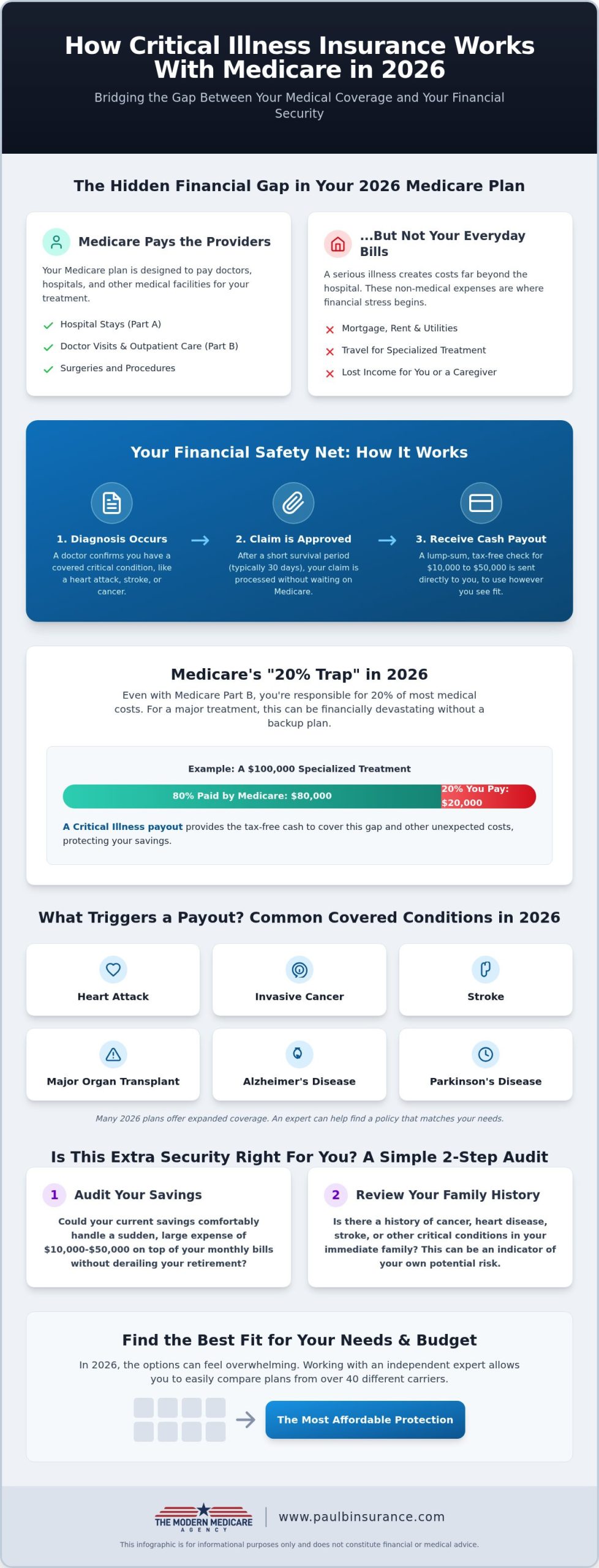
Medicare Part A handles your hospital stays, while Part B covers your outpatient services and doctor visits. Medicare is the foundation of your healthcare plan, but it is not the entire house. Even in 2026, the “20% trap” remains a major concern for those without supplemental protection. If you face a specialized $100,000 treatment for a chronic condition, that 20% co-insurance leaves you with a $20,000 bill out of your own pocket. For most families, that’s not just a bill; it’s a full-blown financial crisis that can’t be ignored.
The Hidden Costs of a Major Diagnosis
The bills from the hospital are only one part of the story. When a major illness hits, your daily life changes in ways that federal programs simply don’t address. You might need to travel to a specialist center several hours away. This means paying for gas, tolls, and lodging for your family. If you’re recovering from a stroke, you might need to install ramps or grab bars in your bathroom immediately. These modifications are vital for your safety, but they’re rarely covered by standard Medicare. Perhaps most importantly, a serious diagnosis often requires a spouse or adult child to take time off work to be your caregiver. A critical illness payout can replace that lost income, allowing your loved ones to focus on your recovery without worrying about how to keep the lights on. For additional perspective on protecting your home and assets during a health crisis, you might explore the debt management strategies from Global Finance. Knowing how does critical illness insurance work with medicare ensures you have the cash needed for these exact moments.
How Critical Illness Insurance Works Alongside Medicare
How does critical illness insurance work with medicare in practice? It’s quite simple. While Medicare is busy handling the medical billing codes, this policy focuses entirely on you. When you are diagnosed with a covered condition, the insurance company sends a lump sum check directly to your home. In 2026, most people choose a benefit between $10,000 and $50,000. It acts as a financial bridge during a very difficult time, giving you the resources to focus on your health rather than your bank account.
One of the best features is that there’s no “coordination of benefits.” This means the critical illness plan doesn’t care what Medicare pays. It doesn’t wait for Medicare to process a claim first. It pays you because you met the diagnosis criteria, period. Plus, getting covered has become much easier. By 2026, many of the top carriers have moved to simplified underwriting. This means you can often get a policy without a full physical exam or blood work. It removes the anxiety of a long, intrusive application process.
The Trigger: What Conditions Start the Payment?
The payout is triggered by a specific medical diagnosis. Standard plans cover the big three: invasive cancer, heart attacks, and strokes. They also cover major organ transplants. However, in 2026, we’ve seen more plans expand their reach to meet modern needs. Many now include a diagnosis of Alzheimer’s or Parkinson’s disease. Once the doctor confirms the condition, there’s usually a “survival period.” This is typically a 30-day window from the date of diagnosis. Once you meet that requirement, the funds are released to you.
Tax-Free Benefits and Financial Flexibility
The money you receive is generally tax-free because you paid the premiums with after-tax dollars. This provides a massive boost to your financial flexibility when you’re feeling vulnerable. You might use the cash to pay off the high out-of-pocket maximums found in many Medicare Advantage plans. Or, you could use it to hire a home health aide to help with daily tasks while you recover. Medicare rarely covers long-term help at home, but your critical illness check can.
You have total control over every dollar. Whether you need to pay for experimental treatments or just keep up with the mortgage, the choice is yours. There are no receipts to submit and no “approved” lists of expenses. If you’re feeling unsure about which carrier offers the best terms for your health history, you can compare your options with an independent expert who puts your needs first and simplifies the search.
Comparing Your 2026 Safety Net Options
When I sit down with folks to review their 2026 coverage, the most common question is whether their current plan is “enough.” To answer that, we have to look at the different jobs each policy performs. A common point of confusion is how Medigap (Medicare Supplement) compares to a critical illness plan. The simplest way to look at it is this: Medigap pays the doctor to keep your medical bills at zero, while critical illness insurance pays you to keep your bank account from hitting zero. They’re two different tools for two different jobs.
By combining these, you can create what I call a “zero-risk” financial environment. You don’t have to choose one over the other; instead, you can use them together to build a wall around your retirement savings. For many of my clients in 2026, budgeting for a small monthly premium is much easier than trying to find thousands of dollars during a medical crisis. It’s about moving from a state of worry to a state of total certainty.
Complementing a Medicare Advantage Plan
If you’ve chosen a Medicare Advantage plan, you likely enjoy the low monthly premiums and extra perks. However, these plans come with an annual “out-of-pocket maximum” that can reach several thousand dollars in 2026. If you face a serious diagnosis like cancer or a heart attack, you’ll likely hit that maximum very quickly. This is where you see exactly how does critical illness insurance work with medicare to protect your wallet. A $5,000 or $10,000 policy can effectively “wipe out” that financial exposure. It gives you the peace of mind that your deductible is already saved and waiting in a policy, rather than sitting in your emergency fund.
Critical Illness vs. Long-Term Care Insurance
People often confuse these two, but they serve very different purposes. Long-term care insurance is designed to pay for ongoing assistance over many years, such as a nursing home or daily help with bathing and dressing. Because it covers such a long period, it can be quite expensive. Critical illness insurance is a one-time check that arrives shortly after your diagnosis. For seniors on a fixed income in 2026, a critical illness plan is often much more affordable. It provides an immediate injection of cash you can use for anything, while long-term care is a broader, more permanent commitment. Using them together provides the most comprehensive protection possible.
Is Critical Illness Insurance Worth It for You?
Choosing to add more insurance can feel like a heavy decision. You want to be protected, but you also don’t want to pay for things you don’t truly need. To help you decide, I recommend a simple four-step audit. This process moves you away from guesswork and toward a decision based on your actual life in 2026. Understanding how does critical illness insurance work with medicare helps you see exactly where this coverage fits into your personal puzzle.
- Step 1: Audit your emergency savings. If you were hit with a $7,000 medical bill tomorrow, would you have the cash ready? If that money is tied up in your home or a retirement account, a lump-sum check provides the immediate liquidity you need.
- Step 2: Review your family history. Genetics aren’t destiny, but they are a guide. If cancer, heart disease, or stroke runs in your family, the statistical likelihood of needing a payout is higher.
- Step 3: Check your prescriptions. Look at your current Medicare Part D plan. Many modern treatments for critical illnesses fall into the “Specialty Tier,” which often requires you to pay a percentage of the drug’s cost rather than a flat co-pay.
- Step 4: Evaluate your support system. Do you have a family member who can step away from their job to care for you? If not, you’ll likely need to hire professional help for daily tasks, which is an expense Medicare usually doesn’t cover.
When to Say ‘Yes’ to Extra Coverage
You should strongly consider this protection if you’ve chosen a Medicare Advantage plan. These plans often have lower monthly premiums but come with high out-of-pocket maximums that can reach several thousand dollars. If your cash reserves are low, this policy acts as your “backup” emergency fund. It’s also a great choice if you want to ensure your spouse’s lifestyle isn’t derailed by your medical bills. Knowing how does critical illness insurance work with medicare gives you the confidence that a diagnosis won’t drain the accounts you’ve spent a lifetime building.
When You Might Already Be Protected
There are times when you might not need this extra layer. If you have a ‘Plan G’ Medigap policy and $50,000 or more in liquid savings, you’re already in a very strong position. You might also be covered if your existing life insurance policy has a “living benefits” rider that allows you to access your death benefit while you’re still alive. Over-insuring is also a risk we help you avoid, as my goal is to find the right balance for your budget. If you’re ready to see how these numbers look for your specific situation, you can request a personalized plan review with our team today.
Finding the Right Plan with The Modern Medicare Agency
Navigating the 2026 insurance market shouldn’t feel like a solo mission. While you now understand how does critical illness insurance work with medicare, finding a specific plan that fits your health history and budget requires a specialist. As an independent broker, I don’t work for the insurance companies. I work for you. My goal is to remove the anxiety from this process by providing a clear, logical path to the right coverage. We focus on education first, ensuring you have the facts before you make any decisions. This “No-Pressure” approach is the foundation of everything we do at The Modern Medicare Agency.
The Benefit of 40+ Insurance Carriers
Choice is your greatest asset in 2026. Many people assume the “big name” insurers they see on TV offer the best value. In my experience, that’s often not the case for critical illness plans. By comparing over 40 different carriers, we often find smaller, highly rated companies that offer more robust benefits for a lower monthly cost. I also take the time to spot the “fine print” exclusions that a restricted agent might miss. This ensures you aren’t surprised by a denied claim later. Having a wide range of choices means we can find a plan that fits your 2026 budget perfectly without sacrificing the protection you need. It’s about finding the highest benefit for the lowest premium, tailored to your specific health profile.
Your Journey to Certainty Starts Here
Your first 15-minute consultation with Paul Barrett is designed to be the most helpful part of your week. We’ll perform a personalized “Gap Analysis” to see exactly where your current Medicare setup might leave you vulnerable. We’ll look at your specific out-of-pocket limits and your savings to see if a supplemental plan makes sense for you. If you don’t need it, I’ll be the first to tell you. If you do, we’ll map out a plan together. This process moves you from a state of distress to one of complete certainty about your future.
Our relationship doesn’t end when the policy starts. We provide year-round support to help with questions or claims as they arise. You deserve a partner who is committed to your long-term security, not just a one-time transaction. If you’re ready to move from uncertainty to total peace of mind, schedule your free Medicare Gap Analysis with Paul today and let’s build your safety net together.
Secure Your Financial Future Today
You’ve taken a vital step by learning how does critical illness insurance work with medicare to protect your hard-earned savings. It’s clear that while Medicare is a strong foundation, the lump-sum benefit of a critical illness plan is the safety net that catches the costs of daily life during a recovery. Whether it’s covering a high out-of-pocket maximum in 2026 or giving you the cash to hire help at home, this protection ensures a medical diagnosis doesn’t drain your bank account.
As an independent broker serving over 34 states, I have access to more than 40 carriers to find the exact fit for your unique situation. You don’t have to navigate these complex choices alone. I am here to act as your calm guide, removing the stress from the process so you can stay focused on your health. Ready for peace of mind? Let Paul find the perfect plan for your needs and budget. You deserve to enjoy your retirement years with total certainty and confidence.
Frequently Asked Questions
Does Medicare cover critical illness insurance premiums?
No, Medicare does not cover the premiums for critical illness insurance. These are private supplemental policies that you pay for separately out of your own pocket. While Medicare is a federal program designed to pay for medical services and hospital stays, it doesn’t provide funds for additional private financial protection plans.
What is the difference between cancer insurance and critical illness insurance?
Cancer insurance is a very specific type of policy that only triggers a payout if you are diagnosed with cancer. Critical illness insurance is much broader. It usually covers cancer, but it also includes other major events like heart attacks, strokes, and organ transplants. For most people in 2026, the broader coverage of a critical illness plan offers more comprehensive security.
Can I get critical illness insurance if I already have a pre-existing condition in 2026?
Yes, you can often still qualify for a plan even if you have a health history. While the insurance company might exclude your specific pre-existing condition from the coverage, you can still be protected against other new illnesses that might occur. Many 2026 plans use simplified underwriting, which means you answer a few health questions rather than undergoing a long medical exam.
How much does a typical critical illness policy cost for someone over 65?
Do I need critical illness insurance if I have a Medigap plan?
Medigap is wonderful for paying your doctors, but it doesn’t help with your daily living expenses. A Medigap plan only covers the “gaps” in medical billing, such as deductibles and co-insurance. Critical illness insurance serves a different purpose by giving you cash for things like your mortgage, utilities, or specialized home care that medical insurance doesn’t touch.
What happens if I never get sick? Do I get my money back?
In most cases, you do not get your money back if you never file a claim. Standard policies are built to provide protection and peace of mind, much like your homeowners or auto insurance. While some plans in 2026 offer an optional “return of premium” rider, these typically come with much higher monthly costs that many retirees choose to avoid.
How fast does the insurance company pay the lump sum after a diagnosis?
Most companies release the funds shortly after you meet the 30-day survival period and submit your claim. Once your doctor confirms the diagnosis with the required paperwork, the process is usually quite fast. This quick payout is a key part of how does critical illness insurance work with medicare to provide immediate financial relief during a crisis.
Can I use the critical illness payout to pay for experimental treatments not covered by Medicare?
Yes, you have complete freedom to use the money however you choose. If you discover a new treatment or a specialist that Medicare doesn’t approve, your critical illness check can cover those costs. There are no “approved” lists or receipts required, so you and your family have total control over your healthcare journey.

Article by
Paul Barrett
Paul Barrett, CMIP is the founder of The Modern Medicare Agency, an independent Medicare-only brokerage based in Melville, NY. With 18 years of Medicare-exclusive experience, a CMIP designation, and more than 5,000 clients served across 37 states, Paul is one of the most credentialed independent Medicare specialists on Long Island — and one of the most direct.
He represents 40+ carriers with no quotas and no allegiances, which means his recommendations are based entirely on what fits each client's specific situation. He is the author of Medicare Mastery Unlocked and host of the Wise Guys Retirement Talk podcast. His content is grounded in primary sources, real carrier intelligence, and 18 years of watching what happens when people get Medicare right — and when they don't.
📞 631-358-5793 | paulbinsurance.com