




A long-term care need can put years of retirement savings under pressure. The benefits of long-term care insurance for seniors may include help paying for personal care at home or in a facility, once the policy’s eligibility requirements and waiting period are met. Benefits commonly begin after a 90-day waiting period when the policyholder has cognitive difficulties or trouble with two or more activities of daily living.
It’s understandable to feel unsure about whether coverage is worth the cost, especially when care needs and future premiums can be hard to predict. In 2026, the right decision starts with understanding what a policy may cover, how its benefit limits work, and what costs could still come from your savings.
This guide explains the benefits of long-term care insurance for seniors, including how it may help protect retirement funds, what care it may cover, and how to weigh the possibility of needing care against premiums that may increase. It also outlines policy details to consider when deciding whether coverage fits your retirement plans.
Key Takeaways
- Learn what kinds of personal care a policy may help pay for, and how eligibility rules and waiting periods affect when benefits begin.
- Understand how benefit limits and care costs can shape the amount you may need to draw from retirement savings.
- See why future care needs are worth considering as part of retirement planning, even though the type and duration of care vary.
- Know why premiums may rise and which policy details can help you assess whether ongoing costs fit your budget.
- Explore how long-term care coverage may fit alongside your retirement resources and other insurance decisions.
What is long-term care insurance?
Long-term care insurance can help pay for personal care when illness or disability makes everyday tasks difficult. Depending on the policy, care may be provided at home, in the community, or in a facility.
Policy Limits and Qualifying for Coverage
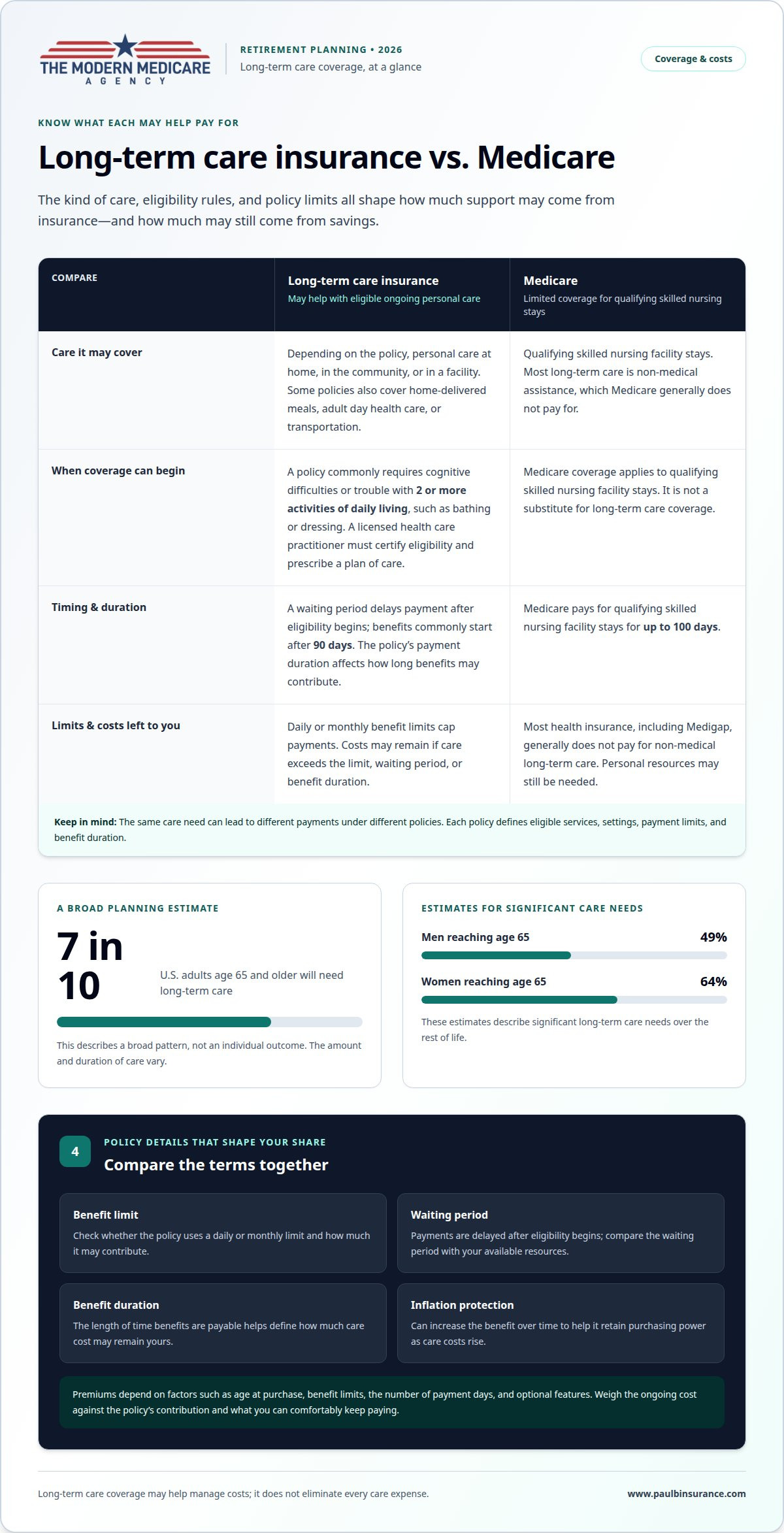
A policy defines the care needs that qualify for benefits and the maximum amount it will pay. Benefits commonly begin when a policyholder has cognitive difficulties or trouble with two or more activities of daily living, such as bathing or dressing. A licensed health care practitioner must certify eligibility and prescribe a plan of care. Needing help alone does not automatically mean benefits begin, so these terms are important.
Benefit Limits, Waiting Periods, and Inflation Protection
Benefit limits cap how much a policy pays, while a waiting period delays payments after eligibility begins. Policies may use a daily or monthly limit, and benefits commonly start after a 90-day waiting period. Inflation protection increases the benefit over time, helping it retain purchasing power as care costs rise. Compare these terms together: a higher limit may still leave costs uncovered if the waiting period or benefit period does not fit your needs.
Coverage may help pay for ongoing assistance with personal tasks, sometimes called activities of daily living. Examples include help with bathing, dressing, or using the bathroom. Some policies also cover home-delivered meals, adult day health care, or transportation. Each policy defines eligible services, settings, payment limits, and benefit duration, so the same care need can lead to different payments under different policies.
Medicare is not a substitute for long-term care coverage. According to the Centers for Medicare & Medicaid Services, Medicare pays for qualifying skilled nursing facility stays for up to 100 days, while long-term care insurance may help with costs beyond Medicare coverage. Most long-term care is non-medical assistance, so Medicare and most health insurance, including Medigap, generally do not pay for it.
Timing affects both eligibility and affordability. A common recommendation is to consider buying coverage between ages 50 and 65, when applicants may be more likely to qualify than after health needs arise. Individual policies use medical underwriting, so poor health or already receiving long-term care services can make approval difficult. Coverage may not suit someone whose premiums would strain their budget or whose resources can cover care without insurance.
Tax treatment is separate from policy benefits. According to the Internal Revenue Service, you can deduct on Schedule A (Form 1040) only the part of your medical and dental expenses that is more than 7.5% of your adjusted gross income (AGI). That rule concerns deductible medical and dental expenses; it does not mean every premium or care expense is deductible.
Financial protection from long-term care costs
Long-term care can create expenses that compete with everyday retirement needs. In 2026, insurance may help pay eligible care costs, reducing how much savings must contribute.
Protecting Retirement Savings
Long-term care insurance can provide a separate source of funds for covered care, potentially leaving more retirement savings available for housing, regular expenses, or a spouse’s needs. The policy’s benefit amount and payment duration determine how much it contributes. It can help manage financial exposure, but it does not eliminate every care expense.
Care costs depend on where and how support is provided. Help at home, adult day health care, assisted living, and nursing home care involve different services. When planning a retirement budget, consider which settings you would prefer and how much income or savings you could direct toward each. This clarifies the policy’s role: it may contribute toward eligible care while personal resources cover other needs.
Future Care Costs and Regional Differences
Care costs differ by location and care setting, so a national figure cannot represent every household’s likely expenses. Local prices and the type of support needed affect the total. In 2026, it’s more useful to think through possible care arrangements than to rely on one national estimate as a personal budget.
Planning also means considering how long support may be needed and which expenses the policy would leave you to pay. The benefit limit and payment duration help define your share. Comparing those terms with your preferred care setting can show how insurance might fit alongside retirement income and savings.
Premiums depend on factors such as age at purchase, benefit limits, the number of payment days, and optional features. Weigh the premium against the policy’s contribution and the amount you can comfortably keep paying. This comparison can help you decide whether coverage fits your priorities without assuming it will cover every future expense.
To consider how coverage may fit your retirement priorities, explore long-term care options.
Likelihood of needing long-term care
In the United States, 7 out of every 10 adults age 65 and older will need long-term care. That estimate describes a broad pattern, not an individual outcome. A person may need a few hours of help at home, support in assisted living, or more extensive care. The likelihood and duration of care both matter when considering how retirement income could be affected.
Estimates also differ between men and women. About 49 percent of men reaching age 65 today will need significant long-term care during their remaining years. For women reaching age 65 today, the estimate is about 64 percent. These figures describe significant care needs over the rest of life, not a promise that any particular person will need care.
How long care lasts is another important part of the picture. Average use of long-term care services in the United States is 3 years. Women typically need care for an average of 3.7 years, compared with 2.2 years for men. These averages can help frame a retirement discussion, but they don’t describe every person’s care experience.
Longer periods of support are less common, yet they can affect a household’s plans. About 14 percent of people will need more than two years of paid long-term care. One in five people turning 65 today will need assistance for longer than 5 years. Together, these estimates show why a plan based only on a short period of help may leave a longer need unaddressed.
Care needs can also differ in type. Someone may first need help with daily living tasks, such as bathing or dressing, while another person may use adult day health care or a nursing facility. In the United States, 35% of people spend any time in nursing facilities, and the average stay is one year. A nursing facility stay is only one possible form of long-term care.
Eligibility for benefits depends on the policy’s terms, not on age alone or an estimate of future need. Policies commonly use cognitive difficulties or trouble with two or more activities of daily living as benefit triggers. A licensed health care practitioner certifies eligibility and prescribes a care plan. A person may need support yet still have to meet the policy’s requirements before benefits begin.
For retirement planning, consider both the chance of needing help and the possible length of care. A 3-year average and the possibility of support lasting longer than 5 years point to different funding needs. Income, savings, family support, and the care settings a person would consider all shape that discussion. These estimates can guide a careful review without predicting what any one person will experience.
Premium increases
Long-term care premiums can change after a policy is issued, so affordability means looking beyond the first payment. Historically, 70 percent to 80 percent of people with traditional policies have seen increases. A group rate hike can range from 20% to 40% in one adjustment, with state insurance regulator approval. That history makes future premium changes part of a careful coverage decision in 2026.
An increase can affect whether a policy remains comfortable to keep, especially when retirement income is fixed. A general rule of thumb is to keep long-term care premiums below 7 percent of income. Treat that as a budgeting guide, not a forecast of future charges. Leave room in your plan for other expenses that may change, such as housing, prescriptions, or support for a spouse.
Before choosing coverage, consider how the insurance company’s rate history fits your budget over time. Compare the premium with the benefit amount, payment duration, and inflation protection. These features affect both the policy’s potential support and its cost. A lower starting premium does not show how manageable the policy will remain if rates change, so consider the ongoing commitment, not just the first payment.
Tax treatment may affect the net cost of qualified long-term care coverage. Premiums may be deductible depending on the policyholder’s age and tax filing status. The applicable deduction limit is tied to the tax year, so a figure from an earlier year should not be treated as a 2026 amount. A deduction also isn’t a reimbursement: it may reduce taxable income, but it doesn’t return the premium dollar for dollar.
For a 2026 tax estimate, separate premium payments from other medical expenses and consider how your filing status affects the calculation. Qualified long-term care insurance benefits are generally not considered taxable income. That distinction can help with planning, but it doesn’t make premiums automatically affordable or deductible. The policy’s qualification and the taxpayer’s circumstances both matter.
The possibility of premium increases makes a realistic long-term budget important. Consider what payment you could maintain alongside routine expenses and how you would respond if the premium changed. Reducing benefits to make the policy more affordable could also reduce its protection. The question is not only whether coverage offers valuable support, but whether its cost can remain manageable as your needs and finances change.
Preserving assets and retirement savings
Long-term care expenses can draw down savings retirees planned to use for housing, daily needs, or family support. Private insurance may help pay eligible care costs, leaving more assets available for other priorities. Protection is limited by the policy’s benefit amount, covered services, and payment period. It can reduce some financial exposure, but does not guarantee that every expense will be covered.
Consider a household planning for nursing home care. If a policy pays only up to its stated limit, the household remains responsible for costs above that amount and for services the policy excludes. Without coverage, those expenses may come from savings or withdrawals from a 401(k) or IRA. Such withdrawals may have tax ramifications, so the amount available to spend can differ from the amount withdrawn.
Long-term care insurance may be most likely to pay off for people with at least $75,000 in assets, not counting their primary home. That figure is a planning reference, not a universal cutoff. A household with fewer assets may find premiums difficult to justify, while a household with more assets may want to weigh coverage against the savings it hopes to preserve. Expected care needs and available income also shape that decision.
Medicaid can pay for long-term care services for people who meet their state’s financial eligibility rules. In most states, a person generally cannot have more than $2,000 in assets in their name to qualify for Medicaid support. State rules and individual circumstances matter, so this threshold isn’t a substitute for understanding local eligibility. Relying on Medicaid may also mean spending down resources before qualifying, rather than preserving them for other goals.
Medicare and most health insurance generally do not cover extended custodial care, such as ongoing help at home or in a nursing home. Families may therefore have to pay privately for services that support daily living. A long-term care policy can provide another source of funds, but its terms determine how much it contributes. Review the benefit limit, waiting period, payment duration, and premium together to see how they fit your assets and retirement income.
There’s no single right balance between paying premiums and keeping savings available. A useful comparison is to estimate which expenses you could cover from income, which would require drawing on retirement accounts, and how policy benefits could change that picture. If preserving assets is a priority, discuss long-term care coverage options as part of your retirement protection choices.
The Modern Medicare Agency: Long term Care
The Modern Medicare Agency offers Long term Care for people considering how to prepare for future care needs. After weighing potential care expenses, policy limits, and premium affordability, you may want to explore whether coverage fits your priorities. Its guidance can also help put long-term care decisions in context with Medicare Advantage, Medicare Supplement (Medigap), and Medicare Part D plans, where relevant to your broader insurance choices.
Long-term care coverage isn’t the right fit for every budget or situation. If you’re unsure how it may fit your plans, contact The Modern Medicare Agency to discuss your options.
Make your next step a thoughtful one
Planning for care is also a chance to decide what you want retirement savings to support. The benefits of long term care insurance for seniors matter most when they align with your priorities, budget, and preferred approach to future care. In 2026, take time to consider which trade-offs feel manageable for you and your household.
A calm conversation can help turn broad concerns into clearer questions about coverage and how it fits alongside other insurance decisions. The Modern Medicare Agency offers Medicare Advantage Plans, Medicare Supplement (Medigap) Plans, and Medicare Part D Plans, as well as long-term care insurance.
Contact The Modern Medicare Agency to talk through your options and decide what next step feels right. You can move forward at your own pace, with a clearer sense of what matters to you.
Frequently Asked Questions
How much coverage?
Choose a coverage level by considering the care you would want, the policy’s total benefit pool, and what you could contribute yourself. Compare the policy’s maximum payment with your preferred care arrangement, then consider how you would handle any difference. Include the possibility that care needs may change over time, and decide whether inflation protection fits your long-range plan.
When do benefits begin?
Benefits begin only after the policy’s eligibility conditions and waiting period have been met. Before coverage starts, a policyholder may need to pay for qualifying care personally. Consider what funds would cover that initial period and what records a claim may require. Reading the policy’s claim instructions before care is needed can help family members understand the process.
What does long-term care insurance cover for seniors?
Coverage depends on the policy, but it may help pay for eligible personal and custodial care. Examples can include assistance with dressing or bathing, home-delivered meals, transportation, and adult day health care. The policy explains which services and care settings qualify, and whether payment is made through reimbursement or another benefit arrangement. Compare those definitions with the support you would want to receive.
What are the main benefits of long-term care insurance for seniors?
The benefits of long-term care insurance for seniors may include funds set aside for eligible care and more flexibility in planning how support is arranged. A policy can help families discuss care preferences before a health change creates urgency. It may also reduce reliance on relatives or personal savings alone. Its practical value depends on the coverage purchased and how well it fits the household’s priorities.
How much does long-term care insurance cost by age and state in the U.S.?
There is no single 2026 premium that applies across ages and states. The amount depends on the policy design and the applicant’s circumstances, including the selected benefit, payment duration, and optional features. Health underwriting can also affect whether an applicant qualifies for an individual policy. For a useful comparison, assess how each policy’s premium relates to the coverage it provides and whether the payment remains manageable in retirement.
How much do nursing homes, assisted living, and in-home care cost in the U.S.?
Costs vary by state, community, care setting, and the amount of assistance used, so one national amount cannot serve as a personal estimate for 2026. Part-time help at home differs from ongoing facility care, and private room choices can affect expenses. For planning, identify the setting you would most likely use and the services involved, then build your budget around local estimates rather than an outdated national figure.
What are the eligibility requirements and health underwriting rules for long-term care insurance?
Applicants for individual coverage generally answer health questions as part of medical underwriting. The insurer uses those answers to assess the application, and health conditions or current care needs can affect eligibility. If a policy is approved, a later claim must meet separate benefit requirements. Qualifying to buy coverage does not automatically establish eligibility for benefits when care is needed.
How does long-term care insurance compare with Medicare, Medicaid, and paying out of pocket?
These options work differently. Long-term care insurance pays according to its policy terms, while paying out of pocket uses personal income or assets. Medicare generally does not cover ongoing custodial support, while Medicaid may help people who meet their state’s eligibility rules. Compare which resources would pay first, what conditions apply, and how much choice each funding approach allows when arranging care.

Article by
Paul Barrett
Paul Barrett, CMIP is the founder of The Modern Medicare Agency, an independent Medicare-only brokerage based in Melville, NY. With 18 years of Medicare-exclusive experience, a CMIP designation, and more than 5,000 clients served across 37 states, Paul is one of the most credentialed independent Medicare specialists on Long Island — and one of the most direct.
He represents 40+ carriers with no quotas and no allegiances, which means his recommendations are based entirely on what fits each client's specific situation. He is the author of Medicare Mastery Unlocked and host of the Wise Guys Retirement Talk podcast. His content is grounded in primary sources, real carrier intelligence, and 18 years of watching what happens when people get Medicare right — and when they don't.
📞 631-358-5793 | paulbinsurance.com