




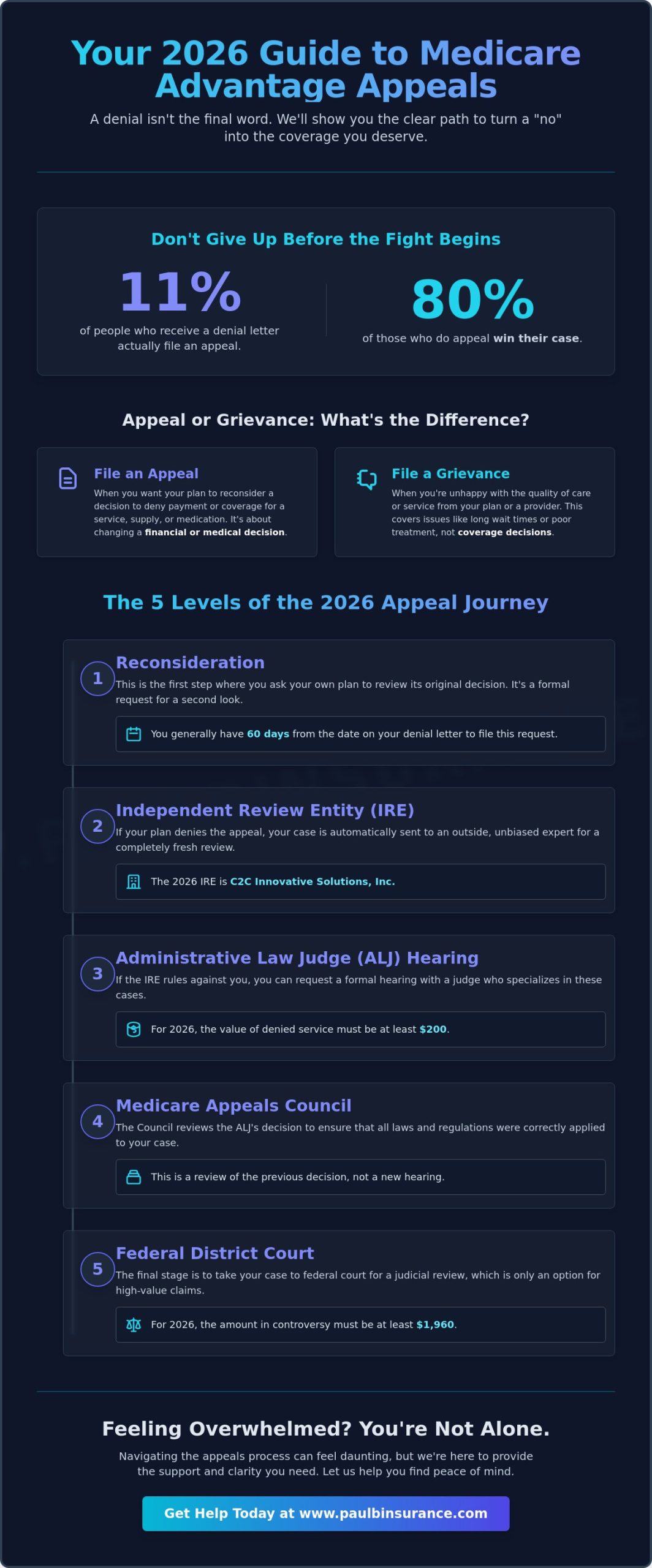
Did you know that only 11% of people who receive a denial letter actually file an appeal, even though those who do win about 80% of the time? It’s a staggering number that shows just how many people give up before the fight even begins. If you’ve just opened a letter saying your care isn’t covered, you might feel like just another number in a massive system. We understand how overwhelming it is to face high medical bills while trying to decipher complex clinical criteria. The good news is that learning how to appeal a medicare advantage plan decision isn’t as daunting as it seems when you have a clear path to follow.
We know you’re looking for security and a way to protect your health without the anxiety of “what if.” In this guide, we’ll show you exactly how to navigate the 2026 appeal process with confidence, helping you turn a “no” into the coverage you deserve. You’ll learn about the new 2026 requirements for plans to explain their specific clinical criteria and the five levels of review. We’ll walk through the evidence you need to change your plan’s mind and provide a clear roadmap so you can move from uncertainty to total peace of mind.
Key Takeaways
- Discover why a denial letter isn’t the final word in 2026 and how new transparency rules help you understand the specific reasons for a plan’s decision.
- Follow our simple, step-by-step instructions on how to appeal a medicare advantage plan decision to move through the process with clarity and confidence.
- Learn how to partner with your doctor to gather the right medical evidence that proves your treatment is necessary and deserves coverage.
- Understand the five levels of the appeal journey, including when your case moves to an independent expert for a fair, unbiased review.
- See how we stand by you as an independent advocate to help you find plans that prioritize your health and well-being over complex paperwork.
Understanding Your Right to Appeal a Medicare Advantage Decision
Receiving a notice that your health plan won’t cover a doctor’s visit or a medication feels like a punch to the gut. We know that feeling of worry, especially when you’re just trying to focus on getting better. In 2026, it’s important to remember that a “no” from your insurance provider is often just the start of a conversation. This official “no” is formally called an Organization Determination. It’s essentially the plan’s first look at your request. If they decide not to cover it, they must now provide you with the specific clinical reasons for that choice. This transparency requirement, which became standard in January 2026, gives us the clarity we need to fight back effectively. Understanding the Medicare Advantage appeals process steps is your first move toward getting the care you deserve.
Time is your most valuable asset here. You generally have 60 days from the date on your denial letter to start the process. We encourage you to act as soon as possible to protect your rights. While the system can feel cold and mechanical, learning how to appeal a medicare advantage plan decision puts the power back in your hands. You aren’t just a number; you’re someone with a right to the benefits you’ve paid for. We’re here to help you navigate this road so you don’t have to face it alone.
Appeal vs. Grievance: Which One Do You Need?
It’s easy to get these two confused, but they serve very different purposes. Think of an appeal as a request to change a financial or medical decision. You file an appeal when you want the plan to pay for a service, a supply, or a drug they’ve denied. A grievance is different. You file a grievance when you’re unhappy with the quality of care or the way you were treated by a provider or the plan itself. If you’re upset about a long wait time and a denied claim, you might actually need to file both. We can help you sort through that confusion so you don’t waste time on the wrong paperwork.
Common Reasons for Medicare Advantage Denials in 2026
Most denials we see in 2026 fall into a few specific categories. The biggest one is “medical necessity.” This means the plan doesn’t believe the treatment is required for your specific condition based on their internal guidelines. Other common hurdles include using an out-of-network provider without prior approval or missing a prior authorization step for a specialized procedure. We work closely with our clients to review Medicare Advantage plans during enrollment to find options that align with their specific doctors and needs. This helps prevent these stressful denials before they even happen. If you’re already facing a denial, knowing these common triggers helps us build a stronger, more targeted case for your appeal.
The Five Levels of the Medicare Appeal Process Explained
The journey from a denial to an approval follows a specific, five-level path. Each level provides a new opportunity for a fresh set of eyes to look at your case. Understanding how to appeal a medicare advantage plan decision starts with knowing these stages so you don’t feel lost in the shuffle. We’re here to guide you through every step, ensuring you feel protected and heard throughout the process. This structured path is designed to ensure that the final word isn’t just based on a plan’s internal policy, but on medical necessity and fairness.
- Level 1: Reconsideration. This is where your own plan reviews its original decision. You generally have 60 days to file this request after receiving your denial notice.
- Level 2: Independent Review Entity (IRE). If your plan says “no” again, they must automatically send your case to an outside expert. Since May 1, 2026, C2C Innovative Solutions, Inc. has been the entity responsible for these reviews.
- Level 3: Administrative Law Judge (ALJ) Hearing. If the IRE denies your request, you can ask for a hearing with a judge. For the 2026 calendar year, the value of your denied service must be at least $200 to qualify for this level.
- Level 4: Medicare Appeals Council. This level involves a high-level review of the judge’s decision to ensure all rules were followed correctly.
- Level 5: Federal District Court. This is the final stage of the process. In 2026, the amount in controversy must be at least $1,960 to move your case into the judicial system.
While five levels might sound exhausting, remember that many cases are resolved much earlier. If you feel your current coverage makes this process too difficult, you can compare other Medicare Advantage plans that might offer a smoother experience for your specific needs.
Standard vs. Fast (Expedited) Appeals
Sometimes you can’t afford to wait the standard 60 days for a decision. If your doctor believes that waiting could seriously harm your life, health, or your ability to regain maximum function, you should request an expedited appeal. Under these urgent circumstances, your plan must give you a decision within 72 hours. It’s vital to have your doctor support this request. A simple, clear statement from them explaining why a delay would be dangerous is usually enough to trigger this fast-track process.
What Happens at the Independent Review Level?
Level 2 is often the most important stage because the people reviewing your case don’t work for your insurance company. They are completely independent and unbiased. As of May 2026, C2C Innovative Solutions handles these Part C reviews. They typically provide a decision within 60 days. Because they are an outside party, this level is frequently where the tide turns in favor of the patient. You don’t even have to file a separate request for this review; your plan is legally required to forward your case automatically if they uphold their first denial.
How to File Your Appeal: A Step-by-Step Guide
Taking that first step to challenge a decision can feel like climbing a mountain. We want to make it feel more like a walk down a well-marked path. When you are learning how to appeal a medicare advantage plan decision, organization is your best friend. Having a clear record of every conversation and document ensures you aren’t just shouting into the void. We recommend starting a dedicated folder today to keep everything in one secure place. This simple act of preparation replaces chaos with a sense of control.
- Step 1: Examine your denial notice. Look for the “Notice of Denial of Medical Coverage.” Thanks to 2026 regulations, this letter must now pinpoint the exact clinical reason for the denial. Don’t just skim it; read every line to understand the specific hurdle we need to clear.
- Step 2: Call your doctor immediately. They are your strongest ally in this process. Ask for the medical records and clinical notes that specifically address the reasons mentioned in your denial letter.
- Step 3: Draft your appeal. You can use the specific form provided by your plan or write a clear, simple letter. Include your name, Medicare number, and a direct explanation of why the service is medically necessary for your health.
- Step 4: Create a paper trail. Send your packet via certified mail with a return receipt or use a secure fax. This gives you proof of the date they received it, which is vital for meeting deadlines.
- Step 5: Track your progress. Keep a log of every phone call. Note the date, the name of the representative you spoke with, and exactly what they told you about your case status.
Deadlines You Cannot Afford to Miss
The clock starts ticking the moment you receive that denial notice. You generally have a 60-day window to file your Level 1 appeal. If you miss this date, you must prove “good cause,” such as a serious illness or a major life disruption, to get an extension. We often suggest our clients aim to file within the first 10 days. Filing quickly helps maintain your continuity of care and ensures that the momentum of your treatment isn’t lost to administrative delays.
Appointing a Representative to Help You
You don’t have to carry this burden by yourself. By using Form CMS-1696, you can officially appoint a family member or a trusted expert to speak on your behalf. Having an advocate ensures that your paperwork is handled with professional precision and that no small detail is overlooked. This specialized support is a key part of a smart Medicare planning strategy. It allows you to focus on your recovery while we help manage the administrative heavy lifting, giving you back your peace of mind.
Gathering Evidence: What You Need to Win Your Case
Winning an appeal is about more than just being right; it’s about proving it with the right documents. While the 2026 transparency rules require plans to be more specific about their denials, the burden of proof still sits with you. We believe that a well-organized case is the best way to move from a state of distress to one of certainty. When you are learning how to appeal a medicare advantage plan decision, think of yourself as a storyteller. Your evidence should tell the story of why your health depends on this specific care. This involves combining professional medical opinions with your own personal experiences.
- The Medical Necessity Letter. This is the foundation of your case. It isn’t just a note saying you need the service; it’s a detailed explanation from your doctor that counters the plan’s specific clinical reasons for denial.
- Clinical Peer-Reviewed Studies. If a plan claims a treatment is “experimental,” we can help you find recent medical studies from 2025 and 2026 that prove the treatment is standard practice.
- Past Medical Records. Gather records that show how previous, cheaper treatments failed to work. This creates a clear history that your requested service is the logical next step.
- Your Care Journal. Don’t overlook the power of your own words. A daily log of symptoms, pain levels, and how the denial is affecting your life provides a human element that data alone cannot capture.
Working with Your Doctor as an Ally
Your physician wants you to get better, but they are often busy. When you ask for a letter of support, bring the denial notice with you. Point out the specific “clinical criteria” the plan used so your doctor can address those points directly. A doctor’s clinical opinion is the strongest evidence in any 2026 appeal. If you need help organizing these conversations, you can contact us for personalized support to ensure your paperwork is perfect.
When Your Appeal Involves Prescription Drugs
Drug denials follow slightly different rules, especially regarding Medicare Part D coverage within an Advantage plan. You might need to file for a “formulary exception” if the drug isn’t on the plan’s list, or a “tiering exception” to get a lower price. If your plan requires “step therapy,” we must show that you’ve already tried the required lower-cost drugs and they didn’t work. Providing specific dates and pharmacy records of these past attempts is often what flips a “no” to a “yes.” We’re here to help you track these details so you never feel like just another number in the system.
Navigating Denials with Confidence: How We Support Your Journey
Facing a health insurance denial can make you feel like you’re standing alone against a giant corporation. We’re here to make sure that isn’t the case. Our mission is to serve as your dedicated advocate, removing the anxiety from a difficult process. While we’ve spent this guide teaching you how to appeal a medicare advantage plan decision, our support doesn’t end with a blog post. We stand by our clients year-round, ensuring you never feel like just a number in a database. Whether you’re filing your first reconsideration or looking for a plan that treats you with more respect, we provide the expert guidance you need to feel secure.
One of the best ways to handle appeals is to avoid them entirely. During the Medicare enrollment period, we help you look beyond the basic premiums and deductibles. In 2026, we have access to more detailed data about which plans have higher rates of prior authorization denials. We help our clients compare Medicare Advantage plans 2026 by looking at these claim histories. Choosing a plan with a reputation for transparency and fair approvals is a powerful way to protect your future health.
Is a Medicare Supplement Plan a Better Fit for You?
For some, the managed care structure of Advantage plans feels too restrictive. If you’re tired of the appeal-heavy nature of these plans, it might be time to look at Medigap. These supplement plans generally offer more freedom to see any doctor who accepts Medicare without needing prior approval. We’ll help you weigh the monthly costs of a supplement plan against the potential stress of denials. If you recently joined an Advantage plan and received a denial, you might even have a “Trial Right” to switch back to Original Medicare and a Medigap plan within your first year. We can help you determine if you’re eligible for this switch.
Your Next Steps Toward Clarity
Take a deep breath. You’ve already taken the most important step by educating yourself on your rights. The path from a “no” to a “yes” is structured and predictable; you have every right to be heard. If you’re feeling overwhelmed, reach out to us for a personalized review of your current coverage. We’ll look at your situation with an expert eye and help you find the peace of mind you deserve. You don’t have to navigate this journey alone. We’re here to protect and empower you every step of the way.
Taking Control of Your Health Coverage
You now have the tools to move from a state of distress to a clear plan of action. Remember that the 2026 transparency rules are on your side; they require your insurance provider to be specific about why they denied your care. By acting quickly within the 60-day window and partnering with your doctor to build a case based on medical necessity, you aren’t just a number in the system. Understanding how to appeal a medicare advantage plan decision is the first step toward reclaiming your confidence and the care you deserve.
We are here to ensure you never have to walk this path alone. As independent brokers representing over 40 carriers, we provide expert guidance across 34 states and offer year-round advocacy for every client we serve. Let us help you find a plan that works for you; schedule a simple, no-pressure chat today. You have the right to a plan that prioritizes your well-being, and we are ready to help you find it. Your journey toward certainty starts with a single step, and we are honored to walk it with you.
Frequently Asked Questions
How long does a Medicare Advantage appeal take in 2026?
Standard appeals take up to 60 days, while expedited ones take 72 hours. In 2026, plans must meet these strict timelines for Level 1 decisions. If you move to Level 2, the Independent Review Entity (IRE) has another 60 days to respond. We know waiting is hard, but these windows ensure your case doesn’t sit on a desk forever. This structure helps remove anxiety from the process and gives you a clear timeline.
What are my chances of winning a Medicare appeal?
Your chances are statistically very high, with roughly 80% of appeals resulting in a win for the patient. About half of all first-level appeals result in the initial denial being overturned. Many people give up because they feel like a number, but the data shows that the system often corrects itself when you speak up. We’re here to help you be part of that winning group and find the peace of mind you deserve.
Can I still get my treatment while the appeal is pending?
You can usually still receive treatment, but you may have to pay out of pocket initially if the plan hasn’t approved it yet. If you win the appeal later, the plan will reimburse you for the covered costs. For urgent situations, always request an expedited appeal to get a decision in 72 hours. This prevents long delays in your care and helps you maintain peace of mind during a difficult time while you navigate the system.
Do I need a lawyer to file a Medicare Advantage appeal?
No, you do not need a lawyer to learn how to appeal a medicare advantage plan decision or to file the paperwork. Most people successfully navigate the process by working with their doctor or an independent advocate. You can also get free help from your State Health Insurance Assistance Program (SHIP). If your case reaches the Federal District Court at Level 5, you might consider legal counsel, but it’s rarely needed for the first four levels.
What is the ‘Independent Review Entity’ and is it really fair?
The Independent Review Entity (IRE) is an outside organization that is not affiliated with your insurance plan. As of May 1, 2026, C2C Innovative Solutions handles these reviews for Part C. Because they don’t work for the insurance company, they provide an unbiased look at your medical necessity. This independence is a vital safeguard that protects you from unfair denials based solely on a plan’s internal profit goals or restricted options.
What happens if I lose my Level 1 appeal?
If your plan upholds its denial at Level 1, your case is automatically sent to the Independent Review Entity for a Level 2 review. You don’t have to file a new request for this second look. This automatic process is designed to ensure that an outside expert reviews every denied claim. It’s a key part of the journey from a state of distress to one of certainty, providing a fresh, impartial perspective on your health needs.
Can my Medicare Advantage plan cancel my coverage if I appeal?
No, your plan cannot cancel your coverage or penalize you in any way for filing an appeal. Filing an appeal is your legal right under federal law. It’s a protected process, and plans are prohibited from taking any negative action against you for using it. We want you to feel empowered to stand up for yourself without any fear of losing your health security, your reliable benefits, or your place in the plan.
How do I write a winning Medicare appeal letter?
A winning letter focuses on medical necessity and directly addresses the clinical reasons the plan gave for the denial. Use the specific criteria mentioned in your 2026 denial notice and explain why you meet them. Include a strong letter of support from your doctor and any relevant medical records. Keep your tone professional and logical. Learning how to appeal a medicare advantage plan decision effectively means letting the medical facts tell your story clearly.

Article by
Paul Barrett
Paul Barrett, CMIP is the founder of The Modern Medicare Agency, an independent Medicare-only brokerage based in Melville, NY. With 18 years of Medicare-exclusive experience, a CMIP designation, and more than 5,000 clients served across 37 states, Paul is one of the most credentialed independent Medicare specialists on Long Island — and one of the most direct.
He represents 40+ carriers with no quotas and no allegiances, which means his recommendations are based entirely on what fits each client's specific situation. He is the author of Medicare Mastery Unlocked and host of the Wise Guys Retirement Talk podcast. His content is grounded in primary sources, real carrier intelligence, and 18 years of watching what happens when people get Medicare right — and when they don't.
📞 631-358-5793 | paulbinsurance.com