




Did you know that a simple two-year delay in signing up for Medicare could cost you an extra $40.58 every single month for the rest of your life? With the standard Part B premium sitting at $202.90 in 2026, those 10% annual penalties add up fast and they never go away. We know how overwhelming it feels to stare at a stack of government forms while worrying about making a mistake that drains your retirement savings. It’s frustrating when terms like “creditable coverage” sound like a foreign language. It’s even worse when you’re just trying to figure out if your current employer plan or COBRA really protects you.
We’re here to show you exactly how to avoid medicare part b penalties by following a clear, stress-free timeline. You don’t have to navigate this alone or fear the lifelong financial consequences of a missed deadline. This guide breaks down the specific steps to verify your current coverage, understand the 2026 enrollment windows, and secure the peace of mind you deserve. We’ll walk through how to document your history properly so you can transition into retirement with total certainty.
Key Takeaways
- Understand why the Part B penalty is a lifelong surcharge and how it can permanently increase your monthly costs if you miss your enrollment window.
- Learn the “20 Employee Rule” and how to verify if your current employer group insurance qualifies as creditable coverage.
- Discover the exact steps for how to avoid medicare part b penalties when you are transitioning from COBRA or a retiree health plan.
- Follow our simple timeline starting six months before your 65th birthday to ensure your paperwork is perfect and your savings are protected.
- Find out how an independent expert can simplify your journey by helping you compare Medicare Supplement or Advantage options from dozens of different carriers.
The Medicare Part B Penalty: A Lifetime Cost You Can Skip
When you first start looking at Medicare, the rules can feel like a maze designed to trip you up. One of the most stressful parts for many people is the fear of making a permanent financial mistake. The government uses the Medicare Part B Late Enrollment Penalty as a way to encourage everyone to join the program as soon as they’re eligible. They want a healthy mix of people in the system to keep it running smoothly for everyone. While that makes sense for the system, it can feel very personal when it’s your retirement budget on the line. We want you to know that this penalty isn’t a one-time fine. It’s a permanent increase that stays with you for life. However, there’s a clear path forward. Learning how to avoid medicare part b penalties is mostly a matter of timing and documentation. We’re here to help you get both right so you can focus on enjoying your retirement instead of worrying about extra bills.
How the 10% Penalty is Calculated in 2026
The math behind the penalty is straightforward but harsh. For every full 12-month period you were eligible for Part B but didn’t have coverage, the government adds 10% to your monthly premium. In 2026, the standard Part B premium is $202.90 per month. If you wait just one full year to sign up, you’ll pay an extra $20.29 every month. If you wait two years, that surcharge jumps to $40.58. These numbers might seem small at first, but they are tied to the base premium. As the cost of Medicare goes up each year, your penalty amount grows right along with it. This means you aren’t just paying a set fee; you’re paying a percentage of a rising cost forever. We’ve seen how these compounding costs can surprise people, which is why we focus on getting your enrollment window right from the start.
The Long-Term Impact on Your Retirement Budget
Think about what those extra dollars look like over a 20-year retirement. A 20% penalty could easily cost you over $9,700 in total surcharges by the time you reach your mid-80s. That’s a significant amount of money that could be better used for your health and comfort. For example, those same funds could easily cover the costs of a high-quality dental insurance plan, helping you maintain your smile without dipping further into your savings. Protecting your fixed income is our priority. We believe that by understanding how to avoid medicare part b penalties now, you’re securing a more stable financial future. Getting it right the first time removes the anxiety of “what if” and gives you the certainty that your hard-earned savings are safe from unnecessary government fees.
The Golden Rule: Understanding Creditable Coverage
Navigating the rules of Medicare doesn’t have to be a source of constant stress. The most important concept you need to master is “creditable coverage.” In simple terms, this is health insurance that the government considers to be at least as good as Medicare itself. Knowing whether your current plan meets this specific standard is the secret to how to avoid medicare part b penalties. If you have this level of coverage through an employer, you can often delay your enrollment until you actually stop working. We spend a lot of time helping our clients verify their plan status so they don’t face a lifetime of extra costs later. We can help you review your current coverage to make sure you’re fully protected before you reach your 65th birthday.
Does Your Work Insurance Count?
The size of your company matters more than you might think in 2026. If your employer has 20 or more employees, your group plan usually counts as creditable. This allows you to stay on your work insurance without any penalty. However, if you work for a small business with fewer than 20 people, the rules are much stricter. For these smaller groups, Medicare usually becomes the primary coverage at age 65. If you stay on a small group plan and skip Part B, you might find yourself responsible for large medical bills that your private insurance simply won’t pay. It’s a common trap that’s easy to avoid with the right information.
Evidence You Need for the SSA
When you finally decide to retire and leave your group plan, the Social Security Administration will ask for proof of your prior coverage. You will need a specific document called Form CMS-L564, also known as the Request for Employment Information. Your employer must sign this form to confirm you had active group coverage based on current work. Without this signature, the government may assume you simply skipped out on Medicare, which triggers those lifelong penalties. Keeping a paper trail now ensures a smooth transition later. Having your documentation ready provides a level of certainty that makes the entire process feel much lighter and more manageable.
Navigating Work Transitions: COBRA and Retiree Plans
Leaving a long term job is a major life milestone. It’s a time for celebration, but it’s also the moment when many people accidentally fall into what we call the “COBRA trap.” We’ve talked with many clients who believed that as long as they had a health insurance card in their wallet, they were safe from government surcharges. Unfortunately, that isn’t how the rules work in 2026. Understanding the nuances of these transitions is a vital part of learning how to avoid medicare part b penalties and keeping your retirement budget on track. Whether you’re taking a severance package or moving to a retiree plan, the type of coverage you have matters much more than the fact that you have coverage at all.
Why COBRA is the #1 Penalty Pitfall
The biggest point of confusion we see involves the difference between “active” employment coverage and “extension” coverage. To the Social Security Administration, COBRA is an extension. It does not count as creditable coverage based on current work. You only have an 8-month window to sign up for Part B once your active employment ends. This clock starts ticking the very next month after your job ends, even if you choose to keep your COBRA coverage for the full eighteen months. Missing this window leads to both a lifelong penalty and a stressful gap in your medical coverage. We’ve helped many people navigate this specific timeline to ensure they don’t get stuck with a permanent 10% surcharge on their $202.90 monthly premium.
Retiree Health Plans vs. Medicare
Retiree plans are another area where we see a lot of uncertainty. These plans are designed to work alongside Medicare, not replace it. In most cases, a retiree health plan acts as secondary coverage. This means it only pays its portion after Medicare Part B has paid its share first. If you don’t enroll in Part B, your retiree plan might refuse to pay for your doctor visits or outpatient services entirely. We always recommend checking your plan’s “Summary of Benefits” very carefully. Most will explicitly state that you must have Medicare Part B active to remain eligible for the retiree benefits. This is a common requirement for those looking at Medicare Supplement plans as well.
If you are a veteran or receiving a severance package, the rules remain just as strict. TRICARE For Life generally requires you to have Part B to stay enrolled. Severance packages, even if they provide health benefits for a year or more, are still not considered “active employment.” We want to help you see these pitfalls before they become expensive mistakes. Knowing how to avoid medicare part b penalties during these transitions gives you the freedom to focus on your next chapter with total peace of mind. We’re here to act as your guide, removing the anxiety from these complex choices.
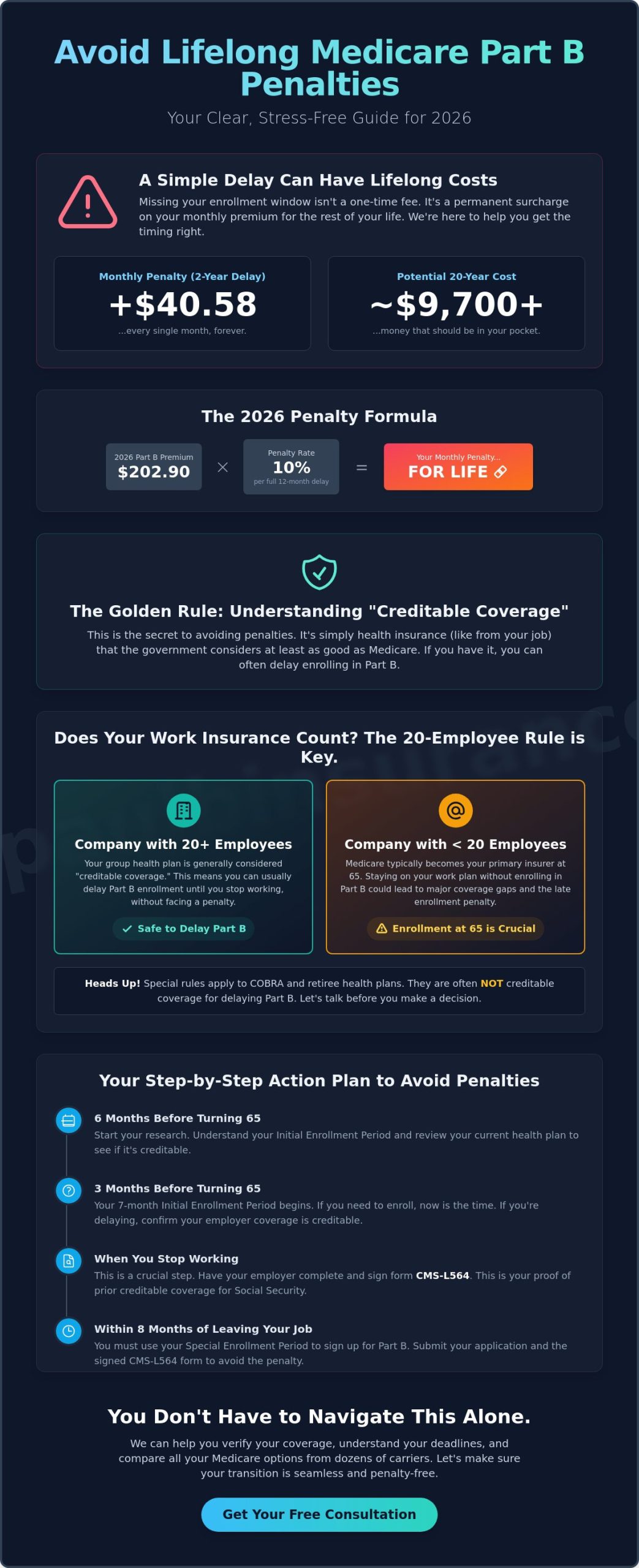
Your Step-By-Step Action Plan to Avoid Penalties
Walking through the Medicare enrollment process can feel like a heavy burden, but it becomes much lighter when you have a clear map. We’ve found that the best way for how to avoid medicare part b penalties is to start early and stay organized. By following a chronological checklist, you can move from a state of uncertainty to a place of total confidence. We recommend beginning your journey at least six months before you blow out the candles on your 65th birthday cake.
- Step 1: Check your status. Visit the Social Security website six months before you turn 65 to see if you’ll be automatically enrolled or if you need to take manual action.
- Step 2: Size up your coverage. Confirm if your (or your spouse’s) employer group plan has 20 or more employees. This is the magic number for 2026.
- Step 3: Mark your calendar. Identify your seven-month Initial Enrollment Period. Missing this window without other creditable coverage is the most common cause of penalties.
- Step 4: Talk to HR. If you plan to work past 65, get written confirmation from your benefits department that your plan is considered “creditable” by Medicare standards.
- Step 5: Set a trigger. Decide on your retirement date and plan to start your Medicare enrollment two months before your employer coverage ends.
The 7-Month Window: Your First Opportunity
Your Initial Enrollment Period (IEP) is a seven-month window that centers around your 65th birthday. It includes the three months before your birthday month, the month you turn 65, and the three months following. We always suggest starting in those first three months. If you wait until the month you turn 65 or the months after, your Part B start date could be delayed, leaving you without coverage when you need it most. This timing is also vital if you’re considering Medicare Supplement Insurance, as your open enrollment for those plans also begins when your Part B is active.
The Special Enrollment Period (SEP) for Late Retirees
If you’re one of the many people working well past age 65 in 2026, you’ll likely use a Special Enrollment Period. This is a key tool for how to avoid medicare part b penalties while staying on a large group plan. Once that employment or insurance ends, you have an eight-month grace period to sign up without penalty. However, don’t wait until the eighth month. We’ve seen too many people face a coverage gap because they waited until the last minute. Starting the process early ensures a seamless transition from work insurance to Medicare. If you want to make sure your specific timeline is protected, we can help you verify your enrollment steps today.
How an Independent Broker Simplifies the Journey
Medicare shouldn’t feel like a second job. Trying to manage the paperwork, timelines, and carrier options by yourself is often overwhelming and risky. We’ve seen many people lose sleep over the fear of making a permanent financial mistake. Relying on government websites alone can leave you with unanswered questions about your specific health needs. We’re here to take that weight off your shoulders. Our mission is to act as your personal advocate, ensuring you understand exactly how to avoid medicare part b penalties while finding coverage that actually works for your life.
Instead of looking at just one company, we look at over 40 different carriers. This variety is key because no single insurance company is the perfect fit for everyone. Why settle for a plan that only covers some of your needs when you could have a tailored fit? We compare Medicare Supplement and Advantage options side-by-side to see which one aligns with your budget and your preferred doctors. This impartial approach is how we protect you from overpaying or choosing a plan that doesn’t cover your specific prescriptions. We handle the complexity so you can enjoy your retirement with total peace of mind.
Unbiased Guidance vs. Carrier Call Centers
When you call a big insurance company directly, you’re talking to a representative who can only sell you that one brand. They are restricted by their own limited options. As independent experts, we aren’t tied to any single carrier. We work for you, not the insurance companies. We can compare Medicare Part D plans and Medicare Advantage plans based on your actual medication list. This ensures you’re not just getting a plan, but the right plan for your unique situation in 2026. We provide year-round support to ensure you never miss a deadline or a plan change as the years go by.
Start Your Journey with a Clear Path
We believe the journey from confusion to certainty starts with a simple conversation. You can reach out to our team for a no-pressure consultation where we look at your specific retirement timeline. To make the most of our first session, it helps to have a list of your current medications and your primary doctors ready. We’ll handle the complex math and the “creditable coverage” verifications for you. Our goal is to provide the security that comes from knowing you have a professional guide watching your back. We are committed to helping you understand how to avoid medicare part b penalties so you can focus on what really matters: enjoying your retirement years with confidence and security.
Take Control of Your Medicare Future Today
You now have a clear roadmap for your transition into Medicare. We’ve covered why identifying creditable coverage is the golden rule and why avoiding the “COBRA trap” is essential for your financial health. By following a structured timeline and keeping accurate records, you’ve learned exactly how to avoid medicare part b penalties in 2026. You don’t have to carry the weight of these complex decisions alone. We provide unbiased guidance by comparing options from over 40 insurance carriers to find your perfect fit. Our team is licensed in more than 34 states; we’re committed to providing personalized support for the life of your plan. Whether you’re turning 65 soon or working well past retirement age, we are here to ensure your journey is smooth and certain.
Let us help you navigate Medicare without the stress, contact us today! You deserve a retirement that’s defined by peace of mind rather than paperwork. We’re ready to help you secure the coverage you need with the care you deserve.
Frequently Asked Questions
What is the Medicare Part B late enrollment penalty for 2026?
In 2026, the penalty is a 10% surcharge on your monthly premium for every full 12-month period you were eligible but didn’t enroll. Since the standard premium is $202.90 this year, a one-year delay adds $20.29 to your bill every single month. This amount isn’t a flat fee; it actually increases every time the national base premium goes up.
Can I avoid the Part B penalty if I have insurance through my spouse?
You can avoid the penalty if you’re covered by a spouse’s active employer plan, provided the company has at least 20 employees. This is considered creditable coverage for Part B. If the company is smaller than 20 people, the government usually expects you to sign up at age 65, even if you’re still covered by that plan.
Is COBRA considered creditable coverage for Medicare Part B?
No, COBRA is not considered creditable coverage for Part B purposes. While it keeps your health insurance active, the government views it as an extension rather than coverage based on “active” employment. You only have eight months after your work ends to enroll in Medicare before the lifelong penalties begin to accrue.
How long does the Medicare Part B penalty last?
The Part B penalty is permanent and stays on your premium for as long as you have the coverage. It’s not a one-time fine or a temporary surcharge. This is why we focus so much on the initial timing; a mistake made today can affect your retirement budget for the next twenty or thirty years.
What happens if I miss my Initial Enrollment Period but I am still working?
If you work for a large employer with 20 or more people, you can sign up later during a Special Enrollment Period without any penalty. However, if your employer has fewer than 20 employees, you likely missed your window. In that case, you’ll have to wait for the General Enrollment Period and will likely face a lifelong surcharge.
How do I prove I had creditable coverage to avoid the penalty?
You’ll need to submit Form CMS-L564 to the Social Security Administration when you finally enroll. This form requires a signature from your employer to verify the dates you had active group health insurance. Keeping a clear paper trail is a vital part of how to avoid medicare part b penalties when you transition into retirement.
Does the Part B penalty apply if I have VA health benefits?
Yes, the penalty applies because VA health benefits are not considered creditable coverage for Part B. While the VA provides excellent care, it doesn’t meet the government’s specific requirement for delaying Medicare enrollment. Most veterans choose to enroll in Part B to ensure they have the flexibility to see civilian doctors when needed.
Can the Medicare Part B penalty be waived or appealed?
Waiving a penalty is very difficult and only happens in rare cases of documented misinformation from a government official. You can file an appeal, but the success rates are quite low for general misunderstandings. This is why we believe the best strategy for how to avoid medicare part b penalties is to follow a professional timeline from the start.

Article by
Paul Barrett
Paul Barrett, CMIP is the founder of The Modern Medicare Agency, an independent Medicare-only brokerage based in Melville, NY. With 18 years of Medicare-exclusive experience, a CMIP designation, and more than 5,000 clients served across 37 states, Paul is one of the most credentialed independent Medicare specialists on Long Island — and one of the most direct.
He represents 40+ carriers with no quotas and no allegiances, which means his recommendations are based entirely on what fits each client's specific situation. He is the author of Medicare Mastery Unlocked and host of the Wise Guys Retirement Talk podcast. His content is grounded in primary sources, real carrier intelligence, and 18 years of watching what happens when people get Medicare right — and when they don't.
📞 631-358-5793 | paulbinsurance.com