



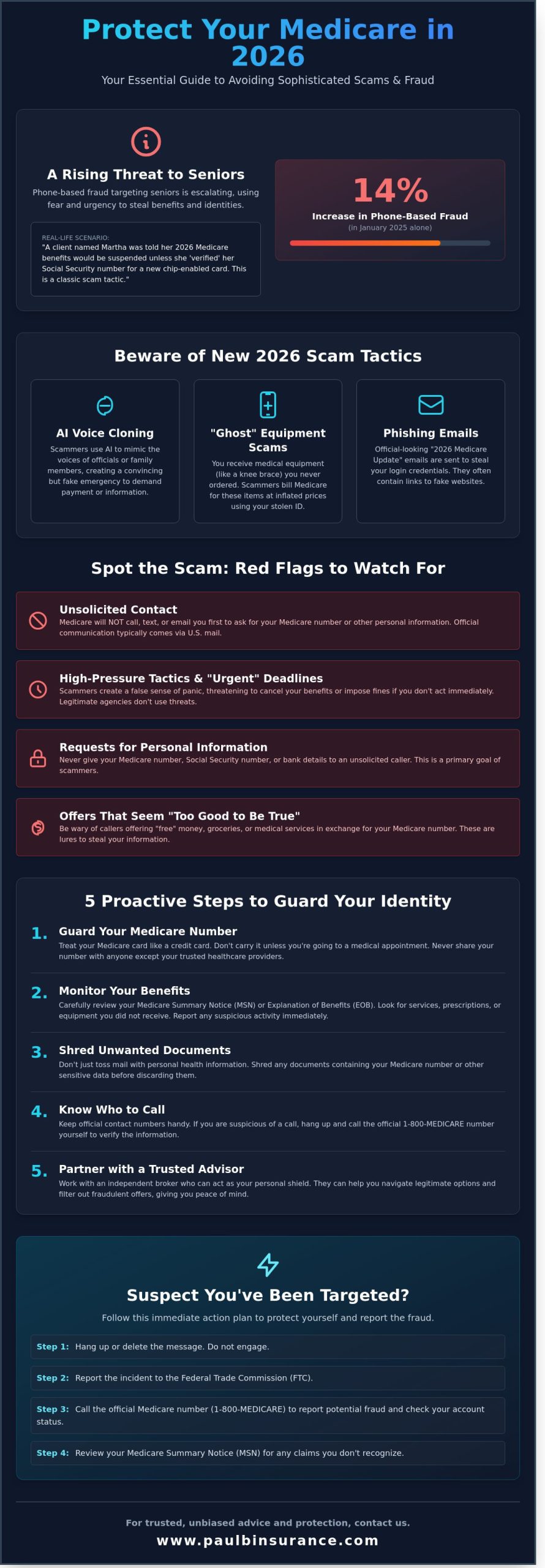
Last Tuesday, a client named Martha received a phone call claiming her 2026 Medicare benefits would be suspended unless she verified her social security number for a new chip-enabled card. It felt urgent, official, and frightening. We hear stories like this every day because phone-based fraud targeting seniors rose by 14 percent in January 2025 alone. If you feel overwhelmed by the constant barrage of unsolicited calls and mail that looks like a legal summons, you aren’t alone. We know how stressful it is to worry about losing your hard-earned benefits or your identity to a stranger.
Our goal is to move you from confusion to confidence by avoiding medicare scams and fraud with a clear, step-by-step plan. In 2026, scammers are using sophisticated AI voice cloning to mimic government officials, but you don’t have to be a victim. We will show you how to recognize these red flags instantly and provide the specific contact numbers you need to report suspicious activity. You’ll learn how to find a trusted advisor who filters out the noise so you can enjoy the peace of mind you deserve.
Key Takeaways
- Discover why scammers are using more sophisticated tactics in 2026 and how you can stay one step ahead of their latest schemes.
- Learn to identify the specific red flags of a fraudulent call, a vital skill for avoiding medicare scams and fraud and keeping your personal information private.
- We share five simple, proactive steps you can take today to guard your Medicare identity and monitor your benefits for suspicious activity.
- Get an immediate action plan to follow if you suspect you’ve been targeted, helping you move from a state of worry to a place of confidence.
- Understand how a trusted independent broker acts as your personal shield, filtering out the noise to ensure you only deal with legitimate, unbiased options.
Why Medicare Fraud is a Growing Concern in 2026
Medicare fraud is the intentional deception or misrepresentation that an individual or entity makes, knowing it could result in some unauthorized benefit to themselves or others. It is a serious crime that impacts every beneficiary. As we enter the 2026 enrollment season, the sophistication of these schemes has reached a new peak. Scammers often target seniors because they know the system is complex and the 2026 updates to Part D coverage can feel overwhelming. We are here to help you move from confusion to confidence by providing the clarity you need for avoiding medicare scams and fraud effectively.
The financial impact of these crimes is staggering. According to the National Health Care Anti-Fraud Association, health care fraud costs the nation an estimated $60 billion annually. This massive drain on the Medicare Trust Fund puts the entire program at risk, potentially leading to higher costs for everyone. A solid foundation in understanding Medicare fraud is your first line of defense. We take our role as your advocate seriously, ensuring you have a trusted partner to help you spot red flags before they compromise your security.
The Real Cost of Scams to Your Benefits
When a criminal steals your Medicare number, they don’t just steal money from the government; they steal your peace of mind. These thieves use your information to file fake claims for services you never received. This can lead to your legitimate benefits being exhausted. For example, if a scammer bills Medicare for a high-end wheelchair in your name, you might be denied that same equipment later when you actually need it. Beyond medical records, these breaches often lead to full identity theft, affecting your credit and personal finances. Fraud also forces the CMS to adjust rates. For 2026, many experts point to systemic fraud as a contributing factor to the rising baseline premiums for Part B.
New 2026 Tactics: AI Voice Cloning and Tech Scams
In 2026, technology has given scammers powerful new tools. We have seen a rise in AI voice cloning where a caller sounds exactly like a family member or a government official. They might claim there is a problem with your Medicare Advantage plan and demand immediate payment. Another common tactic is the “ghost” medical equipment scam. You might receive a knee brace or glucose monitor you never ordered. Scammers bill Medicare for these items at inflated prices using your stolen ID. We also see fake “2026 Medicare Update” emails. These messages look official but are designed to steal your login credentials. Always remember that avoiding medicare scams and fraud starts with skepticism. We recommend never giving your Medicare number to anyone who calls you out of the blue.
Recognizing the Red Flags of a Medicare Scam
We know the feeling of a ringing phone or a cluttered mailbox can cause instant stress. In 2026, scammers use sophisticated tools to try and trick you, but their goals remain the same. The first step in avoiding medicare scams and fraud is knowing that Medicare will never call you out of the blue to ask for your number. If someone calls claiming to be from the government and asks for your Medicare ID, hang up immediately. Legitimate agencies already have your information on file and will typically contact you via the U.S. Postal Service first.
There is a big difference between a broker you’ve asked to help you and a random “cold caller.” Federal regulations in 2026 strictly prohibit insurance companies from making unsolicited calls to enroll you in a plan. If you didn’t give a specific company permission to contact you, they are breaking the law. Before you engage with any mailer or text, use this quick mental checklist to evaluate the message:
- Did I request this specific information?
- Is the sender asking for my Medicare number or bank details?
- Are they using “urgent” language to make me act fast?
- Does the offer sound too good to be true, like “free” money or groceries?
Unsolicited Calls and “Urgent” Deadlines
Scammers love to create a false sense of panic. They might tell you that your benefits will be canceled by the end of the day or that you’ll face a massive fine if you don’t act before the October 15, 2026, enrollment start date. These “limited time offers” are designed to stop you from thinking clearly. The Social Security Administration and Medicare do not use threats to get people to enroll. We want you to feel empowered to take your time. If you feel rushed, it’s a major red flag. According to the official CMS guidance on fraud, any high-pressure tactic is a clear sign of a potential scam. We believe the best way to stay safe while avoiding medicare scams and fraud is to stay calm and verify every claim.
Requests for Personal Info or “Small Fees”
Treat your Medicare number with the same level of care as your credit card or Social Security number. We often see scammers offering “free” medical screenings or DNA tests at community events or through text messages. They claim they just need your Medicare number to “process” the free service. This is a trap used to bill the government for services you never received. Be wary of anyone claiming there’s a “processing fee” for your new 2026 Medicare card. The government never charges a fee to issue or replace your card. If you’re unsure about a piece of mail you’ve received, we can help you understand your legitimate plan options without any pressure or hidden costs.
5 Proactive Steps to Guard Your Medicare Identity
The year 2026 has brought new challenges in the fight against identity theft. Scammers are using more sophisticated tools than ever before to target your benefits. Protecting yourself doesn’t have to be complicated or stressful. We believe that simple habits are the best defense for avoiding medicare scams and fraud. By following these five proactive steps, you can move from a place of worry to a state of total confidence.
- Step 1: Treat your Medicare card like your Social Security card. In 2026, your Medicare number is a key that unlocks your private health information. Do not carry your card in your wallet unless you are going to a doctor’s appointment. Keep it in a safe, locked location at home.
- Step 2: Scrutinize your Medicare Summary Notice (MSN) every month. This document is your first line of defense. It acts as a receipt for your care. If you see charges for a wheelchair you never ordered or a test you never took, it is a major red flag.
- Step 3: Never give information to anyone who comes to your door. Medicare employees will never visit your home unannounced to sell you a plan or check your “eligibility.” If someone knocks on your door claiming to be from the government, do not let them in and do not share any personal details.
- Step 4: Use a trusted, independent broker to verify any plan changes. Scammers often use high-pressure tactics during the 2026 enrollment periods. An independent broker works for you, not the insurance company. We help you verify if a plan change is actually in your best interest.
- Step 5: Register for the “Do Not Call” list and opt-out of mailings. While this won’t stop every scammer, it significantly reduces the amount of “junk” outreach you receive. This makes it much easier to spot the legitimate communications from the fraudulent ones.
Reviewing Your Medicare Summary Notice (MSN)
Your MSN arrives every three months if you have Original Medicare. When you open it, look closely at the dates of service and the names of the providers. Scammers often use “double billing” where they charge Medicare twice for the same procedure. They might also list services on dates when you were home and not at a clinic. If you find an error, you should learn how to report Medicare fraud to ensure your benefits remain protected. We can help you understand these statements during our annual reviews to ensure everything looks correct.
Using Trusted Sources for Plan Comparisons
Searching for plan details online in 2026 can be risky. Many websites are “lead-gen” traps designed to collect your phone number and sell it to dozens of telemarketers. This is a common way people end up being targeted for avoiding medicare scams and fraud. Instead of clicking on random ads, we encourage you to use The Modern Medicare Agency for unbiased advice. You can safely research your options by looking through our Medicare Advantage Guide. We simplify the jargon so you know exactly how your coverage works without the fear of being misled.
What to Do If You Suspect You Are a Victim of Fraud
Discovering that you might have been targeted by a scammer is a heavy weight to carry. You might feel angry, embarrassed, or even scared; those feelings are completely normal in 2026 because these criminals have become incredibly clever. Please don’t beat yourself up. The most important thing right now is to move from worry into action. We are here to help you regain control. If you think someone stole your information, we can look at the situation together to see if it’s a real threat or just a false alarm. Our goal is to move you from confusion to confidence as quickly as possible.
Immediate Steps to Secure Your Information
Speed is your best friend when avoiding medicare scams and fraud consequences. We recommend you follow this checklist immediately to protect your identity and your hard-earned savings:
- Call your bank: If you shared any financial details, call your credit card company or bank right away. They can freeze your accounts or issue new cards immediately to stop unauthorized charges.
- Flag your Social Security: Contact the Social Security Administration to place a “block” on your electronic record. This prevents anyone from changing your direct deposit or contact info online without your direct permission.
- Update your passwords: It’s vital that you update your login credentials. You should change your password for medicare.gov to something unique that you don’t use anywhere else. A strong password is your first line of defense against digital intruders.
How to Report Scams to Official Channels
Once your accounts are safe, you need to alert the authorities. This helps protect other seniors in your community too. Call 1-800-MEDICARE (1-800-633-4227) to report any suspicious claims you see on your Summary Notice. If the representative confirms fraud, they will start the process of issuing you a brand new Medicare number and card. This usually takes about 14 days to arrive in your mailbox. You should also reach out to your local Senior Medicare Patrol (SMP). These volunteers specialize in tracking 2026 fraud trends in your specific state and provide one-on-one counseling. Finally, file a report with the Federal Trade Commission (FTC) at IdentityTheft.gov. They provide a personalized recovery plan that guides you through every step of clearing your name.
If you aren’t sure if a call or email was a scam, don’t stay in the dark. We are dedicated to your protection and can help you verify if a communication was legitimate. You don’t have to face this maze alone. We are here to provide unbiased guidance, and our process is never rushed, never pressured.
How a Trusted Independent Broker Acts as Your Shield
Choosing a Medicare plan in 2026 feels like walking through a minefield of robocalls and flashy mailers. We believe the best way to stay safe is to understand who’s actually on your side. A “captive agent” works for a single insurance company. Their job is to sell you that company’s specific plan, whether it fits your needs or not. We operate differently as independent brokers. We don’t answer to one corporation; we represent dozens of carriers. This independence is your primary defense in avoiding medicare scams and fraud. We filter out the noise so you only see legitimate, high-quality options that meet CMS standards for 2026. Similarly, for those on the business side of the medical field, Healthcare Biz Brokers, Inc. provides the specialized expertise needed to navigate the complex process of buying or selling healthcare businesses with full transparency.
The Benefit of a Personal Advocate in 2026
The 2026 landscape brings significant shifts, including the full implementation of the $2,000 out-of-pocket cap on prescription drugs. Scammers often use these complex changes to confuse you. If you receive a suspicious call or a “new card” request, you can call us first. We’ll tell you if it’s a legitimate update or a trap. We help you safely compare Medigap plans without the pressure of a sales pitch. Our services come at no cost to you. This is vital because real Medicare help is free. If anyone asks for a “consultation fee” to help you enroll, you’ll know immediately it’s a scam.
Moving From Confusion to Confidence with Our Team
Our mission is to take you from a state of worry to a place of total peace of mind. Staying protected while avoiding medicare scams and fraud becomes much simpler when you have a professional team filtering the noise for you. We’ve developed a simple 5-step process to ensure your safety:
- We analyze your current doctors and medications for perfect alignment.
- We verify every plan’s network for the 2026 coverage year.
- We review Medicare Part D formularies, which change every January 1.
- We handle all the enrollment paperwork to prevent data entry errors.
- We provide year-round support as your first line of defense against new threats.
You’re never rushed and never pressured. When you’re ready to stop the guessing game, Schedule a Call With Paul to protect your future. We’ll turn that “crazy maze” into a clear path forward.
Move From Confusion to Confidence in Your Coverage
Protecting your hard-earned benefits in 2026 starts with staying alert to the red flags we discussed today. You now have the tools to spot high-pressure tactics and the five proactive steps needed to keep your Medicare ID safe. Remember, the key to avoiding medicare scams and fraud is never feeling rushed into a decision. We believe you deserve a clear path through the maze of insurance options without the stress of being targeted by bad actors.
You don’t have to navigate this complex system alone. We serve seniors across 34+ states, providing the personalized support you need to feel secure. By comparing over 40 carriers, we offer unbiased guidance that puts your needs first. Our team specializes in helping you steer clear of costly enrollment mistakes that can lead to late penalties or gaps in care. We’re here to act as your shield, ensuring your transition into 2026 is smooth and protected.
Ready to secure your future with a partner you can trust? Schedule a Call With Paul to Secure Your Medicare Plan. We’ll work together to find the right fit for your health and your peace of mind.
Frequently Asked Questions
Does Medicare ever call you to ask for your Medicare number?
No, Medicare will never call you out of the blue to ask for your Medicare number or other personal details. Official representatives only call if you have already left a message or if you are currently working with them on an ongoing case. If someone calls claiming they need your number to verify your 2026 benefits, hang up immediately. This is a common tactic used by those avoiding medicare scams and fraud to steal your identity.
What should I do if someone comes to my door saying they are from Medicare?
You should politely decline to speak with them and close your door. Medicare employees and private insurance agents are legally prohibited from making unannounced visits to your home to sell plans or “verify” information. Under CMS regulations for 2026, door to door marketing is strictly forbidden. If an uninvited person shows up at your house, we recommend reporting the incident to the Senior Medicare Patrol at 1-877-808-2468 to help protect others in your community.
How can I tell if a Medicare Advantage ad on TV is a scam?
You can identify a suspicious ad if it makes “too good to be true” promises like adding thousands of dollars back to your Social Security check. Look for the required Medicare disclaimer at the bottom of the screen, which must be visible for at least 60 seconds in 2026. If the ad uses high pressure language or lacks a specific CMS approved code, it is likely a lead generation trap. We suggest looking for trusted, unbiased guidance instead of calling generic hotlines.
Is it safe to give my Medicare number to a local pharmacy?
Yes, it is safe and necessary to provide your Medicare number to a licensed pharmacy where you fill your prescriptions. Your pharmacist needs this data to process your 2026 Part D or Medicare Advantage drug benefits correctly. We recommend only sharing this information with providers you know personally. Always check your monthly “Explanation of Benefits” statement to ensure the pharmacy only billed for the 30 day or 90 day supplies you actually received at the counter.
What is the “New Medicare Card” scam I keep hearing about in 2026?
The “New Medicare Card” scam involves callers claiming that Medicare is issuing plastic cards with “embedded chips” for 2026 and requires a fee to send yours. This is entirely false. Medicare continues to use the standard paper cards to protect your security, and they never charge a fee for a replacement. If someone asks for your bank information to process a “card upgrade” or “shipping fee,” they are attempting to commit fraud. We want you to feel simple confidence in knowing your current card is perfectly valid.
Can a Medicare broker help me report a fraudulent plan?
Yes, an independent broker can provide the expert guidance you need to report suspicious activity or misleading enrollment. We act as your advocate, helping you navigate the 1-800-MEDICARE reporting process if you feel a “captive agent” misled you into a plan that doesn’t fit your needs. Because we are unbiased, we help you document the interaction clearly. This is a vital step in avoiding medicare scams and fraud while moving from a state of confusion to confidence.
Are “free” medical braces or kits offered over the phone legitimate?
No, these offers for “free” back braces or genetic testing kits are almost always scams designed to bill Medicare for thousands of dollars in your name. Medicare only pays for durable medical equipment if it is ordered by your own doctor who is actively treating you. In 2026, the Office of Inspector General reported that these phone solicitations remain a top source of fraudulent billing. If a stranger offers you “free” medical supplies, just hang up the phone.