




The annuity that offers the steadiest income may not be the best fit if you also need flexibility or want to leave money to loved ones. In 2026, choosing an annuity means weighing the security of scheduled payments against the choices you give up in return.
It’s understandable to want retirement income you can count on and to feel unsure which contract details matter most. A lifetime income annuity can pay you for as long as you live, but the payout option affects what happens after your death and whether a spouse or beneficiary may continue receiving payments.
Learning how to choose an annuity for guaranteed income starts with matching its payout and return options to your needs, not simply choosing the largest initial payment. This article explains immediate and deferred income, fixed, variable, and indexed returns, and the trade-offs involving beneficiaries and access to your money. It also covers how to consider annuity income alongside Social Security, a pension, and withdrawals from retirement accounts.
Key Takeaways
- Match immediate or deferred payments to when you need retirement income to begin.
- Consider how lifetime, joint-life, and period-certain options affect income for you and your loved ones.
- Compare fixed, variable, and indexed returns with your comfort with market risk and changing income.
- Coordinate annuity payments with Social Security, pensions, and retirement account withdrawals to shape a more balanced income plan.
- Weigh steady lifetime payments against trade-offs such as reduced access to your money and fewer options for beneficiaries.
What is a guaranteed lifetime income annuity?
A guaranteed lifetime income annuity is a contract that pays income for as long as you live, then ends. Before buying, ask an insurance agent when payments start, how payout choices affect income, and how taxes apply to your money. These answers help you judge whether the contract fits your retirement timeline.
Immediate and Deferred Income
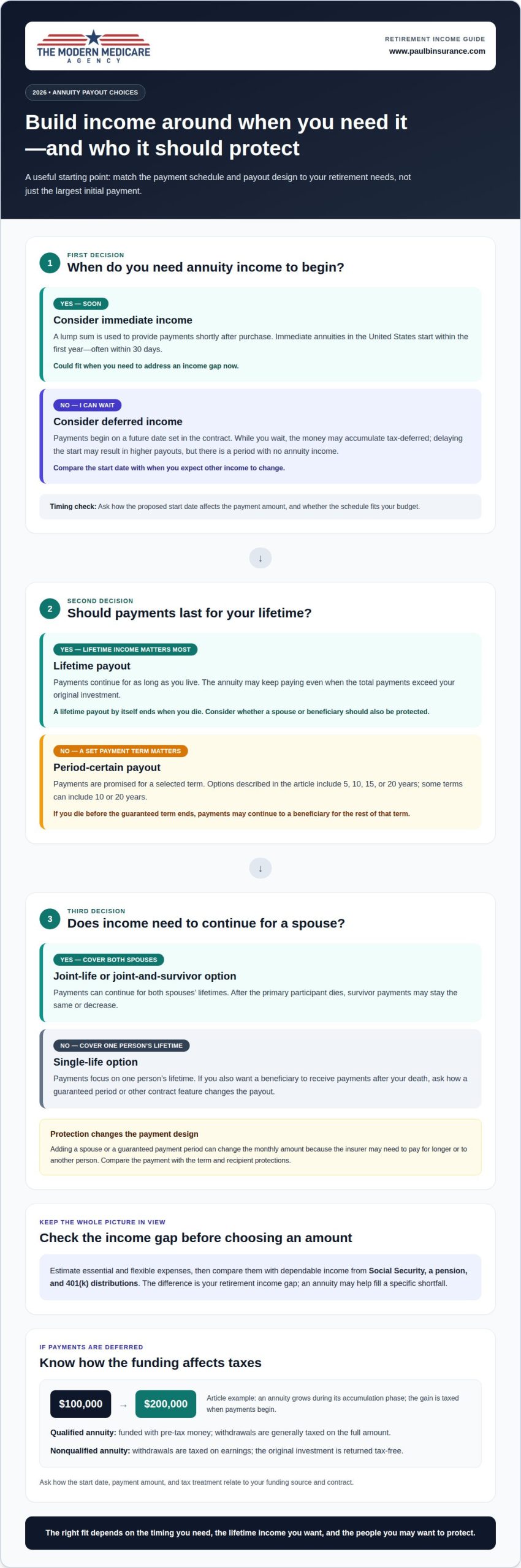
An immediate annuity uses a lump sum to provide income shortly after purchase, while a deferred annuity begins payments on a future date. The distinction matters if you need income soon or can wait while savings remain in the contract. To choose an annuity for guaranteed income, start by matching its payment schedule to your needs.
For example, someone nearing retirement who needs income within the next year may consider immediate payments. Someone with other income for now may prefer a deferred start. Immediate income can address a current gap; deferred income is intended for a later stage of retirement.
Annuity Income Start Dates
Immediate income annuities in the United States start paying within the first year after purchase, often within 30 days. A deferred annuity starts on a future date set in the contract, so the number of years before income begins can vary. That date determines when the payments can support your budget.
If you need income soon, a start date shortly after purchase may be a better fit. If you can wait, delaying payments may result in higher payouts, but you’ll have a period without income from the annuity. A practical way to choose an annuity for guaranteed income is to compare its start date with when you expect other income to change.
Income and Tax-Deferred Growth
During a deferred annuity’s accumulation period, funds grow tax-deferred, meaning taxes are postponed until withdrawals begin. This may matter if you don’t need income yet and want the contract to accumulate value before payments start. Tax treatment also depends on whether you fund the annuity with pre-tax or after-tax money.
For example, a $100,000 annuity that grows to $200,000 during the accumulation phase has a gain taxed when payments begin. Qualified annuities use pre-tax money, and withdrawals are generally taxed on the full amount. With a nonqualified annuity, withdrawals are taxed on earnings, while the original investment is returned tax-free.
Ask the agent to explain the proposed start date, payment amount, and tax treatment based on your funding source. Also ask how delaying the start date changes the payment. These details can help you compare timing and tax effects before committing savings to a contract.
Beneficiary, refund, and period-certain options
In 2026, payout choices shape how long income lasts and who may receive payments after your death. Ask an insurance agent how each option affects your monthly amount, whether a survivor continues receiving income, and what happens if you die during a guaranteed period.
Lifetime and Period-Certain Payouts
A lifetime payout continues for as long as you live, while a period-certain option promises payments for a set term. This choice balances income for your lifetime against payments that may continue to a beneficiary after your death.
Terms can include 10 or 20 years, and some payout options offer 5, 10, 15, or 20 years. A period-certain feature can protect beneficiaries if you die before the term ends. A lifetime option, by contrast, can continue paying even when total payments exceed your original investment.
How Payout Choices Affect Payments
Adding a spouse or a guaranteed payment period can change the monthly amount because the insurer may need to make payments for longer or to another person. A single-life option focuses on one person’s lifetime; a joint-life option can continue payments for both spouses’ lifetimes.
Treat these figures as an example of how a specific payout design works, not as a personal quote. Compare the payment amount with the term and recipient protections.
Beneficiaries and Death Benefits
A beneficiary receives payments or a remaining benefit according to the payout option you select. With joint-and-survivor income, payments may stay the same or decrease after the primary participant dies. This matters to a surviving spouse’s retirement plan, especially if the household relies on the annuity for income.
Some contracts offer optional features, or riders, that add benefits to the basic payout design. A hybrid annuity may combine lifetime income with a benefit for another need, but the specific terms depend on the contract. An inflation-protection feature can adjust payments over time, affecting both the initial income and later amounts. Ask how a rider changes payments, when it applies, and who may receive any remaining benefit.
Beneficiary designations can transfer directly to named beneficiaries outside probate. Review the recipient and payment terms together: a guaranteed period can support beneficiaries, while a joint-life choice can focus on continuing income for a spouse. If you want help weighing these annuity options, annuity guidance can help connect the payout design to your priorities.
Coordinating annuity income with other retirement sources
In 2026, an annuity works best as one part of a retirement income picture, not a stand-alone decision. Compare expected expenses with dependable income from Social Security, a pension, and 401(k) distributions to see where an income gap remains.
Estimating the Retirement Income Gap
A retirement income gap is the difference between expected expenses and dependable monthly income. Estimating it can show whether an annuity might fill a specific shortfall, rather than add income you may not need.
Start by estimating essential and flexible monthly expenses. Then total dependable income from sources such as Social Security and a pension. Subtract that income from your expected expenses. If there’s a shortfall, consider its size and when it begins before weighing an annuity.
For example, a pension may cover some regular expenses, while Social Security covers another portion. Savings and 401(k) distributions may help with the rest, but their value can change with withdrawals and investment growth. A clear monthly picture helps distinguish income you can count on from assets you may need to draw down.
Build your estimate around your retirement timeline, too. Income needs can change when work ends, a pension begins, or another household income source changes. Looking at each stage can help identify when a gap may appear and whether guaranteed payments could address it. Comprehensive financial planning services, such as those offered by Zenith Wealth, emphasize evaluating cash flow and asset allocation across different life stages to ensure long-term stability.
Coordinating Guaranteed Income Sources
Coordinating guaranteed income means considering annuity payments alongside Social Security and pension income. The timing and amount of each source affect how much of your retirement savings you may need to use.
Employer-sponsored pension payments can depend on age, years worked, and salary. Set those payments beside Social Security and any planned 401(k) distributions. Then consider whether an annuity should cover a remaining need, such as monthly expenses that continue throughout retirement.
Your retirement timeline can guide the choice. If you need income soon, an immediate annuity may address a current gap; if income is needed later, a deferred annuity can fit a future stage. Immediate income annuities in the United States start within the first year after purchase, often within 30 days. Match the start date to when other income is expected, not simply to the purchase date.
Risk tolerance matters as well. Consider how comfortable you are relying on savings exposed to investment changes, and how much predictable income would help you feel secure. A person with dependable pension and Social Security income may have different needs from someone relying more heavily on savings and 401(k) distributions.
Finally, consider the annuity’s role in your overall income plan. An insurer calculates payouts using factors such as age, premium amount, payout option, and prevailing interest rates. Focus on how the proposed payment fits your monthly gap, timeline, and comfort with investment risk. This keeps the decision centered on the income role you need, not just a payout figure. For broader portfolio coordination and long-term retirement strategies, advisory firms like Financial Mentors Wealth Management emphasize balancing predictable cash flow alongside structured wealth creation goals.
Fixed, variable, and indexed annuity returns
In 2026, annuity contracts can offer fixed, variable, or indexed returns. The type affects how interest or investment performance shapes account value and income, so compare the contract’s return method with your comfort with change.
A fixed annuity sets amounts guaranteed in the contract, and the insurance company bears the investment risk. Its return may be easier to understand than one tied to market performance. Read how the contract sets interest and payments, and whether those amounts apply during accumulation, payout, or both.
A variable annuity places money in investment options, so account earnings and payouts can rise or fall. Some contracts may offer minimum guarantees as an option, but the guarantee terms matter. Variable annuities can have annual fees of 2% or more, and the principal may fall when markets decline. Consider both costs and investment risk when judging the potential return.
An indexed annuity links interest earnings to a market index, usually combining a guaranteed minimum interest rate with index-linked interest. The contract limits growth potential and offers principal protection. An index gain does not necessarily translate into the same gain for the annuity. Before comparing projected growth with a fixed return, understand how the cap and minimum rate work.
Fixed indexed annuities and registered index-linked annuities may be options to consider when retirement is five to 10 years away. A registered index-linked annuity can use a buffer that protects against losses up to a stated amount, such as 10%. The annuity owner absorbs losses beyond that buffer. This design can limit some losses without removing market risk.
Compare each contract by asking what drives its return, what limits growth, and what happens when investments decline. For a variable annuity, include annual fees and any optional minimum guarantee. For an indexed contract, focus on the index link, cap, and protection terms. For a fixed annuity, understand which amounts the contract guarantees and when they apply.
Consider the annuity’s role in your retirement income, not just its return potential. A steady contractual amount may suit someone who values predictability; a variable return may appeal to someone comfortable with changes. Index-linked growth and protection have their own limits. Start with the trade-off you can accept, then check whether the contract’s terms support that choice.
Advantages and disadvantages of income annuities
In 2026, an income annuity can turn a premium into a predictable payment stream. That can help cover recurring expenses and reduce reliance on withdrawals from savings during retirement. A lifetime payout also addresses the risk of outliving savings because payments continue for the annuitant’s lifetime. The trade-off is access: after purchase, getting a large part of the money back may be difficult or costly.
Income certainty has an important limit: annuity guarantees are backed exclusively by the issuing insurer’s claims-paying ability. The contract, rather than the market, sets the promised payment terms, but the guarantee depends on the insurer being able to meet its claims. Consider this alongside the payment schedule, payout duration, and the amount of retirement savings you would commit.
Reduced flexibility can matter if expenses change. Annuity lump-sum withdrawals may incur fees, and many annuities have surrender charges ranging from 5% to 10%. Surrender periods average seven years. During that period, taking out more than the contract allows can trigger charges. This can make an annuity a poor fit for money you may need soon for a major expense or an unexpected change.
Compare the steady income with the value of keeping funds accessible. For example, someone with other savings for emergencies may be more comfortable committing some retirement funds than someone with limited available cash. The right balance depends on expected expenses, dependable income, and risk tolerance. A payment stream can support a plan, but committing too much may leave less room to respond to changing needs.
Beneficiary protection involves another trade-off. A lifetime-only option can provide income for as long as you live, but payments end at death. A period-certain or joint-life option can continue payments for a set term or a spouse’s lifetime, though these choices affect the monthly amount. Compare the protection each option provides with the income you need today.
Use a simple comparison before purchase: identify the expenses the annuity would cover, the funds you need to keep accessible, and the payout terms that matter to your household. Then weigh predictable income against surrender limits, beneficiary outcomes, and insurer claims-paying ability. If you’re ready to review annuity options for retirement income, focus on how each contract fits your priorities, not just its initial payment.
The Modern Medicare Agency
The Modern Medicare Agency can help you discuss annuity options as you consider how retirement income may fit your broader insurance needs. When you’re weighing payout choices, return types, and access to savings, a clear conversation can help you understand how an annuity contract aligns with your priorities. The agency also helps eligible individuals compare Medicare coverage, which may be a separate part of preparing for retirement expenses. These are distinct decisions, and Medicare coverage is not a substitute for retirement income planning.
If you’d like to talk through annuity options and your insurance needs, contact The Modern Medicare Agency.
Make your next retirement decision with confidence
Give yourself time to turn what you’ve learned into clear priorities. Write down what you want predictable income to support, how much flexibility matters, and what you hope to leave to loved ones. Those priorities can guide a focused conversation about whether an annuity belongs in your retirement approach.
The answer to how to choose an annuity for guaranteed income starts with the role you want it to play in your life, not with a product name or payment illustration. The Modern Medicare Agency can help you consider related coverage needs through Medicare Advantage Plans, Medicare Supplement (Medigap) Plans, and Medicare Part D Plans.
For a personal conversation about your insurance needs, contact The Modern Medicare Agency. You can take this one decision at a time, with your priorities leading the way.
Frequently Asked Questions
How are annuities taxed?
Taxes depend on how the annuity was funded and whether money is being withdrawn. With a qualified annuity funded with pre-tax money, withdrawals are generally taxed on the full amount. With a nonqualified annuity, earnings are taxed when withdrawn, while the original investment is returned tax-free. During the accumulation period, taxes on growth are deferred until withdrawals begin. Keep the funding source in mind when estimating spendable income.
Who shouldn’t buy annuities?
An annuity may not fit someone who needs ready access to the money committed to the contract, or whose retirement income plan already covers predictable expenses. It may also be a poor match for someone unwilling to accept the contract’s payout limits, charges, or insurer-related risk. For example, someone saving for a near-term expense may need greater flexibility. The key question is whether the income benefit is worth reduced access to the money.
Will my spouse continue to receive payments after I pass away?
Your spouse continues receiving payments only if the contract’s payout option provides for a surviving spouse. A joint-life option can pay over both spouses’ lifetimes, but the amount may stay the same or decrease after the first spouse dies. A single-life payout generally focuses payments on one annuitant’s lifetime. Before choosing, consider whether your spouse could cover household expenses with the survivor payment alone.
Are annuities safe?
Annuities are insurance contracts, but their guarantees depend on the issuing insurer’s ability to pay claims. They are not all free from risk: a variable annuity’s account value can fall when investments decline, while fixed payments follow the contract’s terms. Safety depends on the type of annuity, its provisions, and the insurer’s claims-paying ability. Consider the contract’s guarantees and limits separately.
Can I access my money if needed?
Access depends on the annuity contract, and withdrawing a lump sum may involve fees or surrender charges. A withdrawal can also affect future income, so it’s important to understand the contract’s access provisions before committing funds. Tax consequences may apply as well. According to the Internal Revenue Service, withdrawals from a fixed or variable deferred annuity before age 59½ may incur a 10% penalty.
Do you pay taxes on your annuity purchase?
Buying an annuity does not by itself determine the tax due later; the funding source and withdrawals matter. A qualified annuity uses pre-tax money, so withdrawals are generally taxed on the full amount. For a nonqualified annuity, the original investment is returned tax-free, while earnings are taxed when withdrawn. For example, someone funding an annuity with money already taxed should distinguish the investment from its later earnings.
How Much Does a $100,000 Annuity Pay Per Month?
The actual payment depends on factors such as interest rates and the payout option you choose. A lifetime-only option and a choice that protects a spouse or beneficiary can produce different monthly amounts. Treat this range as an illustration, not a personal income estimate.
Is an annuity a good investment?
An annuity can serve a useful role when you value contractual income more than access to the invested money or market growth potential. It isn’t automatically right for every retirement plan. Compare its purpose with your other income, savings needs, risk comfort, and beneficiary priorities. For example, using money intended for long-term income can help preserve separate savings for expenses that require flexibility.

Article by
Paul Barrett
Paul Barrett, CMIP is the founder of The Modern Medicare Agency, an independent Medicare-only brokerage based in Melville, NY. With 18 years of Medicare-exclusive experience, a CMIP designation, and more than 5,000 clients served across 37 states, Paul is one of the most credentialed independent Medicare specialists on Long Island — and one of the most direct.
He represents 40+ carriers with no quotas and no allegiances, which means his recommendations are based entirely on what fits each client's specific situation. He is the author of Medicare Mastery Unlocked and host of the Wise Guys Retirement Talk podcast. His content is grounded in primary sources, real carrier intelligence, and 18 years of watching what happens when people get Medicare right — and when they don't.
📞 631-358-5793 | paulbinsurance.com