
Coordinating Medicare and Social Security benefits means understanding that these two programs run on separate timelines and separate enrollment rules. Most people assume they work as one system. They do not. Medicare eligibility starts at 65 regardless of when you claim Social Security, which can begin as early as 62 or as late as 70. Getting the timing wrong costs real money through permanent premium penalties. This guide walks you through exactly how the two programs interact, when enrollment is automatic, and what you must do yourself to avoid coverage gaps.
How to coordinate Medicare and Social Security benefits: the enrollment basics
Medicare and Social Security are separate federal programs with different eligibility ages and different enrollment processes. Social Security retirement benefits can start between age 62 and 70. Medicare eligibility begins at 65, full stop. Delaying Social Security does not delay Medicare. That single fact is the foundation of every coordination decision you will make.
The Social Security Administration (SSA) and the Centers for Medicare and Medicaid Services (CMS) share data, which is why your Social Security payment status at age 65 determines whether Medicare enrolls you automatically or whether you must act yourself. Understanding which situation applies to you is the first step in getting this right.
How does automatic Medicare enrollment work when receiving Social Security at 65?
If you are already receiving Social Security retirement benefits when you turn 65, Medicare Parts A and B start automatically on the first day of your birth month. You do not need to submit a separate Medicare application. The SSA handles the enrollment and mails your red, white, and blue Medicare card roughly three months before your 65th birthday.
There is one timing quirk worth knowing. If your birthday falls on the first day of the month, your Medicare coverage actually begins on the first day of the prior month. For example, if you turn 65 on june 1, your Medicare starts may 1.
Key facts about automatic enrollment:
- Parts A and B both start automatically when you receive Social Security at 65.
- Your Part B premium is deducted directly from your Social Security check rather than billed separately.
- Residents of Puerto Rico are automatically enrolled in Part A only. They must actively enroll in Part B if they want it.
- Railroad Retirement Board (RRB) recipients also receive automatic enrollment, handled through the RRB rather than SSA.
- You can decline Part B if you have other qualifying coverage, such as an active employer group health plan.
Pro Tip: Review your Medicare card when it arrives. Confirm the effective date and check that both Part A and Part B are listed. If anything looks wrong, call the SSA at 1-800-772-1213 immediately.
What steps to take if you delay Social Security past 65 but need Medicare?
Delaying Social Security past 65 is a common strategy to increase your monthly benefit. The problem is that Medicare does not wait with you. Medicare eligibility begins at 65 no matter when you plan to claim Social Security. If you are not receiving Social Security payments at 65, Medicare will not enroll you automatically. You must sign up yourself.
The window for doing this is called the Initial Enrollment Period (IEP). Missing it triggers permanent penalties.
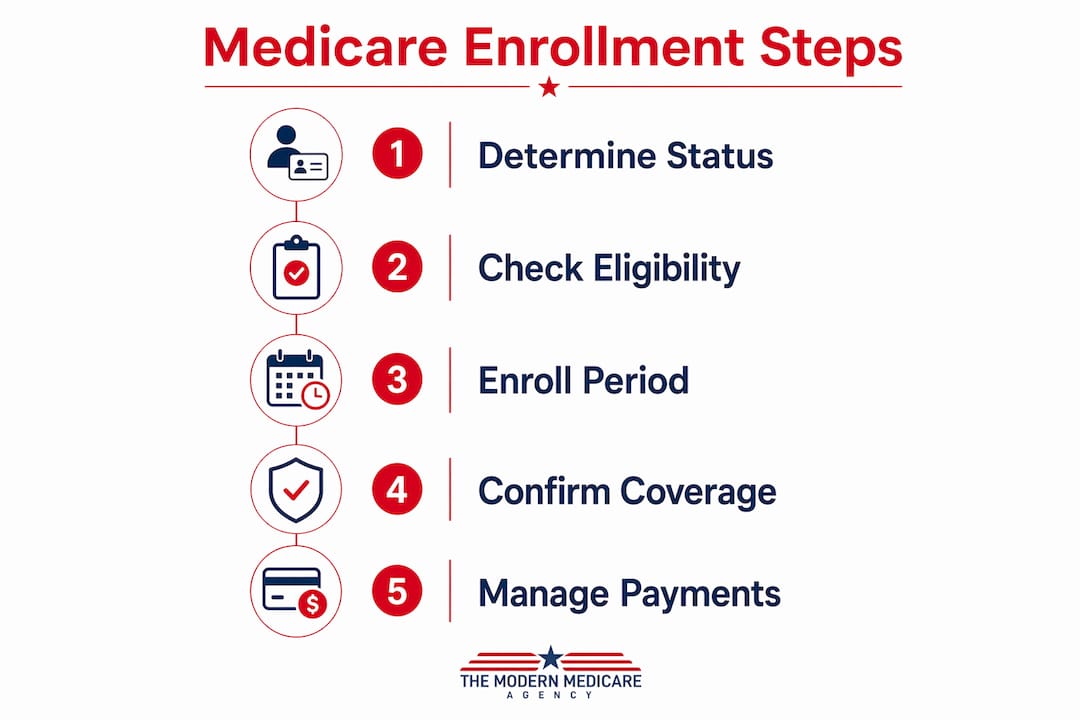
Here is how to enroll during your IEP:
- Know your 7-month window. The IEP opens three months before your 65th birthday month, includes your birthday month, and closes three months after. That is seven months total.
- Apply through SSA.gov. You can enroll in Medicare Parts A and B online at SSA.gov, by phone, or at your local Social Security office.
- Enroll in Part B even if you skip Part A. Most people get Part A premium-free. Part B costs a monthly premium, but skipping it without qualifying coverage triggers a permanent 10% penalty for every 12-month period you were eligible but not enrolled.
- Check your employer coverage status. If you are still working at 65 and covered by an employer group health plan, you may qualify for a Special Enrollment Period (SEP). The SEP gives you eight months after your employer coverage ends to enroll in Part B without penalty.
- Mark your calendar. Set a reminder at least four months before your 65th birthday so you have time to gather documents and complete the application.
Pro Tip: Do not wait until the last month of your IEP to enroll. Enrolling in the first three months of your IEP means your coverage starts the month you turn 65. Enrolling later delays your start date.
For a full breakdown of Medicare enrollment periods, Paulbinsurance has a plain-language guide that maps every key deadline.
How do Medicare and Social Security premiums and payments coordinate?
The financial connection between Medicare and Social Security is direct and automatic for most retirees. Part B premiums are deducted from your Social Security check each month if you are receiving Social Security when you enroll in Medicare. You never see a separate bill from CMS. Your Social Security deposit simply arrives smaller by the amount of your Part B premium.

If you are not yet receiving Social Security when you enroll in Medicare, CMS bills you directly. You pay by mail or set up electronic funds transfer (EFT). This billing arrangement continues until you start Social Security, at which point premiums shift to automatic deduction.
Key points on premium coordination:
- Part A is premium-free for most people who worked at least 10 years and paid Medicare taxes. No deduction from Social Security is needed.
- Part B has a standard monthly premium set annually by CMS. Higher-income earners pay more through the Income-Related Monthly Adjustment Amount (IRMAA).
- Late enrollment penalties add permanently to your Part B premium. A two-year delay without qualifying coverage adds 20% to your premium for life.
- Review your net retirement income after Part B premiums are deducted. Many retirees are surprised by how the deduction affects their monthly Social Security deposit.
Paulbinsurance recommends projecting your retirement cash flow with Part B premiums already subtracted. That number is your real monthly income from Social Security.
What are common mistakes in Medicare and Social Security coordination?
The most costly mistake retirees make is assuming Medicare enrollment is automatic regardless of their Social Security status. If you are not receiving Social Security at 65, Medicare Parts A and B will not start on their own. You must enroll during your IEP or face permanent penalties.
Other frequent errors include:
- Treating enrollment as a household decision. Each person must enroll individually. Your spouse’s Social Security status has no effect on your Medicare enrollment requirement.
- Assuming COBRA or retiree coverage qualifies for SEP. Only active employer group health plan coverage qualifies. COBRA and retiree health plans do not protect you from the Part B late penalty.
- Forgetting Part D. Skipping a Medicare prescription drug plan (Part D) when first eligible also carries a late enrollment penalty if you go without creditable drug coverage.
- Relying on verbal advice. Always verify enrollment decisions using official sources: the Medicare & You handbook, SSA.gov, or Medicare.gov.
“Proactive use of official resources and professional Medicare counseling can prevent confusion and costly errors.” — Medicare & You Handbook 2026
Set a calendar reminder 120 days before your 65th birthday. Use that time to confirm your Social Security payment status, check whether employer coverage qualifies for SEP, and complete your Medicare application if needed. Paulbinsurance also offers Medicare enrollment help for seniors who want a guided walkthrough of every step.
Medicare enrollment scenarios: a side-by-side comparison
Your enrollment action depends entirely on two factors: whether you receive Social Security at 65, and whether you have qualifying employer coverage.
| Scenario | Medicare enrollment action | Penalty risk |
|---|---|---|
| Receiving Social Security at 65 | Automatic Parts A and B. No action needed. | None if enrolled on time. |
| Delaying Social Security, no employer coverage | Must enroll during 7-month IEP at 65. | Permanent 10% per year if IEP missed. |
| Delaying Social Security, active employer coverage | May delay Part B. Enroll within 8-month SEP after coverage ends. | None if SEP rules followed. |
| Receiving Social Security before 65 (disability) | Automatic enrollment after 24 months of disability benefits. | None under standard rules. |
| Puerto Rico resident receiving Social Security | Automatic Part A only. Must actively enroll in Part B. | Part B penalty if not enrolled timely. |
The SEP for employer coverage is one of the most misunderstood protections in Medicare. It applies only when you are actively employed and covered by your own employer’s group health plan. Retirement coverage and COBRA do not count. If you are unsure whether your coverage qualifies, confirm with your HR department and get the answer in writing before your IEP closes. You can also review whether you can delay Medicare without penalty at Paulbinsurance.
Key Takeaways
Coordinating Medicare and Social Security benefits requires knowing your enrollment status at 65 and acting before your Initial Enrollment Period closes.
| Point | Details |
|---|---|
| Automatic enrollment requires Social Security | You must already receive Social Security at 65 for Medicare to enroll you automatically. |
| IEP is a 7-month window | Enroll in Medicare during the three months before, your birthday month, and three months after turning 65. |
| Late Part B penalty is permanent | Missing your IEP without qualifying coverage adds 10% to your Part B premium for every year you delayed. |
| Premiums deduct from Social Security | Once you receive Social Security, Part B premiums come out of your monthly check automatically. |
| Each spouse enrolls individually | Your Social Security status does not affect your spouse’s Medicare enrollment obligation. |
What I have learned after nearly 20 years helping people with Medicare
I have been working with Medicare consumers since 2007. The single biggest source of financial pain I see is not a bad plan choice. It is a missed enrollment deadline caused by a wrong assumption.
The assumption almost always sounds like this: “I thought Medicare would just kick in when I turned 65.” For people already on Social Security, that is true. For everyone else, it is not. And the penalty for that assumption is not a one-time fee. It follows you for the rest of your life on Medicare.
The second thing I want to say plainly: do not make this a household decision. I have sat with couples where one spouse was automatically enrolled and the other was not, and the one who was not assumed they were covered because their partner was. Medicare does not work that way. Every individual has their own enrollment clock.
My advice is simple. Put a reminder in your phone four months before your 65th birthday. Call SSA.gov or visit your local Social Security office. Confirm your status. If you are not receiving benefits, apply for Medicare during your IEP. If you have employer coverage, get written confirmation that it qualifies for SEP protection. Do not rely on memory or assumptions when permanent financial penalties are on the table.
The Medicare & You handbook is free, updated annually, and covers every scenario in plain language. Use it. And if you want a second set of eyes on your specific situation, that is exactly what independent Medicare agents are here for.
— Paul
Medicare coverage that works alongside your benefits
Once your Medicare enrollment is sorted, the next question most retirees ask is how to fill the gaps Original Medicare leaves behind.

Original Medicare (Parts A and B) covers a broad range of services but does not cap your out-of-pocket costs. A Medicare Supplement plan covers many of those gaps, including copays, coinsurance, and hospital costs beyond what Medicare pays. At Paulbinsurance, our independent agents have specialized in Medicare since 2007. We help you compare Supplement plans, Medicare Advantage options, and Part D drug coverage so your benefits work together from day one. Reach out to Paulbinsurance to review your options with no pressure and no cost.
FAQ
Does delaying Social Security delay my Medicare enrollment?
No. Medicare eligibility begins at 65 regardless of when you claim Social Security. You must enroll in Medicare during your Initial Enrollment Period even if you plan to delay Social Security until 70.
What happens if I miss my Medicare Part B enrollment window?
Missing your IEP without qualifying coverage results in a permanent 10% premium surcharge for every 12-month period you were eligible but not enrolled. This penalty lasts as long as you have Part B.
How is my Medicare Part B premium paid if I receive Social Security?
Your Part B premium is deducted directly from your monthly Social Security check. If you are not yet receiving Social Security, CMS bills you directly by mail or electronic funds transfer.
Can my spouse’s Social Security status affect my Medicare enrollment?
No. Each person must enroll in Medicare individually based on their own Social Security payment status and work history. Your spouse’s enrollment does not trigger or protect yours.
Does employer coverage protect me from the Part B late penalty?
Yes, but only if the coverage is through an active employer group health plan. Employer coverage qualifies you for an 8-month Special Enrollment Period after that coverage ends. COBRA and retiree health plans do not qualify.