




Trying to work out how to file a Medicare claim yourself in 2026? If you have Original Medicare, complete the Patient Request for Medical Payment form, CMS-1490S, and mail it with an itemized bill and supporting documents to the Medicare contractor for your state. The process is different for Medicare Advantage, so start by contacting your plan for its forms and mailing address.
It’s understandable if paperwork, deadlines, and uncertainty about what happens next feel like a lot. Take it one step at a time. This guide explains what to include, where to send your claim, how long processing may take, and how to check its status.
You’ll also learn what to do if information is missing or a claim is denied. A clear path from preparing the form to checking for an update can help you handle the next step with confidence.
Key Takeaways
- For an Original Medicare claim, use the CMS-1490S form and mail it with an itemized bill and supporting documents.
- Check the filing deadline early: claims generally must be filed within 12 months after the service date.
- Make sure the itemized bill lists each service, its date and place, the charge, and the provider’s name and address.
- Allow up to 60 days for processing, then use your Medicare account or call Medicare to follow the claim’s status.
- If you have Medicare Advantage, contact your plan for its claim forms, mailing address, and deadline.
How do I file a claim?
For Original Medicare in 2026, use CMS-1490S, the Patient Request for Medical Payment form, and include supporting documents. According to the Centers for Medicare & Medicaid Services, you can appeal a denied claim within 120 days of receiving the denial using Form CMS-20027.
-
Download the CMS-1490S Claim Form
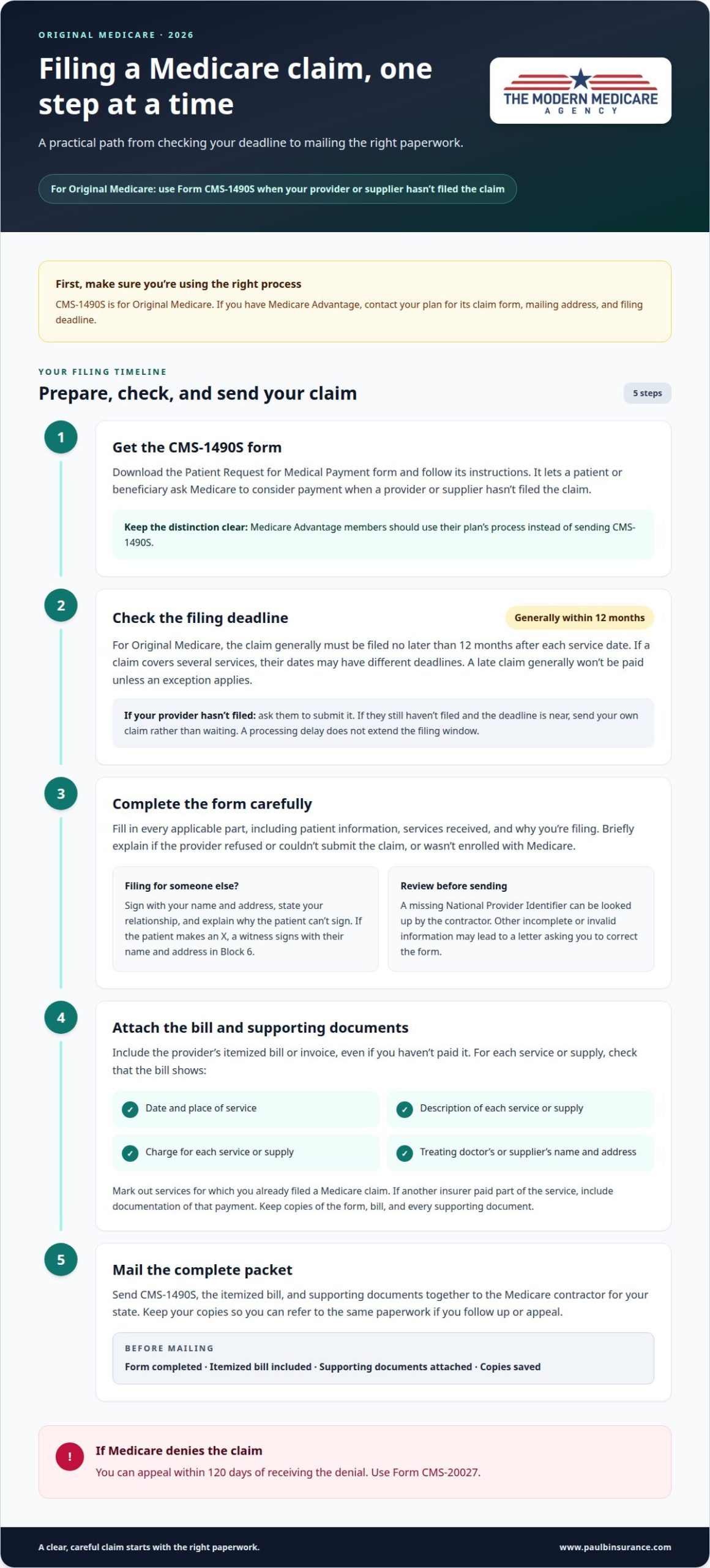
Download the Patient Request for Medical Payment form, CMS-1490S, from Medicare’s official forms page, and use its instructions while preparing your claim. The form is for a patient or beneficiary asking Medicare to consider payment when a provider or supplier hasn’t filed the claim. If you’re enrolled in Medicare Advantage, the process may differ; the Medicare Advantage plan guide explains how that coverage works.
Use the form for Original Medicare, not as a substitute for your plan’s claim process. Medicare Advantage members should contact their insurer for the required form and mailing address. That distinction helps you start with the right request rather than sending CMS-1490S to the wrong place.
-
Complete the Medical Payment Request Form
Fill in every applicable part of CMS-1490S, including the patient’s information, the services received, and the reason you’re filing. Explain clearly if the provider or supplier refused or was unable to submit the claim, or wasn’t enrolled with Medicare. A short, specific explanation helps show why you’re making the request for medical payment yourself.
Review the entries before sending the form. If the National Provider Identifier is missing, the Medicare contractor can look it up during processing. Other incomplete or invalid information may lead to the form being returned with a letter explaining what to correct. Completing the form carefully can help avoid that delay.
If you’re filing for another patient, sign with your own name and address, state your relationship to the patient, and briefly explain why they can’t sign. If the patient can’t write their name, they may make an X; a witness should sign their name and address in Block 6.
-
Add Supporting Documentation
Attach the provider’s itemized bill or invoice, even if you haven’t paid it. Medicare needs an itemized bill to process your request. It should show the date and place of each service, describe each service or supply, list the charge, and include the treating doctor’s or supplier’s name and address.
Before attaching bills, mark out any services for which you already filed a Medicare claim. If another insurer paid part of the service, include documentation about that payment with your request. Keep copies of CMS-1490S, the bill, and every supporting document you send. Those records make it easier to refer to the exact claim if you need to follow up or appeal.
Make sure the paperwork matches the claim. For example, a bill for several visits should list each visit’s date and service rather than combine them into one unclear charge. Submit the claim and supporting documents together so Medicare can compare the payment request with the services listed.
Medicare claim filing deadline
For Original Medicare, a claim generally must be filed no later than 12 months, or one full calendar year, after the service date. If it is filed later, Medicare won’t pay its share unless an exception applies. Check the service date early so you have time to act if the provider hasn’t filed.
For Medicare Advantage or Part D, contact your plan for its claim process and deadline. Medicare Advantage filing limits are shorter than Original Medicare’s, and Part D reimbursement procedures can vary by plan.
- Count the deadline from the date of service. Identify the date each service or supply was provided, then count 12 months from that date. A claim covering several services may have different service dates, so don’t assume they all share one filing deadline. Use the earliest date to help spot a claim that needs attention first.
Gather the paperwork promptly and leave enough time to submit it. A processing delay doesn’t extend the filing window. Keep the service date with your records so you can refer to it when following up with the provider or Medicare.
- Ask the provider to file before submitting your own claim. If you have Original Medicare and the provider hasn’t submitted the claim, contact them and ask them to file it. This gives the provider a chance to submit it directly, as is generally done for covered services.
If the provider still hasn’t filed and the deadline is near, submit your own claim rather than waiting. Use CMS-1490S with the itemized bill. Keep copies of your submission so you can refer to the same documents if you need to follow up.
- Use your plan’s process for Medicare Advantage or Part D. If you have Medicare Advantage, contact your insurer for the required forms, mailing address, and filing deadline. These deadlines are shorter than Original Medicare’s, so don’t rely on Original Medicare’s time limit.
If you have Part D, ask your plan how to request reimbursement. Depending on the plan, for example, you may pay upfront for a Tdap vaccine and submit a reimbursement claim. Follow the plan’s instructions for forms and supporting documents.
- Understand what filing can and cannot pay. Filing a claim doesn’t guarantee payment. Medicare won’t pay for care from an opt-out provider, even if you file yourself. In most states, non-participating Original Medicare providers may charge beneficiaries up to 115% of Medicare’s rate in 2026, according to the Centers for Medicare & Medicaid Services.
For covered Part B services in 2026, Medicare typically reimburses 80% of the Medicare-approved amount after the deductible is met. The beneficiary may owe coinsurance. Review the bill and claim outcome to understand what Medicare allowed and what remains your responsibility.
If you’re reviewing how prescription coverage works before a reimbursement request, Medicare Part D plan details can help clarify the role of your plan.
Claim processing time
In 2026, Original Medicare typically processes a claim in approximately 30 days. A review can take up to 60 days after Medicare receives your form, especially if information needs attention. Use these steps to monitor progress and understand what each update means.
- Start counting from when Medicare receives your form. The processing period begins after Medicare receives the claim, not when you prepare or mail it. Keep a copy of your completed paperwork and note when you sent it. This gives you a clear reference if you need to ask about the claim later.
Processing usually takes approximately 30 days, but Medicare may take up to 60 days after receiving the form. A claim involving a hospital stay or several services can require review of more details. Allow for the full processing window before treating a quiet status as a final decision.
- Look for the claim in your Medicare account. After Medicare receives and processes the claim form, you can usually see it in your Medicare.gov account within 24 hours. Check the claim details for the service, provider, and payment decision. The online record can help you distinguish a claim that is still being processed from one that has been decided.
If the claim isn’t visible, confirm that Medicare has had time to receive and process it. The 24-hour timeframe applies after those steps, not immediately after mailing. Keep your account details private, particularly when reviewing health services or insurance coverage on a shared device.
- Call Medicare if you need a status update. Call 1-800-MEDICARE to ask about a claim’s status. Have the patient’s Medicare information and service details available, so the representative can identify the correct request. You can also ask whether the Medicare Administrative Contractor needs more information.
Medicare offers phone or live-chat help 24 hours a day, 7 days a week, except some federal holidays. If your question concerns a plan’s claim rather than Original Medicare, contact that insurer directly. The plan manages its own claim process and can explain its coverage decision.
- Read the Medicare Summary Notice when it arrives. Original Medicare sends a Medicare Summary Notice every three months. It lists recent claims and shows what Medicare approved or paid. Compare it with your records, including a hospital bill or provider invoice. It’s a summary, not a bill, so use it to understand the claim decision and any amount listed as your responsibility.
Keep the notice with your claim paperwork. If a claim remains unresolved after the stated processing window, or the notice doesn’t match the service you received, call Medicare with the service date and provider details. Those specifics help identify the claim during follow-up.
Documents to include with a claim
For a 2026 Original Medicare claim, prepare the CMS-1490S form, an itemized bill, and any supporting documents that explain the service. Use these steps to assemble a clear packet and keep a record of what you submit.
- Gather the provider’s itemized bill. It must identify the date and place of each service, describe each service or supply, list the charge, and show the treating doctor’s or supplier’s name and address. A single total without service details may not give Medicare enough information to process the claim.
If the bill covers several appointments, make sure each visit appears separately with its own date and service description. You may submit a CMS-1490S claim even if you haven’t paid out of pocket, but Medicare needs the itemized bill to process it. Include the complete bill rather than a payment receipt alone.
- Include documents explaining payments by other insurance. If another insurer covered or considered the service, include its Explanation of Benefits notice with your Medicare request. The notice shows how the other insurance handled the charge before Medicare reviews its share.
Before attaching the bill, cross out any services for which you’ve already filed a Medicare claim. For example, if a statement includes a visit submitted separately, cross out that service line. This helps distinguish the new request from services already filed.
- Match each supporting document to the claim. Keep the paperwork relevant to the service you’re asking Medicare to review. If the provider’s invoice includes several supplies or appointments, make sure the descriptions and dates match the services listed on your claim form.
Keep a copy of the completed CMS-1490S, the full itemized bill, and every supporting document. Note which services you marked out and retain the insurer’s notice if you included one. These copies give you a useful record when checking the claim’s status or responding to a Medicare letter.
- Include permission paperwork only when someone else needs to discuss the claim. CMS-10106, the Authorization to Disclose Personal Health Information, lets you authorize Medicare to discuss your claims and health records with a chosen person. It can help when you want someone to speak with Medicare on your behalf.
For Medicare Advantage, follow the plan’s claim instructions and use its documents instead of assuming Original Medicare’s forms apply. Contact the insurer for its forms and supporting-document requirements. Keeping the requested paperwork together can help prevent a missing document from delaying the review.
Mailing claims to the appropriate Medicare Administrative Contractor
For Original Medicare in 2026, mail the claim form and supporting paperwork to the contractor serving your state. Use these steps to find the correct address and send your medical payment request to the right place.
-
Find the Appropriate Medicare Contractor
Open the Medicare Administrative Contractor Address Table included with the claim form and find the entry for your state. Original Medicare Part A or Part B claims go to the address listed for that state. Don’t choose an address based only on where you received care. Use the state listing in the table.
If you can’t locate the table or read the address, call Medicare at 1-800-633-4227 and ask for your contractor’s mailing address. Have your state and the service details ready. This can help you avoid sending the request to an office that handles another state’s claims.
- Confirm which insurance program handles the claim. The correct destination depends on whether you have Original Medicare or Medicare Advantage. For Original Medicare, use the contractor address listed for your state. If you have Medicare Advantage, contact your insurer for its claim form and mailing address.
Don’t send a Medicare Advantage claim to an Original Medicare contractor unless your plan instructs you to. The insurer handles its plan’s claim process, and submission rules can differ. Get the plan’s address before mailing to keep the request in the right process.
-
Mail the Claim to the Contractor
Place the completed CMS-1490S medical payment form, the itemized bill, and supporting documents together. Check that the bill identifies each service and that the forms relate to the same patient and claim. For example, a doctor’s invoice for several visits should accompany the request covering those visits.
Use the contractor’s address exactly as printed in the table. Before sealing the envelope, keep copies of every page for your records. These copies let you review what you submitted if the contractor sends a letter or you need to ask about the claim’s status.
- Keep a record of the mailing. Note when you sent the claim and retain any mailing receipt or delivery record. These details help identify your submission if you follow up with Medicare or the contractor.
If the address is unclear, call 1-800-MEDICARE before mailing rather than guessing. A correctly directed claim gives the appropriate contractor the opportunity to review the form and bill. For help understanding plan coverage alongside Original Medicare, explore Medicare Advantage guidance.
The Modern Medicare Agency
The Modern Medicare Agency can help you understand how your coverage choice affects where claims go and who handles them. If you’re weighing Medicare Advantage, Medigap, or Part D, its independent brokers offer personalized guidance to compare plans and select coverage that fits your needs. This can be useful when you’re unsure whether a claim belongs with Original Medicare or your private plan. The agency works with plans from over 40 carriers and provides year-round support across more than 34 states. Its role is plan guidance, not filing a claim with Medicare on your behalf.
For help understanding your Medicare coverage options, contact The Modern Medicare Agency.
Move forward with a clearer coverage picture
A claim can also raise broader questions about whether your Medicare coverage fits your needs. You may want to understand which plan handles certain services or whether your current choices still feel right. Consider those questions separately from the paperwork. A claim decision and a plan decision are related, but they aren’t the same.
If you’re still unsure how to file a Medicare claim yourself, first identify what’s causing concern: the claim process, the coverage involved, or how your plan choices work together. The Modern Medicare Agency offers personalized guidance to help you compare Medicare options. That support is for understanding coverage choices, not deciding or processing a Medicare claim.
When you’re ready to talk through your next step, contact The Modern Medicare Agency. You can move forward at your own pace, with a clearer sense of the questions you want answered.
Frequently Asked Questions
What is a Medicare claim?
A Medicare claim is a request for Medicare to decide whether it will pay for a health service or supply. The provider usually submits it, but you may need to file if the provider refuses or cannot submit it. For example, you may need to request payment for a covered medical service if the provider hasn’t filed the claim.
How do I check on my claim to make sure it was processed?
Check your Medicare.gov account for the claim, or call Medicare at 1-800-633-4227. Keep the service date and provider’s name nearby so you can identify the right claim. Original Medicare also sends a Medicare Summary Notice every three months. Review the notice against your records, especially if a service appears missing or the listed decision differs from what you expected.
What are the timeframes for filing a claim?
In 2026, the general Original Medicare filing window ends 12 months after the date of service. If you’re waiting for a provider to file, contact them before that window closes. If they still haven’t submitted the claim and time is running short, file it yourself. Medicare Advantage plans have shorter claim-filing limits, so ask your plan for its deadline and instructions.
Why did I get a bill, and what do I do with it?
A bill may show what the provider says you owe, while the Medicare Summary Notice explains how Original Medicare handled a claim. Compare the bill and notice with the services you received. If the provider hasn’t filed, ask them to submit the claim. If you file it yourself, include the itemized bill, even if you haven’t paid it.
What are the time limits to making a claim?
In 2026, most Original Medicare claims for services and supplies must be filed no later than 12 months after the service date. If the deadline is missed, Medicare won’t pay its share unless an exception applies. The appeal deadline is separate: you can submit a redetermination request within 120 days of receiving a denial. Use Form CMS-20027 to request that review.
What do I submit with the claim?
For an Original Medicare claim, submit CMS-1490S with an itemized bill. The bill should identify each service’s date and place, describe the service or supply, list its charge, and name the treating doctor or supplier and address. Include another insurer’s Explanation of Benefits notice if you’re also requesting Medicare payment. Keep a copy of everything you send for your records.
When can I file a Medicare claim myself instead of having the provider file it?
You may need to file when a provider or supplier refuses or is unable to submit an Original Medicare claim. If you paid out of pocket for a Medicare-covered service or supply for that reason, you can submit your own claim to seek payment. You can also submit CMS-1490S before paying, but Medicare needs the itemized bill to process the request.
How do I file a claim for Original Medicare Part A or Part B?
For an Original Medicare claim in 2026, use the Patient Request for Medical Payment form, CMS-1490S. Complete the form, explain why you’re filing, and include the itemized bill and related supporting documents. Mail the packet to the Medicare Administrative Contractor address listed for your state in the form’s address table. Medicare Advantage members should use their plan’s claim process instead.

Article by
Paul Barrett
Paul Barrett, CMIP is the founder of The Modern Medicare Agency, an independent Medicare-only brokerage based in Melville, NY. With 18 years of Medicare-exclusive experience, a CMIP designation, and more than 5,000 clients served across 37 states, Paul is one of the most credentialed independent Medicare specialists on Long Island — and one of the most direct.
He represents 40+ carriers with no quotas and no allegiances, which means his recommendations are based entirely on what fits each client's specific situation. He is the author of Medicare Mastery Unlocked and host of the Wise Guys Retirement Talk podcast. His content is grounded in primary sources, real carrier intelligence, and 18 years of watching what happens when people get Medicare right — and when they don't.
📞 631-358-5793 | paulbinsurance.com