




What if the daily medication you depend on suddenly disappears from your insurance plan on January 1? It is an unsettling thought, but it happens to thousands of people every autumn when carriers quietly adjust their drug lists. If you are wondering how to make sure my prescriptions are covered next year, taking a proactive look at your plan right now is the single best way to protect your health and avoid painful pharmacy surprises.
Sorting through thick insurance notices, technical jargon, and shifting copay tiers can feel exhausting. You shouldn’t have to spend your fall worrying whether your doctor-prescribed medications will still be affordable in 2026. In this guide, you will learn exactly how to review your medication list, verify plan formularies, and protect your coverage before annual enrollment closes. We will walk you through a clear, step-by-step path from confusion to complete certainty for the year ahead.
Key Takeaways
- Reviewing your Annual Notice of Change every fall reveals critical drug tier jumps and pharmacy network shifts before they take effect on January 1.
- Understanding how to make sure my prescriptions are covered next year starts with creating an accurate inventory of your daily medications and verifying each one against updated 2026 plan formularies.
- Comparing Medicare Advantage and standalone Part D options ensures your plan’s structure matches both your medical lifestyle and your specific medication needs.
- Having a medication removed from a formulary is manageable through practical safety nets like temporary transition fills, physician exception requests, and annual plan switches.
- Partnering with an independent broker lets you evaluate dozens of insurance carriers side by side, giving you clarity and complete confidence in your coverage.
Why Prescription Drug Coverage Changes Every Year
Every autumn, millions of Americans open their mailboxes to find significant changes in their health plans. Why does this happen so routinely? Behind the scenes, private insurers renegotiate pricing, rebates, and distribution agreements with pharmaceutical manufacturers every single year. Because these financial negotiations shift constantly, a health plan’s prescription drug formulary changes as well. When you wonder how to make sure my prescriptions are covered next year, understanding these annual business cycles gives you the clarity you need to stay ahead.
A medication you have relied on for years might suddenly jump to a higher copay tier, require new prior authorization approvals, or disappear from the list entirely. Ignoring these autumn updates can lead to severe shocks at the pharmacy checkout counter come January. Taking a few moments to review your plan details protects your wallet and guarantees continuous care.
Understanding the Annual Notice of Change Document
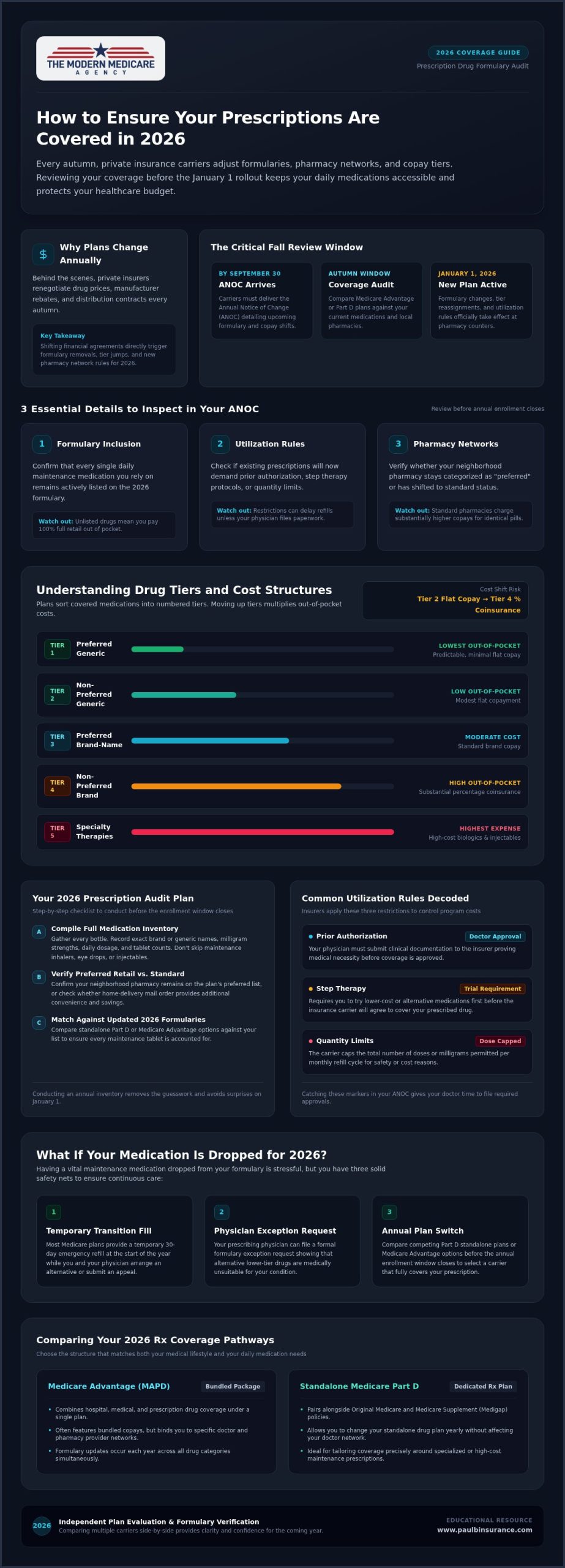
By September 30, insurance carriers must deliver the Annual Notice of Change (ANOC) to all existing members. While this packet can look intimidating, you only need to focus on a few vital pages. Flip directly to the section detailing your Medicare Part D prescription drug benefits. Look closely at these three details:
- Formulary inclusion: Confirm that every daily maintenance medication you take remains listed for 2026.
- Utilization rules: Check whether existing prescriptions now require quantity limits, step therapy, or prior authorization paperwork from your doctor.
- Pharmacy networks: Verify if your local pharmacy is still categorized as “preferred.” Standard pharmacies often charge significantly higher copayments for the exact same pills.
How Formularies and Drug Tiers Determine Costs
Insurance plans sort covered medications into numbered tiers. Tier 1 and Tier 2 usually include preferred and non-preferred generic drugs with very low copays. Tier 3 covers preferred brand-name drugs, while Tier 4 and Tier 5 contain non-preferred brands and high-cost specialty therapies.
When an insurer moves your daily maintenance tablet from Tier 2 to Tier 4, your monthly out-of-pocket expense can multiply overnight. Instead of paying a predictable flat fee, you may face substantial percentage-based coinsurance. This restructuring explains why knowing how to make sure my prescriptions are covered next year is essential: catching tier shifts early lets you adjust before the new plan year takes effect.
Step-by-Step Guide: Auditing Your Prescriptions for 2026
Conducting an annual drug review gives you complete control over your healthcare budget. Rather than guessing whether your medications are protected, a structured audit removes the mystery entirely. If you want to know how to make sure my prescriptions are covered next year, taking a few methodical steps during the fall enrollment window ensures you enter 2026 with total confidence. You can also explore our comprehensive Medicare Part D guide to understand how standalone plans structure these rules.
Compile an Accurate List of Current Medications
Start by gathering every medication bottle currently in your medicine cabinet. Write down the precise brand or generic name printed on each label. Note your exact daily dosage, milligram strength, tablet count, and monthly refill schedule. Don’t overlook maintenance inhalers, eye drops, or specialty biological injectables, as these specialized treatments often face the strictest coverage criteria.
Verify Pharmacy Networks and Preferred Retail Locations
Where you fill a prescription matters just as much as what is in the bottle. Plans partner with pharmacy chains to establish preferred retail networks where members pay reduced copayments. Standard pharmacies, by contrast, charge significantly higher rates for identical prescriptions. Check if your neighbourhood pharmacy remains on the preferred list for 2026, or ask whether home-delivery mail order offers better convenience.
Watch Out for New Utilization Management Restrictions
Insurers often manage costs by placing safety rules on specific medications. When reviewing 2026 formularies, watch closely for three common restriction markers:
- Prior Authorization: Your physician must submit clinical documentation proving medical necessity before the insurer agrees to pay.
- Step Therapy: You must try lower-cost alternative medications first before the plan approves your current drug.
- Quantity Limits: The plan restricts the number of pills or doses dispensed within a 30-day window.
If your audit reveals that a necessary drug is excluded or restricted, your doctor can help you request a formulary exception based on medical need. Comparing complex medication regimens across dozens of competing formularies can feel overwhelming. If you would like guidance from a patient advocate, you can connect with an independent broker who will review your complete prescription list across multiple carriers at no cost to you.
Medicare Advantage vs. Part D: Comparing Your Rx Options
Securing reliable medication coverage in 2026 starts with choosing the right plan structure. Under modern Medicare, you receive prescription drug benefits through one of two primary pathways: an all-in-one bundled plan or a separate standalone policy. Both formats follow regulated formulary standards, but their operational rules differ dramatically. Learning how to make sure my prescriptions are covered next year means looking at how your overall healthcare needs align with each pathway.
Your current prescriptions should play a massive role in this decision. If you take several brand-name medications, selecting a plan based purely on general medical benefits can leave you with steep pharmacy bills. Taking time to weigh bundled convenience against standalone flexibility ensures you don’t compromise your medical care or your budget.
Bundled Drug Coverage in Medicare Advantage Plans
Many beneficiaries choose Medicare Advantage plans because they combine hospital, clinical care, and prescription benefits into a single convenient card. These options frequently offer zero-dollar plan premiums and include helpful extras like routine vision and dental insurance. However, they rely on managed care networks. You must fill prescriptions at designated network pharmacies and consult participating providers to keep costs predictable.
Standalone Part D Paired with Medigap Coverage
The second option pairs Original Medicare and Medigap coverage with an independent Part D prescription plan. This strategy keeps your medical coverage and your drug coverage separate. You can see any provider nationwide who accepts Medicare, giving you total freedom of care.
This separation also protects your annual flexibility. If your current drug carrier drops a maintenance medication or raises a copay tier for 2026, you can easily switch to a different standalone Part D carrier during open enrollment without touching your underlying supplement policy. When researching how to make sure my prescriptions are covered next year, this modular approach often delivers the highest level of personalization for complex prescription routines.
What to Do If Your Medication Is Dropped for 2026
Opening your mailbox to discover that an essential medication is no longer covered can spark immediate worry. It is a stressful realization, but you don’t have to panic. Medicare rules include clear protections designed to ensure patients are never left stranded without necessary therapies. If you find yourself wondering how to make sure my prescriptions are covered next year after receiving a negative notice, taking swift action before December 7 keeps your healthcare affordable and uninterrupted.
Several effective paths exist to solve this problem. Whether you work directly with your prescribing physician or shop for an alternate insurance carrier, you have reliable tools at your disposal to maintain access to your treatments.
Requesting a Formulary Exception from the Insurer
Your doctor plays an indispensable role if your plan drops coverage. You can ask your doctor to file a formal request for a formulary exception directly with the carrier. In this statement, your physician confirms that alternative treatments on the drug list are ineffective or pose adverse health risks. Under federal standards, insurers must issue an expedited decision within 24 hours for urgent health threats, or within 72 hours for standard requests.
Exploring Clinically Sound Therapeutic Alternatives
Schedule a quick conversation with your doctor to review alternative therapies. Often, a plan replaces one brand-name medication with another clinically equivalent option on a lower copay tier. Never adjust or switch treatments on your own; always allow your healthcare provider to confirm that an alternative compound produces identical medical outcomes safely.
Utilizing Transition Refills and Enrollment Periods
What happens if January arrives before you can resolve the issue? You still have temporary safety nets available:
- Transition Fills: Part D plans must provide a one-time, 30-day emergency fill during the first 90 days of the new plan year for ongoing prescriptions. This buys you vital time to file an appeal.
- Medicare Advantage Open Enrollment: Between January 1 and March 31, individuals enrolled in Medicare Advantage can switch plans once if their current setup proves unworkable.
- Special Enrollment Periods: Certain life events or qualifying criteria allow off-cycle switches during the year.
Navigating these steps alone can feel exhausting when you simply want your prescriptions filled. If your current coverage is dropping an important maintenance drug, contact The Modern Medicare Agency today to compare alternative plans across dozens of trusted carriers and protect your care.
How an Independent Medicare Broker Secures Your Coverage
Sifting through dozens of carrier drug lists every autumn can feel exhausting. You don’t have to tackle this complex process on your own. When you look into how to make sure my prescriptions are covered next year, partnering with an independent broker transforms a confusing chore into a reassuring experience. Best of all, independent broker services are 100 percent free to you, with no added fees or retail markups.
Having an experienced guide on your side brings instant relief. Instead of spending hours deciphering fine print, you receive clear answers tailored to your household budget and medical priorities.
Independent Brokers vs. Captive Insurance Agents
Understanding who you are talking to makes a major difference. Captive insurance agents work exclusively for one company and can only sell that company’s specific plans. If their carrier drops your medication for 2026, a captive agent cannot offer solutions from competitors.
By contrast, The Modern Medicare Agency operates as an independent brokerage representing more than 40 top-rated insurance carriers across over 34 states. Because we don’t work for an insurance carrier, our loyalty stays entirely with you. We review the entire market to find the right coverage rather than forcing your health into a limited box.
Personalized Support from The Modern Medicare Agency
Led by Paul Barrett, our agency acts as your dedicated patient advocate throughout the life of your policy. We input your complete medication regimen, including exact dosages and preferred pharmacies, into specialized software to pinpoint the plan that delivers the lowest overall cost for 2026.
Our commitment doesn’t end once your enrollment form is complete. If a pharmacy billing problem arises or an insurer updates its rules mid-year, our team steps in to help resolve the issue directly with the carrier on your behalf.
Taking Action Before Annual Enrollment Deadlines
Timing is critical during the fall. The Medicare Annual Enrollment Period runs strictly from October 15 through December 7. Submitting your application early ensures your carrier issues your new insurance identification cards well before January 1st arrives. Discovering how to make sure my prescriptions are covered next year gives you complete clarity today and true peace of mind for all of 2026.
Protect Your Peace of Mind and Health for 2026
You shouldn’t have to face the pharmacy counter in January wondering whether your vital medications are covered. Taking control of your healthcare starts with a simple proactive audit. By reviewing your Annual Notice of Change, checking tier shifts, and confirming your preferred pharmacy before December 7, you protect both your well-being and your wallet. If you have been searching for how to make sure my prescriptions are covered next year, you don’t have to navigate these complex details alone.
At The Modern Medicare Agency, we provide 100 percent free, unbiased guidance across more than 40 top-rated carriers in over 34 states. We evaluate both Medicare Advantage and standalone Part D plans to match your exact prescriptions with zero fees and no markup on your premiums. Schedule your free 2026 prescription coverage review with Paul Barrett today and step into the new year with complete confidence.
Frequently Asked Questions
How do I check if my prescription drugs are covered for 2026?
Review the Annual Notice of Change sent by your insurance provider every September. This document lists upcoming changes to covered medications, tier placements, and pharmacy networks for 2026. If you want to know how to make sure my prescriptions are covered next year, compare your complete medication list against the plan’s updated formulary or consult an independent broker who can cross-reference your prescriptions across multiple carriers.
What should I do if my Medicare plan drops my medication next year?
Contact your prescribing physician immediately to explore clinically equivalent alternatives covered under your current plan’s 2026 formulary. If no safe alternative exists, ask your doctor to file an expedited formulary exception request with your insurer. Alternatively, you can use the Annual Enrollment Period from October 15 to December 7 to switch to another carrier that covers your exact prescription.
Can an insurance plan change my drug formulary in the middle of the year?
Yes, insurance plans can modify formularies mid-year, but they must follow strict federal guidelines. Typically, carriers only remove brand-name medications if a generic equivalent becomes available or if the FDA releases a safety warning. When an insurer removes a drug or increases costs mid-year, they must provide affected policyholders with at least 30 days of written notice or a 30-day refill at the pharmacy.
What is the difference between preferred and standard pharmacy coverage?
Preferred pharmacies contract directly with your insurance plan to offer medications at significantly lower copayments or coinsurance rates. Standard pharmacies still participate in the plan network, but you pay higher retail out-of-pocket costs at the counter for the exact same prescription. Filling your medications at an in-network preferred pharmacy or through plan-approved mail delivery remains one of the simplest ways to lower your annual prescription expenses.
How does a formulary exception work if my drug is not covered?
A formulary exception is an appeal where your doctor asks the insurance carrier to cover an excluded medication or grant a lower copay tier. Your physician must submit documentation proving that covered alternatives were ineffective or caused severe adverse reactions. Plans must deliver standard decisions within 72 hours, or expedited decisions within 24 hours if waiting could seriously harm your health.
Does it cost anything to use an independent Medicare broker for drug reviews?
No, working with an independent broker like The Modern Medicare Agency is 100 percent free. You pay zero consultation fees, advisory charges, or premium markups. Insurance carriers compensate independent brokers directly when you enroll, ensuring your rates remain identical to buying directly from the company. Our team reviews your prescriptions and provides ongoing, unbiased advocacy throughout the year across more than 34 states.
Can I switch my Medicare prescription drug plan after December 7?
Yes, under specific circumstances. If you are enrolled in a Medicare Advantage plan, you can make a one-time plan switch during the Medicare Advantage Open Enrollment Period between January 1 and March 31. Beyond that, you must qualify for a Special Enrollment Period due to life events like moving outside your plan service area. Understanding how to make sure my prescriptions are covered next year before December 7 avoids relying on these exceptions.

Article by
Paul Barrett
Paul Barrett, CMIP is the founder of The Modern Medicare Agency, an independent Medicare-only brokerage based in Melville, NY. With 18 years of Medicare-exclusive experience, a CMIP designation, and more than 5,000 clients served across 37 states, Paul is one of the most credentialed independent Medicare specialists on Long Island — and one of the most direct.
He represents 40+ carriers with no quotas and no allegiances, which means his recommendations are based entirely on what fits each client's specific situation. He is the author of Medicare Mastery Unlocked and host of the Wise Guys Retirement Talk podcast. His content is grounded in primary sources, real carrier intelligence, and 18 years of watching what happens when people get Medicare right — and when they don't.
📞 631-358-5793 | paulbinsurance.com