




Cutting back on your doctor visits is the absolute worst way to protect your retirement savings. If you are wondering how to manage healthcare on a fixed income in 2026, the real answer is plugging coverage leaks, not skipping the care you need to stay well. You shouldn’t have to hold your breath every time you open an unexpected medical bill or stand at the pharmacy counter. Between rising medication costs, dental expenses, and mailboxes full of confusing insurance flyers, it’s completely understandable to feel overwhelmed and protective of your monthly budget.
You deserve genuine peace of mind and a predictable monthly routine with no surprise expenses. In this guide, you will discover clear, practical steps to protect your health and budget without sacrificing quality care in retirement. We’ll explore helpful public assistance programs, uncover hidden plan perks, and give you the confidence to select the exact coverage structure that fits your unique lifestyle.
Key Takeaways
- Discover how to balance predictable monthly benefits against variable 2026 medical costs so surprise bills never derail your retirement budget.
- Use a simple four-step audit to review your doctors, prescriptions, and annual plan notices before expensive coverage gaps catch you off guard.
- Find out how state and federal relief programs like Extra Help can substantially lower your prescription copays and routine expenses.
- Master practical daily tactics showing you how to manage healthcare on a fixed income, from zero-cost preventive visits to smart pharmacy choices.
- Learn why working with an independent broker provides unbiased guidance across top insurance carriers without costing you a single penny.
Understanding Healthcare Costs on a Fixed Income in 2026
Managing your health on a fixed retirement income comes down to balancing predictability against volatility. Your monthly Social Security or pension payment arrives as a dependable, unchanging amount. In contrast, medical bills can swing wildly from one week to the next. Figuring out how to manage healthcare on a fixed income starts by taking control of these unpredictable swings before they disrupt your household budget.
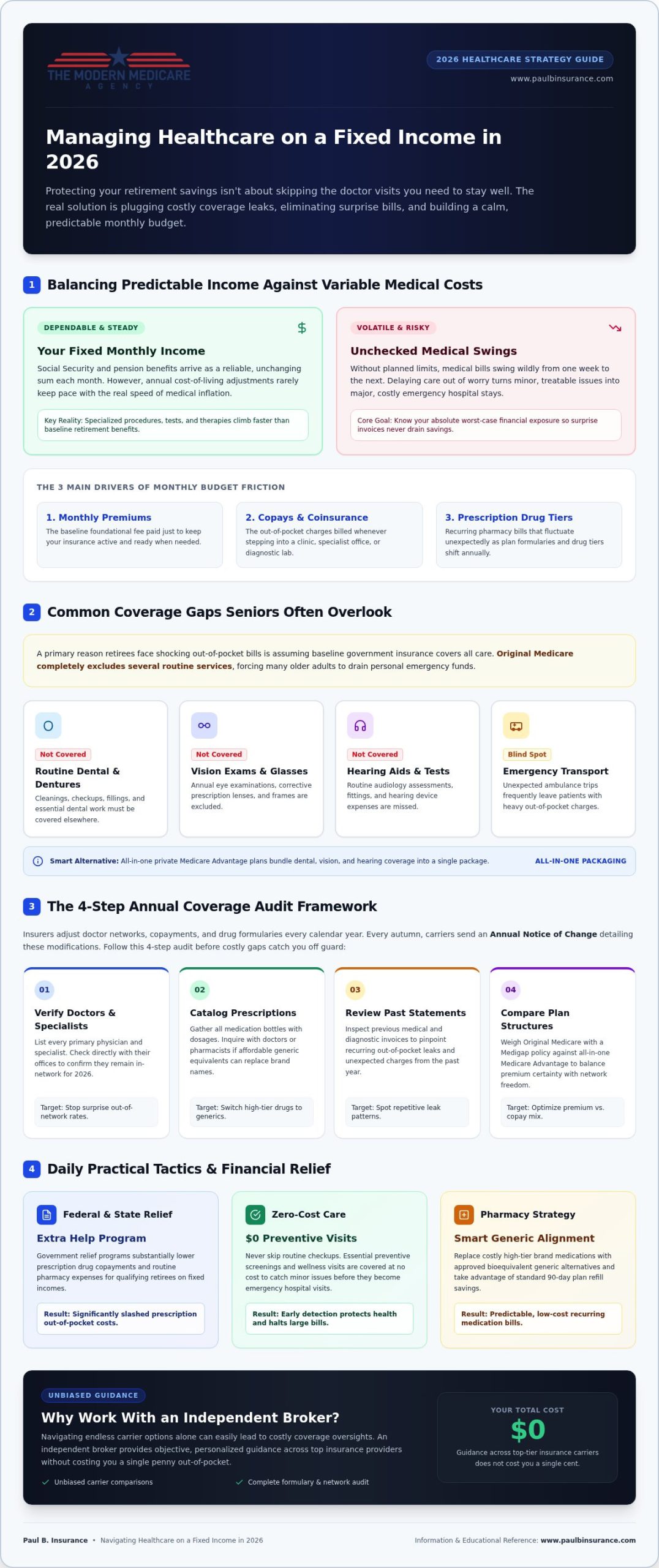
Medical bill anxiety is real, especially in 2026 as general inflation continues to strain everyday household finances. When every dollar already has an assigned purpose, opening an unexpected specialist invoice or paying a sudden lab fee feels frightening. Three main cost drivers typically create this financial friction:
- Monthly premiums: The baseline cost you pay simply to keep coverage active.
- Copayments and coinsurance: The fees charged every time you step into an office, clinic, or diagnostic center.
- Prescription drug costs: The recurring medication expenses that can shift based on insurance benefit tiers.
When money feels tight, it is tempting to postpone routine visits or stretch out medications. Delaying necessary care is dangerous. Putting off simple screenings or skipping doses frequently turns minor, treatable issues into major emergency hospital visits that bring severe financial and physical consequences.
The Reality of Fixed Incomes and Medical Inflation
Social Security cost-of-living adjustments rarely keep pace with rising medical costs. When specialized medical procedures, testing, and therapy rates climb faster than baseline retirement benefits, your purchasing power quietly erodes. True peace of mind does not come from crossing your fingers and hoping you stay healthy. It comes from knowing your absolute worst-case financial exposure for the year, ensuring that an unexpected diagnosis never drains your emergency savings.
The Common Coverage Gaps Seniors Overlook
A major reason retirees struggle with unexpected bills is assuming that basic government coverage pays for everything. It does not. Original Medicare leaves significant gaps that catch many beneficiaries off guard. Routine dental cleanings, dentures, basic vision exams, eyeglasses, and hearing aids are entirely excluded. Emergency transportation creates another blind spot; an unexpected ambulance trip can leave you with hefty out-of-pocket charges.
These uncovered expenses force many older adults to pull funds directly from their personal savings. Exploring options like our Medicare Advantage guide can help you see how all-in-one private plans bundle dental, vision, and hearing coverage into a single package. Learning how to manage healthcare on a fixed income means identifying these hidden coverage gaps early, protecting your wallet from costly surprises down the road.
Step-by-Step Guide to Auditing Your Healthcare Coverage
Most retirees pick a health plan when they stop working and never look at the paperwork again. That approach can quietly drain your hard-earned savings over time. Learning how to manage healthcare on a fixed income requires conducting an annual coverage audit. Insurance companies adjust doctor networks, copayments, and drug formularies every calendar year, which means a plan that worked wonders in the past might cost you significantly more in 2026.
Every autumn, your carrier sends an Annual Notice of Change detailing these exact updates. Instead of tucking that thick envelope into a drawer, use this straightforward four-step audit framework to protect your monthly cash flow:
- List your primary physicians and specialists.
- Catalog every current prescription and dosage.
- Review your past year of medical statements for surprise out-of-pocket charges.
- Compare your overall coverage structure against alternative options.
Taking the time to cut your health care costs through regular reviews gives you complete clarity over where your money goes.
Step 1: Inventory Your Prescriptions and Preferred Providers
Gather all your prescription bottles, noting down exact dosages and refill frequencies. Ask your doctor or pharmacist whether affordable generic equivalents can replace any higher-tier brand-name drugs on your list. Next, contact your specialists directly to ensure they remain participating in-network providers under your plan for 2026. Network contracts change frequently, and seeing an out-of-network provider can trigger massive surprise bills.
Step 2: Evaluate Original Medicare With Medigap vs. Medicare Advantage
Balancing your budget comes down to personal preference between predictability and bundled features. Pairing Original Medicare with a supplemental policy creates steady, predictable monthly expenses. You can explore comprehensive Medigap options to protect against unpredictable hospital and doctor coinsurance. On the other hand, checking our detailed Medicare Advantage guide helps you weigh whether bundled perks like dental, vision, hearing, and fitness allowances better support your monthly routine.
Step 3: Review Out-of-Pocket Maximums and Hidden Caps
An out-of-pocket maximum acts as your financial safety net, capping what you pay for approved medical services each calendar year. Pay close attention to the distinction between in-network caps and regional out-of-network exposures. Tracking your monthly medical statements helps catch billing errors or duplicate copays before they cause unnecessary budget strain. If reviewing these complex details feels daunting, the friendly team at The Modern Medicare Agency is always here to help you audit your options at zero cost.
Financial Assistance Programs That Cut Healthcare Expenses
Qualifying for financial assistance is one of the most effective ways to master how to manage healthcare on a fixed income. Millions of older adults leave significant funds on the table each year simply because they assume these safety nets are reserved only for people with virtually no assets. In reality, federal and state support programs exist specifically to provide everyday retirees with breathing room in their monthly budgets.
Medicare Savings Programs (MSP): Premium and Deductible Relief
State-run Medicare Savings Programs offer immediate relief by paying expenses that would otherwise chip away at your retirement checks. Depending on your monthly income and countable resources in 2026, four distinct programs can step in to protect your household cash flow:
- Qualified Medicare Beneficiary (QMB): Functions like a comprehensive shield, covering Part A and Part B premiums, deductibles, coinsurance, and copayments.
- Specified Low-Income Medicare Beneficiary (SLMB): Covers your monthly Part B premium, returning that money directly to your monthly Social Security check.
- Qualifying Individual (QI): Also covers your Part B premium on a first-come, first-served basis through state allocations.
- Qualified Disabled and Working Individuals (QDWI): Assists qualifying working individuals with disabilities by paying their monthly Part A premiums.
Checking your eligibility is straightforward. You can reach out to your local Area Agency on Aging or State Health Insurance Assistance Program (SHIP) for patient, step-by-step application guidance at no cost.
The Part D Extra Help Program for Medication Affordability
Prescription drugs represent one of the largest ongoing expenses for older adults. The federal Extra Help program, also known as the Low-Income Subsidy, provides vital financial support for these recurring costs. Retirees who qualify in 2026 pay no drug plan deductibles, and their prescription copayments are legally capped at no more than $5.10 for generic drugs and $12.65 for brand-name medications.
The restructuring of federal prescription coverage has eliminated the old coverage gap, providing greater predictability throughout the entire year. Pairing this subsidy with an optimized standalone Medicare Part D plan ensures you never have to choose between filling your maintenance prescriptions and covering essential household utilities. In addition, many states operate State Pharmaceutical Assistance Programs that add another layer of local savings directly onto your drug coverage.
Daily Tactics to Lower Out-of-Pocket Medical and Dental Bills
Trimming small expenses on a weekly basis adds up to major financial relief over a full calendar year. Understanding how to manage healthcare on a fixed income isn’t just about selecting the right policy during enrollment season; it is equally about how you use your benefits every single day. Taking full advantage of built-in plan perks and making simple adjustments at the pharmacy counter can save you hundreds of dollars each year.
Start by scheduling your covered preventive services. Medicare covers a wide range of wellness visits, mammograms, diabetes screenings, and cardiovascular blood tests at zero out-of-pocket cost, provided your doctor accepts assignment. Utilizing these appointments keeps you proactive. Catching high blood pressure or early-stage conditions early prevents complex medical treatments that carry high specialty copays down the road.
In addition, check whether your policy provides an over-the-counter allowance. Many modern private plans give members a quarterly or monthly credit to order everyday health items, including pain relievers, vitamins, toothpaste, and first-aid supplies, shipped directly to your door at no additional charge.
Smart Pharmacy and Prescription Management Strategies
Where you fill your prescriptions can change what you pay. Plans categorize retail locations into standard and preferred network pharmacies, with preferred stores offering significantly lower copayments for the exact same pills. Ask your doctor to write 90-day supplies for maintenance drugs rather than 30-day fills, and consider using your plan’s home-delivery mail-order service to lock in deeper discounts. Always ask your physician if a therapeutic generic equivalent exists. Local supermarket chains and retail pharmacies also maintain generic cash-pay discount lists that can occasionally beat insurance copays entirely.
Affordable Dental, Vision, and Preventive Care Options
Preserving your oral health is essential to maintaining your overall physical wellness. Since basic Medicare excludes dental cleanings, fillings, and extractions, you have to look for smart alternatives. Community health centers often offer dental checkups on a sliding-scale fee tied to your monthly retirement income. If you need dedicated protection against unexpected dental bills, consider enrolling in specialized dental insurance plans designed specifically for seniors.
Small daily choices protect your monthly budget from unnecessary erosion. If you want a helping hand reviewing your pharmacy benefits or finding dental coverage that fits your budget, contact The Modern Medicare Agency today for friendly, unbiased support.
Why Partnering With an Independent Broker Protects Your Budget
Making smart insurance decisions alone can feel like walking through a maze blindfolded. Aggressive commercials, endless mailers, and complicated plan jargon leave many seniors feeling pressured rather than informed. Discovering how to manage healthcare on a fixed income becomes much simpler when you have an experienced guide walking beside you. An independent insurance broker serves as your personal advocate, protecting your wallet from costly oversights without charging you a penny for their help.
Every dollar in retirement counts. Because independent brokers receive their compensation directly from insurance carriers, you receive completely free consultations, comparisons, and enrollment assistance. You never pay extra fees or higher premiums for working through a broker. You simply gain access to seasoned expertise dedicated to your financial security.
Independent Brokers vs. Captive Agents: The Freedom of Choice
Understanding who sits across the table from you makes all the difference. Captive agents work for a single insurance company, which means they can only offer that specific carrier’s catalog. If that company raises prices or drops your doctor, a captive representative cannot offer an alternative. Independent brokers operate autonomously. The Modern Medicare Agency works across more than 34 states with access to over 40 top-rated carriers. Instead of pushing a quota, an independent broker evaluates dozens of competing options to find the specific coverage structure that matches your personal budget and healthcare needs.
Year-Round Advocacy Beyond Initial Enrollment
True support should not disappear after you sign an application. A dedicated broker acts as your ally throughout the entire year, long after initial enrollment wraps up. If a doctor prescribes a new medication mid-year, your broker can verify coverage tiers and explore preferred pharmacies. When unexpected billing discrepancies or denied claims create anxiety, your broker steps in to untangle customer service red tape on your behalf.
This enduring commitment reflects Paul Barrett’s core philosophy: treating retirees with genuine patience, empathy, and educational guidance rather than high-pressure sales tactics. Having an ethical professional review your policies annually ensures your coverage stays tight, efficient, and fully aligned with your fixed income year after year.
Protect Your Health and Retirement Savings in 2026
Securing your medical care shouldn’t mean sacrificing the retirement lifestyle you worked so hard to build. Learning how to manage healthcare on a fixed income really comes down to staying proactive. When you regularly audit your plan, tap into available assistance programs, and make smart everyday pharmacy choices, you transform unpredictable medical bills into a dependable, manageable routine.
You don’t have to tackle these complex choices on your own. The Modern Medicare Agency is here to bring you clarity and complete peace of mind. Licensed across more than 34 states, our independent team compares options from over 40 top-tier insurance carriers to find the right fit for your unique needs. Best of all, you receive 100% free guidance with zero pressure and no obligation to enroll.
Get your free, unbiased Medicare plan review today and step forward into 2026 with total confidence in your coverage.
Frequently Asked Questions
Can I get help paying my Medicare Part B premium if I have low income?
Yes, state-administered Medicare Savings Programs help pay your monthly Part B premium if you qualify financially. Programs like SLMB and QI cover your standard Part B premium directly, returning that deducted money back to your monthly Social Security check. The Qualified Medicare Beneficiary program goes even further by covering deductibles, coinsurance, and copayments as well. You can apply directly through your state medical assistance office.
What should I do if my prescription drugs cost more than my monthly budget?
Apply for the federal Extra Help program immediately to lower your medication expenses. In 2026, qualifying individuals pay zero deductibles and deeply discounted copays on generic and brand-name drugs. You should also ask your doctor about generic alternatives, use preferred network pharmacies, or check State Pharmaceutical Assistance Programs. Mastering these adjustments is a vital step in discovering how to manage healthcare on a fixed income.
Is Medicare Advantage always cheaper than Original Medicare on a fixed income?
Not necessarily, because total annual costs depend entirely on how often you need medical care. Medicare Advantage plans often offer very low monthly premiums and bundled dental perks, but you pay copayments every time you visit specialists or undergo procedures. In contrast, pairing Original Medicare with a Medigap plan carries a higher monthly premium but provides steady, predictable costs with few out-of-pocket medical surprises.
Does it cost any money to work with an independent Medicare broker?
No, working with an independent broker is completely free for consumers. Independent brokerages like The Modern Medicare Agency receive compensation directly from insurance carriers when you enroll in a plan. Premium rates are set by law, meaning you never pay higher fees or markups for utilizing an advisor. You receive personalized, unbiased guidance across dozens of top-rated carriers without spending a single dollar of your savings.
What is the difference between Medicaid and Medicare Savings Programs?
Medicaid provides broad healthcare coverage for individuals with limited income, while Medicare Savings Programs specifically help pay Medicare out-of-pocket costs. Full Medicaid covers services that Medicare excludes, such as long-term nursing care. Medicare Savings Programs have slightly higher income and resource thresholds in 2026, making them accessible to retirees who earn too much for full Medicaid but still need help covering premiums.
Can I change my healthcare plan outside the Annual Enrollment Period if my income drops?
Yes, a significant drop in household income or qualifying for public assistance triggers a Special Enrollment Period. If you qualify for Medicaid or the Part D Extra Help program at any point in 2026, you unlock special windows to adjust your coverage. This flexibility ensures you don’t stay trapped in an unaffordable plan when your financial circumstances change mid-year.
How can I afford routine dental care when Medicare does not cover it?
You can secure affordable dental care through dedicated private dental insurance, Medicare Advantage allowances, or sliding-scale community clinics. Many private plans include basic dental allowances, while standalone senior dental policies provide structured benefits for routine cleanings, fillings, and dentures. Evaluating these options shows you practical ways regarding how to manage healthcare on a fixed income without neglecting your oral health.

Article by
Paul Barrett
Paul Barrett, CMIP is the founder of The Modern Medicare Agency, an independent Medicare-only brokerage based in Melville, NY. With 18 years of Medicare-exclusive experience, a CMIP designation, and more than 5,000 clients served across 37 states, Paul is one of the most credentialed independent Medicare specialists on Long Island — and one of the most direct.
He represents 40+ carriers with no quotas and no allegiances, which means his recommendations are based entirely on what fits each client's specific situation. He is the author of Medicare Mastery Unlocked and host of the Wise Guys Retirement Talk podcast. His content is grounded in primary sources, real carrier intelligence, and 18 years of watching what happens when people get Medicare right — and when they don't.
📞 631-358-5793 | paulbinsurance.com