




What if your Medicare enrollment date actually started six months before you even signed the paperwork? For many people turning 65 in 2026, this “lookback rule” is a source of genuine anxiety. You have worked hard to build your savings, and the last thing you want is to be hit with a 6% tax penalty just because the timing was off. It is completely normal to feel overwhelmed by the conflicting rules. Learning how to manage medicare with a health savings account (HSA) should provide you with a sense of security, not a list of new worries.
I understand how much you value the peace of mind that comes from being prepared. This guide will show you exactly how to transition from contributing to your HSA to spending those funds wisely on your 2026 healthcare costs. We will establish a clear timeline for stopping your contributions based on your specific situation. You will also discover how to use your account to pay for your $202.90 monthly Part B premiums and other qualified expenses. By the time you finish reading, you will have a simple, step-by-step strategy to stay compliant and confident in your financial future.
Key Takeaways
- Learn the essential steps for how to manage medicare with a health savings account (HSA) to ensure your transition is smooth and tax-free.
- Understand the 6-month lookback rule to avoid the 6% IRS penalty on excess contributions when your Medicare coverage begins.
- Discover how your existing HSA funds can pay for 2026 out-of-pocket costs, including your $202.90 monthly Part B premiums.
- Follow a clear 2026 timeline to stop your contributions at the right time and coordinate with your employer’s payroll department.
- Find out how to choose a Medicare plan that works alongside your remaining HSA balance to provide the most financial security.
The Golden Rule: Why Medicare and HSA Contributions Cannot Mix
Understanding how to manage medicare with a health savings account (HSA) starts with one firm rule: you cannot contribute new money to your account once you are enrolled in any part of Medicare. The IRS is very specific about this requirement. To be eligible to put money into a Health Savings Account (HSA), you must be covered by a High Deductible Health Plan and have no other health coverage. Because Medicare is considered “other coverage,” it effectively flips the switch on your ability to save. This applies even if you only have Part A.
Many people feel a sense of frustration when they hear this. You have spent years using this account as a powerful tool for your future. It’s important to remember that you still own every penny already in that account. That money continues to grow tax-free, and you can spend it on your healthcare needs whenever you like. The only thing that changes is your ability to add new funds. You are moving from the “saving” phase of your life into the “spending” phase, and that is a perfectly natural transition.
The Part A Trap for Working Seniors
If you plan to keep working past age 65, you might think your HSA is safe. However, if you decide to claim Social Security benefits, you are automatically enrolled in Medicare Part A. This “stealth” enrollment can catch you off guard. Suddenly, your HSA eligibility vanishes mid-year because you now have other coverage. While many seniors choose to delay Part B to save on monthly premiums, Part A often starts automatically and stops your contributions in their tracks. It is a common point of stress, but knowing it is coming helps you stay in control of your timeline.
The 2026 HSA Contribution Limits
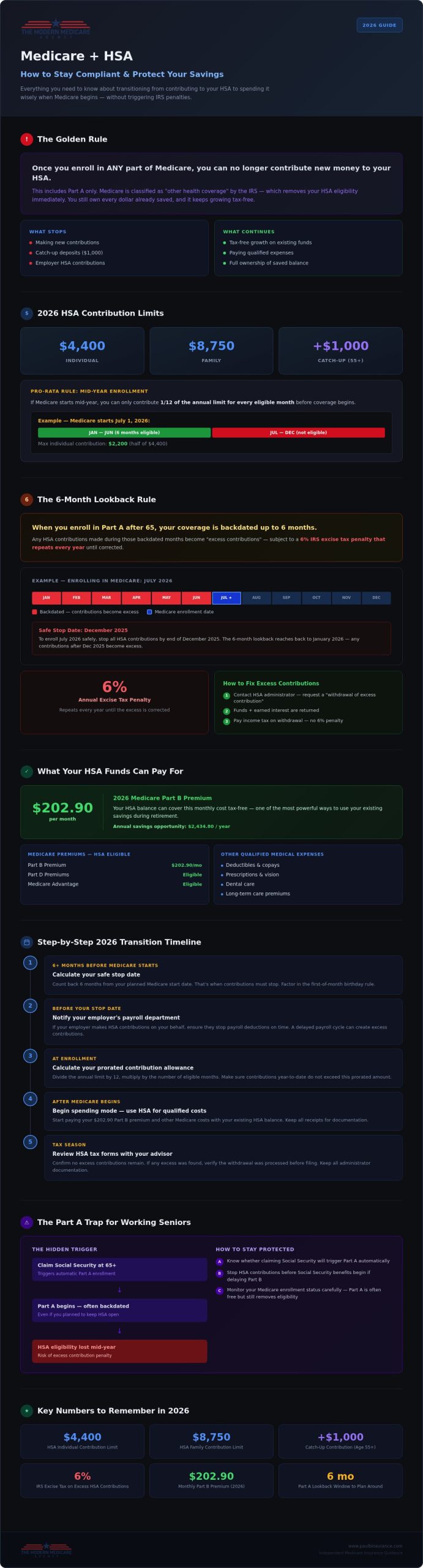
For the 2026 tax year, the IRS has set the contribution limits at $4,400 for individuals and $8,750 for families. If you are 55 or older, you can still add an extra $1,000 as a catch-up contribution. If you join Medicare halfway through the year, you’ll need to calculate a prorated amount to avoid penalties. In 2026, a pro-rata contribution means you can only deposit one-twelfth of the annual limit for every month you were eligible before your Medicare coverage began. For example, if your Medicare starts on July 1, you can only contribute half of the annual limit for that year. Taking a moment to do this math now prevents a headache during tax season later.
The 6-Month Lookback Rule: Avoiding the IRS Penalty Trap
The “lookback rule” is often the most confusing part of learning how to manage medicare with a health savings account (HSA). When you enroll in Medicare Part A after your 65th birthday, the coverage doesn’t just start the day you sign up. Instead, the government backdates your coverage for up to six months. This rule exists because of the Social Security Act Title XVIII, which sets the framework for how your insurance works. While this retroactive coverage sounds helpful, it creates a serious conflict for your HSA. Any money you put into your account during those six backdated months is considered an “excess contribution” by the IRS.
If you make this mistake, you will face a 6% excise tax penalty on that extra money. This tax isn’t a one-time fee. It repeats every year the excess funds stay in your account. It’s a stressful situation, but it is entirely avoidable with a bit of planning. You don’t have to navigate these technicalities alone. Our goal is to make sure your transition into 2026 is as smooth as possible.
Calculating Your Safe Stop Date
If you plan to enroll in Medicare in July 2026, you might assume you can contribute through June. However, because of the six-month lookback, your Part A coverage would likely be backdated to January 2026. To stay safe, you should stop all HSA contributions by December 2025. If your 65th birthday falls on the first of the month, your Medicare eligibility actually starts the month before. For those individuals, the lookback rule can be even more precise. Planning ahead is the best way to protect your savings. If you feel unsure about your specific timeline, reaching out to an independent Medicare broker can provide the clarity you need.
Correcting Excess Contributions
Don’t panic if you realize you’ve already contributed too much for 2026. You can fix the error before you file your taxes. First, contact your HSA administrator and ask for a “withdrawal of excess contribution.” They will return the extra funds plus any interest earned on that money. You will need to pay income tax on the amount you withdraw, but you will avoid that nagging 6% penalty. Keep every receipt and letter from your administrator. Proper documentation is your best defense if the IRS ever has questions about your 2026 filings, and Apex Income Tax & Multiservice LLC can provide the professional oversight needed to handle these corrections accurately. It’s a simple process that saves you money and stress in the long run.
Once you stop contributing, you might wonder what happens to the money you have already saved. I want to reassure you: that money is yours forever. It stays in your account, continues to grow tax-free, and is ready for you whenever a medical bill arrives. When you are looking at how to manage medicare with a health savings account (HSA), the focus shifts from building a balance to using it as a powerful tool for your 2026 healthcare costs. You’ve worked hard to save this money, and now it’s time for that money to work for you.
The IRS allows you to use your HSA for many Medicare-related expenses. This includes your deductibles, copays, and coinsurance. A major benefit is that you can also use these tax-free funds to pay for your Medicare Part B premiums, which are $202.90 per month in 2026. You can also pay for Part D prescription drug coverage and Medicare Advantage premiums. However, there is one critical exception you must remember: you cannot use HSA funds to pay for Medigap (Medicare Supplement) premiums. According to IRS Publication 969, while most other premiums are eligible once you are 65, Medigap remains the one outlier that requires a different payment source.
HSA vs. Medicare Advantage Premiums
If you have a significant balance in your account, a Medicare Advantage Plan can be an excellent fit. Since you can use your HSA to pay the monthly premiums for these plans, it effectively lowers your out-of-pocket costs using money you have already set aside. This strategy turns your HSA into a secondary layer of protection. It helps you cover the gaps in coverage without dipping into your monthly Social Security check or other retirement income.
Other HSA-Qualified Senior Expenses
Your HSA is also a lifesaver for costs that Original Medicare typically ignores. You can use your funds for dental exams, eyeglasses, and hearing aids. These expenses can add up quickly in retirement, but your tax-free savings can soften the blow. If you find that your HSA balance isn’t quite enough to cover major procedures, you might consider adding Dental Insurance Plans to your coverage. Additionally, you can use your HSA to pay for a portion of qualified long-term care insurance premiums. This provides an extra level of security as you age, helping you stay prepared for whatever the future holds.
Managing the Transition: A Step-by-Step 2026 Timeline
Moving from a high-deductible plan to Medicare involves several moving parts. It is much easier to handle when you break the process down into small, manageable steps. By mapping out your journey early, you can avoid the 6% tax penalty and move into your new coverage with total confidence. Here is your 2026 guide for how to manage medicare with a health savings account (HSA) without the stress.
- 9 Months Before Enrollment: Review your current balance. This is the time to decide if you’ll use your funds for immediate needs, like dental work, or keep them for future long-term care premiums.
- 7 Months Before: Contact your HR department. You need to adjust or stop your payroll deductions to stay ahead of the six-month lookback rule we discussed earlier.
- 3 Months Before: This is your window to compare Medicare Supplement Insurance against Medicare Advantage. Think about which plan structure best protects your remaining savings.
- Enrollment Month: Confirm your official start date with Social Security. Verify that your total 2026 contributions don’t exceed the prorated limit for the months you were eligible.
Coordinating with Your Employer
If you are still working, your employer’s contributions count toward your annual limit just like your own do. Ask your HR coordinator how they handle matching funds when an employee transitions to Medicare mid-year. If you retire in July 2026, for example, you must ensure your combined contributions stay within the prorated amount for those first six months. It is also wise to ask what happens to your health plan coverage the moment you stop your HSA-eligible status. Clear communication now prevents expensive surprises during tax season.
The Role of an Independent Broker
Choosing a plan is about more than just premiums. It’s about how that plan fits into your overall financial life. An independent Medicare broker provides an unbiased look at the market. Paul Barrett takes the time to understand your specific goals. He helps you decide if an Advantage plan’s lower premium or a Medigap plan’s predictable costs will serve you better in 2026. Having an expert advocate means you don’t have to guess which rules apply to you. If you are ready to build your personal transition plan, contact The Modern Medicare Agency today for a clear path forward from confusion to certainty.
Finding the Right Medicare Plan to Complement Your HSA Savings
Think of your remaining HSA balance as a strategic partner for your retirement. It acts like a specialized form of secondary insurance that is already funded and waiting to be used. When you are deciding how to manage medicare with a health savings account (HSA), your goal is to find a plan that lets those savings last as long as possible. Because we are independent and work with over 40 different carriers, we can look at the whole market to find the specific plan that aligns with your financial safety net. We don’t just look at premiums; we look at how your HSA can absorb the out-of-pocket costs that different plans require.
One area where your HSA provides significant relief is with Medicare Part D. While you can’t add new money to your account, you can use every cent of your existing balance to pay for your monthly drug plan premiums and your pharmacy copays. This is a huge advantage in 2026, especially as prescription costs continue to be a major part of many seniors’ budgets. By using tax-free money for these bills, you keep more of your Social Security income in your pocket for other living expenses.
Tailoring Your Coverage to Your Health Needs
If you have a healthy HSA balance, you have more flexibility in your plan choice. You might decide that a plan with a lower monthly premium but higher copays makes sense for you. Since you have the HSA funds to cover those copays, you aren’t worried about an unexpected doctor visit breaking your budget. For example, I recently helped a client who wanted the freedom of a Medigap plan but was worried about the monthly cost. We chose a high-deductible version of the plan, which significantly lowered her monthly premium. She then used her HSA to pay the plan’s deductible. This strategy gave her the broad access of a supplement plan while using her existing savings to keep her ongoing monthly costs low.
Your Next Steps for a Stress-Free 2026
Navigating these rules doesn’t have to be a lonely or stressful journey. You have done the hard work of saving for your future, and now it is time to let that money work for you. The most important thing you can do right now is create a personalized roadmap for your transition. At The Modern Medicare Agency, we offer no-cost consultations to help you weigh your options without any high-pressure tactics. We are here to protect your interests and give you the peace of mind you deserve. Reach out to us today, and let’s make sure your 2026 Medicare experience is simple, clear, and perfectly tailored to your needs.
Step Into Your 2026 Medicare Journey with Confidence
Transitioning to Medicare doesn’t have to feel like a financial hurdle. You’ve spent years building your savings, and now you have the knowledge to use those funds effectively. By mastering the timing of the six-month lookback rule and identifying which 2026 premiums are eligible for tax-free spending, you’ve already taken the biggest step toward avoiding penalties. You now understand how to manage medicare with a health savings account (HSA) with clarity and precision.
Navigating these complex rules is much simpler when you have a dedicated advocate by your side. We provide independent guidance by comparing options from over 40 insurance carriers to find the perfect fit for your unique situation. Serving clients across 34+ states, our team offers the year-round support you need to ensure your coverage remains reliable. Get your personalized Medicare & HSA roadmap from Paul Barrett today to move from a state of uncertainty to one of total peace of mind. You’ve worked hard for your savings. It’s finally time to let them provide the security you deserve.
Frequently Asked Questions
Can I use my HSA to pay for Medicare Part B premiums?
Yes, you can use your HSA funds to pay for your Medicare Part B premiums. In 2026, the standard monthly premium for Part B is $202.90. Since these are considered qualified medical expenses, you can pay them directly from your account or reimburse yourself later. This is a great way to lower your out-of-pocket costs while using money you’ve already saved tax-free. It helps your monthly Social Security check go a little bit further.
What happens if I contribute to my HSA after I enroll in Medicare?
If you accidentally contribute to your account after enrolling in Medicare, the IRS will impose a 6% excise tax penalty. This penalty applies to the excess amount for every year it remains in your account. To avoid this, you must stop all contributions as soon as your Medicare coverage begins. If a mistake happens, work with your account administrator to withdraw the extra funds before you file your 2026 tax return to avoid the penalty.
Can I pay for my spouse’s Medicare premiums with my HSA?
Yes, you can use your account to pay for your spouse’s Medicare premiums if they are age 65 or older. This is a helpful strategy for couples learning how to manage medicare with a health savings account (HSA) together. Even if your spouse isn’t the account holder, the funds can cover their Part B or Part D costs. Just remember that Medigap premiums are still excluded from this rule, regardless of who the coverage is for.
Is it better to keep my HSA or switch to Medicare if I am still working?
The right choice depends on your specific employer plan and your current health needs. If your employer has more than 20 employees, you might choose to delay Medicare to keep contributing to your HSA. However, if your company plan has a high deductible, Medicare might offer more comprehensive coverage at a lower cost. We can help you compare your current benefits against 2026 Medicare Advantage or Supplement plans to find the most secure path.
Can I use my HSA for Medigap premiums in 2026?
No, you cannot use HSA funds to pay for Medicare Supplement (Medigap) premiums in 2026. While the IRS allows you to pay for Part B, Part D, and Medicare Advantage premiums with tax-free dollars, Medigap is specifically listed as an exception. You’ll need to use other retirement income or personal savings to cover these specific monthly costs. Understanding these distinctions is a key part of how to manage medicare with a health savings account (HSA).
How does the 6-month lookback rule work if I apply for Medicare at age 67?
If you apply for Medicare at age 67, your Part A coverage will be backdated by six months from your application date. This means if you apply in October 2026, your coverage effectively started in April 2026. Any HSA contributions made during those six months would be considered “excess” and subject to a penalty. It’s best to stop your payroll deductions at least six months before you plan to submit your Medicare application to stay safe.
Do I have to spend all my HSA money once I start Medicare?
You aren’t required to spend your HSA balance by any specific deadline. The money in your account is yours to keep forever, even after you start Medicare. It continues to grow tax-free, and there is no “use it or lose it” rule like there is with a Flexible Spending Account. You can choose to spend it now on your 2026 deductibles or save it for future needs like long-term care or specialized dental procedures.
What Medicare expenses are NOT eligible for HSA reimbursement?
The most common Medicare expense that isn’t eligible for HSA reimbursement is the Medigap premium. Additionally, you cannot use your funds for non-medical items like gym memberships, most over-the-counter supplements without a prescription, or cosmetic procedures. Most other costs, including the $283 Part B deductible for 2026 and your prescription copays, are perfectly fine to pay with your tax-free savings. Always keep your receipts to prove the expenses were for qualified medical care.

Article by
Paul Barrett
Paul Barrett, CMIP is the founder of The Modern Medicare Agency, an independent Medicare-only brokerage based in Melville, NY. With 18 years of Medicare-exclusive experience, a CMIP designation, and more than 5,000 clients served across 37 states, Paul is one of the most credentialed independent Medicare specialists on Long Island — and one of the most direct.
He represents 40+ carriers with no quotas and no allegiances, which means his recommendations are based entirely on what fits each client's specific situation. He is the author of Medicare Mastery Unlocked and host of the Wise Guys Retirement Talk podcast. His content is grounded in primary sources, real carrier intelligence, and 18 years of watching what happens when people get Medicare right — and when they don't.
📞 631-358-5793 | paulbinsurance.com