
What if you could stop dreading your mailbox and finally feel certain that your medical bills are under control for 2026? It’s completely natural to feel a bit of a sting when you see the standard Part B premium rise to $202.90 or face the new $283 deductible. The Medicare system often feels like it’s designed to keep you guessing, leaving you worried that one wrong choice might lock you into expenses you simply can’t afford. You aren’t alone in this frustration, and you don’t have to navigate these complex changes by yourself.
This guide is here to show you exactly how to reduce medicare out of pocket costs by using clear, actionable strategies that protect your hard-earned savings. We will explore how the new $2,100 prescription drug cap works in your favor and how an independent expert can shop around to find you a better deal than a restricted agent could. You will learn about specific programs you might qualify for and how to build a plan that removes the fear of financial surprises. By the end, you’ll have a simple path toward the security and peace of mind you deserve.
Key Takeaways
- Understand why Original Medicare has no annual limit and how to add a “safety net” to your coverage for 2026.
- Learn how to reduce medicare out of pocket costs by weighing the predictable costs of Medigap against the lower monthly premiums of Medicare Advantage.
- Find out if you qualify for programs like Extra Help or Medicare Savings Programs that can pay your premiums and lower drug costs to just a few dollars.
- Use simple hospital habits, like verifying your “inpatient” status, to protect yourself from large, unexpected medical bills.
- Discover how an independent broker can shop across 40 different carriers to find the one plan that fits your unique needs and budget.
Understanding Your Medicare Out-of-Pocket Costs in 2026
When you start planning your retirement budget, it’s easy to focus only on your monthly premiums. Most people think of their premium as their “cost,” but that’s only part of the story. Your premium is simply the subscription fee you pay to keep your coverage active. The real impact on your bank account often comes from “hidden” out-of-pocket costs. These are the deductibles, copays, and coinsurance you pay every time you visit a doctor or pick up a prescription. If you’re looking for Understanding Your Medicare Out-of-Pocket Costs, you’ll see that these expenses can add up quickly if you don’t have a plan to manage them.
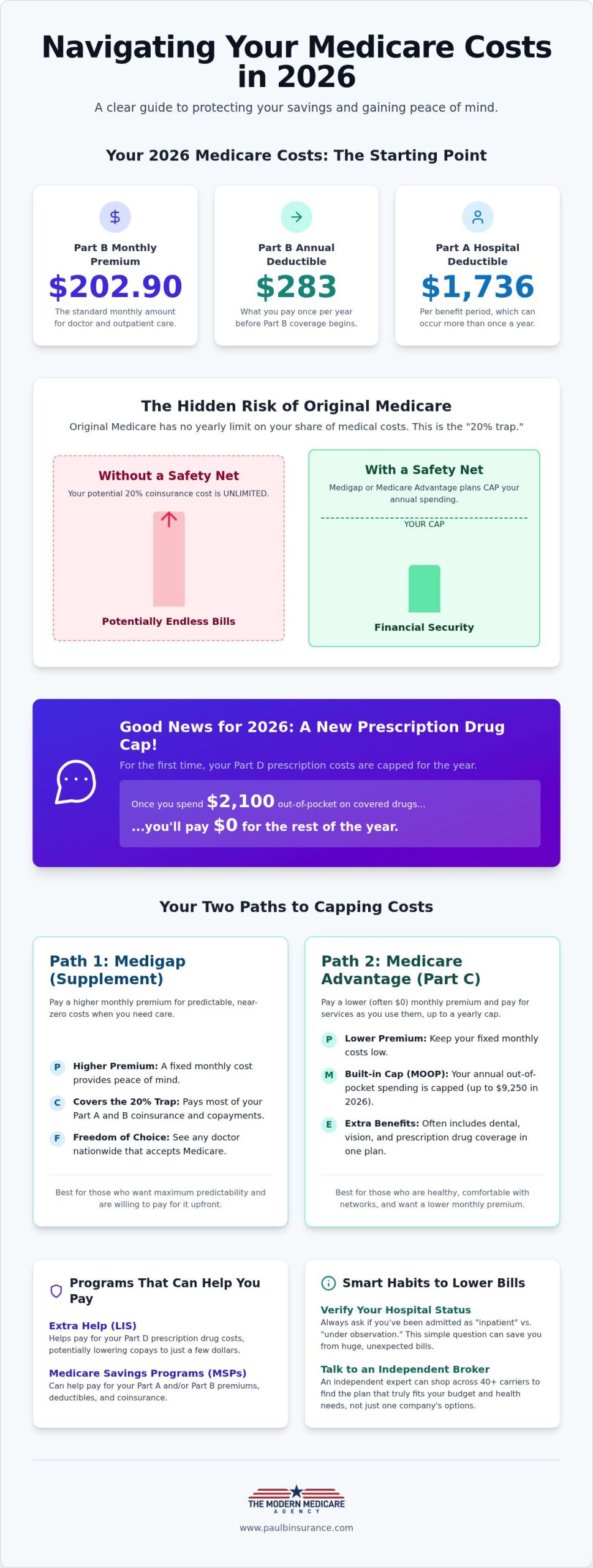
The biggest risk with Original Medicare is that it has no annual out-of-pocket limit. This means there’s no “ceiling” on how much you might have to spend in a single year. If you face a serious illness or a long hospital stay in 2026, your share of the bills could theoretically keep growing forever. An out-of-pocket maximum is the most you’ll ever have to pay for covered medical services in a calendar year, and it serves as your most vital financial safety net against total exhaustion of your savings.
Breaking Down Part A and Part B Expenses
Many people are surprised to learn that “premium-free” Part A doesn’t mean your hospital stay is free. For 2026, the Part A deductible has risen to $1,736 per benefit period. It’s crucial to remember that a benefit period isn’t the same as a calendar year. If you’re hospitalized, then go home, and then have to return 61 days later, you could be responsible for that $1,736 deductible all over again.
Part B covers your doctor visits and outpatient care, but it comes with a 20% coinsurance requirement. This is often called the “20% trap” because there’s no cap on that amount. Whether your bill is $100 or $100,000, you’re responsible for 20% of the Medicare-approved cost after you meet your $283 annual deductible. Learning how to reduce medicare out of pocket costs involves finding a way to cap that 20% so a single surgery doesn’t derail your retirement.
The Reality of Prescription Drug Costs (Part D)
Your pharmacy costs are another area where spending can feel unpredictable. In 2026, Part D premiums vary significantly between insurance companies, with the average stand-alone plan projected at $34.50 per month. However, the premium is just the starting point. You also need to account for copays and coinsurance at the pharmacy counter, which can fluctuate based on which “tier” your specific medications fall into.
The good news for 2026 is the new $2,100 out-of-pocket maximum for Part D drugs. Once you hit that limit, you won’t pay another penny for your covered prescriptions for the rest of the year. This change provides much-needed certainty, but choosing the right plan is still the best way to keep your monthly spending low. You can learn more about Medicare Part D options to see how different carriers handle your specific list of medications.
Choosing Between Medigap and Medicare Advantage to Limit Spending
Deciding between a Medicare Supplement plan and a Medicare Advantage plan is the most important choice you’ll make for your 2026 budget. Think of it as choosing which “bucket” your medical expenses will fall into. You can either pay a higher, predictable amount every month to keep your future costs low, or you can pay a very low monthly premium and cover your medical bills as they arise. To find the right path, take a look at your medical bills from 2025. If you visited the doctor frequently or had several tests, those small copays might actually add up to more than a monthly premium would have cost. This simple review is often the first step in learning how to reduce medicare out of pocket costs effectively.
Every Medicare Advantage plan includes a Maximum Out-of-Pocket (MOOP) limit, which is the absolute highest amount you will pay for covered medical services in a calendar year before the plan begins to pay 100% of the costs. For 2026, the federal limit for these plans is $9,250, though many individual plans set their own limits much lower. While this provides a safety net, it’s a much higher ceiling than what you would find with a supplement plan. If you’re feeling overwhelmed by these options, you can compare plans with an expert who can help you do the math.
Is a Medicare Supplement Plan (Medigap) Right for You?
For many people in 2026, Medigap Plan G remains the gold standard for cost predictability. While you’ll pay a higher monthly premium, the plan steps in to cover nearly all the gaps left by Original Medicare. Most importantly, it eliminates that 20% coinsurance for doctor visits and outpatient surgeries that can otherwise drain a savings account. You pay your monthly premium and your small annual Part B deductible, and then your medical bills are largely taken care of for the rest of the year. You can read more about What is Medicare Supplement Insurance? to see if this “all-in” approach fits your lifestyle.
Saving with Medicare Advantage Plans
If you prefer to keep your monthly fixed costs as low as possible, Medicare Advantage might be the right fit. Many of these plans have premiums as low as $0, and they often include extra benefits like dental, vision, and hearing coverage that Original Medicare doesn’t offer. However, you must stay within the plan’s network of doctors and hospitals to keep your costs down. Going out-of-network can lead to significant cost spikes that bypass your usual copays. If you have limited income, you might also qualify for Medicare Savings Programs which can help pay for your premiums. You can explore your local options in our guide to Medicare Advantage Plans 2026.
Exploring Financial Assistance: Medicare Savings Programs and Extra Help
Many people feel a heavy weight on their shoulders when they see the 2026 Medicare Part B premium of $202.90. It’s a significant monthly expense, especially when you’re also trying to manage a rising annual deductible. However, you might not have to carry that burden alone. There are several federal and state programs designed specifically to help seniors with limited income stay afloat. If you’ve been wondering how to reduce medicare out of pocket costs, checking your eligibility for these programs is one of the most effective steps you can take. You might be surprised to find that you qualify even if you think your income is a bit too high, as many states have updated their limits for 2026.
The Extra Help program is a federal initiative that provides financial support to lower your Medicare Part D costs, specifically by eliminating your annual drug deductible and reducing your copays to just a few dollars. This program alone can save you thousands of dollars a year. Many people assume they don’t qualify because they own a home or have a small savings account, but the rules are more generous than you might think. In 2026, the focus is on keeping you protected, not on making you spend every penny before you can get help.
Qualifying for Medicare Savings Programs
There are four types of Medicare Savings Programs (MSPs) that can help pay your premiums and, in some cases, your deductibles and coinsurance. The Qualified Medicare Beneficiary (QMB) program is particularly powerful in 2026. If you qualify for QMB, the state pays your Part B premiums and your doctors are legally not allowed to bill you for Medicare-covered services. For an individual, the monthly income limit is $1,350 with an asset limit of $9,950. Your state’s Medicaid office handles these applications, and they look at your specific situation to see which of the four programs fits you best. It’s a journey from financial stress to a state of certainty.
Lowering Drug Costs with Extra Help
For your prescriptions, the Low Income Subsidy, or Extra Help, is a true lifesaver. In 2026, individuals with a monthly income below $2,015 and resources less than $18,090 can qualify for this assistance. This program is especially important now that the Part D structure has changed. While everyone benefits from the new $2,100 out-of-pocket cap, those with Extra Help see their costs drop even further. It effectively eliminates late enrollment penalties and ensures your pharmacy visits are predictable. Instead of worrying about which tier your medication falls into, you’ll know your cost is capped at a very low, manageable amount. You can compare Part D plans with us to see how these subsidies apply to your specific medications.
Practical Habits to Lower Your Everyday Medical Expenses
Verifying “Assignment” is a simple habit that can save you hundreds of dollars. When a doctor accepts assignment, they agree to accept the Medicare-approved amount as total payment for their services. If they don’t, they can bill you for an “excess charge,” which is up to 15% more than the standard rate. This extra cost comes straight out of your pocket. Checking this one detail before you set an appointment is a direct way to understand how to reduce medicare out of pocket costs without changing your actual coverage.
Another common financial pitfall is the “Observation vs. Inpatient” trap. If you’re kept in the hospital for a night or two, you might assume you’ve been “admitted.” However, if the hospital classifies your stay as “observation,” you’re actually an outpatient. This means Part B rules apply instead of Part A, leading to higher coinsurance and potentially no coverage for a follow-up stay in a skilled nursing facility. Always ask the hospital staff directly: “Am I an inpatient or under observation?” It’s a small question that protects your savings.
Sticking with the same plan for years is a mistake that many people make. Insurance companies change their doctor networks and drug lists every single year. A plan that was perfect for you in 2023 might be the most expensive option for you in 2026. Reviewing your coverage annually ensures you aren’t paying for benefits you don’t use or missing out on lower premiums elsewhere. Choosing generic drugs is the fastest way to lower your Part D costs in 2026 because they often fall into lower pricing tiers with minimal copays.
Smart Provider Choices and Billing Accuracy
You can use the Medicare “Care Compare” tool to find doctors and facilities that provide high-quality care at lower costs. Once you receive care, make a habit of reviewing your Medicare Summary Notice (MSN). Look for services you didn’t receive or double-billing. If you see an error or a denied claim that you believe should be covered, don’t be afraid to file an appeal. The appeals process is a right you have to ensure the system works fairly for you. If you need a partner to help you look over these options, you can contact an independent broker for guidance.
Optimizing Your Prescription Drug Strategy
Your choice of pharmacy matters just as much as your choice of plan. Most Part D plans use “preferred pharmacies” where your copays are significantly lower than at “standard” pharmacies. In 2026, the new $2,100 out-of-pocket cap for prescriptions is a major win, especially if you take high-cost medications. Even with this cap, you should still ask your doctor about “therapeutic alternatives.” These are different drugs that treat the same condition but might sit in a lower, more affordable pricing tier. You can explore more ways to save in our guide to Medicare Part D.
How an Independent Broker Simplifies Your Path to Lower Costs
When you’re trying to figure out how to reduce medicare out of pocket costs, the sheer number of choices can feel like a mountain you have to climb alone. Many people encounter “captive agents” without even realizing it. These are representatives who work for just one insurance company. Because they are restricted to only one brand, they can’t tell you if a competitor has a lower premium or better drug coverage for your specific needs. An independent broker like Paul Barrett works for you, not the insurance companies. We have the freedom to shop across 40+ different carriers to find the one plan that fits your life perfectly in 2026.
Our role is to act as your calm, expert guide through a system that often feels designed to confuse. We don’t just look at the monthly premium; we dig into the details of your specific doctors and medications to ensure you aren’t walking into a financial trap. If a bill arrives in your mailbox that is higher than you expected, you don’t have to spend hours on hold with a giant corporation. You call us. We provide year-round support and act as your advocate whenever you have questions or concerns about your coverage. The best part of this partnership is that our expert help is completely free for you. We are compensated by the carriers, which allows us to provide impartial, professional advice at no cost to the consumer.
Unbiased Advice for Your 2026 Medicare Journey
We believe in a methodical approach that removes the heavy lifting from your shoulders. Instead of you spending weeks comparing spreadsheets, we use our tools to filter through dozens of options in minutes. This process is about more than just numbers; it is about finding the security that comes from a plan tailored to your budget. We take the time to explain every detail in simple language so you can make a choice with total confidence. You can learn more about what to look for when you Find a Trusted Medicare Broker who will put your interests first.
Your Next Steps Toward Financial Security
You shouldn’t have to spend your retirement worrying about the next medical bill. Our Melville-based team is ready to help you navigate the 2026 changes with a simple, no-pressure consultation. We will look at your current plan, check it against the new $2,100 drug cap, and see if there is a way to lower your monthly spending. This is your journey from a state of distress to one of absolute certainty. Contact The Modern Medicare Agency today for a free cost review and let us help you find the financial peace of mind you deserve.
Take Control of Your 2026 Healthcare Budget
You now have a clear roadmap for the year ahead. We’ve explored how choosing the right plan type can protect you from the 20% coinsurance trap and how the new $2,100 drug cap offers a real safety net for your pharmacy spending. Whether you qualify for state assistance programs or simply need to switch to a plan that better fits your current doctors, the tools to protect your savings are within your reach. Understanding how to reduce medicare out of pocket costs doesn’t have to be a source of stress when you have a dedicated advocate by your side.
Our team serves clients in over 34 states, and we are ready to compare more than 40 different carriers to find your perfect match. It’s important to remember that our help comes at zero cost to you. We are here to ensure you never overpay for the care you need or feel stuck with a plan that no longer works. You deserve to enter 2026 with total confidence and financial clarity.
Get a Free, Personalized Medicare Cost Review for 2026
You have worked hard for your retirement, and we are here to help you protect it every step of the way.
Frequently Asked Questions
What is the maximum out-of-pocket limit for Medicare in 2026?
For 2026, the maximum out-of-pocket limit for Medicare Advantage plans is $9,250 for covered medical services. It’s vital to remember that Original Medicare itself has no annual limit at all. This is why many people look for strategies on how to reduce medicare out of pocket costs by choosing a plan that provides a firm financial ceiling, ensuring a surprise illness won’t drain your savings.
Can I change my Medicare plan to lower my costs mid-year?
You typically can’t change your plan in the middle of the year unless you qualify for a Special Enrollment Period. These windows are usually triggered by life events, such as moving to a new home or losing your employer coverage. If you already have a Medicare Advantage plan, you also have a window from January 1 to March 31 to make a one-time switch to a different plan.
Does Medigap cover the Part B deductible in 2026?
No, Medigap plans available to those new to Medicare in 2026 don’t cover the Part B deductible, which is $283 this year. Federal law changed in 2020 to prevent new plans from covering this specific cost. Most people now choose Plan G, which covers almost every other gap in your coverage once you pay that initial $283 out of your own pocket.
How do I know if I qualify for the Medicare Savings Program?
You qualify for a Medicare Savings Program based on your monthly income and your total assets. For example, the QMB program for individuals in 2026 generally requires an income below $1,350 and assets under $9,950. Since these limits can change and some states have different rules, the best way to know for sure is to have an expert review your specific financial situation.
Will the $2,100 drug cost cap apply to me in 2026?
Yes, the out-of-pocket cap for Part D prescription drugs is $2,100 in 2026, and it applies to everyone with a Medicare drug plan. Once you spend $2,100 on your covered medications at the pharmacy, your plan will pay 100% of your drug costs for the rest of the year. This is a massive relief for anyone managing chronic conditions with expensive medications.
Is there a penalty for not having a Part D plan if I don’t take drugs?
There’s a permanent financial penalty if you go 63 days or more without a Part D plan or other “creditable” drug coverage. Medicare calculates this by taking 1% of the national base beneficiary premium for every month you were without coverage. Even if you don’t take medications now, having a low-cost plan is a smart way to protect your future budget from these growing penalties.
How can an independent broker help me save money on Medicare?
An independent broker helps you save by comparing over 40 different insurance carriers to find the lowest price for your specific needs. Unlike agents who work for just one company, we aren’t restricted to one brand’s prices. We can look at the whole market to find the most effective strategy for how to reduce medicare out of pocket costs, and our services are free.
What happens if I can’t afford my Medicare premiums?
If you’re struggling to pay your premiums, you should immediately look into the four Medicare Savings Programs run by your state. These programs are designed to pay your Part B premiums and, in many cases, your deductibles and coinsurance as well. These programs exist specifically to ensure that every senior can access the healthcare they deserve without facing financial ruin or constant stress.

Article by
Paul Barrett
Paul Barrett, CMIP is the founder of The Modern Medicare Agency, an independent Medicare-only brokerage based in Melville, NY. With 18 years of Medicare-exclusive experience, a CMIP designation, and more than 5,000 clients served across 37 states, Paul is one of the most credentialed independent Medicare specialists on Long Island — and one of the most direct.
He represents 40+ carriers with no quotas and no allegiances, which means his recommendations are based entirely on what fits each client's specific situation. He is the author of Medicare Mastery Unlocked and host of the Wise Guys Retirement Talk podcast. His content is grounded in primary sources, real carrier intelligence, and 18 years of watching what happens when people get Medicare right — and when they don't.
📞 631-358-5793 | paulbinsurance.com