




Inpatient means a doctor formally admitted you and Medicare Part A covers the stay. Observation means you’re technically an outpatient getting monitored, billed under Medicare Part B, even if you’re sleeping in a hospital bed on the same floor. That single distinction decides whether you pay one Part A deductible or a stack of separate Part B coinsurance charges, and whether Medicare will pay for a nursing home stay afterward at all.
TL;DR:
- Observation stays can lead to significantly higher out-of-pocket costs due to 20% coinsurance on multiple separate services, sometimes exceeding inpatient deductibles.
- The two-midnight rule relies on documentation of a doctor’s expectation to need at least two nights of hospital care, not on clinical severity; unclear notes can result in observation classification.
- Observation days do not count toward the three-night inpatient stay required for Medicare to cover skilled nursing facility care, which can result in unexpected bills.
- Patients should request and review the formal admission order and MOON notice before discharge to understand their status and standing for appeals if needed.
- Medicare Advantage plans may apply different criteria for inpatient versus observation status, often requiring internal reviews rather than CMS benchmarks.
Table of Contents
- Inpatient vs Observation Status: What the Words Actually Mean
- Part A vs. Part B: What Each Status Actually Costs You
- The Two-Midnight Rule and Why Your Doctor’s Notes Matter
- Skilled Nursing Coverage, the MOON Notice, and Your Appeal Options
- What to Ask and What to Collect Before You Leave the Hospital
- How Status Changes the Shape of Your Hospital Stay
- Beyond Medicare: How Private Insurance Handles the Same Split
- The Real Cost of Getting Labeled “Observation”
- Why This Rule Exists: The Regulatory Backstory
- Misconceptions That Cost Patients Money
- Paul B Insurance’s Take: Close the Gap Before It Costs You
- Where to Verify These Rules Yourself
- Sources
Inpatient vs Observation Status: What the Words Actually Mean
The words sound clinical. They’re actually billing categories, and the difference has almost nothing to do with which bed you’re in.
Inpatient status starts the moment a physician writes a formal admission order. That order is the trigger. Once it’s written, Medicare Part A takes over your hospital bill. Observation status means no one has written that order yet, or a doctor has decided you need watching, not admitting, because your condition is still unclear. You’re an outpatient the whole time, even if you spend three nights in a hospital room down the hall from someone who’s technically an inpatient.
Here’s the part that trips people up: the room, the nurses, the monitors, and the meals can look identical. Medicare confirms that hospital status is a billing designation, not a description of your physical location or the intensity of care you’re receiving.
Observation typically happens in a few places:
- The emergency department, while doctors run tests to decide next steps
- A dedicated observation unit, often for chest pain, falls, or medication reactions
- A regular inpatient-style bed, simply coded differently on the back end
If your observation stay stretches past 24 hours, the hospital is required to hand you a Medicare Outpatient Observation Notice (MOON) within 36 hours of when observation services started. That notice has to explain, in writing, why you’re outpatient and what that means for your wallet. If nobody has handed you one and you’ve been there over a day, ask for it by name.
Part A vs. Part B: What Each Status Actually Costs You
The financial split comes down to which part of Medicare is footing the bill, and the two work in completely different ways.
Inpatient care runs through Part A. You pay one deductible per benefit period, one Part A deductible, which varies but is often around $1,700 (https://paulbinsurance.com/medicare-part-a-2026-understanding-your-hospital-insurance-and-costs), and that single payment generally covers your room, nursing care, meals, and most hospital services for the covered days. Observation care runs through Part B, and Part B doesn’t work off one flat deductible. You typically owe 20% coinsurance on each covered service separately: the ER visit, each diagnostic scan, each lab test, physician fees on top of that. CMS guidance on billing structure confirms observation and inpatient care are billed under entirely separate parts of Medicare, with separate cost-sharing rules.
Statistic Callout: A two-night observation stay with imaging, labs, and specialist consults can rack up several individual 20% charges that, added together, sometimes exceed what a single Part A deductible would have cost for the same clinical care.
Here’s a simplified side-by-side for a short stay:
- Inpatient, two nights: One Part A deductible covers the room, nursing, and most services for that benefit period.
- Observation, two nights: Separate 20% coinsurance on the ER visit, each imaging study, each lab panel, and physician charges, which stack up individually rather than folding into one flat fee.
There’s a second wrinkle with observation stays: self-administered drugs, like your usual home pills, are sometimes billed separately under Part B and may not be covered the way they would be during an inpatient stay, since outpatient drug billing works differently than inpatient pharmacy coverage.
If you’re on a Medicare Advantage plan instead of Original Medicare, the math changes again. MA plans run their own utilization review and can evaluate a stay of any length for medical necessity, so the two-midnight benchmark doesn’t apply the same way it does under Original Medicare.
The Two-Midnight Rule and Why Your Doctor’s Notes Matter
CMS uses a simple benchmark to decide who should be admitted as an inpatient: if a physician reasonably expects you’ll need hospital care spanning at least two midnights, that expectation generally supports inpatient admission. CMS refreshed this guidance on March 12, 2026, but the core two-midnight benchmark hasn’t changed.
Here’s what a lot of patients get wrong about it: the rule is a reimbursement benchmark, not a clinical diagnosis. It’s about expected time in the hospital, not how sick you are in that moment. Two patients with the same condition can get different status labels depending on how their doctor documented the expectation at admission.
That documentation matters more than most people realize:
- A doctor’s note stating “expect at least two midnights of hospital care” carries real weight toward inpatient status.
- A vague note with no time estimate leaves room for a reviewer to classify you as observation instead.
- Status can shift mid-stay if your condition worsens or improves, and that shift should be documented, too.
Utilization review nurses and physician advisors are often the ones flagging these cases internally, and accurate admitting documentation is consistently the strongest evidence in a later appeal.
Pro Tip: Ask directly, “Did the admitting doctor document an expectation of at least two midnights?” If the answer is vague, ask them to add that expectation to your chart before you leave. It’s the single most useful sentence in your file if you ever need to appeal.
Skilled Nursing Coverage, the MOON Notice, and Your Appeal Options
Here’s the consequence that blindsides more Medicare beneficiaries than any coinsurance bill: observation days don’t count toward the three-day inpatient stay Medicare requires before it will pay for skilled nursing facility (SNF) care afterward. Spend three nights under observation, then get discharged to a nursing home for rehab, and Medicare may cover none of it, because only inpatient days count toward that three-day threshold.
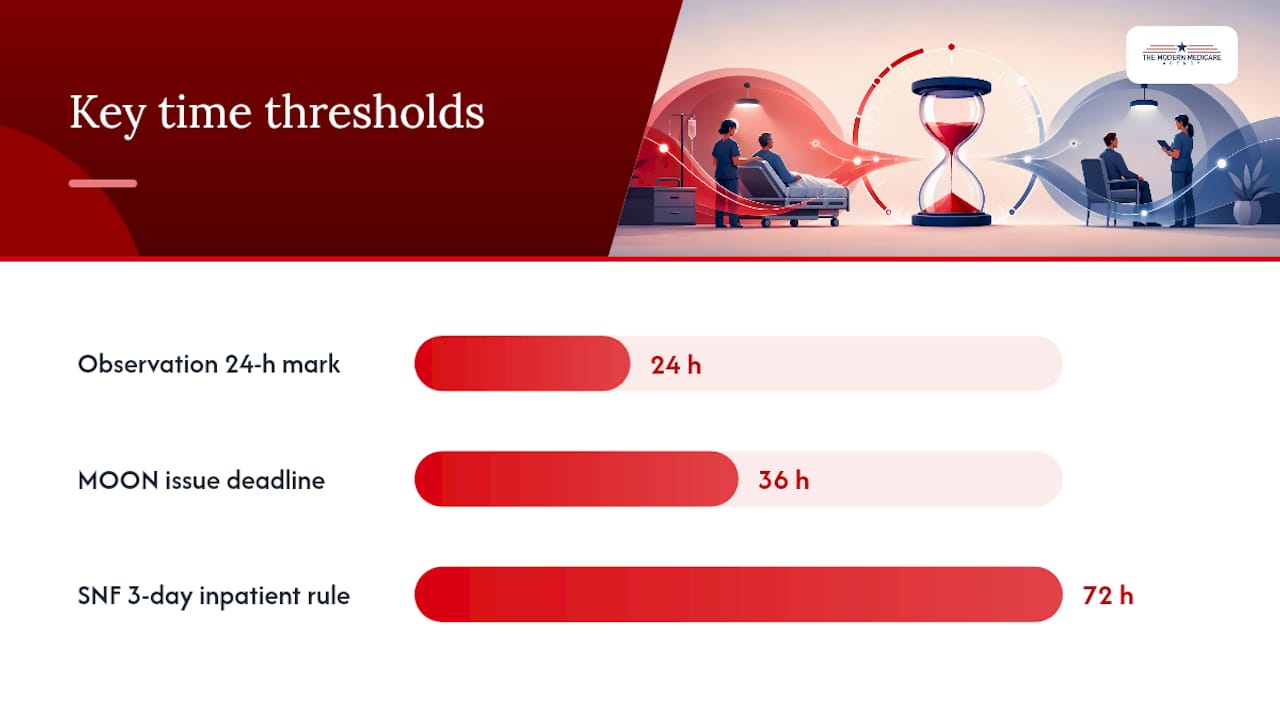
The MOON notice exists specifically to warn you about this before you leave. Hospitals must issue it within 36 hours of observation services passing the 24-hour mark, and it has to spell out, in plain language, why you’re outpatient and how that could affect SNF coverage. The common failure point: hospitals sometimes deliver it late, or buried in a stack of discharge paperwork nobody reads closely.
If you believe your status was wrong, you have two possible paths:
- Prospective appeal, while still in the hospital. You or a family member can call the Quality Improvement Organization (QIO) for your state before discharge and request an expedited review of your status.
- Retrospective appeal, after discharge. Following the Alexander v. Azar litigation, certain beneficiaries reclassified from inpatient to observation gained the right to appeal after the fact, covering claims from 2009 through 2025, with a permanent prospective appeal pathway now in place starting February 14, 2025.
Retrospective appeals require solid documentation. Contemporaneous clinical notes showing the admitting physician’s expectation of length of stay, combined with your MOON and Medicare Summary Notice, are the core evidence a reviewer needs to reconsider your case.
Not every beneficiary qualifies for the retrospective route, so check current eligibility criteria with the Center for Medicare Advocacy before assuming a past stay is appealable.
What to Ask and What to Collect Before You Leave the Hospital
You don’t need a medical degree to protect yourself here. You need four questions and a folder.
Ask the nursing staff or charge nurse directly: “Am I currently listed as inpatient or observation?” Then ask, “Has a formal admission order been written?” If the answer is no, ask when a decision is expected and whether the doctor has documented an expected length of stay.
Before you’re discharged, request copies of:
- The formal admission order, if one exists
- Your MOON notice, if you were in observation more than 24 hours
- A billing department contact number for questions after discharge
- Complete discharge paperwork, including any notes on expected next-level care
If you’re still in the hospital and disagree with your status, call your state’s QIO immediately to request an expedited prospective review. Waiting until after discharge closes that door and pushes you into the more complicated retrospective process.
Pro Tip: Take a phone photo of your MOON notice and admission paperwork the moment you receive them. Discharge day is chaotic, and paperwork gets lost. A photo in your phone is backup you control.

How Status Changes the Shape of Your Hospital Stay
Inpatient and observation don’t just differ on paper. They can shape how long you stay and what gets ordered.
Observation is built around a clock. Hospitals generally aim to resolve observation cases within 24 to 48 hours, either admitting you formally or discharging you home, because open-ended observation billing invites scrutiny from payers. That time pressure can mean faster-paced testing and quicker discharge decisions than an inpatient stay would carry.
Inpatient status carries less of that urgency. Once you’re formally admitted, the clinical team plans around your actual recovery timeline rather than a billing clock, which sometimes means more thorough follow-up testing or a longer runway before discharge.
Services covered can differ too, particularly around ancillary care. An inpatient stay typically bundles nursing, meals, and most ancillary services into one Part A payment. Observation care itemizes those same services under Part B, which is why two patients receiving nearly identical care can walk away with very different bills. The clinical care itself. Bloodwork, imaging, physician rounds. Often looks the same regardless of status. It’s the paperwork trailing behind it that diverges.
Beyond Medicare: How Private Insurance Handles the Same Split
The inpatient versus observation distinction isn’t a Medicare-only quirk. Private insurers use similar billing categories, though the details vary by carrier and plan.
Employer group plans and marketplace plans generally follow the same logic: inpatient claims route through hospital benefits, often with a flat copay or percentage coinsurance tied to a single stay, while observation claims route through outpatient benefits, sometimes with per-visit copays that stack the same way Medicare Part B charges do.
Medicare Advantage plans deserve a specific callout here, since they’re private insurance built on top of Medicare rules. As mentioned earlier, MA plans run their own utilization review and can apply medical necessity criteria to a stay of any length, meaning the two-midnight presumption that guides Original Medicare doesn’t carry the same automatic weight. If you’re on an MA plan, your status determination may hinge more on your specific plan’s internal review process than on the CMS benchmark alone, which is one more reason to ask direct questions about status the moment you’re admitted, regardless of which type of coverage you carry.
The Real Cost of Getting Labeled “Observation”
The three-day SNF rule gets most of the attention, and it deserves it. But it’s not the only financial trap hiding in observation status.
Self-administered medications, your regular home prescriptions, are one of the most common surprise charges. Under observation, hospitals frequently bill these as outpatient drugs rather than folding them into a covered service, which means you may pay out of pocket for medications you’d have received free as an inpatient. Every diagnostic test, consult, and procedure during observation generates its own separate coinsurance charge rather than folding into a single deductible.
Research on observation billing patterns suggests that longer observation stays correlate with higher patient costs in some analyses, particularly once a stay stretches past 48 hours and accumulates more individually billed services. The financial risk isn’t fixed. It grows the longer you sit in observation without a formal admission decision.
This is exactly the kind of gap a Medicare Supplement (Medigap) policy or a hospital indemnity plan is designed to soften, since both can help offset the piecemeal Part B charges that observation status generates.
Why This Rule Exists: The Regulatory Backstory
The inpatient versus observation split isn’t arbitrary. It grew out of decades of Medicare trying to control hospital billing incentives, and understanding the backstory explains why the rule feels so unforgiving.
CMS introduced the Two-Midnight Rule specifically to give hospitals and physicians a clearer, more consistent benchmark for admission decisions after years of inconsistent, hospital-by-hospital judgment calls that regulators worried were being used to game reimbursement. The rule shifted the decision toward a physician’s documented time-based expectation rather than a subjective severity assessment.
The MOON notice requirement followed a separate legal push. Patient advocates argued for years that beneficiaries were being kept in the dark about their status, sometimes discovering only at discharge, or after a rejected SNF claim, that they’d never technically been admitted. Congress responded with the NOTICE Act, which created the MOON requirement now enforced through CMS guidance.
The appeals pathway has its own legal history, rooted in the Alexander v. Azar litigation that challenged whether beneficiaries reclassified from inpatient to observation had any right to contest that decision. That case is why a formal appeals process exists today instead of leaving beneficiaries with no recourse at all. Some observers, including medical ethics researchers, have pointed out that status decisions are still shaped as much by reimbursement pressure as by pure clinical judgment, a tension the current rules haven’t fully resolved.
Misconceptions That Cost Patients Money
The biggest misconception is assuming your room assignment tells you your status. It doesn’t. You can be in a standard hospital bed, on a regular floor, with a full care team, and still be classified as observation. The only way to know for certain is to ask directly and get the admission order, or lack of one, confirmed in writing.
A second misconception: people assume observation status is temporary and low-stakes, something that gets sorted out automatically. It often doesn’t get revisited unless someone, you, a family member, or a sharp-eyed case manager, pushes for it. Status can sit unresolved for days if nobody flags it.
A third misconception: many beneficiaries believe Medicare Advantage plans follow the exact same two-midnight logic as Original Medicare. They don’t have to, and many apply their own separate medical necessity review instead.
Finally, a lot of patients assume the MOON notice is just a formality to sign and set aside. It’s actually one of the most useful documents you’ll receive during a hospital stay, since it’s the hospital’s own written admission that you’re outpatient and a roadmap for what that means financially. Read it the day you get it, not the day you’re discharged.
Paul B Insurance’s Take: Close the Gap Before It Costs You
Since 2007, I’ve watched Medicare beneficiaries get blindsided by bills that had nothing to do with the quality of care they received and everything to do with a billing label nobody explained to them. That’s the real failure here: not the rule itself, but how rarely anyone walks patients through it at the bedside.
A practice built on education first can help you make better coverage decisions by understanding what you’re actually exposed to. If you want a coverage review that accounts for gaps like observation billing, whether that means a Medicare Supplement plan or a hospital indemnity policy, reach out for a no-pressure conversation about your options.
— Paul
Where to Verify These Rules Yourself
For the policy text itself, start with CMS’s Two-Midnight Rule fact sheet and its MOON notice guidance. For appeals contacts and eligibility, the Center for Medicare Advocacy’s FAQ is the most current resource. For personalized plan help, see our guides on Medicare Part A and skilled nursing facility coverage.
This article is general information, not a substitute for advice from a qualified doctor. Consult a qualified healthcare professional about your own circumstances before acting on anything here.
Sources
- Medicare Outpatient Observation Notice (MOON) (CMS fact sheet)
- Medicare
- Center for Medicare Advocacy FAQ on observation status appeals
- NCBI / analysis on observation costs and consequences