




Medicare limits out-of-pocket cost sharing to no more than $35 for a one-month supply of each covered insulin product. Part D drug plans have followed this rule since January 1, 2023. Part B coverage for insulin delivered through a traditional durable medical equipment pump joined it on July 1, 2023.
The cap applies specifically to “covered insulin products” listed on your plan’s formulary, and Part D deductibles do not apply to them. That’s the good news. The catch is that the cap controls what you pay, not whether your plan covers your exact insulin.
- Part D: $35 max per one-month supply, no deductible, effective January 1, 2023.
- Part B (pump insulin): $35 max per one-month supply, effective July 1, 2023.
- Not covered by the cap: syringes, pump supplies not billed as DME, and non-formulary insulin brands.
Quick fact: A three-month mail-order fill can still cost up to $105 total, since the $35 cap applies per one-month supply, not per prescription.
Key Takeaways
Medicare caps insulin cost sharing at $35 per one-month supply for covered products, but that protection only works if your specific insulin is on your plan’s formulary.
| Point | Details |
|---|---|
| Know your effective dates | Part D’s $35 cap started January 1, 2023; Part B pump insulin followed on July 1, 2023. |
| Confirm formulary status | The cap only applies to insulin products actually listed on your plan’s formulary, so check before you fill. |
| Watch multi-month fills | A 90-day supply can cost up to $105 total, since the cap applies per one-month supply, not per prescription. |
| Document overcharges | Keep receipts and NDC numbers, and escalate to 1-800-MEDICARE or a SHIP counselor if your plan doesn’t reimburse promptly. |
| Get a formulary review | Paulbinsurance helps beneficiaries compare Part D and MA-PD plans and confirm insulin coverage before you commit. |
Table of Contents
- How Does Medicare’s Insulin Savings Program Work?
- Who Qualifies for the $35 Insulin Cap?
- How to Confirm Your Insulin Is Covered Before You Fill
- Other Ways to Lower Insulin Costs in 2026
- What to Do If You Were Charged More Than $35
- Questions to Ask Before You Choose or Switch Plans
- How an Independent Agent Helps You Verify Insulin Coverage
- Where to Verify These Details Yourself
- An Honest Look at What the $35 Cap Actually Fixes
- Get Help Confirming Your Insulin Coverage for 2026
- Sources
How Does Medicare’s Insulin Savings Program Work?
Medicare splits insulin coverage into two separate buckets, and which one applies to you depends entirely on how you take your insulin, not which plan you’re enrolled in.
Part D handles insulin you self-administer: pens, vials, and inhaled insulin picked up at a pharmacy. If your insulin appears on your plan’s drug formulary, your cost sharing for a one-month supply cannot exceed $35, and you don’t have to satisfy a deductible first. That last detail catches people off guard. Most Part D drugs require you to hit your deductible before copays kick in. Covered insulin products skip that step entirely.

Part B covers insulin only when it’s delivered through a traditional insulin pump classified as durable medical equipment. That $35 cap took effect later, on July 1, 2023, and it works the same way: no more than $35 for a one-month supply of pump insulin, once your Part B deductible is met (Part B’s deductible rules still apply, unlike Part D).
A “covered insulin product” means two things: it’s FDA-approved or licensed, and it sits on your specific plan’s formulary. Insulin pumps, needles, and syringes are treated as supplies, not drugs, so they fall outside this particular cap even when insulin itself is covered.
- Multi-month fills get billed per month’s supply, so a 90-day fill can run up to $35 times three.
- Confirm your pharmacy’s “one-month supply” quantity in advance. Definitions can vary slightly by plan.
- Pump insulin and pen/vial insulin are billed under different parts of Medicare, even for the same patient.
The Part D Senior Savings Model tested this $35 structure voluntarily starting in 2021, and the Inflation Reduction Act turned it into a universal requirement for every Part D plan in 2023.
Who Qualifies for the $35 Insulin Cap?
Every Part D enrollee qualifies, whether you have a standalone drug plan or a Medicare Advantage plan with drug coverage (MA-PD). There’s no separate application. If your plan covers Part D drugs and your insulin is on the formulary, the cap applies automatically.
Extra Help changes the math further. Beneficiaries with Full Extra Help typically pay less than $35 already, often just a few dollars per fill. Those with Partial Extra Help get a reduced but not eliminated copay, and the $35 cap serves as a ceiling rather than the actual price they’ll pay.
A few situations sit outside the standard rule:
- Disposable patch pumps are sometimes billed as Part D drugs rather than Part B DME, which changes which cap applies.
- Employer retiree plans and ERISA-governed group coverage aren’t bound by Medicare’s cap unless they’ve adopted it voluntarily.
- Non-Medicare payers, including some Medicaid programs, follow their own cost-sharing rules entirely.
How to Confirm Your Insulin Is Covered Before You Fill
Don’t assume your specific insulin brand is covered just because “insulin” is covered. Formularies vary by plan, and a brand switch by your doctor can knock you off your current formulary overnight. Here’s how to check:
- Open Medicare’s Plan Finder and add your exact insulin, including strength and form (pen versus vial), to your drug list.
- Compare total estimated cost across plans, not just the copay. Premiums and pharmacy network differences move the real number.
- Call your plan or check the formulary directly to confirm the NDC listing and whether prior authorization or step therapy applies.
- Update your drug list every Open Enrollment (October 15 to December 7), since formularies change annually.
- If you experience a major life event, like losing employer coverage, ask whether a Special Enrollment Period lets you switch plans outside the standard window.
Pro Tip: Call your plan directly and ask for insulin coverage confirmation in writing, or note the representative’s name and call reference number. If a billing dispute comes up later, that record speeds up the appeal.
If the process feels confusing, Medicare Part D’s drug coverage rules are worth reviewing in full before you commit to a plan for the year.
Other Ways to Lower Insulin Costs in 2026
The $35 cap is a ceiling, not always the floor. Several programs can push your actual cost lower, or cover gaps the cap doesn’t touch.
- Extra Help (Low Income Subsidy): Apply through the Social Security Administration or your state Medicaid office. Full Extra Help recipients often pay just a few dollars per insulin fill, well under $35.
- State Pharmaceutical Assistance Programs: Many states run supplemental drug assistance that wraps around Medicare, particularly useful if you’re near the Extra Help income threshold but don’t quite qualify.
- Manufacturer patient assistance programs: Insulin manufacturers offer income-based savings cards and assistance programs. Eligibility rules differ by manufacturer and by whether you’re enrolled in a government program, so verify current U.S. terms directly with the manufacturer.
- Pharmacy strategy: A 90-day mail-order fill can simplify pickups, but remember the $35 cap applies per month’s supply, so a 90-day fill still totals up to $105, not a flat $35.
- Preferred network pharmacies: Using your plan’s preferred pharmacy instead of an out-of-network one often lowers your copay below the cap itself.
For pump users, a Medigap policy can help with the Part B deductible and coinsurance tied to pump insulin, since Original Medicare cost sharing still applies before the $35 cap kicks in.
Pro Tip: If you’re deciding between a 30-day and 90-day supply, ask your pharmacist to break down the per-month charge in writing so you can compare it against your plan’s stated cap.
What to Do If You Were Charged More Than $35
Billing errors happen, especially with older claims from early 2023 when plans were still adjusting systems.
- Keep your receipt and pharmacy label, and note the date, NDC number, and quantity filled. Ask the pharmacy for an itemized receipt if you didn’t get one.
- Contact the pharmacy first to flag the discrepancy, then call your plan directly if it’s not resolved. Plans were required to reimburse enrollees for overcharges on fills between January 1 and March 31, 2023, with a defined reimbursement window.
- If your plan doesn’t respond or resolve it, escalate to 1-800-MEDICARE, contact your local SHIP counselor, or ask an independent agent to intervene on your behalf.
Questions to Ask Before You Choose or Switch Plans
Enrollment decisions made without checking formulary details are the single biggest reason beneficiaries end up paying more than they expected for insulin.
- Add every insulin you take to Plan Finder and compare the total yearly estimated cost, not just the advertised copay.
- Confirm the exact brand, strength, and dosage form appears on the plan’s formulary, since generic-sounding names can hide formulary gaps.
- Ask directly about prior authorization, step therapy, and quantity limits tied to your insulin.
- Confirm your preferred pharmacy is in-network and will actually apply the $35 cap at the counter, not just in the plan’s marketing materials.
Reviewing how to check drug coverage under Part D before Open Enrollment closes gives you time to switch plans if your current one falls short.
How an Independent Agent Helps You Verify Insulin Coverage
Paul Barrett has worked directly with Medicare beneficiaries since 2007, helping them check formularies, compare total plan costs, and resolve billing disputes.
- Formulary checks against your exact insulin brand and dosage form.
- Side-by-side plan comparisons factoring premiums, not just copays.
- Direct help filing appeals or reimbursement claims when a plan overcharges.
Where to Verify These Details Yourself
Official sources beat secondhand summaries, especially for a rule with strict effective dates. Start with Medicare’s own insulin coverage page for the plain-language rule, then check CMS’s Part D Senior Savings Model page for the policy’s origin. KFF’s insulin cap explainer breaks down common points of confusion, and the CMS FAQ PDF covers reimbursement mechanics in detail. Save copies of any plan correspondence alongside these pages in case you need them later.
An Honest Look at What the $35 Cap Actually Fixes
The conventional advice on this topic stops at “insulin is capped at $35, so you’re covered.” That’s technically true and practically incomplete. The cap fixed the price problem. It didn’t fix the coverage problem, and those are two different things.
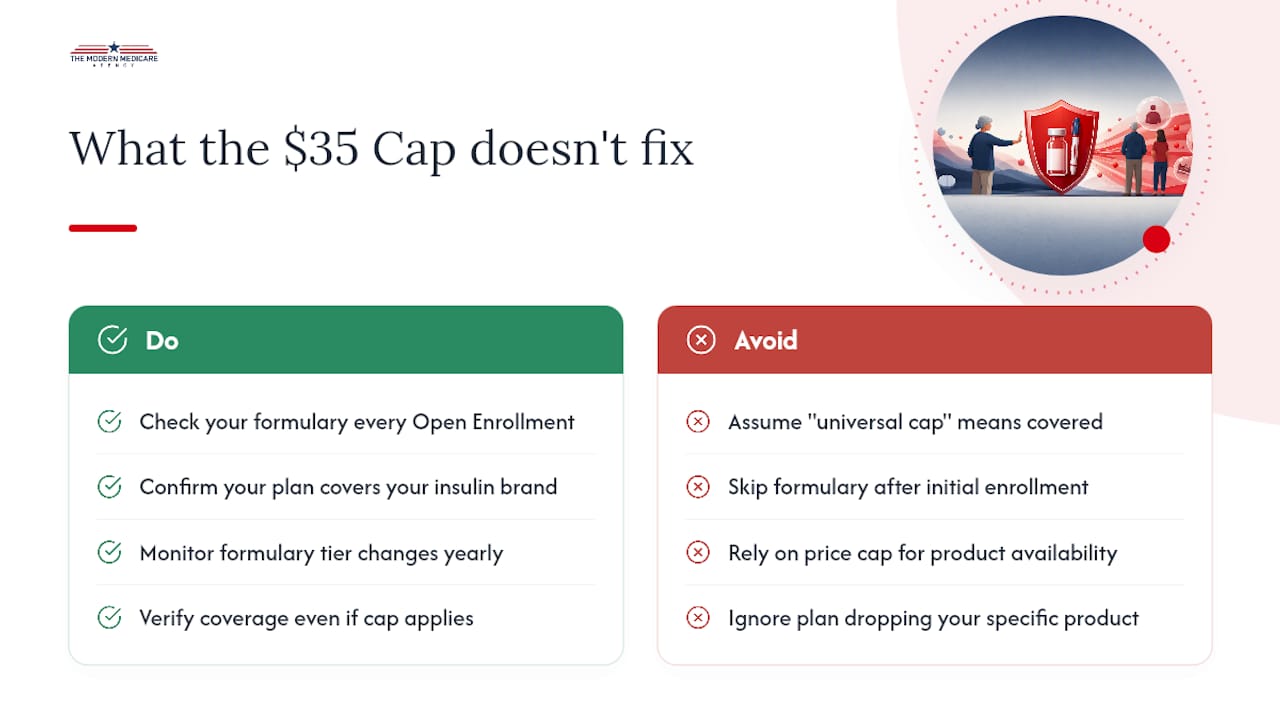
Before the Inflation Reduction Act, the Part D Senior Savings Model required beneficiaries to hunt for one of a limited set of participating plans just to get predictable insulin pricing. That hunt is gone now. Every Part D plan must honor the cap. But I think too many beneficiaries hear “universal cap” and stop paying attention to their formulary, which is exactly backward. The formulary is where the real risk still lives: a plan can comply with the $35 rule to the letter while simply not covering the brand your doctor prescribed.
If you take one thing from this article, make it this: check your formulary every single Open Enrollment, not just when you first enroll. Insulin brands get shuffled between formulary tiers more often than people expect, and the $35 cap does nothing to protect you from a plan that drops your specific product entirely.
— Paul
Get Help Confirming Your Insulin Coverage for 2026
Paulbinsurance is the independent alternative to guessing your way through Plan Finder alone. Instead of comparing formularies and premium math by yourself, you get a licensed agent who checks your exact insulin brand against real plan formularies and shows you the true annual cost, not just the advertised copay.

Paul Barrett has guided Medicare beneficiaries through plan selection since 2007, with no fee to you since the service is paid by the carrier when you enroll. That means a formulary check, a side-by-side plan comparison, and enrollment help all cost you nothing extra beyond your plan premium.
If you’re comparing Part D or Medicare Advantage options for 2026, start with a review of your Part D plan choices and get a formulary check before your next fill.
This article is general information, not a substitute for advice from a qualified doctor. Consult a qualified healthcare professional about your own circumstances before acting on anything here.
Sources
- Medicare
- Part D Senior Savings Model — CMS
- The facts about the $35 insulin copay cap in Medicare — KFF