




IRMAA stands for the Income-Related Monthly Adjustment Amount — a mandatory surcharge added to your Medicare Part B and Part D premiums if your income is above a certain threshold. If you’re a higher earner, it means paying meaningfully more for the exact same Medicare coverage everyone else has. It’s one of the more confusing parts of Medicare, mostly because of when it’s calculated and how sharply it can jump — so let’s walk through exactly how it works, what it costs at every income level, and what to do if you think you shouldn’t be paying it.
How IRMAA Actually Works
The 2-year lookback. The government sets your IRMAA bracket using your Modified Adjusted Gross Income (MAGI) from your tax return two years prior. Your 2026 Medicare premiums are based on your 2024 tax return. This lag is the single biggest source of confusion — and of unpleasant surprises — because your Medicare bill this year reflects your financial life from two years ago, not today.
What it applies to. IRMAA affects Part B (medical insurance) and Part D (prescription drug coverage) only. It does not apply to Part A for the vast majority of people, since most don’t pay a Part A premium at all.
The cliff effect. This is the detail that catches people off guard most. IRMAA brackets are hard cutoffs, not a gradual phase-in. If your MAGI is one dollar over a bracket threshold, you pay the entire surcharge for that whole tier — not a prorated amount. Crossing from $109,000 to $109,001 in MAGI can mean paying hundreds of dollars more per month, all year.
It’s per person, and it’s not permanent. If both spouses are on Medicare, each one pays their own IRMAA surcharge separately — the income threshold is based on your joint MAGI, but the bill isn’t split, it’s doubled. And IRMAA isn’t a life sentence: it’s recalculated every single year based on that year’s two-years-prior income. If your income drops back down, so does your IRMAA, automatically, two years later.
The Full 2026 Bracket Table
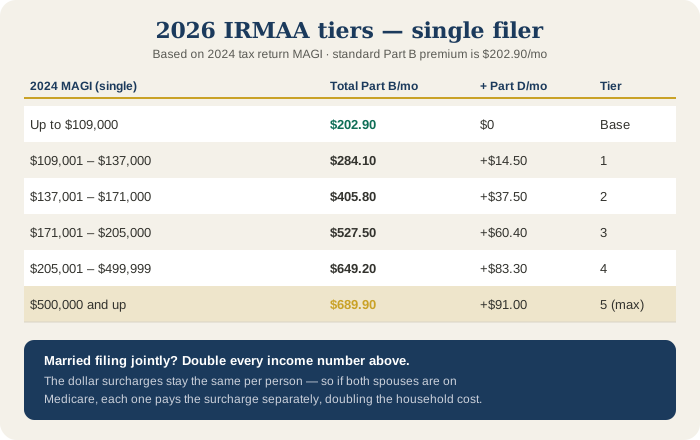
The standard 2026 Part B premium is $202.90/month, and that’s what everyone below the first threshold pays, no surcharge attached.
For married couples filing jointly, every income number in that table doubles — so the first tier starts at $218,001 instead of $109,001, and so on up the chart. The dollar amount of the surcharge itself stays the same per person; it’s the income thresholds that double for joint filers.
A couple of real examples, to make the numbers concrete:
- A single filer with $200,000 MAGI lands in Tier 3: a total Part B premium of $527.50/month plus a $60.40/month Part D surcharge — about $4,615 more per year than someone under the threshold.
- Joint filers with $250,000 MAGI land in Tier 1: $284.10/month Part B plus $14.50/month Part D, per spouse if both are on Medicare — about $2,296 per year for the couple combined.
- A single filer at the very top, $500,000+ MAGI, pays the maximum: $689.90/month Part B plus $91.00/month Part D — nearly $6,936 more per year, more than triple the standard premium.
Paul’s Honest Take: The number that surprises people most isn’t the top tier — it’s how close Tier 1 sits to a completely ordinary income. $109,000 for a single person, or $218,000 for a couple, isn’t an “ultra-wealthy” threshold anymore. A lot of retirees with a pension, some investment income, and Social Security land there without ever feeling like high earners. This isn’t just a tax on the ultra-rich — it’s worth checking your own numbers even if you don’t think of yourself as in that category.
Why IRMAA Exists (and Why It Keeps Reaching More People)
IRMAA isn’t an arbitrary penalty — it’s written directly into Medicare’s statute. Below the first threshold, your premium covers roughly 25% of what Part B actually costs the program, with the government covering the rest. Each IRMAA tier raises your share of that cost — to 35%, 50%, 65%, 80%, and 85% at the top tier. In other words, it’s a cost-sharing formula, not a fine.
Here’s the part worth understanding, though: the first four tier thresholds adjust every year for inflation, but the top tier — $500,000 single, $750,000 joint — is frozen by law through at least 2028. As the lower brackets creep upward with inflation and the top one stays fixed, more people land in that top bracket every year without their real financial situation changing much at all. This is sometimes called “bracket creep,” and it’s a genuine, ongoing trend worth knowing about if you’re anywhere near the higher tiers.
The Married Filing Separately Trap
This is one of the least understood — and most costly — corners of IRMAA, and it deserves its own warning.
If you’re married but file your taxes separately, and you lived with your spouse at any point during the year, you do not get the standard single-filer bracket table. Instead, your brackets collapse to just three tiers, and the first one is brutal: one penny above $109,000 in MAGI jumps you straight to a $649.20/month Part B premium plus an $83.30/month Part D surcharge — the equivalent of Tier 4 on the normal table, triggered at Tier 1 income.
To put that in perspective: a single filer at $109,001 pays about $95.70/month in combined IRMAA surcharges. A Married Filing Separately filer at that exact same income pays $529.60/month — more than five times as much, for identical income.
Paul’s Honest Take: If you’re married and considering filing separately for any reason — a tax strategy, a legal separation, anything — and either of you is on Medicare, stop and check this first. I’ve seen this catch people who had a perfectly good tax reason to file separately but had no idea it would detonate their Medicare premium. Talk to a tax professional who specifically knows this rule before you file, not after.
New to Medicare? IRMAA Works a Little Differently in Your First Year
If you’re just enrolling in Medicare, Social Security may not yet have a tax return from two years ago on file for you — especially if your income has changed significantly, like right after retiring. In that case, Social Security can use a more recent tax return, or in some situations, ask you to provide an estimate of your current income. This is actually the same mechanism as the SSA-44 life-changing-event process described below — it’s worth knowing this applies not just to appeals, but potentially to your very first IRMAA determination too.
What Triggers an Unexpected IRMAA Surcharge
Because IRMAA is based on MAGI, a single unusual income year can trigger a surcharge two full years later — often after your income has already gone back to normal. Common triggers:
- Capital gains — selling a home, investment property, or a large stock position
- Large retirement account withdrawals — a bigger-than-usual distribution from a traditional IRA or 401(k)
- Roth conversions — converting a traditional retirement account creates a real, one-time spike in taxable income for that year
- Business income — selling a business or receiving a large final payout
Paul’s Honest Take: This is exactly why IRMAA planning has to happen before the transaction, not after. If you’re thinking about a Roth conversion or selling an investment property in the next few years, run the IRMAA math first — sometimes spreading a conversion across two smaller years instead of one big year avoids tripping a bracket entirely. Once the tax return is filed, the door’s closed for that year.
What this adds up to over time: IRMAA isn’t a one-time fee — it recurs every year your income stays above the threshold. A single filer stuck in Tier 1 ($95.70/month combined surcharge) for ten years pays roughly $11,480 more than someone under the threshold, just from that one bracket. That’s real money worth factoring into any decision that might push your income over a line — not because the surcharge itself is unreasonable, but because it’s easy to underestimate how it compounds.
One small silver lining: IRMAA surcharges count as Medicare premiums, which means they can potentially be included as deductible medical expenses on Schedule A if your total medical expenses exceed 7.5% of your adjusted gross income for the year. This doesn’t eliminate the surcharge, but it can soften the cost at tax time for people who itemize. Worth raising with your tax preparer rather than assuming it doesn’t apply to you.
How to Appeal an IRMAA Determination
If you get an IRMAA initial determination notice from Social Security, you have a real, legal path to appeal it — but only under specific circumstances. This is where Form SSA-44 comes in.
You can request a new determination if you’ve had a Life-Changing Event that significantly reduced your income since the tax return your current IRMAA is based on. Qualifying events include:
- Retirement or a reduction in work hours (the most common reason by far)
- Death of a spouse
- Marriage, divorce, or annulment
- Loss of income-producing property due to a disaster or fraud
- Loss or reduction of a pension
What Doesn’t Qualify
This is the part people get wrong most often: a one-time income spike from capital gains or a Roth conversion is not a qualifying life-changing event. If that’s what triggered your IRMAA, there’s no appeal available — you pay the surcharge for that specific year, and it automatically clears the following year once your income drops back down (remember, it’s recalculated annually with the same 2-year lookback).
How the Appeal Actually Works
- Confirm you have a genuine qualifying event from the list above — not just “my income is lower now” for an unrelated reason.
- Complete Form SSA-44, available directly from the Social Security Administration. You’ll estimate your current-year income and explain the life-changing event.
- Submit supporting documentation — this varies by event type: a retirement letter from your employer, a death certificate, divorce decree, or similar proof.
- Submit it to Social Security, either by mail or in person at a local office. This can be done any time after the event occurs — you don’t need to wait for your next Medicare bill.
- Wait for a new determination. Social Security will review the new estimated income and, if approved, recalculate your premium going forward — it isn’t retroactive to cover months you’ve already paid at the higher rate, so submitting promptly matters.
Paul’s Honest Take: Retirement is by far the most common — and most successful — reason we see for an SSA-44 appeal. If you retired last year and your Medicare premium is still based on your final working year’s income, don’t just accept it. That form exists exactly for this situation, and it’s a straightforward process once you have the paperwork together.
Frequently Asked Questions
If I appeal and get approved, does it change what I already paid? No. A successful SSA-44 appeal changes your premium going forward from approval, not retroactively. This is exactly why it’s worth filing as soon as the life-changing event happens rather than waiting.
Do I need to appeal every year if my income stays low? Generally, no — once Social Security has your updated income estimate on file, it should be used correctly for that determination period. But IRMAA is recalculated annually based on actual tax returns as they become available, so it’s worth double-checking your notice each year rather than assuming it’s automatically correct.
I’m about to retire — should I file the SSA-44 before or after I actually stop working? You can generally file once the event has occurred or is about to. If you’re not sure of the exact timing that applies to your situation, it’s worth a quick call rather than guessing and having to refile.
Does my Medicare Advantage plan premium include IRMAA? The Part B portion of IRMAA applies regardless of whether you’re in Original Medicare or a Medicare Advantage plan, since Part B is still part of your coverage either way. If your Medicare Advantage plan includes drug coverage, the Part D IRMAA surcharge is paid separately to Medicare, not folded into your plan’s premium.
Can I do anything to avoid IRMAA before it happens? For predictable events like Roth conversions or large asset sales, yes — timing and spreading income across years can help you stay under a threshold. For life circumstances, that’s really what the appeal process exists for after the fact. This is genuinely worth a planning conversation with a tax professional or financial advisor before a big transaction, not after.
My spouse and I file separately for unrelated tax reasons — does that affect our Medicare? Potentially, significantly. If you lived together at any point during the year, Married Filing Separately collapses your IRMAA brackets to just three tiers with a much lower, harsher threshold than single or joint filers get. This is worth checking with a tax professional before you file, since the Medicare cost impact can be dramatically larger than any tax benefit from filing separately.
I just retired and I’m enrolling in Medicare for the first time — will IRMAA use my old working salary? It might, if that’s the most recent tax return Social Security has on file — but this is exactly the kind of situation the life-changing-event process (Form SSA-44) is designed to fix. Since retirement is the single most common qualifying event, don’t assume you’re stuck paying IRMAA based on your last working year; ask about a redetermination right away.
The Bottom Line
IRMAA is a real cost that catches a lot of people off guard, mostly because of the two-year lookback and the cliff-style brackets. If your income has genuinely changed due to a real life event — especially retirement — Form SSA-44 is a legitimate, often successful way to fix it. If it was a one-time income spike, the best move is simply knowing it’s temporary and planning around it next time.
Related Reading
- Medicare Costs: What You’ll Actually Pay in 2026
- Medicare and Social Security: How They’re Connected
- Medicare Deductibles, Coinsurance, and Copays: What’s the Difference?
- The Part B Late Enrollment Penalty: How It’s Calculated and How Long It Lasts
Sources:
- CMS — 2026 Medicare Parts A & B Premiums and Deductibles
- Social Security Administration — POMS HI 01101.020: IRMAA Sliding Scale
- Social Security Administration — POMS HI 01101.031: How IRMAA Is Calculated
- Medicare.gov — 2026 Medicare Costs
- Social Security Administration — Form SSA-44
- 42 U.S.C. § 1395r(i) — Statutory IRMAA cost-sharing tiers
This article reflects 2026 Medicare rules and is for educational purposes, not tax or financial advice. Every income situation is different — if you’d like help thinking through an IRMAA appeal or planning around an upcoming transaction, call us at 631-358-5793. No pressure, no cost.