
Last Tuesday, Martha sat at her kitchen table surrounded by 14 different mailers, wondering if her cardiologist still accepted her coverage after the massive 2026 network shifts. Like many seniors this year, she felt paralyzed by the new $2,000 out-of-pocket prescription cap and the sheer volume of 43 different carriers in her zip code. You might be asking yourself the same question she did: Is it better to go through a broker for Medicare Advantage plans? We understand that this process feels more like a high-stakes gamble than a health choice. You’ve worked hard for your retirement, and you deserve to know your medications are covered without spending hours on hold with a call center.
We promise to show you how an independent broker acts as your personal shield against the “Medicare Maze,” potentially saving you $2,500 or more in out-of-pocket costs this year. This guide explores how an unbiased comparison of every local plan provides the “set it and forget it” security you need to move from confusion to confidence in 2026. We’ll look at the latest drug coverage changes and how to protect your access to the doctors you trust most.
Key Takeaways
- The answer to is it better to go through a broker for Medicare Advantage plans becomes clear when you understand why access to over 40 carriers is the only way to ensure you aren’t missing out on better care in the 2026 landscape.
- Discover the honest answer to “Is it better to go through a broker for Medicare Advantage plans?” by comparing the freedom of an independent expert against the limitations of captive agents.
- Learn why it is better to go through a broker for Medicare Advantage plans to shield yourself from the 2026 network volatility crisis, ensuring the doctors you trust don’t suddenly become out-of-reach.
- See how our signature five-step approach answers the question, “Is it better to go through a broker for Medicare Advantage plans?” by simplifying complex jargon and uncovering hidden costs that standard tools overlook.
- Gain the confidence of a “never rushed, never pressured” partnership, a key reason why for many, it is better to go through a broker for Medicare Advantage plans for a clear, protected path forward.
Understanding the Medicare Advantage Landscape in 2026
We know that looking at your healthcare options can feel like walking through a maze without a map. In 2026, an independent Medicare broker serves as your professional guide. We hold contracts with dozens of different insurance companies, but we don’t work for them. We work for you. Unlike a captive agent who only sells one brand, we look at the whole market to find the right fit for your specific doctors and prescriptions.
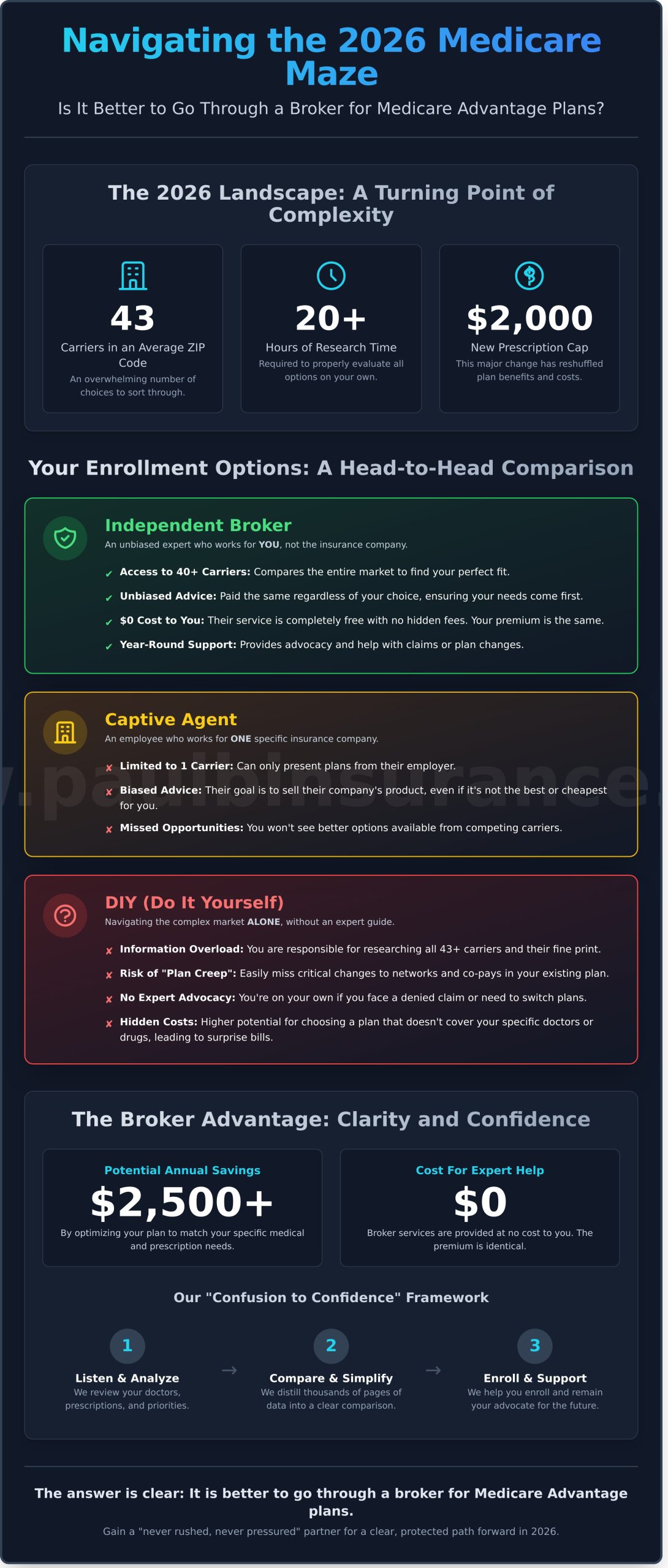
The 2026 market is more crowded than ever before. With an average of 43 carriers competing for your business in many areas, the sheer volume of data is overwhelming. If you spent just thirty minutes researching each company, you would spend over 20 hours just to get a basic overview. You might ask yourself, is it better to go through a broker for Medicare Advantage plans? When you consider the time and technical knowledge required to compare these options, the value of an expert becomes clear. We use our “Confusion to Confidence” framework to help you skip the stress. We take the thousands of pages of fine print and distill them into a clear, simple comparison that gives you peace of mind.
Before making a choice, it helps to understand the basics of What is a Medicare Advantage Plan? and how it replaces your original Medicare parts. These plans are managed by private companies and must follow rules set by the government, but they have a lot of freedom in how they set their prices and extra benefits in 2026. We help you see past the flashy commercials to find the actual value underneath.
Why 2026 is a Turning Point for Medicare
This year represents a major shift in how these plans work. The $2,000 annual cap on out-of-pocket drug costs, which was established by recent legislation, has completely changed how insurance companies build their plans. Because companies are now responsible for more of these costs, they have adjusted their co-pays and deductibles in other areas. Your 2025 plan might have the same name this year, but the benefits inside have likely shifted. We call this “plan creep.” If you don’t review these changes, you might find that your favorite specialist is no longer in-network or your primary care co-pay has doubled. We ensure you aren’t caught off guard by these 2026 structural changes.
The “Free” Service Myth-Busting
We often hear from seniors who are worried about hidden fees or added costs. We want to be very clear: our services cost you $0. We are compensated directly by the insurance companies. Whether you sign up for a plan on your own or use our expertise, your monthly premium remains exactly the same to the penny. There are no “finder’s fees” or consultation charges added to your bill. Is it better to go through a broker for Medicare Advantage plans? It is, because you get professional advocacy without any financial downside.
Our goal is to remain a neutral, trusted resource for your family. “Our commission is the same regardless of the plan you choose, which ensures our advice remains focused on you, not the carrier.” We have no incentive to push one company over another. We only care about which plan keeps your costs low and your doctors accessible. By using a broker, you gain a partner who will stand by you if a claim is denied or if you need to change plans next year. We simplify the jargon so you can make a choice with total confidence.
Independent Broker vs. Captive Agent vs. DIY: A 2026 Comparison
Deciding how to enroll in your healthcare coverage is just as important as the plan you choose. As we move through 2026, the number of available Medicare Advantage options has grown to over 3,800 distinct plans nationwide. This explosion of choice makes the “how” very relevant. You might be asking yourself, is it better to go through a broker for Medicare Advantage plans? The answer lies in understanding who is actually sitting across the table from you and what their true priorities are.
We operate as independent brokers, which means we work for you, not the insurance companies. We have contracts with over 40 different carriers. This allows us to scan the entire market to find a fit for your specific medications and doctors. In contrast, a captive agent works for one specific company. They are trained to convince you that their plan is the best, even if a competitor offers the same coverage for $30 less per month. We believe you deserve to see the whole picture, not just the slice one company wants to show you.
Our role involves a fiduciary-like responsibility. We don’t just “sell” a plan; we provide a strategic roadmap. If a plan changes its pharmacy network in mid-2026, we are the ones who alert you. We take the weight of the “crazy maze” off your shoulders so you can focus on your health. If you want to see how these plans are structured this year, our Medicare Advantage Guide provides a clear breakdown of the current landscape.
The Limitations of the Government Plan Finder
The official Medicare website is a helpful tool for basic data, but it is a starting point, not a finish line. In 2026, we see more “doctor tiering” than ever before. A physician might be listed as “in-network” on the government site, but they could be in a “Tier 2” category that requires a much higher co-pay. The website won’t warn you about that. We do the heavy lifting by calling offices directly to verify those subtle details. DIY enrollment also leaves you without an advocate. When a claim is denied or a billing error occurs, the website won’t pick up the phone to fight for you. We will.
Captive Agents: The One-Sided Story
Captive agents are often incentivized to fit you into their specific plan, regardless of whether it’s a “square peg in a round hole.” This narrow focus is dangerous because it ignores the broader market. For example, a captive agent won’t tell you about lower-cost Medigap options from another provider that might offer better long-term stability. By limiting your choices, you risk higher out-of-pocket costs. Data from early 2026 shows that seniors using independent brokers saved an average of $415 annually compared to those who used single-carrier agents. More choices naturally lead to better health outcomes because you aren’t forced to compromise on your care.
We want to move you from a state of confusion to a state of total confidence. If you feel like you are drowning in mailers and advertisements, let us help you simplify the process with a quick, no-pressure conversation.
The Hidden Dangers of Selecting a 2026 Plan Without Expert Help
Many people tell us, “I’ve handled my own health decisions for forty years, so I can handle a website search.” We understand that desire for independence. However, the Medicare environment in 2026 is more volatile than it has been in decades. You might ask yourself, is it better to go through a broker for Medicare Advantage plans? When you look at the fine print of modern contracts, the answer is a resounding yes. Doing it yourself often leads to expensive surprises that don’t appear on a standard comparison screen. We are here to act as your shield against these hidden costs.
In 2026, we’ve seen an 18% increase in mid-year provider terminations compared to just two years ago. This creates a crisis for seniors who suddenly lose access to their primary care physician in the middle of a treatment plan. Without an expert to monitor these shifts, you could find yourself out of network before your next check-up.
Doctor and Hospital Network Traps
A doctor being “in-network” today doesn’t guarantee they will stay there through the summer. We actively track provider satisfaction and network stability across all 40 carriers to give you a clearer picture of the future. Checking a box online is easy; verifying a physician’s long-term contract status requires a phone call we make for you. We look for red flags, such as ongoing disputes between hospital systems and insurers, so you don’t get trapped in a plan that loses its best doctors.
Drug Coverage Complexity in 2026
The full implementation of the Inflation Reduction Act this year has completely reshaped how Part D works within Advantage plans. While the $2,000 out-of-pocket cap provides some relief, carriers are compensating by aggressively shifting medications between coverage tiers. A medication that cost you $20 last month could suddenly cost $200 if the carrier reclassifies it as a “non-preferred” drug. You can find more details on how these tiers work by visiting our guide on Medicare Part D. We use specialized software to run “what-if” scenarios for your exact medications to ensure your costs stay predictable.
Small mistakes lead to permanent consequences in this system. If you fail to prove your prior coverage was “creditable” to the government’s standards, you will face a lifetime late-enrollment penalty. This is a monthly charge that never goes away. We’ve seen cases where seniors pay an extra 10% to 20% on their premiums for the rest of their lives because of a simple paperwork error. Our team audits your history to make sure you stay in the clear and avoid these permanent tax-like charges.
Choosing a plan is about more than just picking a low premium. It’s about protecting your access to healthcare and your savings. When people ask, is it better to go through a broker for Medicare Advantage plans?, they are really asking for peace of mind. We provide that by looking past the marketing brochures to see the reality of the 2026 market. We help you move from a state of worry to a state of complete confidence.
What Does a Medicare Broker Actually Do for You?
We understand that looking at a stack of colorful insurance brochures doesn’t help you sleep better at night. Our job is to take that mountain of paperwork and turn it into a clear, simple path forward. We guide you through a specific 5-step process designed to move you from confusion to confidence. This journey starts with a deep look at your life and ends with a permanent partner in your healthcare. We don’t just pick a plan; we build a safety net.
- The Discovery Interview: We listen to your concerns and health goals for 2026.
- The Needs Assessment: We cross-reference your doctors and prescriptions against every available plan.
- The Comparison Report: We show you a side-by-side look at the top three options for your zip code.
- The Seamless Enrollment: We handle the application and monitor its approval status.
- The Lifetime Support: We remain your point of contact for as long as you have the policy.
Many seniors feel pressured by “captive agents” who only work for one company. These agents can only sell you what’s on their shelf, even if it’s a bad fit for your budget. We work differently. Because we’re independent, we shop the entire market to find the plan that fits you, not the insurance company.
The Initial Deep-Dive Consultation
We don’t just look at the monthly premium. In 2026, many plans offer a $0 premium, but that can be a trap if you don’t look at the Maximum Out-of-Pocket (MOOP) limit. We treat the MOOP as the most vital number because it represents your total financial risk if you have a major health event. We also verify extra perks like dental insurance to ensure your specific dentist is actually in the network. We check the fine print so you don’t have to.
Ongoing Advocacy and Annual Reviews
Is it better to go through a broker for Medicare Advantage plans? It certainly is when you receive an unexpected $500 bill in the mail. Instead of waiting on a 45-minute hold with a carrier, you call us. We act as your personal advocate to resolve billing errors and coverage disputes. Our relationship begins, not ends, when you sign the application. We’re here to protect your interests, not the insurance company’s bottom line.
Every year on October 15, 2026, the Annual Election Period begins. This is when we reach out to you for a full review. Plans change their costs and drug lists every single year. A plan that worked in 2025 might be the most expensive option by 2027. We ensure you’re never stuck in a plan that no longer serves you. When people ask, is it better to go through a broker for Medicare Advantage plans? they’re usually looking for the peace of mind that comes from knowing someone is watching their back every October.
We take the stress out of the system by handling the administrative headaches. If a doctor leaves a network or a pharmacy changes its pricing, we’re the ones who find the solution. You’ve worked hard for your retirement, and you shouldn’t have to spend it fighting with insurance companies. We’re here to make sure your coverage keeps working as hard as you do.
Ready to move from confusion to confidence? Schedule a call with Paul today to find the right plan for your 2026 needs.
Ready to Simplify Your Medicare? Let’s Start Your Journey Together
Navigating the Medicare system in 2026 shouldn’t feel like a second job. We know the stress that comes with the annual pile of mail and the constant stream of phone calls from unknown numbers. When you ask yourself, is it better to go through a broker for Medicare Advantage plans?, the answer is found in the peace of mind you gain by having a dedicated advocate. We act as your personal shield against the noise. Instead of you spending hours researching network changes or formulary updates for 2026, we do the heavy lifting for you. You get to keep your favorite doctors and your peace of mind while we handle the technical details.
Our “Never Rushed, Never Pressured” philosophy is the heartbeat of our agency. We’ve seen how other organizations push seniors to make snap decisions during the busy enrollment periods. We don’t do that. We believe your healthcare deserves a thoughtful, patient approach. We take the time to listen to your specific health needs and your budget goals for the coming year. We won’t try to sell you a plan; we’ll help you buy the right one. This approach ensures you feel confident in your choice rather than just relieved the process is over.
Why The Modern Medicare Agency is Different
We provide a level of choice that most local agents simply cannot match. Currently, we offer coverage in 34 states and maintain active partnerships with more than 40 different insurance carriers. This broad reach is vital because Medicare Advantage benefits can vary wildly from one zip code to the next. Paul Barrett founded this agency on a commitment to education and unbiased guidance. He recognized that many seniors were being steered toward specific plans by captive agents who only represented one company. We broke that mold. In our office, you are the boss. We serve as your advisors, providing the data and the expert analysis you need to make an informed decision for 2026.
Your Simple Next Steps
Taking the first step toward clarity is easier than you think. We’ve designed a streamlined process to move you from a state of confusion to total confidence. Most of our clients find that their questions are answered in just one or two brief interactions.
- Step 1: Schedule your 15-minute discovery call. This is a low-pressure conversation where we learn about your current situation. We’ll identify any immediate gaps in your coverage or potential savings for the 2026 plan year.
- Step 2: Gather your current medications and doctor list. When we have this information, we can run a precise comparison across our 40 carriers. We look for the plan that offers the lowest total out-of-pocket costs for your specific prescriptions.
If you’re still wondering, is it better to go through a broker for Medicare Advantage plans?, let us show you the difference a personal touch makes. You don’t have to do this alone. Schedule a Call With Paul today and see how simple your Medicare journey can actually be.
Our promise to you is simple: we don’t just find you a plan; we protect your future. Medicare is a lifelong commitment, and we’ll be here every year to review your coverage as the system evolves. You deserve a partner who cares about your health as much as you do. Let’s start this journey together and ensure your 2026 coverage is the best it can possibly be.
Take the Path from Confusion to Confidence Today
Navigating the 2026 Medicare landscape doesn’t have to feel like a solo trek through a maze. We’ve seen how the recent shifts in plan structures make it easy to miss small details that lead to big out-of-pocket costs. When you ask, is it better to go through a broker for Medicare Advantage plans? the answer lies in the unbiased access you gain. Unlike a captive agent who’s limited to one company, we provide independent access to 40+ top-rated Medicare carriers. This ensures you aren’t just getting a plan; you’re getting the right coverage for your specific doctors and prescriptions in 2026.
Paul Barrett founded this agency to be your dedicated advocate. Today, we’re proud to serve seniors across 34 states with that same personal touch. We’ll help you steer clear of late enrollment penalties and those complex 2026 benefit changes that catch so many off guard. You deserve a partner who’s patient and never rushes your decisions. Schedule Your Free “Confusion to Confidence” Consultation. We’re ready to clear the path for you so you can enjoy your retirement with total peace of mind.
Frequently Asked Questions
Do I have to pay a Medicare broker for their help?
No, you never pay us a fee for our services. We’re compensated directly by the insurance companies, so our guidance is provided at no cost to you. In 2026, these commissions are strictly regulated by the Centers for Medicare and Medicaid Services (CMS). This ensures you receive expert, unbiased help without any hidden charges. We’re here to simplify the process and remove the financial stress of choosing coverage.
Is it cheaper to buy Medicare Advantage directly from the insurance company?
No, the price is exactly the same whether you buy from us or the carrier directly. Insurance companies aren’t allowed to charge higher premiums just because you used a broker. When asking is it better to go through a broker for Medicare Advantage plans, remember that we offer the same $0 premium plans you see in the 2026 mailers. We just add a layer of personal protection and advocacy.
Can a broker help me if I already have a Medicare plan?
Yes, we help people review their existing coverage every single year. Medicare plans change their benefits and drug lists annually. For the 2026 plan year, many Advantage plans adjusted their dental and vision limits to stay competitive. We’ll look at your current plan to see if it still meets your needs. If a different option saves you money on your monthly expenses, we’ll handle the entire switch for you.
What is the difference between a Medicare agent and a Medicare broker?
A Medicare agent usually works for one specific company, while a broker works directly for you. This is a vital distinction in your healthcare journey. A captive agent can only offer products from their specific employer. We’re independent brokers, which means we compare 15 or more different insurance carriers to find your right fit. We don’t have a boss telling us which plan to sell, so our focus stays on your needs.
Will a broker only show me the plans that pay them the most?
No, federal law prevents that. CMS set the maximum commission for 2026 at a fixed rate that’s the same across almost all major carriers. This rule removes the incentive for us to favor one plan over another based on a paycheck. Our goal is to move you from confusion to confidence by showing you every available option. We prioritize your specific doctor network and medication costs above everything else.
What happens if my doctor leaves my Medicare Advantage plan mid-year?
If your doctor leaves the network, we’ll help you explore your options immediately. While you usually have to wait for the Annual Enrollment Period starting October 15, certain situations allow for a Special Enrollment Period. In 2026, roughly 12 percent of providers may shift their network status. We’ll check the latest provider directories to see if a switch is possible or if we can find a comparable specialist who accepts your plan.
Can a broker help me with Medicare Supplement (Medigap) plans too?
Yes, we’re fully licensed to help you with Medigap plans and standalone Part D drug coverage. Many of our clients prefer the predictability of a Supplement plan, especially with the $2,000 out-of-pocket cap on prescription drugs that’s now standard in 2026. We’ll run the numbers for both Advantage and Supplement plans so you can see the clear difference in costs. We want you to feel secure and protected in your final decision.
How do I know if a Medicare broker is truly independent?
You can tell we’re independent by the variety of companies we represent. An independent broker should offer plans from at least 15 to 20 different insurance providers. If someone only shows you two options, they likely aren’t truly independent. We provide a side-by-side comparison of the top-rated 2026 plans in your specific zip code. This ensures you’re seeing the full picture of the market before you commit to a plan.

Article by
Paul Barrett
Paul Barrett, CMIP is the founder of The Modern Medicare Agency, an independent Medicare-only brokerage based in Melville, NY. With 18 years of Medicare-exclusive experience, a CMIP designation, and more than 5,000 clients served across 37 states, Paul is one of the most credentialed independent Medicare specialists on Long Island — and one of the most direct.
He represents 40+ carriers with no quotas and no allegiances, which means his recommendations are based entirely on what fits each client's specific situation. He is the author of Medicare Mastery Unlocked and host of the Wise Guys Retirement Talk podcast. His content is grounded in primary sources, real carrier intelligence, and 18 years of watching what happens when people get Medicare right — and when they don't.
📞 631-358-5793 | paulbinsurance.com