
What if the biggest threat to your retirement isn’t the monthly bill you expect, but the 20% co-insurance you don’t? As we look at the healthcare landscape in 2026, we know many people are asking: is it worth paying for a medigap plan when you already face a $202.90 monthly premium for Part B? It’s natural to feel anxious about rising costs, especially with the Part B deductible now at $283 and the Part A hospital deductible reaching $1,736. We understand the confusion between Medigap and Medicare Advantage can be exhausting when you’re just looking for a bit of security.
We’re here to help you find that peace of mind. We’ll show you how to weigh a predictable monthly premium against the risk of unlimited out of pocket costs. This guide explains how a supplement plan creates a financial ceiling to protect your savings from unexpected illness. We’ll also explore how you can keep the freedom to see any doctor in the country who accepts Medicare. By the end, you’ll have a clear, simple path to a budget you can actually trust. Let’s take this journey from uncertainty to total confidence together.
Key Takeaways
- Learn how Medigap acts as a vital financial shield against the 20% gap in 2026, protecting your retirement from rising healthcare inflation.
- Use our simple calculation to determine if it is worth paying for a medigap plan based on your personal health needs and monthly budget.
- Discover the freedom of the “Any Doctor” rule, which ensures you can see any provider who accepts Medicare without worrying about narrow networks.
- Compare the “Pay Now” versus “Pay Later” strategies to decide if you prefer a predictable monthly cost or lower premiums with higher bills when you’re sick.
- See how we provide clear, independent guidance across dozens of carriers to turn your healthcare confusion into a simple, confident decision.
Is It Worth Paying for a Medigap Plan in 2026?
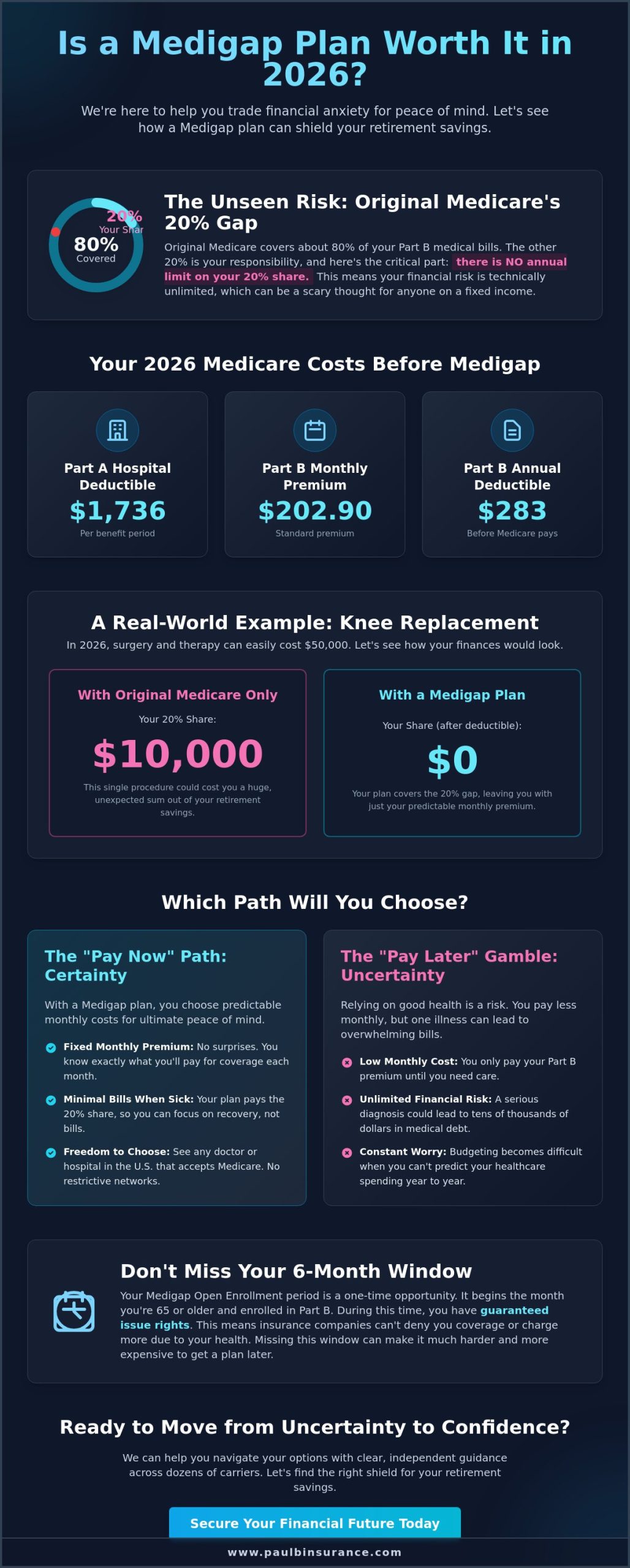
We know the question on your mind: is it worth paying for a medigap plan when your monthly budget is already under pressure? In 2026, the standard Part B premium has reached $202.90 a month. Adding a Medigap premium on top of that can feel like a heavy lift. However, Original Medicare leaves a massive hole in your coverage that we call the 20% gap. Without a supplement, you are responsible for 20% of nearly every medical bill, and there is no limit on how high those costs can climb. This is where Medigap serves as a protective shield for your savings.
We use a simple “Certainty Framework” to help you evaluate insurance value. It’s a way to look at your finances with total clarity. Would you rather have a predictable monthly bill or the constant anxiety of a potential $10,000 or $20,000 hospital invoice? In 2026, healthcare inflation is making medical services more expensive than ever. This makes the value of a fixed monthly cost much higher than it was in previous years. We want to help you move from a state of worry to a state of total certainty.
The Reality of Original Medicare’s 20% Gap
Many people don’t realize that Medicare Part B has no out of pocket maximum. This means your financial risk is technically unlimited. Think about a common procedure like a knee replacement. In 2026, the total cost for surgery and physical therapy can easily reach $50,000. With only Original Medicare, your 20% share would be $10,000. That is a significant hit to any retirement fund. It’s easy to think you don’t need a Medigap plan because you are in good health today. But health can change in an instant. Relying on “good health” as a coverage strategy is a gamble that often leads to financial distress when an unexpected illness strikes.
Why 2026 is a Unique Year for Medicare Decisions
This year brings specific challenges that make your choice even more critical. Significant changes to Part D prescription drug plans are shifting how we look at total healthcare costs. Because of these shifts, securing a Medigap plan during your initial enrollment window is vital. This is the six month period when you have guaranteed issue rights. If you miss this window, you might face medical underwriting or even be denied coverage later. We want to make sure you have the freedom to choose your own doctors without these hurdles. For more details on how timing affects your choices, see our guide on Medicare Eligibility: A Clear Guide for 2026.
What You Get for Your Money: The Core Benefits of Medigap
When we think about value, we look at more than just the price tag. We look at what that money actually buys you in terms of freedom and security. One of the most reassuring things about these plans is their standardized nature. Federal law ensures that every Plan G or Plan N offers the exact same core benefits, regardless of which insurance company you choose. When you ask yourself is it worth paying for a medigap plan, consider that you aren’t just buying insurance; you’re buying a federal guarantee of coverage. This consistency removes the guesswork from the process.
The “Any Doctor” rule is perhaps the most significant benefit. Unlike other plan types that restrict you to a local network, a Medigap plan travels with you. If a doctor, hospital, or specialist anywhere in the United States accepts Medicare, they accept your Medigap policy. There are no network maps to study and no “out of network” surprises to fear. This level of consistency is why we often recommend exploring Medigap options as a way to simplify your life. To understand more about the official rules, you can read about how Medigap policies work on the government’s own website.
Coverage Beyond the Basics
In 2026, the costs of a hospital stay can be staggering. Original Medicare charges a Part A deductible of $1,736 for every benefit period. Most Medigap plans cover this cost in full. They also pick up the daily co-insurance costs, which have risen to $434 per day for hospital stays lasting longer than 60 days. For those who love to travel, many plans also include foreign travel emergency coverage. This is a vital feature if you plan to spend your retirement seeing the world. We believe in transparency, so we always remind our clients that Medigap doesn’t cover everything. It typically excludes things like dental insurance and vision care. Knowing these boundaries helps you build a complete plan without any hidden gaps.
The Freedom of No Referrals
Nothing causes more stress than waiting for a “gatekeeper” to give you permission to see a specialist. With Medigap, that barrier simply doesn’t exist. If you need to see a cardiologist or an orthopedic surgeon, you just make the appointment. You don’t need a referral from a primary care doctor. This direct access saves you time and removes a layer of administrative headache. Freedom of Access is the primary non-financial benefit that makes many seniors decide that is it worth paying for a medigap plan for the sheer convenience alone. It’s about being in control of your own healthcare journey without asking for permission.
Medigap vs. Medicare Advantage: The ‘Pay Now’ vs. ‘Pay Later’ Debate
We often see people feeling torn between two very different paths. To simplify the choice, we use a framework called ‘Pay Now’ or ‘Pay Later’. Medigap is the ‘Pay Now’ option. You pay a higher monthly premium upfront, but your medical bills stay very low or even hit zero after you meet your small annual deductible. Medicare Advantage is the ‘Pay Later’ option. You might pay a $0 or very low monthly premium today, but you pay co-pays and co-insurance every time you visit a doctor or hospital. When asking is it worth paying for a medigap plan, the answer usually depends on whether you value a predictable budget or a lower monthly bill right now.
At The Modern Medicare Agency, we don’t push you toward one specific side. We help you navigate both paths by looking at your unique health needs and travel plans. We want you to feel empowered, not pressured. If you prefer knowing exactly what your healthcare will cost each month, Medigap offers that peace of mind. If you are comfortable with variable costs in exchange for a lower premium, an Advantage plan might fit. You can explore the details of the alternative path in our Medicare Advantage Plans: A Simple Guide for 2026.
Financial Predictability vs. Low Monthly Cost
The biggest difference between these two choices often comes down to your “Maximum Out-of-Pocket” limit. In 2026, many Advantage plans have limits that reach several thousand dollars. If you face a major health event, you could be responsible for that entire amount. With a Medigap Plan G, your primary out-of-pocket cost is the $283 Part B deductible. After that, your plan covers the rest. This predictability is why Medigap is the preferred choice for those who travel across state lines. You don’t have to worry about being “out of network” while visiting family or vacationing. Here is a quick look at how they compare:
- Monthly Premium: Higher (Average is around $220 for Plan G at age 65).
- Deductibles: You only pay the $283 Part B deductible.
- Network: Total freedom; see any doctor in the U.S. who accepts Medicare.
Medicare Advantage (The ‘Pay Later’ Path)
- Monthly Premium: Often $0 or very low.
- Deductibles: Varies by plan; often includes separate co-pays for specialists and hospital stays.
- Network: Limited to local HMO or PPO networks.
The ‘Locked In’ Factor
One of the biggest misconceptions we encounter is the idea that you can simply switch to Medigap whenever you get sick. In most states, that isn’t how it works. Your first chance to buy a policy is usually your best chance because of medical underwriting rules. If you start with an Advantage plan and develop a chronic condition later, insurance companies can charge you more or even deny your application for a supplement. This is a critical factor when deciding if is it worth paying for a medigap plan early on. We can check your eligibility for a switch in 2026, but starting with a supplement plan is the most secure way to protect your future. You can find more details on these rules on the official Medicare website.
How to Decide if the Premium is Worth It for Your Budget
Deciding if is it worth paying for a medigap plan often comes down to a simple math problem. We look at the total annual premium versus your potential out of pocket risks. In 2026, the average Plan G premium for a 65-year-old is around $220 a month, which totals $2,640 per year. If you face just one major medical event, such as a three-day hospital stay, you would immediately owe the $1,736 Part A deductible plus 20% of all physician fees. One single health crisis can easily cost you more than the entire year of premiums. For many of our clients, this “Peace of Mind” tax is a price worth paying to ensure they never see a surprise medical bill in their mailbox.
This coverage is especially valuable if you manage chronic conditions or visit specialists several times a year. If you travel often, you also gain the security of knowing your coverage follows you across state lines without network restrictions. However, we also recognize that a high monthly premium might not be worth it for everyone. If your monthly cash flow is very tight and you are in excellent health with no upcoming procedures, the higher premium might feel like a burden. In those cases, we can explore different paths together to find a balance that fits your specific financial situation.
Analyzing Your Health History
We suggest looking back at your medical usage over the last two years to spot patterns. Did you have multiple specialist visits? Are you planning a surgery in late 2026? If you want a middle ground, Plan N is an excellent alternative. It offers lower monthly premiums, often ranging from $103 to $242, in exchange for small co-pays at the doctor’s office and emergency room. It still provides the same “Any Doctor” freedom but helps keep your fixed monthly costs lower. If you are unsure which plan fits your history, we can help you compare these options side by side to find your best fit.
The Role of Prescription Drugs
It is vital to remember that Medigap plans do not include coverage for your medications. To have a complete safety net, you must pair your supplement with a Medicare Part D plan. In 2026, Part D has undergone significant changes to help lower your total drug costs, making it a critical piece of your healthcare puzzle. We specialize in bundling these plans together so your coverage feels like one seamless system. Our goal is to remove the stress of managing multiple policies so you can focus on enjoying your retirement with total certainty.
Securing Your Future with The Modern Medicare Agency
We know that deciding if is it worth paying for a medigap plan is a deeply personal choice. It is about more than just the math on a page; it is about how you want to feel when you wake up each morning. Our mission at The Modern Medicare Agency is to remove the heavy weight of stress and confusion that often comes with these complex systems. We act as your patient guide, moving you from a state of worry to one of total confidence. We don’t just help you sign up for a plan and then walk away. We provide year-round support to ensure your coverage continues to meet your needs as your health or lifestyle changes. We are committed to being your partner for the long term.
Why an Independent Broker is Your Best Advocate
When you work with us, you gain access to more than 40 different insurance carriers. This is a major advantage over “captive” agents who can only show you a small handful of options from a single company. Because we are independent, our only goal is to find the right fit for you. We help you compare the entire 2026 market to find the plan that fits your budget and your specific doctor preferences. We take pride in our impartial approach. Our services come at no cost to you, which means you get expert advice without any added financial burden. To learn more about how we protect your interests as an independent partner, you can read our Medicare Broker: Your Complete Guide to Finding a Trusted Advisor.
Your Next Steps for Peace of Mind
We believe that clarity comes from a structured, logical path. Our process is simple and designed to empower you without any high-pressure tactics. We start with a personal consultation to understand your health history and your financial goals for retirement. Then, we provide a side-by-side comparison of standardized plans to show you exactly where your money goes. Finally, we handle the enrollment details so you don’t have to deal with the paperwork. We encourage you to reach out before your enrollment window closes to ensure you secure your rights to a plan without medical questions. Let us help you protect your hard-earned savings. We are here to serve as your advocate, ensuring that your journey through Medicare in 2026 is one of total certainty and peace of mind.
Take Control of Your Healthcare Future Today
We’ve explored how Medigap acts as a vital shield against the unlimited 20% costs of Original Medicare. By choosing a supplement, you trade the anxiety of unpredictable medical bills for the security of a fixed monthly budget. You also secure the freedom to see any doctor in the country who accepts Medicare, without the hassle of referrals or network restrictions. Deciding if is it worth paying for a medigap plan is ultimately about choosing certainty over the unknown. It’s about ensuring that a single illness doesn’t drain your hard-earned retirement savings.
Paul Barrett and our expert team are licensed in over 34 states to provide nationwide expertise. We offer independent access to more than 40 top-rated carriers, ensuring you get unbiased guidance tailored to your specific needs. We are here to simplify the process and remove the confusion from your decision. Let us help you find the perfect Medigap plan for your 2026 budget—contact us today! We look forward to being your trusted partner on this journey toward a more secure and peaceful retirement.
Frequently Asked Questions
Is Medigap worth it if I am currently healthy?
Yes, we believe it is worth it because your health can change in an instant. While you might feel great today, Original Medicare has no out of pocket limit on that 20% co-insurance. One sudden illness or accident in 2026 could result in bills that far exceed a year of premiums. When asking is it worth paying for a medigap plan, remember that securing a plan while you are healthy also ensures you get the best rates during your initial enrollment period.
Can I be denied a Medigap plan if I have pre-existing conditions?
You cannot be denied coverage or charged more if you apply during your six month Medigap Open Enrollment Period. This window starts the month you are 65 and enrolled in Part B. If you wait until later, insurance companies in most states can use medical underwriting to look at your health history. They might deny your application or charge higher premiums based on those conditions. We always suggest acting during your protected window to avoid these hurdles.
How much do Medigap premiums typically increase each year?
Most people see their premiums increase annually. These adjustments are usually based on inflation and the rising cost of medical care in 2026. The specific amount depends on how your plan is rated in your state. Some plans increase as you get older, while others raise rates for everyone in the group. We help you look at the historical rate stability of different carriers before you make your final choice.
What happens if I want to switch from Medicare Advantage to Medigap in 2026?
Switching can be difficult because you generally have to answer health questions and pass medical underwriting. Unless you are in a specific trial period or have a special guaranteed issue right, a company could deny your application. We recommend checking your eligibility before making any changes. We can help you navigate these rules to see if a switch is possible for your specific situation.
Does a Medigap plan cover dental and vision care?
Standard Medigap plans do not include coverage for routine dental, vision, or hearing care. They are designed specifically to fill the gaps in Original Medicare Part A and Part B. If these services are important to you, we can help you find separate dental insurance policies to complete your coverage. This ensures you have a full safety net without any unexpected out of pocket costs for your basic care.
Is Plan G better than Plan N for most people?
Neither plan is objectively better, but they serve different needs. Plan G is the most popular because it covers everything after you meet the $283 Part B deductible. Plan N often has lower premiums but requires small co-pays for doctor visits and emergency room trips. When asking is it worth paying for a medigap plan, many choose Plan G for the total predictability it provides for their monthly budget.
Do I still need to pay my Medicare Part B premium if I have Medigap?
Yes, you must continue to pay your monthly Part B premium to keep your coverage active. In 2026, the standard premium is $202.90. Your Medigap premium is a separate bill paid directly to the private insurance company you choose. Think of Medigap as a protective addition to your Medicare foundation. You need both parts to ensure your medical costs are fully managed and your savings are protected.
Can I use my Medigap plan in a different state?
Yes, your Medigap plan is highly portable. You can use it at any doctor or hospital in the United States that accepts Medicare. There are no network restrictions or state boundaries to worry about. This makes it an ideal choice for anyone who travels frequently or spends part of the year in a different climate. Your coverage stays exactly the same whether you are at home or visiting family across the country.

Article by
Paul Barrett
Paul Barrett, CMIP is the founder of The Modern Medicare Agency, an independent Medicare-only brokerage based in Melville, NY. With 18 years of Medicare-exclusive experience, a CMIP designation, and more than 5,000 clients served across 37 states, Paul is one of the most credentialed independent Medicare specialists on Long Island — and one of the most direct.
He represents 40+ carriers with no quotas and no allegiances, which means his recommendations are based entirely on what fits each client's specific situation. He is the author of Medicare Mastery Unlocked and host of the Wise Guys Retirement Talk podcast. His content is grounded in primary sources, real carrier intelligence, and 18 years of watching what happens when people get Medicare right — and when they don't.
📞 631-358-5793 | paulbinsurance.com