




Just last week, a client named Sarah called me, here at The Modern Medicare Agency, sounding completely exhausted after spending hours trying to figure out why her neighbor’s Ozempic was covered while her own Zepbound prescription faced a different set of rules. It is incredibly frustrating to feel like you are guessing about your health and your budget at the same time. You might have heard that medicare coverage for zepbound and ozempic has shifted significantly this year, and you are right to feel a bit overwhelmed by the new terminology. Does it feel like the rules change every time you visit the doctor? The team at The Modern Medicare Agency wants to help you replace that anxiety with a clear, simple path forward.
In this guide from The Modern Medicare Agency, you will discover the key differences between Zepbound and Ozempic and learn how the new 2026 Medicare rules affect your coverage. We will walk through the medical details of each drug, the new $2,000 out-of-pocket spending cap, and the specific eligibility rules for the 2026 GLP-1 Bridge program. By the time we are finished, you will have a clear understanding of your options so you can choose your plan with total peace of mind.
Key Takeaways
- Understand the medical differences between Zepbound and Ozempic and how their unique active ingredients affect your body differently.
- Learn how medicare coverage for zepbound and ozempic is determined by your specific health diagnosis rather than just the drug name.
- Discover how the new $2,000 annual out-of-pocket cap for 2026 Medicare Part D plans provides a vital safety net for your prescription costs.
- Identify if you qualify for the 2026 Medicare GLP-1 Bridge program, which offers a new pathway for weight management medication coverage.
- Gain peace of mind by learning how to compare over 40 different carriers to find the most reliable and affordable plan for your needs.
Understanding the Basics: Are Zepbound and Ozempic Really the Same?
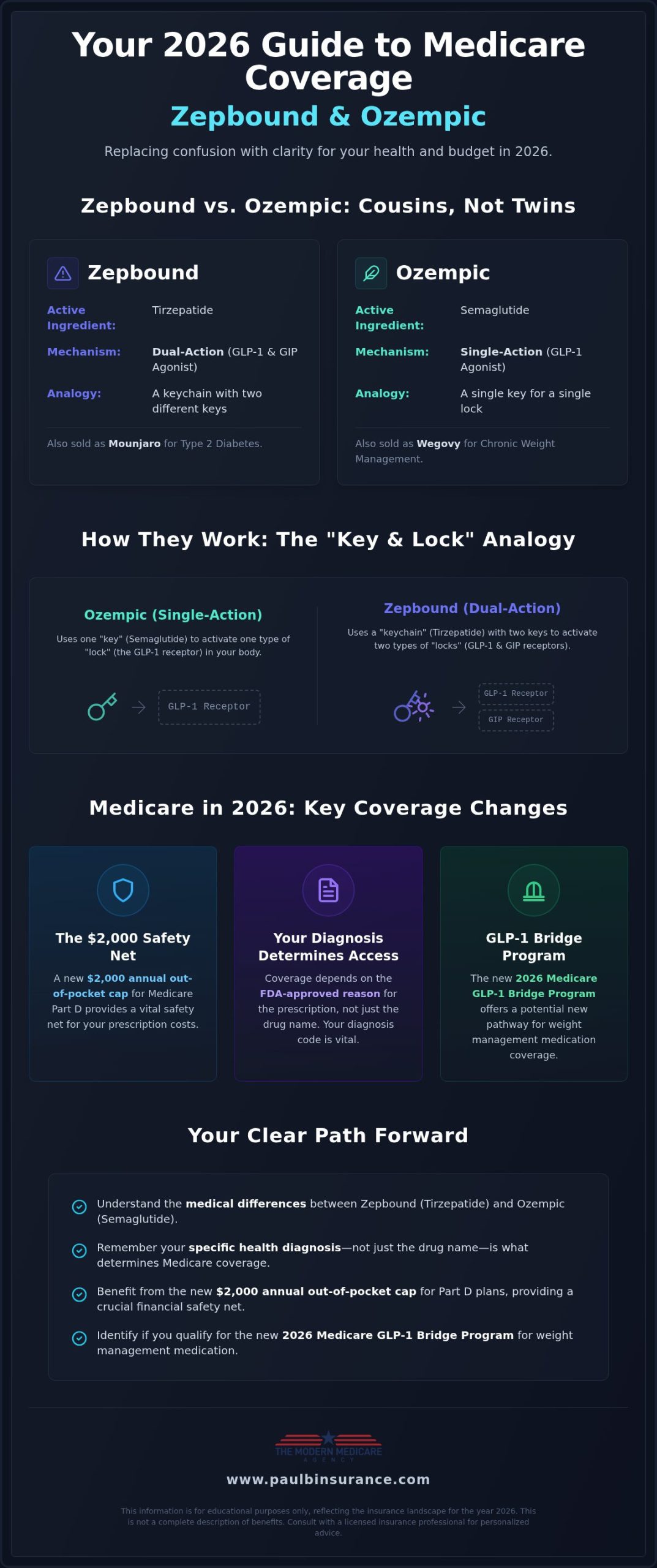
It is very common to feel confused by the sea of brand names currently hitting the market. You see one name on the evening news and a different one on your friend’s prescription bottle. To answer the most common question first: No, Zepbound and Ozempic are not the same medication. Think of them as cousins rather than twins. While they both belong to a class of medications that help regulate appetite and blood sugar, they contain different active molecules that interact with your body in unique ways. In 2026, these medications have become household names for seniors, yet the terminology remains a major source of anxiety. Understanding the science behind the label is the first step toward securing the right medicare coverage for zepbound and ozempic. We see many people who feel left behind by the fast pace of medical changes, but a little clarity goes a long way.
Meet the Molecules: Semaglutide and Tirzepatide
The confusion often starts because one single drug can have two different brand names depending on what it is treating. It helps to look at the actual ingredients inside the pen. Here is how they break down:
- Ozempic contains semaglutide. This is the same active ingredient found in Wegovy.
- Zepbound contains tirzepatide. This is the same active ingredient found in Mounjaro.
You might wonder why drug companies use so many different names for what seems like the same thing. It mostly comes down to how the FDA approves them for specific uses. One name is used for treating type 2 diabetes, while another is used specifically for chronic weight management. Understanding How GLP-1 Drugs Work helps clarify that while Ozempic targets one specific hormone receptor, Zepbound targets two. This distinction can lead to different results and, more importantly, different insurance rules.
Why the Name on the Box Matters for Your Insurance
Medicare looks closely at what is called the “indicated use” of a drug. This simply means the specific reason your doctor wrote the prescription. If your doctor prescribes Zepbound, Medicare traditionally sees a weight loss medication. If they prescribe Mounjaro, they see a diabetes medication. Even though the molecule inside the pen is exactly the same, the name on the box changes how your Medicare Part D plan evaluates the claim.
This is why your diagnosis code is so vital. Your doctor must provide a code that matches the FDA-approved use for that specific brand name. Without that match, you might face a denial at the pharmacy counter. We often see clients who are eligible for medicare coverage for zepbound and ozempic but get stuck in a loop of paperwork because the name on the prescription doesn’t align with the primary reason for treatment. Getting this right from the start saves you both money and stress.
How They Work: A Simple Comparison of Semaglutide vs. Tirzepatide
Have you ever wondered why you feel full after a small meal on some days, but can’t seem to stop snacking on others? It often comes down to hormones. These medications act as “hormone helpers” that mimic the signals your body naturally sends to your brain. When you understand how these signals work, the landscape of medicare coverage for zepbound and ozempic becomes much easier to understand. Ozempic uses a single-action approach. It focuses on one hormone called GLP-1, which helps slow down how fast your stomach empties and tells your brain you have had enough to eat. It is a reliable method that has helped many people manage their blood sugar for years.
Zepbound takes things a step further with a dual-action approach. It mimics GLP-1, but it also targets a second hormone called GIP. This combination is why the FDA approval for Zepbound was such a significant milestone for weight management in 2026. By hitting two different pathways, Zepbound often leads to more significant weight loss than single-action drugs. However, it is important to remember that “more” isn’t always better for everyone. Your unique health history and how your body reacts to these hormones will determine which path is safest for you.
The Key and Lock Analogy
Think of your body’s cells as having tiny locks called receptors. To get a specific result, like feeling full, you need the right key to open that lock. An agonist is simply a medication that acts like a key to fit into a lock and turn a specific system on in your body. Ozempic carries one key that fits into the GLP-1 lock. Zepbound is like a keychain with two different keys that open two different locks at the same time. This dual-action can create a stronger signal for your body to manage energy and hunger. If you’re feeling stuck choosing between these options, you can compare Part D plans with us to see which “key” fits your current budget and health goals.
Common Side Effects to Discuss with Your Doctor
Since both medications change how your digestive system moves, it’s very common to experience some “settling in” symptoms. Most people report feelings of nausea or mild digestive changes when they first start. Because Zepbound works on two different hormone pathways, some people find their side effects feel a little different than they would on Ozempic. The good news is that these feelings usually fade as your body gets used to the medication. Doctors typically use a slow “titration” schedule, which means they start you on a very low dose and increase it gradually over several months. This patient approach helps your body adjust comfortably. It’s always a good idea to have a calm conversation with your doctor about what to expect so you can feel confident as you begin your journey toward better health.
Approved Uses: Why Your Diagnosis Determines Your Access
The label on your prescription bottle is important, but for insurance companies, your medical diagnosis is what really opens the door to coverage. Many seniors feel a sense of dread when they hear their medication might not be covered. It often feels like a technicality is standing between you and your health. Understanding how the FDA categorizes these drugs can help you and your doctor navigate the system more effectively. In 2026, the rules for medicare coverage for zepbound and ozempic are tied directly to specific health conditions that go beyond just weight or blood sugar numbers. We want to help you understand these rules so you don’t face unexpected hurdles at the pharmacy.
Ozempic is primarily approved to help adults with type 2 diabetes manage their blood sugar. Because it also has a proven track record of reducing the risk of major heart events, Medicare plans are much more likely to approve it when these conditions are present. On the other hand, Zepbound is approved for chronic weight management. A common mistake we see is the “off-label” trap. This happens when a doctor prescribes Ozempic for weight loss alone. Since the FDA hasn’t approved Ozempic specifically for that use, your insurance plan will likely deny the claim. This can be a huge financial blow if you’re on a fixed income. It’s a stressful situation that we want to help you avoid.
Ozempic and Heart Health
In 2026, Ozempic has become a cornerstone for seniors with cardiovascular concerns. It’s often prescribed not just for diabetes, but specifically to protect the heart. Medicare plans recognize that controlling blood sugar and protecting the heart go hand-in-hand. This dual benefit makes it much easier to secure coverage through a Medicare Part D plan. Recent 2026 updates also highlight its role in kidney protection. This adds another layer of medical necessity that insurance companies respect. It’s about more than just one number on a lab report. It’s about your long-term safety.
Zepbound and Sleep Apnea
One of the biggest shifts we’ve seen in 2026 is the new approval for Zepbound to treat moderate-to-severe obstructive sleep apnea. This is a game-changer. For years, many seniors were denied coverage because their plan excluded weight loss drugs. Now, if you have a sleep apnea diagnosis, that same medication may be viewed as a necessary treatment for a respiratory condition. It’s a new pathway to access that didn’t exist before. If you’ve been denied in the past, this 2026 update might be the key to finally getting the medicare coverage for zepbound and ozempic that you need. It brings a new sense of hope to many who felt stuck in a confusing system.
Medicare Coverage in 2026: Will Your Plan Pay?
If you’ve been feeling anxious about how you’ll afford your prescriptions this year, I have some very good news to share. 2026 is a landmark year for anyone using high-cost medications. For the first time ever, there’s a hard limit on what you have to pay out of your own pocket. This change is specifically designed to protect you from the soaring costs of modern medicine. Understanding the new rules for medicare coverage for zepbound and ozempic is no longer about guessing; it’s about knowing your rights under the new laws.
While Medicare has traditionally excluded drugs used solely for weight loss, the situation has changed significantly. If your medication is prescribed for a health condition like type 2 diabetes, heart disease, or even chronic kidney disease, it’s often covered as a standard benefit. The key is knowing whether your specific plan includes these drugs on its formulary, which is just a fancy word for its list of covered drugs. Whether you have a Medicare Advantage plan or a standalone Part D plan, checking that list is the most important step you can take today. Every plan has a different list, and those lists can change every year.
The 2026 Out-of-Pocket Cap Explained
The biggest relief for many seniors is the new $2,000 annual cap on all Medicare Part D prescription drug costs. Once you spend $2,000 on your covered medications in 2026, you won’t pay another penny for the rest of the year. Because drugs like Zepbound and Ozempic can be expensive, you’ll likely reach that cap much faster than in previous years. This makes choosing the right Medicare Part D plan more vital than ever. You want a plan that counts your specific medication toward that cap so you can reach your safety net as early as possible. It provides a level of financial security that simply didn’t exist before this year.
The Medicare GLP-1 Bridge Program
Starting on July 1, 2026, a special temporary program began that changes the game for those seeking weight management support. The Medicare GLP-1 Bridge program provides coverage for Zepbound with a predictable $50 monthly copay. To qualify, you generally need to meet certain BMI thresholds, such as a BMI of 35 or higher, or a lower BMI combined with conditions like high blood pressure or heart disease. This program is a temporary bridge designed to help until broader rules take effect in 2028. It’s a wonderful opportunity to get the care you need without the financial stress. If you’re feeling confused about your eligibility, you can reach out for a personal plan review to see if this bridge is the right path for you.
Finding Certainty: How to Navigate the 2026 Plan Maze
It is completely natural to feel a sense of dread when you look at the long list of insurance companies and plan options available this year. Many people make the mistake of simply staying with the company they have always used or picking the first name they recognize. In 2026, that single decision could cost you thousands of dollars. Each insurance company builds its own list of covered drugs, and they don’t all treat these new medications the same way. When you only look at one carrier, you are only seeing a tiny slice of the map. We want to show you the whole picture so you can move forward with total confidence.
As independent brokers, we don’t work for the insurance companies. We work for you. We have the tools to compare over 40 different carriers at the same time. This is the only way to truly guarantee that you are getting the best medicare coverage for zepbound and ozempic available in your area. Our mission is to protect you from high out-of-pocket costs by doing the heavy lifting and research on your behalf. You shouldn’t have to be an insurance expert to get the medicine your doctor says you need.
The ‘Formulary Search’ Process
We use a math-based approach to find your ideal plan. This starts by looking at your specific medication list and checking it against every available formulary. We pay close attention to “Tiering.” For example, one plan might list your medication as a Tier 3 drug, while another calls it a Tier 4. This small change can drastically affect your monthly copay. We also look at pharmacy networks. Using a “preferred” pharmacy instead of a “non-preferred” one can often save you hundreds of dollars over the course of the year. We look at these tiny details so you don’t have to worry about them.
Your Next Steps for Peace of Mind
You don’t have to wait until you are standing at the pharmacy counter to find out if your plan will pay. A quick, conversational call can clear up the confusion and give you a clear look at your 2026 options. We’ll walk you through the specifics of medicare coverage for zepbound and ozempic and help you understand exactly when you’ll hit that $2,000 spending cap. Our goal is to move you from a state of uncertainty to a state of absolute certainty. Let us help you find the right 2026 plan today so you can focus on your health instead of your paperwork.
Take Control of Your Health and Your Budget in 2026
The healthcare landscape has changed significantly this year, but you don’t have to navigate it alone. We have explored how Zepbound and Ozempic offer different paths to better health and how the 2026 rules provide a new safety net for your wallet. Whether it’s the $2,000 out-of-pocket cap or the new GLP-1 Bridge program, there are now more ways than ever to manage your costs. Securing reliable medicare coverage for zepbound and ozempic shouldn’t feel like a source of constant anxiety.
Our team is here to take the weight off your shoulders. We provide a personalized drug formulary analysis and independent advice that always puts your needs first. Instead of feeling limited by one company, we help you compare 40+ carriers to find the perfect fit for your specific health journey. You deserve the peace of mind that comes from knowing your plan is working as hard as you are. Get a Simple, Unbiased Review of Your 2026 Medicare Options
You now have the information you need to make a great choice. We are ready to help you turn that knowledge into a plan that protects your health and your future with total certainty.
Frequently Asked Questions
Does Medicare Part D cover Zepbound for weight loss in 2026?
Yes, in 2026, Zepbound is covered for weight loss through the temporary GLP-1 Bridge program. This program launched on July 1, 2026, and provides a much-needed pathway for those who don’t have a diabetes diagnosis. You’ll need to meet specific BMI criteria and have your doctor submit a prior authorization. This is a significant shift from previous years when weight loss medications were almost always excluded from standard Part D coverage.
Can I switch from Ozempic to Zepbound if my Medicare plan changes?
You can switch medications, but it isn’t as simple as swapping one pen for another. Since Ozempic and Zepbound have different FDA-approved uses, your doctor must provide a diagnosis code that matches the new medication. If you switch to Zepbound for weight management, you’ll likely move from standard Part D coverage to the Bridge program rules. It’s a journey that requires careful coordination between your physician and your insurance carrier to avoid gaps in care.
What is the $2,000 Part D cap and how does it work in 2026?
The $2,000 cap is a new financial safety net that limits your total yearly spending on covered prescriptions. Once your out-of-pocket costs reach $2,000 in 2026, your plan pays 100 percent of your covered drug costs for the rest of the year. This is particularly helpful for high-cost medications. It removes the fear of the “donut hole” and provides a predictable budget for your healthcare. It’s one of the most reassuring changes for seniors in decades.
Will my Medicare Advantage plan cover Ozempic for Type 2 Diabetes?
Most Medicare Advantage plans do cover Ozempic when it’s prescribed to manage Type 2 Diabetes or reduce cardiovascular risk. Since these plans include prescription drug coverage, Ozempic is typically listed on their formulary. However, your specific copay will depend on which “tier” the plan assigns to the drug. We can help you look at the drug lists for over 40 carriers to ensure your specific plan offers the most reliable medicare coverage for zepbound and ozempic.
How much will I pay for Zepbound under the Medicare GLP-1 Bridge?
Eligible patients will pay a flat copay of $50 for a 30-day supply of Zepbound under the Bridge program. This price is a massive reduction from the retail costs that often exceeded $1,000 in previous years. This predictable cost helps remove the anxiety of shifting prices at the pharmacy. Keep in mind that this program is currently scheduled to run through December 31, 2027, providing a stable window for your weight management treatment plan.
Is tirzepatide more effective than semaglutide for seniors?
Clinical data suggests that tirzepatide, the active ingredient in Zepbound, can lead to more significant weight loss because it targets two hormone receptors instead of just one. Ozempic uses semaglutide, which only targets the GLP-1 receptor. While “more” weight loss sounds better, it doesn’t mean it’s the right choice for every senior. Some people tolerate the single-action approach of semaglutide much better. Your doctor will help you decide which molecule fits your specific health profile and goals.
What happens if my Medicare drug plan removes my medication from its list?
If your plan removes a drug, they generally must provide a 30-day notice or a one-time transition refill. This can be a very stressful moment, but you have options. You can work with your doctor to request a “formulary exception” or appeal the decision based on medical necessity. Alternatively, you can use the Annual Enrollment Period to switch to one of the other 40+ carriers that still includes your medication on their list. We specialize in helping clients navigate these sudden changes.
Do I need a special ‘prior authorization’ for these medications?
Yes, both Zepbound and Ozempic almost always require prior authorization. This means your doctor must submit paperwork to your insurance company proving that you meet the specific medical criteria for the drug. For medicare coverage for zepbound and ozempic, this usually involves verifying your diagnosis, such as Type 2 Diabetes for Ozempic or a specific BMI for Zepbound under the Bridge program. It’s a methodical process, but once approved, it provides the certainty you need to start your treatment.

Article by
Paul Barrett
Paul Barrett, CMIP is the founder of The Modern Medicare Agency, an independent Medicare-only brokerage based in Melville, NY. With 18 years of Medicare-exclusive experience, a CMIP designation, and more than 5,000 clients served across 37 states, Paul is one of the most credentialed independent Medicare specialists on Long Island — and one of the most direct.
He represents 40+ carriers with no quotas and no allegiances, which means his recommendations are based entirely on what fits each client's specific situation. He is the author of Medicare Mastery Unlocked and host of the Wise Guys Retirement Talk podcast. His content is grounded in primary sources, real carrier intelligence, and 18 years of watching what happens when people get Medicare right — and when they don't.
📞 631-358-5793 | paulbinsurance.com