
Senior arranging medication and care supplies

Medicare Eligible Seniors: Long Term Care Alternatives by Asset Bands

The practical financial alternatives to traditional long-term care insurance are hybrid life or annuity policies, annuities with LTC riders, deliberate self-funding, Medicaid planning as a backstop, HSA tax strategies, and short-term care policies. Most people do best combining two or three of these, matched to their assets, health, and family situation. Paulbinsurance can model those combinations against your actual numbers rather than a generic worksheet.


TL;DR:

  • Hybrid life insurance offers fixed premiums and a combined benefit, making it suitable for those with existing policies seeking LTC protection without overpaying for coverage.
  • Annuities with LTC riders provide guaranteed income boosts during care needs but generally cover lower costs than standalone policies, requiring careful product comparison.
  • Self-funding requires disciplined asset management and may be limited by opportunity costs, often supplemented with hybrid policies for catastrophic coverage.
  • Medicaid planning is a backup option involving asset transfers and specialized trusts, but it is complex and best managed by elder-law attorneys, not DIY methods.
  • Combining multiple strategies based on individual assets, health, and family support yields more tailored and effective long-term care funding than generic solutions.

Table of Contents

Long Term Care Alternatives: Hybrid Life Insurance Policies Explained

Hybrid life insurance, also called linked-benefit insurance, pairs a permanent life policy with a long-term care benefit. If you need care, you draw against the policy’s death benefit while you’re alive. If you never need care, your heirs still collect a payout. That structure solves the classic objection to standalone LTC insurance: paying decades of premiums for coverage you might never use. Hybrid life or LTC riders lock in fixed premiums for the life of the policy, and many carriers offer return-of-premium features if you cancel early, according to AARP’s review of hybrid long-term care insurance.

The trade-off is coverage efficiency. You typically get less LTC benefit per dollar than a standalone policy delivers, and the upfront cost runs higher.

  • Best for buyers with idle life insurance need who also want LTC protection
  • Well suited to people who can fund a lump sum or 1035 exchange from an existing policy
  • Less ideal if maximizing pure LTC coverage per premium dollar is the priority

Pro Tip: If you already own an old whole life or universal life policy with cash value, ask an agent whether a 1035 exchange into a hybrid product makes sense before you let that policy sit idle.

Annuities With Long-Term Care Riders

An annuity-based LTC rider (sometimes called a doubler or enhancement) increases your monthly payout, often two to three times your base income amount, once you qualify for care under the policy’s triggers, according to Annuity.org’s breakdown of LTC annuity riders. Hybrid annuity-LTC contracts work a bit differently: you pay a single premium upfront, which funds both a dedicated LTC pool and a smaller death benefit for heirs.

Under the Pension Protection Act of 2006, qualified distributions used for long-term care expenses can be tax-free, which matters if you’re pulling from a large annuity balance. These products tend to appeal to people sitting on low-yield CDs or idle savings who want guaranteed income plus a safety net, rather than a separate insurance premium.

  • Pro: potential tax-free LTC distributions under PPA rules
  • Pro: repositions otherwise idle cash into guaranteed income
  • Con: total LTC coverage is usually lower than a standalone policy
  • Con: contracts are complex and require careful comparison shopping

A hybrid annuity’s LTC pool is a fixed multiple of your premium, not an open-ended benefit, so bigger care needs can still outrun it.

Self-Funding: Building Your Own Care Reserve

Self-funding means setting aside a specific, named account, mentally and often legally fenced off, that exists solely to pay for care if you need it. This isn’t the same as vaguely hoping your retirement portfolio will “probably be enough.” A real reserve gets sized, tracked, and protected from being spent on anything else.

  1. Estimate a target reserve based on your local cost of care and how many years you’d want covered.
  2. Fence the money: open a separate account or earmark specific holdings so they aren’t touched for vacations or gifts.
  3. Reposition low-yield assets, such as CDs, into instruments (including annuities) that grow while still remaining accessible for care costs.
  4. Revisit the reserve every few years as costs and health change.
  5. If your reserve wouldn’t cover a worst-case, multi-year stay, layer in a hybrid policy for catastrophic protection.

The real risk with self-funding is opportunity cost. Money set aside for care isn’t available for your spouse’s income, your grandkids’ education, or an inheritance, so self-insuring for LTC demands discipline most people underestimate. That’s precisely why so many self-funders eventually add a hybrid policy on top, rather than relying on the reserve alone.

Medicaid Planning: The Backstop, Not the Plan

Medicaid pays for a large share of nursing home care in the United States, but only after you’ve spent down to strict, state-specific asset limits, often close to $2,000 in countable assets for an individual, per the NAIC’s Long-Term Care Shopper’s Guide. Most states apply a 60-month look-back period on asset transfers, and moving money out of your name too late triggers a penalty period during which Medicaid won’t pay.

Spousal protections exist so a healthy spouse isn’t left destitute, but the rules are technical and vary by state.

  • Irrevocable trusts can shelter assets, but only if funded well before the look-back window closes
  • Medicaid-compliant annuities can convert a lump sum into an income stream that may not count against eligibility
  • An elder-law attorney, not a general financial advisor, should structure any of this

Think of Medicaid planning as insurance against catastrophe, not a primary funding strategy. For most middle-class households, leaning on Medicaid means accepting facility and provider limits you wouldn’t choose voluntarily. It’s the floor, not the plan.

HSAs, Tax Rules, and Short-Term Care Policies

A Health Savings Account offers a triple tax advantage: pre-tax contributions, tax-free growth, and tax-free withdrawals when used for qualified medical expenses, which includes qualified long-term care premiums and many LTC costs. If you’re still working and HSA-eligible, catch-up contributions after age 55 let you build this reserve faster heading into retirement.

The IRS also caps how much of an LTC premium counts as deductible, and those caps rise with age, so a 70-year-old can deduct considerably more than a 50-year-old paying the same premium. That age-based structure rewards buying certain products earlier rather than waiting.

Funding tool Tax treatment Best use
HSA Tax-free growth and withdrawals for qualified LTC costs Bridging smaller, ongoing care expenses
Age-based LTC premium deduction IRS caps rise with age Reducing net cost of standalone or hybrid premiums
Short-term care policy Premiums often qualify similarly to standalone LTC Lower-cost bridge coverage

Short-term care policies, which typically cover up to a year of care, cost less than standalone LTC insurance and work well as a bridge for people who can’t afford full LTC premiums or who missed the window for standard underwriting, according to AARP’s guide to long-term care insurance alternatives.

Pro Tip: If you’re within a few years of Medicare eligibility and still have earned income, max out HSA contributions now. That account can quietly become your personal LTC premium fund later.

Building Your Layering Strategy by Net Worth

There’s no single right answer here, but your asset level should drive which combination makes sense.

  • Under $200,000 in assets: Family caregiving support plus early Medicaid planning tends to be realistic. Full self-funding usually isn’t feasible.
  • $200,000 to $500,000: A hybrid policy sized modestly, paired with HSA savings and Medicaid as a fallback, balances cost against protection.
  • $500,000 to $1 million: Partial self-funding combined with a hybrid policy for catastrophic scenarios often fits best.
  • Over $1 million: Self-funding the bulk of expected costs, backed by a hybrid policy or annuity rider for extended or severe care needs, usually makes the most financial sense.

Timing matters as much as the dollar amount. Underwriting gets stricter and premiums climb every year you wait, and a health diagnosis in your late 60s or early 70s can shut the door on standalone LTC insurance entirely. Some employer or association plans offer guaranteed-issue windows worth checking before you assume you need full underwriting.

Before buying anything, ask an advisor these questions:

  1. Does this policy include inflation protection, and how is it calculated?
  2. What’s the elimination period before benefits start paying?
  3. Can the benefit transfer to a different care setting if my needs change?
  4. What exactly happens to my premium if I cancel or never use the benefit?
  5. How are qualified distributions or premiums taxed under current IRS rules?

Run these numbers as a scenario model, not a one-time purchase decision. The mix that fits at 62 may look different at 68.

Where Medicare Falls Short on Long-Term Care

Medicare generally does not pay for custodial long-term care, the day-to-day help with bathing, dressing, and eating that most nursing home and home care actually involves. Medicare’s involvement is narrow:

  • Skilled nursing care after a qualifying hospital stay, for a limited number of days
  • Limited home health visits tied to a specific medical need, not ongoing custodial support

That gap is exactly why the alternatives above exist. If you want the full picture of what Medicare will and won’t pay toward a nursing home stay, Paulbinsurance’s guide on Medicare and nursing home coverage breaks down the specifics, and this overview of Medicare and long-term care costs covers the underlying rules in more depth.

Care Settings That Don’t Require an Insurance Payout

Not every long-term care solution runs through an insurance product. In-home support services, adult day programs, assisted living, and other community-based care options often get funded through a mix of the financial tools already covered here, self-funded reserves, HSA dollars, or Medicaid once someone qualifies, rather than a dedicated policy.

In-home support services range from a few hours of help with bathing and meals to round-the-clock care, and cost scales directly with hours needed. Adult day programs offer a lower-cost middle ground: structured activity and supervision during the day, which lets a working family caregiver keep a job while a parent or spouse gets social engagement and monitoring. Assisted living communities bundle housing, meals, and a moderate level of personal care assistance, positioned between fully independent living and a nursing home.

Community-based care also includes options like adult family homes and residential care options with a smaller, more personal setting than a large facility. None of these require an LTC insurance policy to access, but nearly all of them cost real money out of pocket unless Medicaid or a hybrid policy’s benefit is paying the bill.

The financial planning question isn’t which of these settings you’ll choose. It’s whether the money to pay for whichever setting you eventually need is already lined up. A family that has layered a hybrid policy with a modest self-funded reserve has more flexibility to choose in-home support over a nursing home admission, because they aren’t forced into whichever option Medicaid happens to cover in their state.

Facility Care Versus Home and Community Care: Weighing the Real Trade-offs

Nursing home and other facility-based care delivers the highest level of medical supervision, appropriate for people with complex conditions, dementia-related safety risks, or needs beyond what family or aides can manage at home. The trade-off is cost, loss of independence, and, for many seniors, a real hit to quality of life tied to leaving a familiar home.

Home and community care, whether through in-home support services, adult day care, or assisted living choices, tends to preserve more autonomy and can delay or avoid facility placement altogether. It works best when a person’s needs are moderate and somewhat predictable, and when family caregiver support or paid aides can fill the gaps. It works less well when medical needs escalate quickly or when a family caregiver’s health or finances start buckling under the load.

Neither option is universally better. Facility-based care concentrates cost into one predictable monthly bill, which some families find easier to plan around than the variable, sometimes escalating cost of in-home hours. Home care usually costs less at lower hour counts but can approach or exceed nursing home costs once someone needs near-constant supervision.

This is where the funding side connects directly to the care-setting decision. A family relying solely on Medicaid may find their choices narrowed toward whichever facilities accept Medicaid patients in their state. A family with a self-funded reserve or hybrid policy benefit has more freedom to choose the setting that actually fits, rather than the setting that’s affordable.

Money alone doesn’t solve a long-term care crisis if the legal paperwork isn’t in place before it’s needed. A durable power of attorney names someone to manage your finances if you become incapacitated, and without one, your family may need a court-appointed guardianship, a slower and more expensive process for everyone involved.

A healthcare power of attorney and a living will work together to make sure your medical wishes get followed even when you can’t speak for yourself. The living will states your preferences on life-sustaining treatment; the healthcare power of attorney names who makes decisions the living will doesn’t cover.

Guardianship exists as a last resort, when no advance directives were signed and a court has to appoint someone to manage a person’s affairs. It’s expensive, public, and slower than any of the tools above, which is exactly why elder-law attorneys push clients to sign powers of attorney and living wills well before a health crisis, not after one.

These documents also matter for Medicaid planning specifically. An agent under a financial power of attorney may need explicit authority to make the asset transfers or trust funding that Medicaid planning requires. A generic, off-the-shelf power of attorney form sometimes lacks that language, which is one more reason an elder-law attorney, not a template downloaded online, should draft these documents alongside your funding strategy.
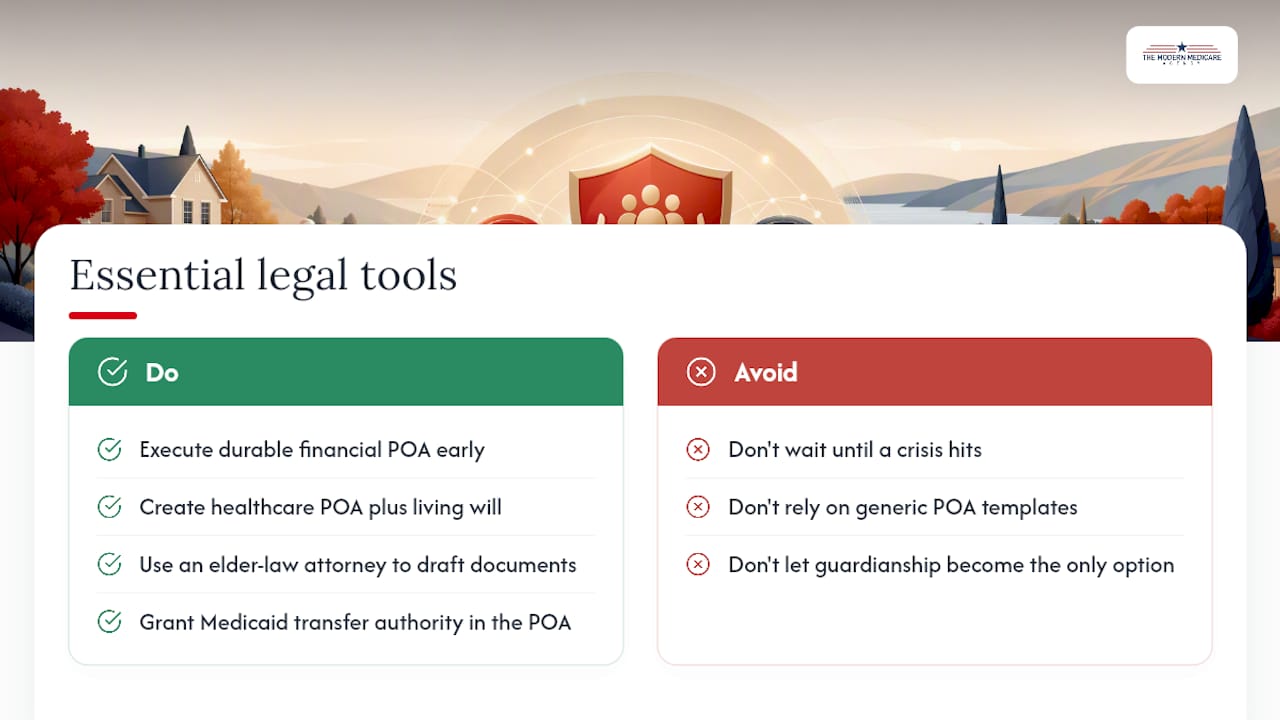
Legal Tools That Belong in Every LTC Plan — overview diagram

Funding Sources Beyond Insurance and Medicaid

A few less obvious funding sources deserve a look, particularly for veterans and people holding older life insurance policies. The VA’s Aid and Attendance benefit provides additional monthly payments to eligible wartime veterans and surviving spouses who need help with daily activities, on top of standard VA pension benefits. It’s underused largely because veterans don’t realize they qualify.

Long-term care trusts, distinct from the Medicaid-planning trusts mentioned earlier, can be structured during estate planning specifically to hold assets earmarked for care, sometimes with more flexibility than a rigid insurance contract offers, though they require an attorney to draft correctly.

Life settlements are another option: selling an unwanted or unaffordable life insurance policy to a third party for a lump sum, typically worth more than the policy’s cash surrender value but less than its death benefit. That lump sum can fund a care reserve or a hybrid policy premium. It’s not the right move for everyone, since giving up the death benefit permanently affects what heirs eventually receive, but for someone who was going to let the policy lapse anyway, it converts a dying asset into usable care funding.

How LTC Alternatives Affect Quality of Life and Family Caregivers

The financial mechanics matter, but they exist to serve a human outcome: fewer forced decisions made in a crisis, and less strain on the people who’d otherwise carry the load alone. Family caregiver support isn’t infinite. Unpaid family caregivers routinely absorb the gap between what a parent needs and what the family can afford, often at real cost to their own health, income, and relationships.

A funding plan that’s actually in place before a crisis changes that dynamic. It means a daughter doesn’t have to quit her job to provide full-time care because there’s no money for paid in-home support. It means a spouse isn’t forced to choose between their own retirement security and their partner’s care needs. Quality of life for the person receiving care improves too, since having funding secured usually means more choice over where and how care happens, rather than defaulting to whichever option is cheapest or fastest to arrange.

The absence of a plan doesn’t mean the absence of care. It means care happens anyway, just under worse financial terms and heavier caregiver burden, discovered at the worst possible moment.

Matching the Right Alternative to Your Situation

Start with three honest questions: What can you afford to set aside without jeopardizing other goals? What does your health history suggest about insurability? And what does your family situation look like, do you have caregivers nearby, or would paid care be the default?

Someone in good health at 62 with meaningful liquid assets has far more menu options than someone at 74 with a recent diagnosis and modest savings. The first person can still comfortably underwrite a hybrid policy or annuity rider. The second may be looking at short-term care coverage, aggressive HSA use, and early Medicaid planning conversations with an attorney.

Family dynamics matter just as much as the balance sheet. A senior with an adult child able and willing to provide in-home support needs less paid-care funding than someone aging alone. Neither situation is better or worse, but pretending your family looks like someone else’s leads to the wrong funding mix.

This is the case for modeling scenarios with a professional rather than picking a product off a comparison chart. The right answer depends on numbers specific to you: your assets, your health, your family, and your goals, not a generic recommendation that ignores all four.

Paul Barrett has specialized in Medicare and senior insurance since 2007, and the single most common mistake seen across nearly two decades of client conversations is the same one: people search for “the best” LTC alternative as if one exists universally. It doesn’t. A hybrid policy that’s brilliant for a healthy 63-year-old with $700,000 in assets can be the wrong purchase entirely for a 71-year-old managing a recent cardiac diagnosis on half that balance.

Scenario modeling isn’t a sales tactic, it’s the only honest way to answer this question. Cookie-cutter advice skips the variables that actually determine outcomes: your specific health underwriting risk, your state’s Medicaid rules, and how much liquidity you can genuinely fence off. If you want your numbers run against real options instead of a generic list, reach out for a modeled conversation.

— Paul

Get Personalized Guidance From Paulbinsurance

Paulbinsurance exists because these decisions shouldn’t be made from a blog post alone. As an independent Medicare-focused agency, the team compares annuity and hybrid options across carriers, walks through the tax mechanics that actually apply to your situation, and refers you to elder-law counsel when Medicaid planning is the right next step, rather than guessing at rules that vary by state.

Paulbinsurance

Services include education on every option covered here, side-by-side plan comparisons, annuity and hybrid product conversations, and enrollment support once you’ve chosen a direction. None of this requires you to already know which product fits, that’s the point of talking to someone first.

If you’re ready to see how these alternatives apply to your own numbers, start with a look at Medicare Advantage plan options or reach out directly to request a scenario model built around your assets, health, and goals.

Sources

This article is general information, not a substitute for advice from a qualified financial advisor. Consult a qualified financial professional about your own circumstances before acting on anything here.


What Is Medicare Part B and What Does It Actually Cover?

The complete guide to Medicare’s medical insurance — every service it covers, exactly what it costs in 2026, how it works with group insurance and VA benefits, and the excess charges most people have never heard of until they get a surprise bill.

The Short Answer

Medicare Part B is medical insurance — it covers doctor visits, outpatient care, preventive services, durable medical equipment, and more. Unlike Part A, Part B is not premium-free for anyone: everyone pays a monthly premium (202.90in2026formostpeople),anannualdeductible(283), and 20% coinsurance on most covered services, with no yearly cap on that 20% under Original Medicare alone. Whether you need to enroll at 65, and whether delaying is safe, depends heavily on your employment status and your employer’s size — getting this wrong is one of the most consequential and permanent mistakes in all of Medicare.

Key Takeaways

  • Part B is never premium-free — everyone pays a monthly premium, and higher earners pay significantly more through IRMAA.
  • The 20% coinsurance under Original Medicare alone has no yearly cap — this is the single biggest financial risk in Medicare, and it’s the reason Medigap and Medicare Advantage exist.
  • Whether you can safely delay Part B without a penalty depends on your employer’s size: 20+ employees generally allows delay; fewer than 20 generally does not.
  • Missing your enrollment window triggers a permanent 10% penalty for every 12-month period you went without coverage.
  • Veterans can and generally should enroll in Part B even with VA benefits, since Medicare and VA coverage don’t coordinate — each only pays for care received within its own system.
  • “Excess charges” from non-participating providers can add up to 15% on top of what Medicare approves, and only some Medigap plans protect you from them.

What Part B Actually Covers

While Part A handles hospital room and board, Part B is the half of Original Medicare that covers medical care and most services delivered outside a hospital admission — doctor visits, outpatient procedures, and ongoing medical needs.

What’s covered

  • Doctor visits — primary care and specialists
  • Outpatient surgeries and procedures
  • Diagnostic lab work, X-rays, and MRIs
  • Emergency room visits
  • Ambulance services
  • Outpatient mental health care
  • Physical, occupational, and speech therapy
  • Chemotherapy and radiation received in an outpatient clinic
  • Durable Medical Equipment (DME) — wheelchairs, oxygen equipment, blood sugar monitors, walkers, and similar equipment
  • Ambulatory surgical center services

Preventive services: the part Medicare gets genuinely right

Most preventive services are covered at 100%, with no deductible and no copay, as long as your provider accepts Medicare assignment. This includes:

  • Your one-time “Welcome to Medicare” wellness visit, available within your first 12 months on Part B
  • Annual wellness visits after that
  • Flu shots and most other recommended vaccines
  • Mammograms
  • Colonoscopies and other cancer screenings
  • Diabetes and cardiovascular screenings
  • Many other screenings recommended by the U.S. Preventive Services Task Force

Paul’s Honest Take: This is one of the most underused parts of Medicare, full stop. I’ve had clients who paid for a private physical every year out of habit and never realized their annual wellness visit through Medicare was completely free. If you haven’t used your Welcome to Medicare visit or your annual wellness visit, that’s real value sitting on the table.

What’s NOT covered

  • Routine dental care — cleanings, fillings, dentures, extractions
  • Routine vision exams and eyeglasses
  • Hearing aids (though diagnostic hearing tests ordered by a doctor may be covered)
  • Long-term custodial nursing home care — help with daily living activities, as opposed to short-term skilled or medical care
  • Routine prescription drugs you pick up at a retail pharmacy — that’s Part D’s job, not Part B’s
  • Cosmetic surgery, unless medically necessary (such as reconstruction after an accident or mastectomy)
  • Most care received outside the United States, with very limited exceptions
  • Routine foot care, such as nail trimming, in the absence of a qualifying medical condition
  • Acupuncture, except for a narrow, specific chronic low back pain benefit
  • Concierge medicine fees and membership-style charges some practices add on top of standard care
  • Long-term care insurance-style services, including most home-based personal care that isn’t tied to a skilled medical need

Paul’s Honest Take: The dental and vision exclusions are the ones that surprise people most, especially since they’re such routine parts of healthcare for most adults. This is exactly why so many Medicare Advantage plans build dental, vision, and hearing benefits into their coverage — Original Medicare was simply never designed to include them, and that gap doesn’t go away on its own.

What Part B Costs in 2026

Part B has three separate cost components, and understanding all three matters:

Cost Component

2026 Amount

Standard monthly premium

$202.90

Annual deductible

$283

Coinsurance on most covered services

20%

The premium is deducted automatically from your Social Security check if you’re already collecting benefits. If you’re not yet collecting Social Security, you’ll receive a bill, typically every three months.

The deductible works differently than Part A’s — it’s a straightforward annual figure. You pay the first $283 of Medicare-approved outpatient costs each calendar year, and then Medicare’s cost-sharing kicks in.

The coinsurance is where the real risk lives. After your deductible is met, Medicare pays 80% of the Medicare-approved amount for most covered services, and you’re responsible for the remaining 20%. There is no yearly cap on this 20% under Original Medicare alone. If you have a $100,000 course of cancer treatment, your 20% share is $20,000 — unless you have a Medigap policy or Medicare Advantage plan absorbing that cost.

Paul’s Honest Take: I put this in bold because it’s genuinely the single most important number in this entire guide. That uncapped 20% is the whole reason Medigap and Medicare Advantage exist as products in the first place. Original Medicare by itself was never designed to protect you from a truly expensive year — it was designed to cover 80% of it and leave the rest to you.

IRMAA: What Higher Earners Actually Pay

If your income is above certain thresholds, you’ll pay more for Part B through the Income-Related Monthly Adjustment Amount (IRMAA) — based on your tax return from two years prior. For 2026, that means your 2024 income determines your premium tier.

2024 Income (Individual)

2024 Income (Married, Joint)

Total Part B / Month

$109,000 or less

$218,000 or less

$202.90

$109,001 – $137,000

$218,001 – $274,000

$284.10

$137,001 – $171,000

$274,001 – $342,000

$405.80

$171,001 – $205,000

$342,001 – $410,000

$527.50

$205,001 – $499,999

$410,001 – $749,999

$649.20

$500,000 and above

$750,000 and above

$689.90

At the top tier, you’re paying more than three times the standard premium. If your income has recently dropped — retirement, the loss of a spouse, or certain other life-changing events — you can appeal your IRMAA determination using Form SSA-44.

Do You Have to Enroll? And What Happens If You Don’t?

Technically, Part B is optional — Medicare won’t force you into it. But opting out without a valid alternative is genuinely risky, because of how the penalty structure works.

If you don’t sign up during your Initial Enrollment Period (the 7-month window around your 65th birthday) and you don’t have qualifying employer coverage, you’ll face a permanent 10% penalty added to your premium for every full 12-month period you went without Part B. That penalty doesn’t expire — you pay it for as long as you have Part B, which for most people means for the rest of your life.

Example: If you delayed enrollment by 24 full months without a valid exception, you’d pay an extra 20% on top of the standard $202.90 premium in 2026 — roughly $40.58 more, every month, permanently.

How Part B Works with Group Insurance

Just like Part A, whether you can safely delay Part B without penalty comes down to one specific number: how many employees your company has.

Companies with 20 or more employees: If you or your spouse are actively working and covered by a genuine group health plan, your workplace insurance is primary, and you can legally delay Part B without any penalty. When that employment or coverage eventually ends, you get an 8-month Special Enrollment Period to enroll in Part B penalty-free.

Companies with fewer than 20 employees: Medicare automatically becomes your primary insurer at 65, regardless of your employment status. You need to enroll in Part B right on schedule. If you don’t, your small employer’s plan can legally refuse to pay claims that Medicare should have covered first — potentially leaving you responsible for the full cost.

Paul’s Honest Take: I say this in nearly every guide I write, because it’s genuinely one of the costliest misunderstandings I encounter: “I have good coverage at work” and “I’m protected from Medicare’s enrollment deadlines” are two completely different statements, and whether the second one is true depends entirely on your employer’s size — not how generous the coverage feels. Confirm the actual employee count before you decide to delay anything.

Retiree Coverage Is Not the Same as Active Employer Coverage

This is a distinction that catches a genuinely large number of people off guard: the “20 or more employees” exception only applies to active employment. If you retire and your former employer offers you retiree health benefits — sometimes a genuinely good, comprehensive plan — that coverage does not create a Special Enrollment Period the way active group coverage does, and it does not exempt you from enrolling in Part B on time.

Paul’s Honest Take: I’ve seen this mistake more than once, and it’s an especially painful one because it happens to people who did everything right during their working years. Someone retires with a strong retiree health plan from a large employer, assumes it works the same way their active coverage did, and delays Part B — only to find out later that retiree coverage was never a valid reason to delay in the first place. The moment you stop actively working, that clock starts, regardless of how good your retiree plan looks on paper. If you’re retiring and keeping employer retiree benefits, treat enrolling in Part B as something to handle right on schedule, not something retiree coverage lets you postpone.

Why You Need Both Part A and Part B for Medigap or Medicare Advantage

Here’s a foundational requirement worth understanding clearly, since it shapes every other coverage decision in Medicare: you must be enrolled in both Part A and Part B before you can buy a Medigap policy or enroll in a Medicare Advantage plan. Neither product exists as a standalone substitute for Original Medicare — both are built specifically to work alongside it.

  • Medigap fills the cost-sharing gaps left by Original Medicare (Parts A and B) — it has nothing to fill in if you’re not enrolled in both parts to begin with.
  • Medicare Advantage legally must provide at least the same coverage as Parts A and B combined, which is only possible because you’re required to be enrolled in both before a Medicare Advantage carrier can enroll you.

Paul’s Honest Take: This surprises people who assume they can somehow “skip” Part B and go straight into a Medicare Advantage plan to avoid the extra premium. It doesn’t work that way — Part B enrollment, and its premium, is a prerequisite either way, whether you end up on Original Medicare with Medigap or on a Medicare Advantage plan. There’s no path through Medicare that avoids the Part B premium once you’re actually using the system.

Does Medicare Work If You’re a Veteran?

Yes — and if you have VA health benefits, understanding how the two systems relate is genuinely important, because they work differently than most people assume.

Medicare and VA benefits do not coordinate. These are two entirely separate systems that each pay only for care received within their own network. Medicare doesn’t pay for care you receive at a VA facility, and VA benefits don’t pay for care you receive from a non-VA doctor or hospital. You, the veteran, choose which system to use each time you seek care.

Here’s the critical point: having VA benefits does not exempt you from Medicare’s enrollment deadlines. VA coverage is not considered a qualifying reason to delay Part B without penalty. If you don’t enroll in Part B during your Initial Enrollment Period and you’re relying solely on VA benefits, you can still trigger the permanent late enrollment penalty.

Why the VA itself recommends enrolling in Medicare anyway:

  • It gives you access to civilian doctors and hospitals outside the VA system
  • VA healthcare funding depends on annual Congressional appropriations, which isn’t guaranteed to remain stable
  • If VA authorizes only part of your needed care at a non-VA facility, Medicare can help cover the rest
  • Having both gives you meaningfully more flexibility and security than relying on either system alone

Paul’s Honest Take: This is one of the most common misconceptions I run into with veterans specifically, and it’s an expensive one to get wrong. Good VA coverage feels like it should be enough, and it might genuinely handle most of your care — but it doesn’t protect you from the Part B enrollment clock the way employer coverage from a large company can. The VA itself actively encourages enrolling in Medicare Parts A and B for exactly this reason. If you have VA benefits and are approaching 65, this is worth a direct conversation before you assume you’re covered.

Veterans who enroll in Part B can also purchase a Medigap policy, which can be particularly valuable if you use non-VA providers regularly — though if you primarily rely on VA facilities for most of your care, the value of an added Medigap policy may be more limited, and worth weighing carefully.

How Long Does It Actually Take to Get Part B Approved?

This is one of the most practical, and most overlooked, pieces of planning — especially if you’re leaving a job after 65 and coordinating your Part B start date around the end of your employer coverage. Applying isn’t instant, and the timeline depends heavily on which enrollment window you’re using.

Enrollment Situation

Typical Processing Time

When Coverage Actually Starts

Initial Enrollment Period (around 65)

2–4 weeks, sometimes up to 6

1st of your birthday month (if applied in the 3 months before) or 1st of the month after you apply (if applied during or after your birthday month)

Special Enrollment Period (leaving employer coverage)

4–8 weeks, sometimes longer

1st of the month after your application is submitted

General Enrollment Period (Jan 1–Mar 31, missed window)

4–6 weeks

1st of the month after you apply

Why the Special Enrollment Period takes longer: applying after leaving employer coverage requires two forms, not one — Form CMS-40B (the actual Part B application) and Form CMS-L564 (Request for Employment Information), which your employer needs to complete to verify you had qualifying coverage. Social Security has to manually review both, which is exactly why this route consistently takes longer than a standard Initial Enrollment Period application.

Paul’s Honest Take: This timeline question comes up constantly with clients who are retiring or leaving a job after 65, and it deserves real attention — not just because of the penalty risk we’ve already covered, but because a slow approval can leave you with an actual gap in coverage if you time it too tightly. My standard advice: start this process at least 2 to 3 months before you need Part B to actually begin, not the week your employer coverage ends. If your former employer is slow to complete their portion of Form CMS-L564, that alone can hold up the entire application — so it’s worth following up with your HR or benefits department directly rather than assuming it’s been submitted.

Practical tips to avoid delays

  • Apply online through SSA.gov whenever possible. It’s consistently the fastest method — mailed or faxed forms are more prone to getting lost or delayed.
  • If you’re on a Special Enrollment Period, submit Form CMS-L564 alongside Form CMS-40B, not separately. They need to arrive together, and one incomplete form can stall the whole application.
  • Expect a short intake lag even with online applications. It can take several business days for an online submission to actually appear on a local Social Security agent’s screen — don’t panic if you call shortly after applying and they say they don’t see it yet.
  • Once approved, you don’t have to wait for your physical card. Your Medicare Beneficiary Identifier typically appears in your online Social Security or Medicare.gov account within a day or two of approval, and you can print a temporary card from there — the physical card generally arrives by mail within about 30 days.

Excess Charges: The Cost Almost Nobody Knows to Ask About

Here’s a detail that surprises even people who’ve been on Medicare for years: not every doctor who accepts Medicare agrees to accept Medicare’s approved amount as full payment.

Providers fall into three categories:

  • Participating providers accept Medicare assignment, meaning they agree to accept the Medicare-approved amount as payment in full. This covers the vast majority of providers — roughly 98% of doctors nationally.
  • Non-participating providers still accept Medicare patients but haven’t agreed to accept the standard rate. They can charge an excess charge of up to 15% above the Medicare-approved amount.
  • Opted-out providers have left the Medicare system entirely and can charge whatever they want under a private contract — Medicare pays nothing at all for care from these providers, except in emergencies.

How excess charges actually work: if the Medicare-approved amount for a service is $300 and you see a non-participating provider, they can legally charge up to an additional $45 (15%) on top, for a total bill of $345 — and that excess amount doesn’t count toward your Part B deductible.

Eight states currently prohibit or limit excess charges entirely: Connecticut, Massachusetts, Minnesota, New York, Ohio, Pennsylvania, Rhode Island, and Vermont. If you live in one of these states, you’re generally shielded from excess charges from providers within your state — though you could still face them if you receive care from a non-participating provider elsewhere.

Paul’s Honest Take: This is exactly why Medigap Plan G matters so much for people who want maximum flexibility. Plan G covers excess charges in full — Plan N does not. If you’re the kind of person who wants the freedom to see any doctor without worrying about billing surprises, that distinction is worth understanding clearly before you pick between the two. And regardless of which plan you choose, it’s always worth asking a new provider directly whether they accept Medicare assignment before your first appointment.

The HSA Rule: Part B Closes the Door Too

If you’re hoping to keep contributing to a Health Savings Account, know this clearly: enrolling in Part B — or any part of Medicare — ends your ability to make new HSA contributions. This isn’t unique to Part B; it applies the moment you enroll in Medicare in any form, including premium-free Part A.

If keeping your HSA active matters to you, the only way to legally delay both Part A and Part B is through qualifying employer coverage — which, as covered above, generally requires an employer with 20 or more employees. And because Part A enrollment can be backdated up to 6 months once you do enroll, it’s smart to stop HSA contributions 6 months before you plan to sign up for Medicare or file for Social Security, whichever comes first.

Frequently Asked Questions

Is there a cap on what I’ll pay for Part B services in a year? Not under Original Medicare alone — the 20% coinsurance has no yearly limit. A Medigap policy or Medicare Advantage plan is what actually caps your exposure.

What happens if I don’t sign up for Part B on time? You’ll generally face a permanent 10% penalty on your premium for every 12-month period you went without coverage, unless you qualify for a Special Enrollment Period through active employer coverage.

Do I need Part B if I have good coverage through a small employer? Almost certainly yes. If your employer has fewer than 20 employees, Medicare becomes your primary insurer at 65 regardless of your job coverage, and not enrolling can leave you exposed to unpaid claims and a lifelong penalty.

Do veterans need Medicare Part B if they have VA benefits? Generally, yes. Medicare and VA benefits don’t coordinate — each only pays for care within its own system — and VA coverage doesn’t exempt you from Medicare’s enrollment deadlines or penalties.

What is a Part B excess charge? An additional charge, up to 15% above the Medicare-approved amount, that a non-participating provider can legally bill you. It doesn’t count toward your deductible, and only Medigap Plan G (among current plans) covers it in full.

Can I keep contributing to my HSA if I enroll in Part B? No. Enrolling in any part of Medicare, including Part B, ends your HSA contribution eligibility going forward.

How long does it take to get approved for Part B? It depends on the enrollment window. Initial Enrollment Period applications typically process in 2–4 weeks. Special Enrollment Period applications, used when leaving employer coverage, generally take 4–8 weeks since Social Security must manually verify your prior coverage using Form CMS-L564. Start the process at least 2–3 months before you need coverage to begin, especially when coordinating around a job ending.

The Bottom Line

Part B is the half of Medicare that covers your everyday medical care — and it’s also where the real financial exposure of Original Medicare lives, thanks to that uncapped 20% coinsurance. Whether you should enroll at 65, whether you can safely delay, and how much of that exposure you’re carrying all depend on details specific to your situation: your employer’s size, your income, your VA status, and which doctors you actually see.

If you want help sorting out exactly how Part B applies to your specific circumstances — or want to understand how Medigap or Medicare Advantage could close that uncapped coinsurance gap — that’s exactly the conversation I have with clients every day, at no cost to you.

Call 631-358-5793 or visit paulbinsurance.com to set up a time to talk it through.

Paul Barrett, CMIP, is the founder of The Modern Medicare Agency, based in Melville, NY, and has spent 18+ years exclusively helping people navigate Medicare — never life insurance, never annuities, just Medicare. He’s licensed in 37 states, represents more than 40 carriers, and has personally helped over 5,000 clients choose coverage that actually fits their lives.

Figures current as of 2026 and sourced from CMS, Medicare.gov, and the Social Security Administration. Individual circumstances vary, especially around employer coverage, VA benefits, and income-based premiums — always verify your specific situation before making enrollment decisions.

Sources

Related Post

Scroll to Top

Request a Callback with
Paul Barrett

Fill out the form below, and we'll call you within 24 hours.