




It depends on your plan type. Some Medicare Advantage plans, mainly PPOs, let you see out-of-network providers, but you usually pay a higher share of the cost. HMOs generally cover only in-network care. Every plan must cover emergency and urgently needed care, whoever provides it. Below, we explain how each plan type works, what a surprise bill can look like, what happens when you travel, and what to do before you book an appointment.
TL;DR
- HMO plans generally require in-network care. PPO plans allow out-of-network care at a higher cost. PFFS plans work differently, with no network in many cases.
- Emergency and urgently needed care is covered even from an out-of-network or out-of-area provider.
- An out-of-network doctor does not have to treat you, and the plan’s terms decide what gets paid. Confirm before you schedule.
- Routine care away from home often depends on your plan’s service area, so check before a long trip or a move.
- If your doctor leaves the network, you can ask your plan about options, pick a new in-network provider, or review your plan choices during open enrollment.
Table of Contents
- What “out of network” means on a Medicare Advantage plan
- How out-of-network rules differ by plan type
- Emergencies and urgent care are always covered
- What out-of-network care can cost you
- Using Medicare Advantage out of state
- Before you get out-of-network care: a checklist
- If your doctor leaves your plan’s network
- When the plan denies a service
- Is a network-based plan right for you?
- Our perspective
- Check your doctors against your plan
- FAQ
- Sources
What “out of network” means on a Medicare Advantage plan
Original Medicare lets you see any provider in the country who accepts Medicare. Medicare Advantage (Part C) is different. A private insurer runs the plan under Medicare’s rules, and it builds a network of doctors, hospitals and other providers that have agreed to its payment terms. Those providers are “in network.” Everyone else is “out of network.”
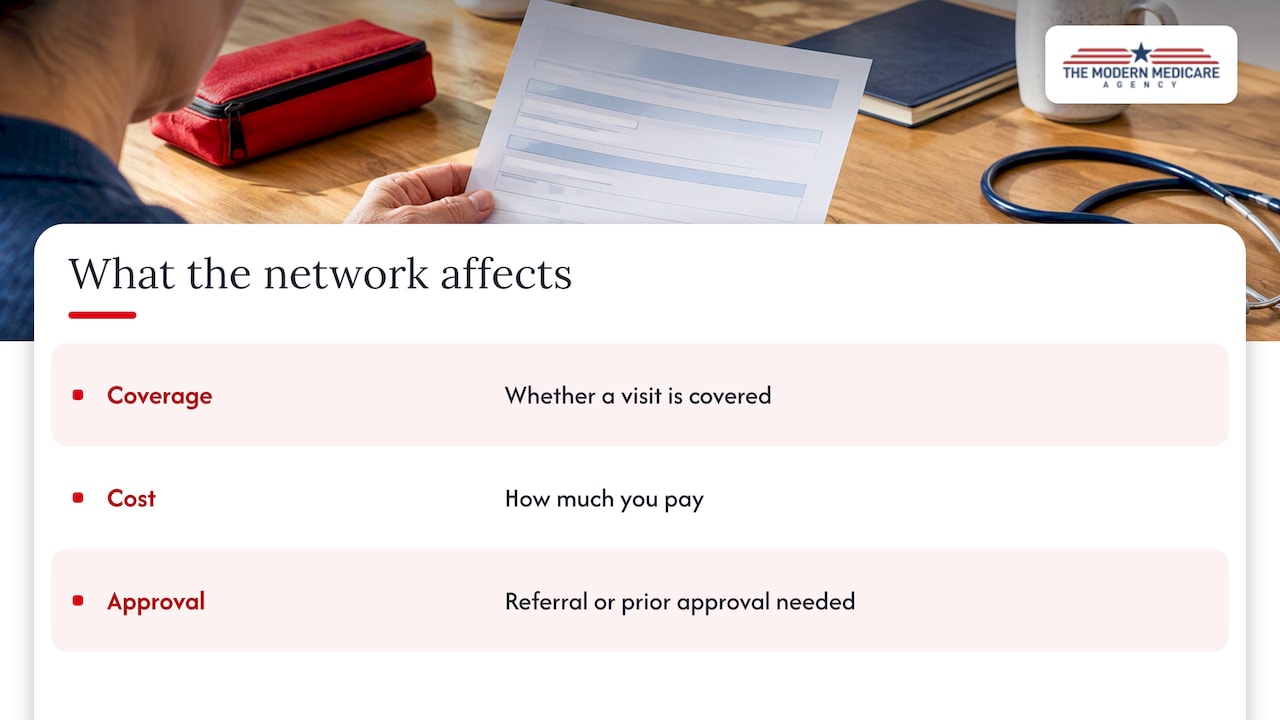
The network matters because it drives three things: whether a visit is covered at all, how much you pay, and whether you need a referral or prior approval first. Medicare Advantage members must follow plan-specific rules, such as getting prior approval for certain services. Skipping a rule can turn a covered service into one you pay for yourself.
Networks also change. Doctors and hospitals join and leave, and a plan’s list can look different from one year to the next. Our guide to Medicare Advantage network restrictions goes deeper on how those limits work.
How out-of-network rules differ by plan type
The label on your plan card tells you more than any other detail. Medicare publishes how each type handles outside providers, and the differences are large.
| Plan type | Out-of-network care | What to expect |
|---|---|---|
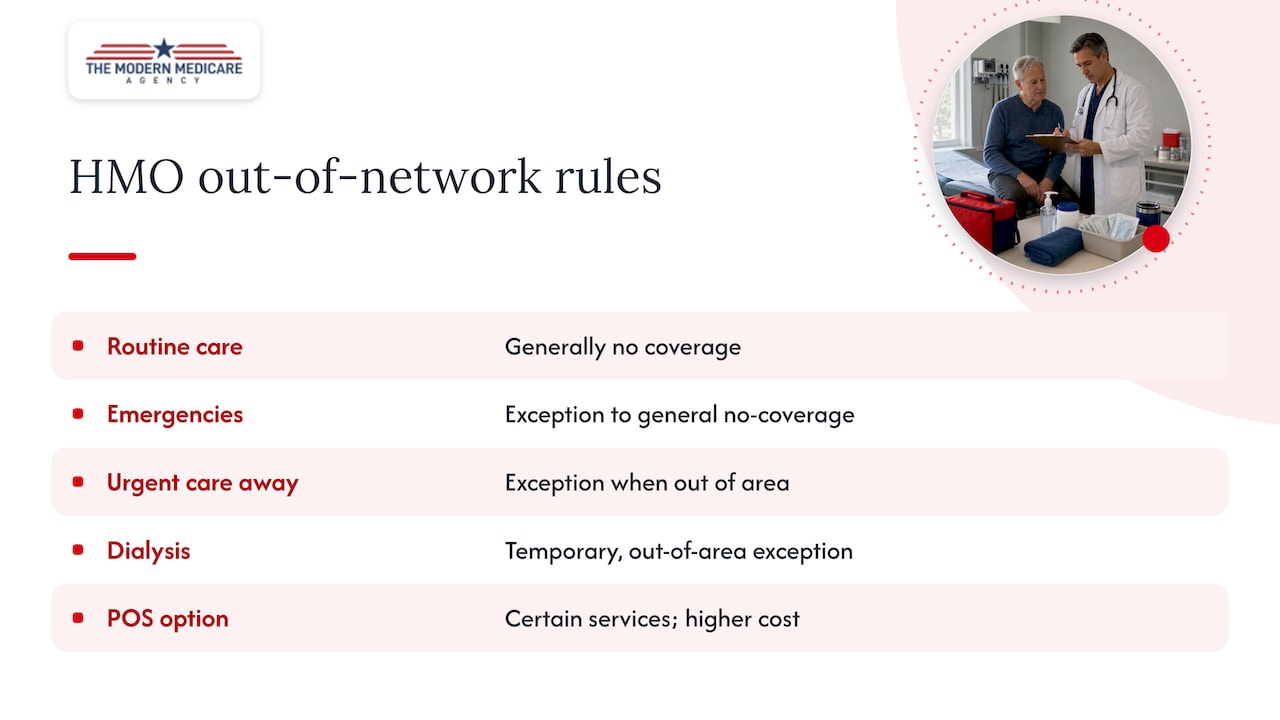
| HMO | Generally not covered, except emergency care, out-of-area urgent care and temporary out-of-area dialysis | Lowest flexibility, you stay in the network |
| HMO Point-of-Service (HMOPOS) | Option to go out of network for certain services | Usually costs more |
| PPO | Allowed for covered services | Higher out-of-pocket costs than in-network |
| PFFS | Any Medicare-approved provider who accepts the plan’s terms and agrees to treat you | Some PFFS plans also use networks |
| SNP (Special Needs Plan) | Depends on the plan | Some require in-network care, others cover qualified out-of-network providers at a higher cost |
These summaries come from Medicare’s pages on comparing Medicare Advantage plan types, HMO point-of-service plans, PFFS plans and Special Needs Plans.
HMO plans
An HMO is the strictest design. Outside the network, you are generally on your own, with a short list of exceptions: emergencies, urgent care when you are out of the area, and temporary out-of-area dialysis. In exchange, HMOs often carry lower premiums and copays. If you have one doctor you will not give up, check that doctor first.
Some HMOs add a point-of-service option. That gives you a way to use out-of-network providers for certain services, usually at a higher cost to you.
PPO plans
A PPO is the plan most people mean when they ask about out-of-network coverage. You can see providers outside the network for covered services, but you will typically pay more than you would in network. That can mean a higher copay or coinsurance, and sometimes a separate out-of-network deductible or out-of-pocket limit. The plan’s Summary of Benefits lists both sets of numbers side by side, so read both columns.
PFFS plans
Private Fee-for-Service plans are the odd ones out. You can go to any Medicare-approved provider who accepts the plan’s payment terms and agrees to treat you. The catch is in those last words. A provider is not obligated to say yes, and some PFFS plans also use specific networks. Availability of PFFS plans varies a lot by county, so many people will not see one on their list.
Special Needs Plans
SNPs serve people with certain conditions, dual eligibility for Medicare and Medicaid, or institutional needs. Some require in-network care. Others cover out-of-network care from qualified providers or facilities, usually at a higher cost. Read the plan’s own documents, because two SNPs in the same county can behave differently.
Emergencies and urgent care are always covered
This is the one rule that does not change by plan type. Medicare Advantage plans must cover emergency care and urgently needed services, even when the provider is out of network or out of the area. You do not need to ask permission first, and you should not delay care to check a directory.
Two practical points:
- Go to the nearest appropriate facility. If you believe your life or health is at serious risk, call 911 or go to the closest emergency room.
- Follow up with your plan afterward. Call the number on your member card to report the visit, and read any bill or explanation of benefits carefully. Your cost share for an emergency is set by your plan’s rules.
When a declared disaster or emergency disrupts care in your area, the protection widens. Your plan must allow care at Medicare-certified facilities from providers outside its network, without a referral, and at the in-network rate.
What out-of-network care can cost you
Medicare does not publish one out-of-network price, because each plan sets its own. What you can count on is the pattern: in-network visits cost the least, and out-of-network visits cost more when they are covered at all. A PPO might charge a flat copay for a specialist in network and a percentage of the bill out of network. The percentage version is the one that surprises people, because the final amount depends on what the provider charges.
A simple way to estimate your exposure before a visit:
- Open your plan’s Evidence of Coverage or Summary of Benefits.
- Find the out-of-network column for the service (specialist visit, outpatient surgery, imaging).
- Ask the provider’s billing office what they expect to charge and whether they will bill your plan.
- Call the plan with the provider’s name and the billing code, and ask how much you would owe.
If you skip step 3, you can end up in the situation brokers see often: the plan allows out-of-network care in principle, but the doctor declines to bill it and asks for payment up front.
Can an out-of-network provider refuse to treat you?
Yes, outside of emergencies. A provider who does not contract with your plan has no obligation to accept it, and out-of-network providers are not required to treat members except in emergencies, a point one regional PPO plan states on its own plan page. PFFS plans say the same thing in Medicare’s own wording: the provider must accept the plan’s terms and agree to treat you. So “my plan allows out-of-network” and “this doctor will see me under my plan” are two separate questions. Always ask the doctor’s office the second one.
Using Medicare Advantage out of state
Original Medicare works in all 50 states and U.S. territories, with no network. Medicare Advantage is tied to a service area, so what happens away from home depends on the plan. According to the National Council on Aging, some plans offer coverage across states and a national pharmacy network, while others do not cover care outside their service area, or apply higher cost sharing or prior authorization to out-of-network care. The same page notes that both Original Medicare and Medicare Advantage must cover emergencies.
In practice:
- Emergency or urgent care while traveling: covered under every plan.
- Routine care while traveling: PPOs are the more flexible option, but you still pay more out of network. HMOs generally do not cover routine care outside the service area.
- Long stays away from home (snowbirds, extended family visits): ask your plan whether it offers a visitor or traveler benefit and how long it lasts. Some members find that a plan built for their home county does not fit a second home in another state.
- Moving permanently: a move outside your plan’s service area usually opens a chance to change plans. Contact the plan and Medicare to confirm your options and timing.
If you split the year between two states, tell your agent before open enrollment, because it changes which plan type makes sense. Our overview of Medicare Advantage plans explains how service areas work.
Before you get out-of-network care: a checklist
Medicare’s own guidance is to check your plan’s provider directory or contact the plan to confirm a provider’s network status, and to ask how much you will pay out of network. Turn that into five steps:
- Confirm the network status. Look the provider up in the plan’s online directory, then call the plan, since directories can lag behind reality. Our guide on how to check if your specialist is in a Medicare Advantage network walks through it.
- Check the exact facility too. A doctor can be in network while the hospital or lab they use is not. Ask about both.
- Ask whether prior approval is needed. Many plans require authorization for surgeries, imaging and other services, and out-of-network care often has stricter rules.
- Get the cost in writing when you can. Ask the provider’s office for an estimate and your plan for the out-of-network cost share.
- Ask whether the provider will bill your plan. If not, find out what you must pay up front and whether you can file a claim yourself.
Do this again every fall. Medicare advises members to confirm that a provider is in the network before scheduling an appointment, especially around the annual enrollment period, October 15 to December 7, when networks and plan details for the next year are being finalized.
If your doctor leaves your plan’s network
This is the most common way people end up out of network without choosing it. When a provider leaves, your plan should make a good faith effort to give you at least 30 days’ notice. To get covered services at the in-network level, you will then need to choose a provider in the plan’s network.
Your options generally look like this:
- Find an in-network replacement. Ask your doctor for referrals within the network.
- Call the plan and ask what is available. Ask about continuing care if you are in the middle of treatment, such as chemotherapy or recovery from surgery. Plans have their own processes, and it is better to ask early.
- Stay with the doctor and pay more. This is only realistic on a PPO or similar plan, and only if the doctor will bill the plan.
- Review your plan at the next enrollment window. If the network no longer fits your life, you may want a plan that includes your doctor, or a different type of coverage entirely.
We cover this scenario in detail in what to do when your doctor leaves your Medicare network.
When the plan denies a service
Sometimes a plan refuses to cover a service or to authorize it in advance, which is common when someone goes out of network without approval. You have the right to appeal. The plan’s written decision, called a Notice of Denial of Medical Coverage, is the document you use to start an appeal. Keep it, note the deadline printed on it, and ask your doctor to support your case with a letter. Your State Health Insurance Assistance Program (SHIP) offers free, unbiased counseling on appeals.
Is a network-based plan right for you?
The out-of-network question is really a question about how much freedom you need. A few quick tests:
- You have specialists you will not change, or you see providers in several states. Look hard at a PPO, or at Original Medicare paired with a Medicare Supplement (Medigap) plan. Medigap works with any provider who accepts Medicare, so it does not have a network. Compare options on our Medicare Supplement page.
- Your doctors are all local and in network, and you want lower monthly costs. An HMO may fit, as long as you accept the network rules.
- You travel often, or live in two places. Ask specifically about out-of-area benefits before you enroll.
Neither path is right for everyone. Medigap generally has higher premiums in exchange for broad access, while Medicare Advantage often has lower premiums in exchange for network rules. The best choice is the one that matches your doctors, your prescriptions and your budget.
Our perspective
We have heard the same story for years: someone picked a plan because the premium looked low, then found out in the middle of treatment that their specialist was not in the network. Nothing in the plan was hidden. Nobody had explained it to them in plain words.
That is why we start with education. Before we talk about any plan, we ask which doctors and hospitals you use, which prescriptions you take, and where you spend your year. Then we check those against the networks of the plans available in your county. As independent agents, we are not tied to one insurer, so we can show you an HMO, a PPO and a Medigap option side by side and tell you honestly what each one trades away. Plan networks can change from year to year, so we also recommend a yearly coverage checkup, not just a one-time purchase.
If your plan is working, we will tell you to keep it. If it is not, we will tell you that, too.
— Paul
Check your doctors against your plan
If you are choosing a plan, or you are unhappy with the one you have, our team can check your doctors, hospitals and prescriptions against the plans available where you live. There is no pressure and no cost to you for the review. Start with our Medicare Advantage plan page to see how we help, or ask us about Medigap if you want a plan without a network.

For a closer look at how to confirm your doctor, read our guide on how to find doctors in your Medicare Advantage network.
FAQ
Does Medicare Advantage cover out-of-network care?
Some plans do, usually at a higher cost. PPOs and HMO point-of-service plans allow it, while standard HMOs generally do not, except for emergencies, out-of-area urgent care and temporary out-of-area dialysis. Check your plan’s Evidence of Coverage for the exact rules.
Can Medicare Advantage plans be used out of state?
It depends on the plan. Emergency and urgent care is covered anywhere, but routine care outside your service area may not be covered, or may cost more. Some plans offer broader coverage across states, so ask your plan before you travel for an extended time.
Will an out-of-network doctor see me?
Not necessarily. Outside of emergencies, a provider who does not contract with your plan can decline to treat you or to bill the plan. Call the doctor’s office and ask whether they accept your specific plan before you book.
What if my doctor leaves my plan’s network?
Your plan should make a good faith effort to give you at least 30 days’ notice. To get covered services at the in-network level, you will need to choose an in-network provider. Call the plan about continuing care if you are in active treatment.
Does Medigap have an out-of-network problem?
Medigap does not use a network. It works alongside Original Medicare, so you can see any provider who accepts Medicare. The tradeoff is usually a higher monthly premium than many Medicare Advantage plans.
Sources
- How to get Medicare services | Medicare
- Compare types of Medicare Advantage Plans | Medicare
- Health Maintenance Organizations (HMOs) | Medicare
- Private Fee-for-Service (PFFS) Plans | Medicare
- Special Needs Plans (SNP) | Medicare
- Getting Care & Drugs in a Disaster or Emergency | Medicare
- Understanding Your Medicare Advantage Plan’s Provider Network | Medicare
- Medicare Advantage and Other Medicare Health Plans workbook | CMS
- Original Medicare and Medicare Advantage Appeals | SHIP
- Does Medicare Cover You Anywhere? | National Council on Aging