
What if your health insurance wasn’t just a stack of confusing paperwork, but a custom shield designed specifically for your life? In 2026, choosing a Medicare Advantage plan often feels like trying to solve a puzzle while someone is shouting at you through the television. We know the stress of seeing those aggressive ads and worrying if your favorite doctor will still be in your network next year. You deserve a healthcare experience that feels safe and predictable, not one that keeps you up at night worrying about hidden costs.
We understand that you want a plan that covers every one of your medications and protects you from massive medical bills. Our goal is to simplify these complexities and help you move from a state of total confusion to one of absolute confidence in your healthcare choices. In this guide, we’ll walk you through the 2026 updates, including the $202.90 Part B premium and the $35 monthly cap on insulin. We will show you how to find a plan with predictable monthly costs so you can focus on your health instead of your spreadsheets.
Key Takeaways
- Learn how your 2026 medicare advantage plan bundles hospital, medical, and pharmacy coverage into one simple package.
- Discover why 75% of enrollees still have access to zero-premium options and what your actual out-of-pocket limits look like this year.
- Understand the vital differences between network-based plans and Original Medicare so you don’t lose access to the doctors you trust.
- Follow our five-step checklist to verify that your specific medications and hospitals are fully covered before you make a choice.
- See why an independent expert who compares over 40 companies protects your interests better than an agent who only works for one brand.
What Are Medicare Advantage Plans and How Do They Work in 2026?
Choosing how to receive your healthcare shouldn’t feel like a high-stakes gamble. When we talk about Medicare Advantage (Part C), we’re describing a private insurance alternative to Original Medicare. Instead of the government paying your doctors directly, these private companies receive a set fee from the federal government to coordinate your care. In 2026, the Centers for Medicare & Medicaid Services (CMS) continues to strictly oversee these contracts to ensure you receive the same level of protection as the traditional system, often with extra benefits added in.
We often call this the “all-in-one” solution for modern healthcare. Why? Because it brings together several different pieces of the Medicare puzzle into a single, cohesive plan. For many of our clients, the move to medicare advantage is about finding a predictable way to manage their health without the stress of managing multiple different insurance policies and billing statements.
The Core Components of a Part C Plan
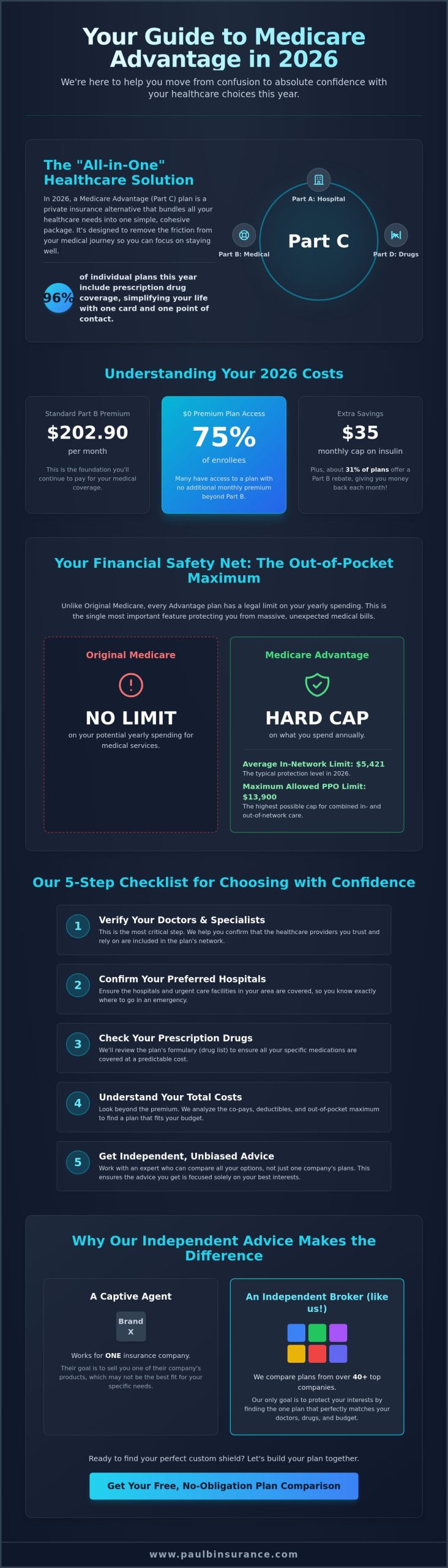
A standard plan in 2026 must cover everything that Original Medicare covers. This includes your hospital stays under Part A and your medical visits or outpatient care under Part B. However, these plans go a step further by integrating prescription drug coverage, also known as Part D, into the package. In fact, 96% of enrollees in individual medicare advantage plans this year have their drug coverage included right in their main plan.
This integration simplifies your medical life significantly. You don’t have to carry three different cards or worry about which company handles which bill. You have one card, one point of contact, and one clear path to your care. It’s about removing the friction from your healthcare journey so you can focus on staying well.
Who Is Eligible for Medicare Advantage in 2026?
To join a plan this year, you must first be enrolled in both Medicare Part A and Part B. Think of these as the foundation you need before we can build your custom shield. You also need to live within the specific service area of the plan you choose. Because these plans are based on local networks of doctors and hospitals, your zip code determines which options are available to you. If you’re wondering about the specific timing of when you can join, you can learn more about how these plans fit into your overall Medicare journey.
Understanding the Costs and Benefits of Medicare Advantage This Year
Talking about money and healthcare in the same breath can feel overwhelming. We want to clear the air. In 2026, the financial landscape of medicare advantage remains quite stable, but there are nuances you need to understand to protect your savings. You might have seen advertisements for “Zero-Premium” plans. It’s a real option. In fact, 75% of enrollees this year have access to a plan with no monthly premium other than their standard Medicare Part B premium, which is $202.90 for most people in 2026. This doesn’t mean the insurance is free; it means the plan is paid by the government to manage your care instead of charging you a monthly fee.
For some, these plans even offer a “Part B rebate.” About 31% of plans this year actually pay back a portion of your Part B premium. We like to think of this as a monthly pay raise. However, we always remind our clients that there is a trade-off. Choosing a lower premium often means you’ll pay more in co-pays when you actually visit the doctor. You may also encounter “prior authorization,” where the plan must approve certain services before they happen. This is a common point of frustration, but a KFF analysis of Medicare Advantage shows that these rules are standard across most private contracts to keep overall costs down.
The Financial Safety Net: Out-of-Pocket Maximums
The most significant benefit of these plans is the safety net they provide. Unlike Original Medicare, which has no cap on what you might spend, every medicare advantage plan has a legal limit on your yearly spending. In 2026, the average out-of-pocket limit for in-network services is $5,421. While the government allows plans to set this limit as high as $9,250, many plans keep it lower to stay competitive. If you choose a PPO plan for more flexibility, your combined in-network and out-of-network limit can go up to $13,900. This cap is why many people feel a sense of peace. You know exactly what your “worst-case scenario” looks like, protecting you from medical bankruptcy.
Beyond the Basics: 2026 Supplemental Benefits
Many people choose these plans for the “extras” that the government doesn’t typically cover. Dental, vision, and hearing benefits are nearly universal in 2026. We also see plans continuing to offer fitness programs, transportation to appointments, and even meal delivery after a hospital stay. It’s about supporting your whole life, not just your medical chart. If you find that a plan’s dental coverage isn’t quite enough for major work, you might consider looking into standalone dental insurance options to fill those gaps. If you feel stuck between two choices, we can help you compare your specific 2026 options to see which financial structure fits your budget best.
Comparing Original Medicare vs. Medicare Advantage: Which Is Right for You?
Choosing between these two paths is the most important decision you’ll make during the 2026 enrollment season. It is a choice between maximum flexibility and maximum value. Original Medicare is the traditional government program. Medicare Advantage is the private alternative we explored in the previous sections. Neither is perfect for everyone. Your unique health needs, your travel plans, and your monthly budget will point the way to the right choice for your life.
In 2026, care management is a significant factor in how these plans differ. With medicare advantage, your insurance company plays an active role in your treatment plan. This often involves a process called prior authorization. This means the plan confirms a procedure or specialist visit is medically necessary before they agree to pay for it. In Original Medicare, this is rarely required. You and your doctor decide on a course of action, and as long as it’s a covered service, Medicare pays its share. It’s a simpler process, but it lacks the coordinated care approach that private plans offer.
When Original Medicare + Medigap Is the Better Choice
If you spend your winters in a warmer climate and your summers back home, Original Medicare is likely your best friend. It offers nationwide coverage. You can see any doctor or visit any hospital in the United States that accepts Medicare patients. To make your costs predictable, we usually recommend pairing this with a Medicare Supplement plan. We often define Medigap as a “gap-filler” because it pays the 20% of medical costs that Medicare does not cover. This creates a very stable monthly budget. You pay a higher premium up front, but you have almost no surprise costs when you visit a specialist or need a series of tests.
When Medicare Advantage Wins on Value
For many of our clients, medicare advantage wins because of its lower monthly fixed costs. If you are generally healthy and prefer to pay for care only when you use it, this path often makes the most financial sense. It is also incredibly convenient. Having your drugs, dental, and vision coverage bundled into one plan saves you the time and energy of managing multiple policies. In 2026, $0 premium plans continue to be a lifeline for those on a fixed income. They allow you to keep more of your monthly check while still providing the peace of mind that comes with a yearly out-of-pocket spending limit. It is a journey from financial uncertainty to a state of total confidence.
5 Essential Steps to Choosing the Best Medicare Advantage Plan
Moving from a state of uncertainty to one of total confidence requires a structured path. We believe that choosing a plan shouldn’t feel like a guessing game. By following a methodical process, you can strip away the marketing noise and focus on what actually matters: your health and your wallet. In 2026, the sheer number of options can be overwhelming, but these five steps will help you build a plan that acts as a true shield for your future.
- Step 1: Audit your medications. Never assume a drug covered last year is still on the list. Check the 2026 formulary for every prescription you take.
- Step 2: Confirm your “Must-Have” providers. Call your doctors directly to ask if they are staying in your specific plan’s network for the upcoming year.
- Step 3: Calculate your “Total Estimated Cost.” Add your monthly premiums to your expected co-pays. Don’t forget the $202.90 Part B premium you still have to pay.
- Step 4: Evaluate the quality. Look at the 2026 CMS Star Ratings. These scores reflect member satisfaction and how well the plan manages chronic conditions.
- Step 5: Review the prior authorization list. If you have a specific condition, check which treatments require the insurance company’s “okay” before you can receive care.
The Medication Audit: Don’t Skip This
Drug tiers change every year. A medication that was affordable in 2025 might move to a higher tier in 2026, significantly increasing your costs. We recommend using our Medicare Part D guide to understand how these formularies work. Remember that in 2026, your insulin costs are capped at $35 per month, which provides a great deal of relief. However, a “cheap” medicare advantage plan can quickly become expensive if your other vital medications aren’t properly covered. We can help you audit your current prescriptions to ensure your 2026 plan is a perfect fit.
Understanding Network Types: HMO vs. PPO
Your lifestyle dictates which network style is best. An HMO (Health Maintenance Organization) usually offers lower costs, but you must stay within the network and get referrals to see specialists. This is often a great fit for those who stay close to home. A PPO (Preferred Provider Organization) gives you the flexibility to go out-of-network, which is vital for travelers. In 2026, PPO plans have an average out-of-pocket limit of $9,825 for combined services. While this is higher than an HMO, the freedom to choose any doctor might be worth the extra cost for your peace of mind. Choosing the right medicare advantage structure ensures you aren’t stuck with unexpected bills while visiting family or vacationing.
Why Working with an Independent Medicare Broker Makes All the Difference
The 2026 Medicare market is louder than ever. You’ve likely seen the commercials and received the mailers. It’s hard to know who to trust when everyone claims to have the “best” plan. We believe the biggest difference in your experience comes down to who your advisor represents. A captive agent is an employee of one specific insurance company. Their job is to sell you that company’s products, even if a better option exists elsewhere. We take a different path. As independent brokers, we don’t work for the insurance companies. We work for you.
We represent over 40 different companies. This means we can look at the entire medicare advantage market to find the one plan that fits your specific needs. Our loyalty is to your health and your budget, not a carrier’s bottom line. We act as your personal advocate, helping you filter through the noise to find clarity and peace of mind. It is a journey from a state of distress to one of absolute certainty.
Our support doesn’t end when you sign your name. We provide year-round assistance. If you receive a bill you don’t understand or your doctor’s office has a question about your 2026 coverage, we are the ones you call. We handle these stressful moments so you don’t have to. We believe in building long-term relationships based on trust and reliable support.
Unbiased Guidance Based on Your Needs
We believe in transparency. When we sit down together, we compare options from major carriers like Aetna, BlueCross, and UnitedHealthcare. We look at the 2026 formularies and network lists for each one. This methodical approach ensures that your medicare advantage choice is based on data, not a high-pressure sales pitch. You can learn more about our commitment to your best interests in our Medicare Broker Guide. We want you to feel empowered by your choices, not restricted by them.
Your Journey to Peace of Mind Starts Here
The insurance market can feel chaotic. Having a calm, expert guide by your side changes everything. We take the time to explain the fine print in simple, declarative sentences. We want you to understand exactly how your plan works before you ever need to use it. This removes the anxiety from the process and replaces it with the security you deserve. We invite you to schedule your free 2026 Medicare consultation with us today. Let’s build your custom shield together and ensure you are protected for the year ahead.
Securing Your Health and Peace of Mind for 2026
Choosing the right healthcare path shouldn’t feel like a burden you carry alone. We’ve explored how a medicare advantage plan can bundle your hospital, medical, and pharmacy needs into one simple package. You now understand how the 2026 out-of-pocket limits and the $35 insulin cap provide a vital financial safety net for your future. Whether you prioritize the flexibility of a PPO or the value of an HMO, the goal is to move you from a state of uncertainty to one of total confidence.
You don’t have to navigate these complex choices by yourself. Paul Barrett and our dedicated team are here to act as your personal advocates. We represent over 40 insurance carriers and are licensed in more than 34 states to provide you with personalized, unbiased guidance. We take the time to handle the fine print so you can focus on what truly matters. Your journey to a stress-free healthcare experience is just one conversation away. Compare 2026 Medicare Advantage Plans with an Independent Expert today. We’re ready to help you build a custom shield that protects your health and your peace of mind.
Frequently Asked Questions
What is the maximum out-of-pocket limit for Medicare Advantage in 2026?
The federal government has set the maximum in-network out-of-pocket limit at $9,250 for 2026. If you choose a PPO plan that allows for out-of-network care, the combined limit for both in-network and out-of-network services is $13,900. These limits act as a vital safety net, ensuring you are protected from unlimited medical bills if a serious health issue arises.
Can I switch from Medicare Advantage back to Original Medicare?
Yes, you can return to Original Medicare during specific times of the year. The primary windows for this change are the Annual Enrollment Period in the fall or the medicare advantage Open Enrollment Period, which runs from January 1 to March 31. We often remind our clients that while switching back is simple, qualifying for a separate Medigap plan later may require a health review in many states.
Do Medicare Advantage plans cover dental and vision in 2026?
Most plans in 2026 include coverage for dental, vision, and hearing services as part of their supplemental benefits. These extras typically cover routine needs like cleanings, eye exams, and hearing aid fittings that Original Medicare does not pay for. We help you review the specific limits of these benefits to ensure they meet your personal health goals.
Is there a monthly premium for Medicare Advantage plans?
Many plans offer a $0 monthly premium, and in 2026, 75% of enrollees have access to these zero-premium options. While the plan itself may not charge a fee, you must continue to pay your standard Medicare Part B premium. We can help you compare these plans to see if the “pay-as-you-go” co-pay structure fits your monthly budget better than a high-premium alternative.
What is the difference between an HMO and a PPO in Medicare Advantage?
An HMO usually requires you to see doctors within a specific network and obtain referrals for specialists to keep your costs low. A PPO offers more freedom to see providers outside the network, though you will generally pay a higher share of the cost for that flexibility. Choosing between them depends on whether you prefer lower costs or the ability to see any specialist without a gatekeeper.
How do I know if my doctor is in a Medicare Advantage plan’s network?
The most reliable way to confirm is to check the plan’s 2026 provider directory or call your doctor’s billing office directly. Because networks can change from year to year, we make it a priority to help you verify your “must-have” doctors before you commit to a new plan. This simple step prevents the stress of discovering your trusted physician is no longer covered after your plan begins.
Do I still have to pay my Medicare Part B premium if I have an Advantage plan?
Yes, you are still responsible for your Medicare Part B premium, which is $202.90 for most people in 2026. Some medicare advantage plans offer a “Part B Buy-Back” or rebate benefit that pays a portion of this premium for you. We can look for these specific plans if reducing your monthly Social Security deduction is a top priority for your household.
What are the Medicare Advantage enrollment periods for 2026?
The Annual Enrollment Period (AEP) is the most important date to remember, running from October 15 to December 7. During this time, anyone with Medicare can join or switch plans for the coming year. If you are already in an Advantage plan and realize it isn’t the right fit, you have a second chance to switch or return to Original Medicare during the Open Enrollment Period from January 1 to March 31.

Article by
Paul Barrett
Paul Barrett, CMIP is the founder of The Modern Medicare Agency, an independent Medicare-only brokerage based in Melville, NY. With 18 years of Medicare-exclusive experience, a CMIP designation, and more than 5,000 clients served across 37 states, Paul is one of the most credentialed independent Medicare specialists on Long Island — and one of the most direct.
He represents 40+ carriers with no quotas and no allegiances, which means his recommendations are based entirely on what fits each client's specific situation. He is the author of Medicare Mastery Unlocked and host of the Wise Guys Retirement Talk podcast. His content is grounded in primary sources, real carrier intelligence, and 18 years of watching what happens when people get Medicare right — and when they don't.
📞 631-358-5793 | paulbinsurance.com