



Medicare Advantage Plans Explained

Clear, Honest Guidance to Help You Decide If Medicare Advantage Is Right for You

Medicare Advantage plans work extremely well for millions of Medicare beneficiaries — and poorly for others.
The difference is almost never the plan itself.
It’s whether the person enrolling understands how Medicare Advantage actually works.
This page is designed to give you the full picture — clearly, calmly, and without sales pressure — so you can decide whether Medicare Advantage fits your healthcare needs, lifestyle, and budget.

What Medicare Advantage Is — and What It Is Not

Medicare Advantage (also called Medicare Part C) is a federally regulated Medicare program administered by private insurance companies.
When you enroll:
  • You are still in Medicare
  • Medicare pays the insurance company to manage your care
  • The plan must follow strict CMS rules
By law, Medicare Advantage plans must cover everything Original Medicare covers — at least as well.
Many plans also include additional benefits.
What changes is how care is accessed, not whether it is covered.

Why Medicare Advantage Exists (Context Matters)

Medicare Advantage was created to:
  • Offer alternatives to Original Medicare
  • Control rising healthcare costs
  • Provide coordinated care models
  • Expand access to prescription drug coverage
  • Add cost protection through spending limits
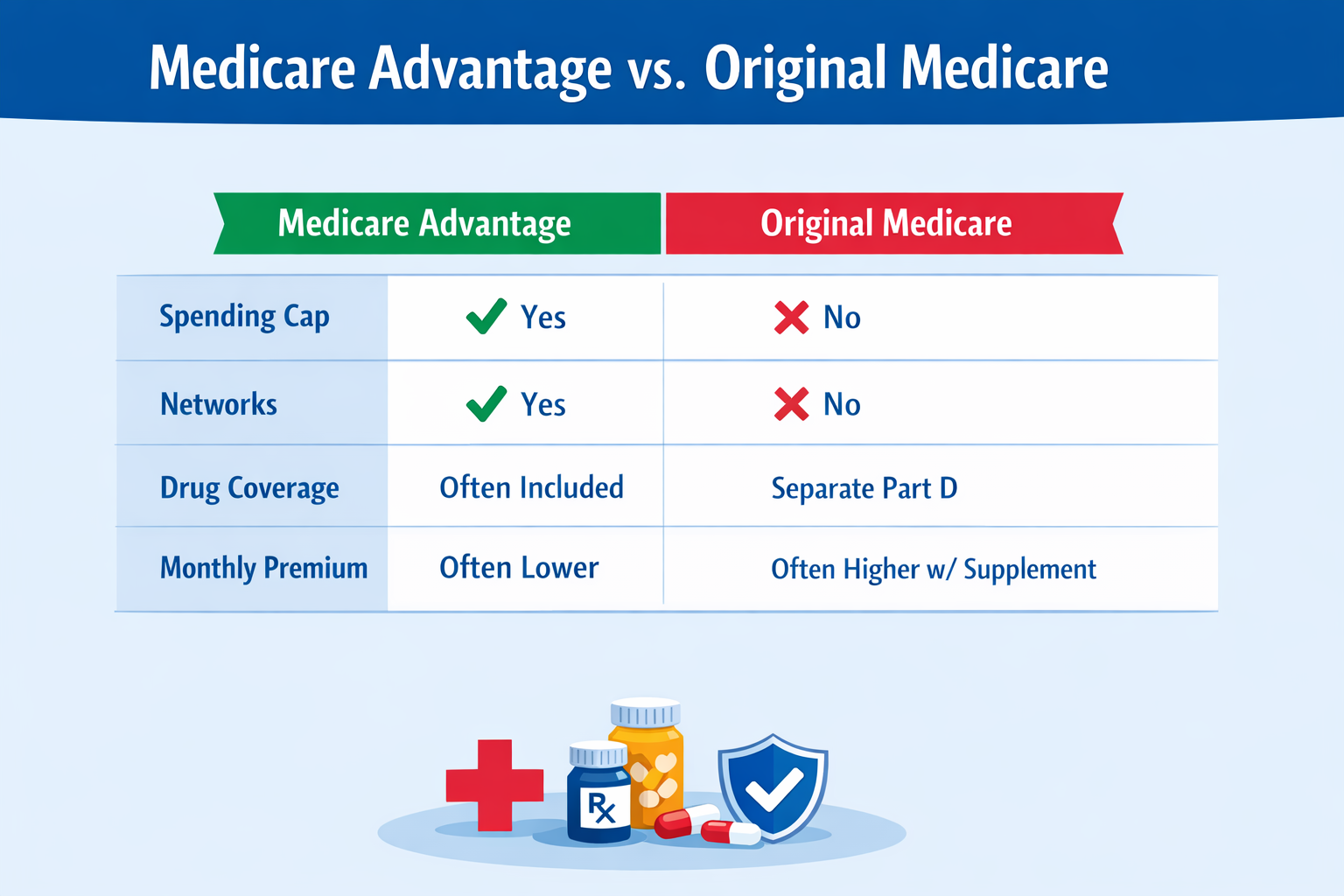
It exists because Original Medicare alone has no out-of-pocket maximum and can expose beneficiaries to unlimited costs without a supplement.

Coverage vs. Access: The Most Important Distinction

This is where confusion usually begins.
Coverage
Medicare Advantage plans must cover all Medicare-approved services.
Access
Plans manage how and where those services are delivered through:
  • Provider networks
  • Referral requirements
  • Prior authorizations
Most dissatisfaction with Medicare Advantage comes from access expectations, not coverage gaps.

Networks: Why They Matter More Than Premiums

Medicare Advantage plans use provider networks.
Depending on plan type:
  • HMO plans require in-network care and referrals
  • PPO plans allow more flexibility but still rely on preferred networks
Important realities:
  • Networks vary by region and ZIP code
  • Networks can change annually
  • Hospitals matter just as much as doctors
For people who want unrestricted provider choice, networks can feel limiting.
For others, they provide structure and lower costs.

Referrals and Prior Authorizations — The Why, Not Just the What

Medicare Advantage plans often require:
  • Referrals to specialists
  • Prior authorization for certain services
This isn’t unique to Medicare Advantage — it’s how most managed healthcare works in the U.S.
For some people:
  • It’s a non-issue
    For others:
  • It feels restrictive
Neither reaction is wrong.
It’s about compatibility with your healthcare style.

Understanding the True Cost of Medicare Advantage

Low or $0 premiums are real — but they are not the full story.
Costs may include:
  • Copays for doctor and specialist visits
  • Daily hospital copays
  • Coinsurance for outpatient procedures
  • Out-of-network costs (if allowed)
However…

The Built-In Spending Cap (A Major Advantage)

Medicare Advantage plans include an annual maximum out-of-pocket limit for medical services.
Once that limit is reached:
  • The plan pays 100% of covered medical costs for the rest of the year
Original Medicare does not have this protection unless you add a Medicare Supplement.
For many people, this cap provides meaningful financial security.

Prescription Drug Coverage: Often Stronger Than Stand-Alone Part D

Most Medicare Advantage plans include Part D prescription coverage.
In many regions, these plans:
  • Offer competitive drug formularies
  • Provide lower copays for common medications
  • Perform better than some standalone Part D plans
Drug coverage should always be reviewed individually — but it is often a strength, not a weakness.

Why Plans Change Every Year (And Why Reviews Matter)

Medicare Advantage plans are renewed annually.
Each year, plans may change:
  • Provider networks
  • Drug formularies
  • Copays and benefits
  • Out-of-pocket limits
This is why annual plan reviews are essential, even if you’re happy today.

Who Medicare Advantage Often Works Best For

Medicare Advantage may be a strong fit if you:
  • Want lower monthly premiums
  • Are comfortable with managed care
  • Prefer bundled coverage (medical + drugs)
  • Value a spending cap
  • Are open to reviewing your plan annually

When Medicare Advantage May Not Be the Best Fit

It may be less ideal if you:
  • Want unrestricted provider access
  • See many specialists
  • Travel frequently across states
  • Prefer minimal administrative rules
  • Want long-term predictability above all else
This is when Medicare Supplement options are often explored.

A Smarter Way to Decide (Education First)

Instead of asking:
“Is Medicare Advantage good or bad?”
A better question is:
“How does Medicare Advantage fit the way I use healthcare?”
When that question is answered honestly, good decisions follow.
Medicare Advantage FAQs — Straight Answers You Deserve

Do Medicare Advantage plans really cover everything Original Medicare covers?
Yes. By law, Medicare Advantage plans must cover all medically necessary services that Original Medicare Part A and Part B cover.
This requirement is written directly into their contract with Medicare.
The difference is not what is covered — it’s how the coverage is accessed, such as networks, referrals, and prior authorizations.
If Medicare Advantage covers the same things, why do people complain?
Most complaints are about access and process, not coverage.
Common frustration points include:
  • A doctor leaving the network
  • Referral requirements
  • Prior authorization delays
  • Unexpected copays
These issues don’t mean care isn’t covered — they mean the plan has rules around how care is delivered.
Are Medicare Advantage plans bad?
No — and saying they are is misleading.
Medicare Advantage plans work very well for millions of people.
They work poorly when someone enrolls without understanding:
  • Networks
  • Prescription coverage
  • How referrals and authorizations work
The plan isn’t the problem — the fit is.
Why do Medicare Advantage plans vary so much by ZIP code?
Medicare Advantage plans are local plans.
They are built around:
  • Local hospitals
  • Local doctor groups
  • Regional healthcare costs
That’s why a plan that works great in one county may be unavailable — or ineffective — in another. This is also why national TV ads can be misleading.
What’s the difference between an HMO and a PPO Medicare Advantage plan?
  • HMO plans usually require referrals and limit care to in-network providers (except emergencies).
  • PPO plans allow more flexibility and may cover out-of-network care at higher cost.
Neither is “better.”
The right choice depends on how important provider flexibility is to you.
Do Medicare Advantage plans require prior authorization?
Most do — especially for:
  • Imaging (MRI, CT scans)
  • Surgeries
  • Infusions
  • Skilled nursing facility stays
This is common in managed care. Some people are comfortable with this structure; others prefer fewer administrative steps.
Do Medicare Advantage plans have a spending limit?
Yes — and this is one of their biggest advantages.
Medicare Advantage plans include an annual maximum out-of-pocket limit for medical services. Once you reach it, the plan pays 100% of covered medical costs for the rest of the year.
Original Medicare does not have this protection unless you add a Medicare Supplement.
Are prescription drugs covered with Medicare Advantage?
Most Medicare Advantage plans include Part D prescription drug coverage.
In many areas, Medicare Advantage drug coverage is as good as or better than standalone Part D plans — but this varies by plan and medication list.
Prescription coverage should always be reviewed drug by drug, not assumed.
Why do Medicare Advantage plans change every year?
Medicare Advantage plans are renewed annually with Medicare.
Each year, insurance companies may adjust:
  • Doctor networks
  • Drug formularies
  • Copays
  • Out-of-pocket limits
This is why reviewing your plan every year is critical — even if nothing changed for you personally.
Can I switch Medicare Advantage plans later?
Yes, but when you can switch matters.
Most people can change plans during:
  • The Annual Enrollment Period (fall)
  • The Medicare Advantage Open Enrollment Period (early in the year)
Certain life events may also trigger Special Enrollment Periods.
Is Medicare Advantage cheaper than a Medicare Supplement?
It often is — monthly.
Medicare Advantage usually has lower premiums, while Medicare Supplements typically cost more monthly but offer more predictable medical costs.
The better option depends on:
  • Budget
  • Health usage
  • Comfort with networks
  • Desire for predictability
Why do some people leave Medicare Advantage after a few years?
Common reasons include:
  • Increased medical needs
  • Desire for broader provider access
  • Frustration with authorizations
  • Preference for predictability
This doesn’t mean Medicare Advantage “failed” — it means needs changed.
Is Medicare Advantage right for me?
That depends on:
  • Your doctors and hospitals
  • Your prescription medications
  • Your travel habits
  • Your budget
  • How you prefer healthcare to work
There is no universal answer — only a right fit.
Final Thought on Medicare Advantage
Medicare Advantage is neither a shortcut nor a mistake.
It’s a legitimate Medicare option that works extremely well when chosen with clarity and realistic expectations.
Education is what makes the difference.

Medicare Advantage Glossary

Clear Definitions for Common Medicare Terms (Plain English)
Medicare uses a lot of unfamiliar language.
This glossary explains the most common Medicare Advantage terms in a way that actually makes sense — so you can feel confident, not confused.
Annual Enrollment Period
The time each fall (October 15 – December 7) when most Medicare beneficiaries can change Medicare Advantage or Part D plans for the following year.
Annual Notice of Change (ANOC)
A letter your Medicare Advantage plan sends each fall explaining what’s changing next year, including premiums, copays, networks, and drug coverage. This document matters more than most people realize.
Copay
A fixed dollar amount you pay for a service, such as a doctor visit or specialist appointment. For example, “$20 per visit.”
Coinsurance
A percentage of the cost you pay for a service. For example, paying 20% of the cost of an outpatient procedure.
Deductible
The amount you must pay out of pocket before the plan begins covering certain services. Some Medicare Advantage plans have no medical deductible, but may have a drug deductible.
Drug Formulary
The list of prescription medications a Medicare Advantage plan covers. Drugs are placed into different tiers, which affect your cost.
Drug Tier
A category used by plans to group medications. Lower tiers usually cost less; higher tiers typically cost more. A drug’s tier can change from year to year.
HMO (Health Maintenance Organization)
A type of Medicare Advantage plan that typically requires you to:
  • Use in-network doctors
  • Get referrals to see specialists
    Emergency care is covered outside the network.
PPO (Preferred Provider Organization)
A type of Medicare Advantage plan that offers more flexibility. You can usually see out-of-network providers, but at a higher cost. Referrals are often not required.
Maximum Out-of-Pocket (MOOP)
The most you’ll pay in a year for covered medical services on a Medicare Advantage plan. Once you reach this limit, the plan pays 100% of covered medical costs for the rest of the year.
This is a major difference from Original Medicare.
Network
The group of doctors, hospitals, and providers that have contracts with a Medicare Advantage plan. Staying in network usually means lower costs.
Original Medicare
Medicare Part A (hospital insurance) and Part B (medical insurance) provided directly by the federal government. Original Medicare does not include a spending cap unless you add a Medicare Supplement.
Out-of-Network
A provider or hospital that does not have a contract with your Medicare Advantage plan. Some plans allow out-of-network care at higher cost; others do not (except emergencies).
Part A
Hospital insurance that helps cover inpatient hospital stays, skilled nursing care, hospice, and some home health services.
Part B
Medical insurance that helps cover doctor visits, outpatient care, preventive services, and medical equipment.
Part C
Another name for Medicare Advantage. It combines Part A and Part B coverage and is offered by private insurance companies approved by Medicare.
Part D
Prescription drug coverage. Many Medicare Advantage plans include Part D, but not all.
Prior Authorization
Approval required from the plan before certain services or medications are covered. Common for imaging, surgeries, and specialty treatments.
Referral
Permission from your primary care doctor to see a specialist. Often required in HMO Medicare Advantage plans.
Service Area
The geographic region where a Medicare Advantage plan is offered. Plans are local and vary by county and ZIP code.
Special Enrollment Period (SEP)
A time outside the standard enrollment periods when you may be allowed to change plans due to certain life events, such as moving or losing other coverage.
Star Ratings
A rating system used by Medicare to measure plan quality, based on factors like customer service and care coordination. Helpful — but not the only thing to consider when choosing a plan.
Supplemental Benefits
Extra benefits not covered by Original Medicare, such as dental, vision, hearing, fitness memberships, or over-the-counter allowances. These vary by plan and location.
TrOOP (True Out-of-Pocket Costs)
A Medicare term used mainly for prescription drug coverage. It tracks how much you personally spend on medications and helps determine when you move through different drug coverage phases.
Utilization Management
How a plan manages care through tools like networks, referrals, and prior authorization. This helps control costs but can feel restrictive for some people.
Why This Glossary Matters
Medicare decisions are hard enough without unfamiliar language getting in the way.
Understanding these terms helps you:
  • Ask better questions
  • Avoid surprises
  • Compare plans more confidently
  • Make choices that truly fit your needs
Want Help Reviewing Medicare Advantage the Right Way?
If you’d like help understanding:
  • Which Medicare Advantage plans are available to you
  • How networks and prescriptions affect your costs
  • Whether Medicare Advantage or Medicare Supplement coverage fits you better
I’m happy to help.
No pressure.
No sales tactics.
Just clear, expert guidance.
Call or Text: 631-358-5793
Schedule a Medicare review


What Is Medicare Part B and What Does It Actually Cover?

The complete guide to Medicare’s medical insurance — every service it covers, exactly what it costs in 2026, how it works with group insurance and VA benefits, and the excess charges most people have never heard of until they get a surprise bill.

The Short Answer

Medicare Part B is medical insurance — it covers doctor visits, outpatient care, preventive services, durable medical equipment, and more. Unlike Part A, Part B is not premium-free for anyone: everyone pays a monthly premium (202.90in2026formostpeople),anannualdeductible(283), and 20% coinsurance on most covered services, with no yearly cap on that 20% under Original Medicare alone. Whether you need to enroll at 65, and whether delaying is safe, depends heavily on your employment status and your employer’s size — getting this wrong is one of the most consequential and permanent mistakes in all of Medicare.

Key Takeaways

  • Part B is never premium-free — everyone pays a monthly premium, and higher earners pay significantly more through IRMAA.
  • The 20% coinsurance under Original Medicare alone has no yearly cap — this is the single biggest financial risk in Medicare, and it’s the reason Medigap and Medicare Advantage exist.
  • Whether you can safely delay Part B without a penalty depends on your employer’s size: 20+ employees generally allows delay; fewer than 20 generally does not.
  • Missing your enrollment window triggers a permanent 10% penalty for every 12-month period you went without coverage.
  • Veterans can and generally should enroll in Part B even with VA benefits, since Medicare and VA coverage don’t coordinate — each only pays for care received within its own system.
  • “Excess charges” from non-participating providers can add up to 15% on top of what Medicare approves, and only some Medigap plans protect you from them.

What Part B Actually Covers

While Part A handles hospital room and board, Part B is the half of Original Medicare that covers medical care and most services delivered outside a hospital admission — doctor visits, outpatient procedures, and ongoing medical needs.

What’s covered

  • Doctor visits — primary care and specialists
  • Outpatient surgeries and procedures
  • Diagnostic lab work, X-rays, and MRIs
  • Emergency room visits
  • Ambulance services
  • Outpatient mental health care
  • Physical, occupational, and speech therapy
  • Chemotherapy and radiation received in an outpatient clinic
  • Durable Medical Equipment (DME) — wheelchairs, oxygen equipment, blood sugar monitors, walkers, and similar equipment
  • Ambulatory surgical center services

Preventive services: the part Medicare gets genuinely right

Most preventive services are covered at 100%, with no deductible and no copay, as long as your provider accepts Medicare assignment. This includes:

  • Your one-time “Welcome to Medicare” wellness visit, available within your first 12 months on Part B
  • Annual wellness visits after that
  • Flu shots and most other recommended vaccines
  • Mammograms
  • Colonoscopies and other cancer screenings
  • Diabetes and cardiovascular screenings
  • Many other screenings recommended by the U.S. Preventive Services Task Force

Paul’s Honest Take: This is one of the most underused parts of Medicare, full stop. I’ve had clients who paid for a private physical every year out of habit and never realized their annual wellness visit through Medicare was completely free. If you haven’t used your Welcome to Medicare visit or your annual wellness visit, that’s real value sitting on the table.

What’s NOT covered

  • Routine dental care — cleanings, fillings, dentures, extractions
  • Routine vision exams and eyeglasses
  • Hearing aids (though diagnostic hearing tests ordered by a doctor may be covered)
  • Long-term custodial nursing home care — help with daily living activities, as opposed to short-term skilled or medical care
  • Routine prescription drugs you pick up at a retail pharmacy — that’s Part D’s job, not Part B’s
  • Cosmetic surgery, unless medically necessary (such as reconstruction after an accident or mastectomy)
  • Most care received outside the United States, with very limited exceptions
  • Routine foot care, such as nail trimming, in the absence of a qualifying medical condition
  • Acupuncture, except for a narrow, specific chronic low back pain benefit
  • Concierge medicine fees and membership-style charges some practices add on top of standard care
  • Long-term care insurance-style services, including most home-based personal care that isn’t tied to a skilled medical need

Paul’s Honest Take: The dental and vision exclusions are the ones that surprise people most, especially since they’re such routine parts of healthcare for most adults. This is exactly why so many Medicare Advantage plans build dental, vision, and hearing benefits into their coverage — Original Medicare was simply never designed to include them, and that gap doesn’t go away on its own.

What Part B Costs in 2026

Part B has three separate cost components, and understanding all three matters:

Cost Component

2026 Amount

Standard monthly premium

$202.90

Annual deductible

$283

Coinsurance on most covered services

20%

The premium is deducted automatically from your Social Security check if you’re already collecting benefits. If you’re not yet collecting Social Security, you’ll receive a bill, typically every three months.

The deductible works differently than Part A’s — it’s a straightforward annual figure. You pay the first $283 of Medicare-approved outpatient costs each calendar year, and then Medicare’s cost-sharing kicks in.

The coinsurance is where the real risk lives. After your deductible is met, Medicare pays 80% of the Medicare-approved amount for most covered services, and you’re responsible for the remaining 20%. There is no yearly cap on this 20% under Original Medicare alone. If you have a $100,000 course of cancer treatment, your 20% share is $20,000 — unless you have a Medigap policy or Medicare Advantage plan absorbing that cost.

Paul’s Honest Take: I put this in bold because it’s genuinely the single most important number in this entire guide. That uncapped 20% is the whole reason Medigap and Medicare Advantage exist as products in the first place. Original Medicare by itself was never designed to protect you from a truly expensive year — it was designed to cover 80% of it and leave the rest to you.

IRMAA: What Higher Earners Actually Pay

If your income is above certain thresholds, you’ll pay more for Part B through the Income-Related Monthly Adjustment Amount (IRMAA) — based on your tax return from two years prior. For 2026, that means your 2024 income determines your premium tier.

2024 Income (Individual)

2024 Income (Married, Joint)

Total Part B / Month

$109,000 or less

$218,000 or less

$202.90

$109,001 – $137,000

$218,001 – $274,000

$284.10

$137,001 – $171,000

$274,001 – $342,000

$405.80

$171,001 – $205,000

$342,001 – $410,000

$527.50

$205,001 – $499,999

$410,001 – $749,999

$649.20

$500,000 and above

$750,000 and above

$689.90

At the top tier, you’re paying more than three times the standard premium. If your income has recently dropped — retirement, the loss of a spouse, or certain other life-changing events — you can appeal your IRMAA determination using Form SSA-44.

Do You Have to Enroll? And What Happens If You Don’t?

Technically, Part B is optional — Medicare won’t force you into it. But opting out without a valid alternative is genuinely risky, because of how the penalty structure works.

If you don’t sign up during your Initial Enrollment Period (the 7-month window around your 65th birthday) and you don’t have qualifying employer coverage, you’ll face a permanent 10% penalty added to your premium for every full 12-month period you went without Part B. That penalty doesn’t expire — you pay it for as long as you have Part B, which for most people means for the rest of your life.

Example: If you delayed enrollment by 24 full months without a valid exception, you’d pay an extra 20% on top of the standard $202.90 premium in 2026 — roughly $40.58 more, every month, permanently.

How Part B Works with Group Insurance

Just like Part A, whether you can safely delay Part B without penalty comes down to one specific number: how many employees your company has.

Companies with 20 or more employees: If you or your spouse are actively working and covered by a genuine group health plan, your workplace insurance is primary, and you can legally delay Part B without any penalty. When that employment or coverage eventually ends, you get an 8-month Special Enrollment Period to enroll in Part B penalty-free.

Companies with fewer than 20 employees: Medicare automatically becomes your primary insurer at 65, regardless of your employment status. You need to enroll in Part B right on schedule. If you don’t, your small employer’s plan can legally refuse to pay claims that Medicare should have covered first — potentially leaving you responsible for the full cost.

Paul’s Honest Take: I say this in nearly every guide I write, because it’s genuinely one of the costliest misunderstandings I encounter: “I have good coverage at work” and “I’m protected from Medicare’s enrollment deadlines” are two completely different statements, and whether the second one is true depends entirely on your employer’s size — not how generous the coverage feels. Confirm the actual employee count before you decide to delay anything.

Retiree Coverage Is Not the Same as Active Employer Coverage

This is a distinction that catches a genuinely large number of people off guard: the “20 or more employees” exception only applies to active employment. If you retire and your former employer offers you retiree health benefits — sometimes a genuinely good, comprehensive plan — that coverage does not create a Special Enrollment Period the way active group coverage does, and it does not exempt you from enrolling in Part B on time.

Paul’s Honest Take: I’ve seen this mistake more than once, and it’s an especially painful one because it happens to people who did everything right during their working years. Someone retires with a strong retiree health plan from a large employer, assumes it works the same way their active coverage did, and delays Part B — only to find out later that retiree coverage was never a valid reason to delay in the first place. The moment you stop actively working, that clock starts, regardless of how good your retiree plan looks on paper. If you’re retiring and keeping employer retiree benefits, treat enrolling in Part B as something to handle right on schedule, not something retiree coverage lets you postpone.

Why You Need Both Part A and Part B for Medigap or Medicare Advantage

Here’s a foundational requirement worth understanding clearly, since it shapes every other coverage decision in Medicare: you must be enrolled in both Part A and Part B before you can buy a Medigap policy or enroll in a Medicare Advantage plan. Neither product exists as a standalone substitute for Original Medicare — both are built specifically to work alongside it.

  • Medigap fills the cost-sharing gaps left by Original Medicare (Parts A and B) — it has nothing to fill in if you’re not enrolled in both parts to begin with.
  • Medicare Advantage legally must provide at least the same coverage as Parts A and B combined, which is only possible because you’re required to be enrolled in both before a Medicare Advantage carrier can enroll you.

Paul’s Honest Take: This surprises people who assume they can somehow “skip” Part B and go straight into a Medicare Advantage plan to avoid the extra premium. It doesn’t work that way — Part B enrollment, and its premium, is a prerequisite either way, whether you end up on Original Medicare with Medigap or on a Medicare Advantage plan. There’s no path through Medicare that avoids the Part B premium once you’re actually using the system.

Does Medicare Work If You’re a Veteran?

Yes — and if you have VA health benefits, understanding how the two systems relate is genuinely important, because they work differently than most people assume.

Medicare and VA benefits do not coordinate. These are two entirely separate systems that each pay only for care received within their own network. Medicare doesn’t pay for care you receive at a VA facility, and VA benefits don’t pay for care you receive from a non-VA doctor or hospital. You, the veteran, choose which system to use each time you seek care.

Here’s the critical point: having VA benefits does not exempt you from Medicare’s enrollment deadlines. VA coverage is not considered a qualifying reason to delay Part B without penalty. If you don’t enroll in Part B during your Initial Enrollment Period and you’re relying solely on VA benefits, you can still trigger the permanent late enrollment penalty.

Why the VA itself recommends enrolling in Medicare anyway:

  • It gives you access to civilian doctors and hospitals outside the VA system
  • VA healthcare funding depends on annual Congressional appropriations, which isn’t guaranteed to remain stable
  • If VA authorizes only part of your needed care at a non-VA facility, Medicare can help cover the rest
  • Having both gives you meaningfully more flexibility and security than relying on either system alone

Paul’s Honest Take: This is one of the most common misconceptions I run into with veterans specifically, and it’s an expensive one to get wrong. Good VA coverage feels like it should be enough, and it might genuinely handle most of your care — but it doesn’t protect you from the Part B enrollment clock the way employer coverage from a large company can. The VA itself actively encourages enrolling in Medicare Parts A and B for exactly this reason. If you have VA benefits and are approaching 65, this is worth a direct conversation before you assume you’re covered.

Veterans who enroll in Part B can also purchase a Medigap policy, which can be particularly valuable if you use non-VA providers regularly — though if you primarily rely on VA facilities for most of your care, the value of an added Medigap policy may be more limited, and worth weighing carefully.

How Long Does It Actually Take to Get Part B Approved?

This is one of the most practical, and most overlooked, pieces of planning — especially if you’re leaving a job after 65 and coordinating your Part B start date around the end of your employer coverage. Applying isn’t instant, and the timeline depends heavily on which enrollment window you’re using.

Enrollment Situation

Typical Processing Time

When Coverage Actually Starts

Initial Enrollment Period (around 65)

2–4 weeks, sometimes up to 6

1st of your birthday month (if applied in the 3 months before) or 1st of the month after you apply (if applied during or after your birthday month)

Special Enrollment Period (leaving employer coverage)

4–8 weeks, sometimes longer

1st of the month after your application is submitted

General Enrollment Period (Jan 1–Mar 31, missed window)

4–6 weeks

1st of the month after you apply

Why the Special Enrollment Period takes longer: applying after leaving employer coverage requires two forms, not one — Form CMS-40B (the actual Part B application) and Form CMS-L564 (Request for Employment Information), which your employer needs to complete to verify you had qualifying coverage. Social Security has to manually review both, which is exactly why this route consistently takes longer than a standard Initial Enrollment Period application.

Paul’s Honest Take: This timeline question comes up constantly with clients who are retiring or leaving a job after 65, and it deserves real attention — not just because of the penalty risk we’ve already covered, but because a slow approval can leave you with an actual gap in coverage if you time it too tightly. My standard advice: start this process at least 2 to 3 months before you need Part B to actually begin, not the week your employer coverage ends. If your former employer is slow to complete their portion of Form CMS-L564, that alone can hold up the entire application — so it’s worth following up with your HR or benefits department directly rather than assuming it’s been submitted.

Practical tips to avoid delays

  • Apply online through SSA.gov whenever possible. It’s consistently the fastest method — mailed or faxed forms are more prone to getting lost or delayed.
  • If you’re on a Special Enrollment Period, submit Form CMS-L564 alongside Form CMS-40B, not separately. They need to arrive together, and one incomplete form can stall the whole application.
  • Expect a short intake lag even with online applications. It can take several business days for an online submission to actually appear on a local Social Security agent’s screen — don’t panic if you call shortly after applying and they say they don’t see it yet.
  • Once approved, you don’t have to wait for your physical card. Your Medicare Beneficiary Identifier typically appears in your online Social Security or Medicare.gov account within a day or two of approval, and you can print a temporary card from there — the physical card generally arrives by mail within about 30 days.

Excess Charges: The Cost Almost Nobody Knows to Ask About

Here’s a detail that surprises even people who’ve been on Medicare for years: not every doctor who accepts Medicare agrees to accept Medicare’s approved amount as full payment.

Providers fall into three categories:

  • Participating providers accept Medicare assignment, meaning they agree to accept the Medicare-approved amount as payment in full. This covers the vast majority of providers — roughly 98% of doctors nationally.
  • Non-participating providers still accept Medicare patients but haven’t agreed to accept the standard rate. They can charge an excess charge of up to 15% above the Medicare-approved amount.
  • Opted-out providers have left the Medicare system entirely and can charge whatever they want under a private contract — Medicare pays nothing at all for care from these providers, except in emergencies.

How excess charges actually work: if the Medicare-approved amount for a service is $300 and you see a non-participating provider, they can legally charge up to an additional $45 (15%) on top, for a total bill of $345 — and that excess amount doesn’t count toward your Part B deductible.

Eight states currently prohibit or limit excess charges entirely: Connecticut, Massachusetts, Minnesota, New York, Ohio, Pennsylvania, Rhode Island, and Vermont. If you live in one of these states, you’re generally shielded from excess charges from providers within your state — though you could still face them if you receive care from a non-participating provider elsewhere.

Paul’s Honest Take: This is exactly why Medigap Plan G matters so much for people who want maximum flexibility. Plan G covers excess charges in full — Plan N does not. If you’re the kind of person who wants the freedom to see any doctor without worrying about billing surprises, that distinction is worth understanding clearly before you pick between the two. And regardless of which plan you choose, it’s always worth asking a new provider directly whether they accept Medicare assignment before your first appointment.

The HSA Rule: Part B Closes the Door Too

If you’re hoping to keep contributing to a Health Savings Account, know this clearly: enrolling in Part B — or any part of Medicare — ends your ability to make new HSA contributions. This isn’t unique to Part B; it applies the moment you enroll in Medicare in any form, including premium-free Part A.

If keeping your HSA active matters to you, the only way to legally delay both Part A and Part B is through qualifying employer coverage — which, as covered above, generally requires an employer with 20 or more employees. And because Part A enrollment can be backdated up to 6 months once you do enroll, it’s smart to stop HSA contributions 6 months before you plan to sign up for Medicare or file for Social Security, whichever comes first.

Frequently Asked Questions

Is there a cap on what I’ll pay for Part B services in a year? Not under Original Medicare alone — the 20% coinsurance has no yearly limit. A Medigap policy or Medicare Advantage plan is what actually caps your exposure.

What happens if I don’t sign up for Part B on time? You’ll generally face a permanent 10% penalty on your premium for every 12-month period you went without coverage, unless you qualify for a Special Enrollment Period through active employer coverage.

Do I need Part B if I have good coverage through a small employer? Almost certainly yes. If your employer has fewer than 20 employees, Medicare becomes your primary insurer at 65 regardless of your job coverage, and not enrolling can leave you exposed to unpaid claims and a lifelong penalty.

Do veterans need Medicare Part B if they have VA benefits? Generally, yes. Medicare and VA benefits don’t coordinate — each only pays for care within its own system — and VA coverage doesn’t exempt you from Medicare’s enrollment deadlines or penalties.

What is a Part B excess charge? An additional charge, up to 15% above the Medicare-approved amount, that a non-participating provider can legally bill you. It doesn’t count toward your deductible, and only Medigap Plan G (among current plans) covers it in full.

Can I keep contributing to my HSA if I enroll in Part B? No. Enrolling in any part of Medicare, including Part B, ends your HSA contribution eligibility going forward.

How long does it take to get approved for Part B? It depends on the enrollment window. Initial Enrollment Period applications typically process in 2–4 weeks. Special Enrollment Period applications, used when leaving employer coverage, generally take 4–8 weeks since Social Security must manually verify your prior coverage using Form CMS-L564. Start the process at least 2–3 months before you need coverage to begin, especially when coordinating around a job ending.

The Bottom Line

Part B is the half of Medicare that covers your everyday medical care — and it’s also where the real financial exposure of Original Medicare lives, thanks to that uncapped 20% coinsurance. Whether you should enroll at 65, whether you can safely delay, and how much of that exposure you’re carrying all depend on details specific to your situation: your employer’s size, your income, your VA status, and which doctors you actually see.

If you want help sorting out exactly how Part B applies to your specific circumstances — or want to understand how Medigap or Medicare Advantage could close that uncapped coinsurance gap — that’s exactly the conversation I have with clients every day, at no cost to you.

Call 631-358-5793 or visit paulbinsurance.com to set up a time to talk it through.

Paul Barrett, CMIP, is the founder of The Modern Medicare Agency, based in Melville, NY, and has spent 18+ years exclusively helping people navigate Medicare — never life insurance, never annuities, just Medicare. He’s licensed in 37 states, represents more than 40 carriers, and has personally helped over 5,000 clients choose coverage that actually fits their lives.

Figures current as of 2026 and sourced from CMS, Medicare.gov, and the Social Security Administration. Individual circumstances vary, especially around employer coverage, VA benefits, and income-based premiums — always verify your specific situation before making enrollment decisions.

Sources

Related Post

Scroll to Top

Request a Callback with
Paul Barrett

Fill out the form below, and we'll call you within 24 hours.