On October 15, 2025, a lifelong Massapequa resident named Joan sat at her kitchen table, staring at a 2026 notice that suggested her specialist at St. Joseph Hospital might soon be out-of-network. It’s a stressful moment when you realize the coverage you’ve relied on for years is shifting under your feet. We understand that the local healthcare system feels more complicated than ever this year. You shouldn’t have to spend your retirement worrying about whether a routine checkup will trigger a hidden out-of-pocket cost.
We agree that your health coverage should be a source of security, not a cause for late-night anxiety. That’s why we’ve simplified the 2026 options to help you compare Medicare advantage Plans PPO vs HMO in Massapequa NY with total clarity. We promise to show you how to keep your local doctors while potentially securing a $0 monthly premium. This guide provides a clear, step-by-step look at network restrictions and benefit changes so you can move from confusion to confidence.
Key Takeaways
-
Understand the fundamental differences between 2026 network rules so you can choose between Medicare Advantage Plans PPO vs HMO in Massapequa NY with total peace of mind.
-
Discover how to use the “Invisible Safety Net” to cap your annual healthcare spending and protect your retirement savings from unexpected costs.
-
Learn the specific 2026 updates for local providers like St. Joseph Hospital and Northwell Health to ensure your trusted doctors remain in your network.
-
Follow our proven 5-step process to move from confusion to confidence, steering clear of common enrollment mistakes and late penalties.
Table of Contents
-
Understanding Your 2026 Medicare Advantage Options in Massapequa
-
Weighing the Costs: Premiums, Deductibles, and Out-of-Pocket Limits
Understanding Your 2026 Medicare Advantage Options in Massapequa
Walking into the Medicare system often feels like entering a maze without a map. We see this every day in our Massapequa office . Seniors arrive feeling stressed, overwhelmed, and worried they’ll make a mistake that sticks with them for years. That anxiety is real, but it doesn’t have to be your experience. We’re here to guide you through the 2026 plan year with clarity and patience. Our mission is to move you from a state of confusion to one of absolute confidence. Medicare Advantage is a private-sector alternative to Original Medicare that often includes extras like dental.
We believe you deserve to feel protected. The 2026 options for Medicare advantage Plans PPO vs HMO in Massapequa NY are more robust than ever. Because we’re independent brokers, we work for you, not the insurance companies. We’re never rushed, and we’re never pressured. We take the time to listen to your specific needs, ensuring your doctors and medications are covered before you ever sign a paper. This personal touch is what keeps our neighbors in Nassau County coming back to us year after year.
What is a Medicare Advantage Plan?
Medicare Advantage, frequently called Part C, is a way to get your Medicare benefits through private insurance companies. In 2026, these plans continue to bundle Part A hospital insurance and Part B medical insurance into one package. Most plans also include Part D prescription drug coverage. We call it the "all-in-one" alternative because it simplifies your healthcare management. Instead of juggling three different cards and multiple premiums, you have a single plan that coordinates your care. This What is Medicare Advantage? resource provides a neutral look at how these private plans have evolved since their inception. In New York, these insurers must follow strict rules, but they have the flexibility to offer benefits that Original Medicare doesn’t cover, like vision and wellness programs.
Why Massapequa Residents Face a Unique Choice
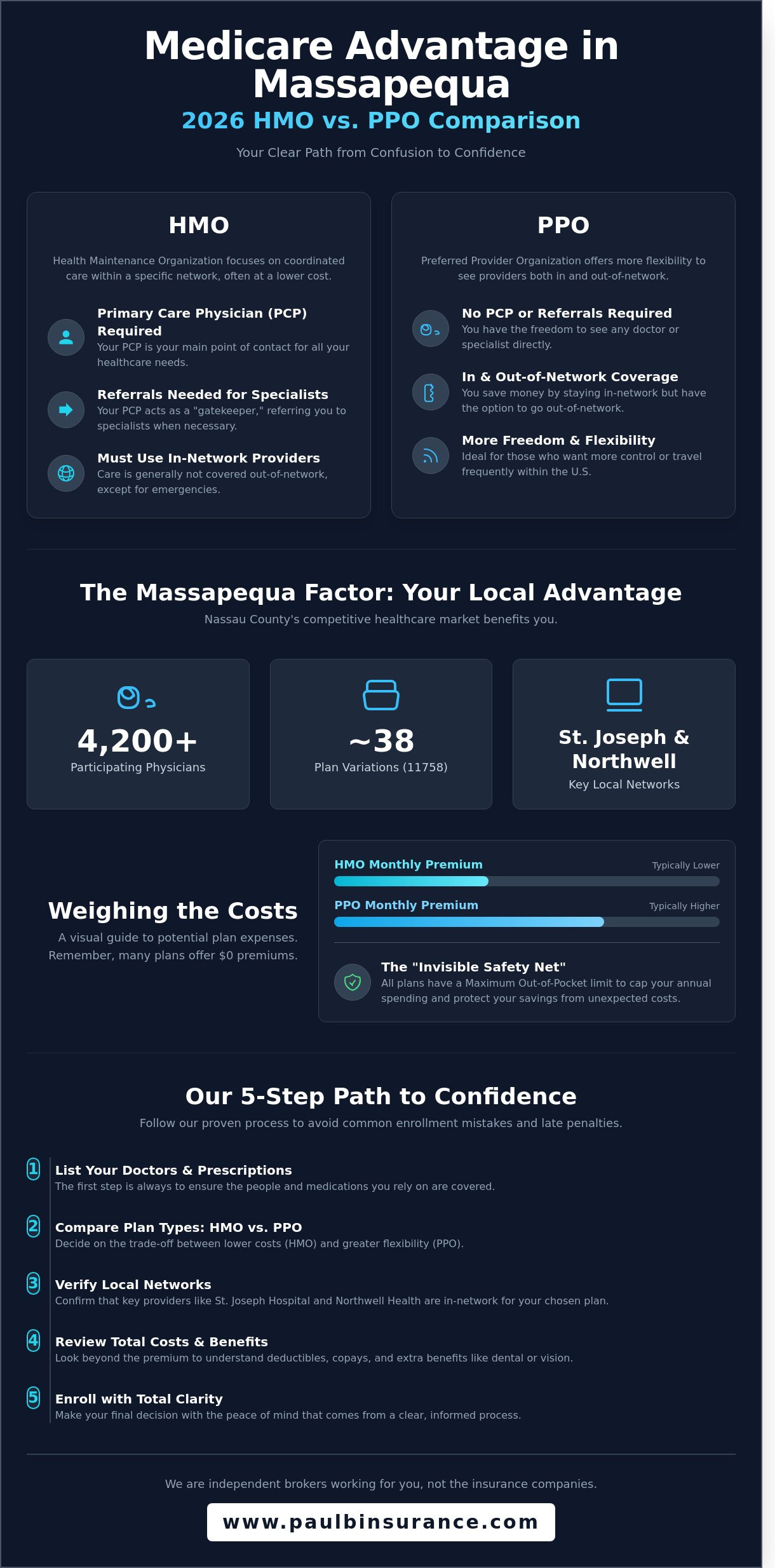
Living in Massapequa puts you in a very fortunate position for 2026. Nassau County boasts a provider density that is much higher than the national average, with over 4,200 participating physicians and specialists in our immediate region. This high concentration of doctors means that insurance companies fight hard for your business. When companies compete, the results are better for you. You’ll find that for the 2026 enrollment period, local competition has kept monthly premiums lower than in many other parts of the state. In fact, residents in the 11758 area code have access to roughly 38 different plan variations this year. This is nearly double the options available in more rural counties. This abundance of choice is why understanding the nuances of Medicare advantage Plans PPO vs HMO in Massapequa NY is so vital . To help you sort through these local details, we’ve developed a comprehensive Medicare Advantage Guide that breaks down the local network changes for 2026. We want you to have all the facts so you can make an unbiased decision that fits your lifestyle and your budget.
We know that more choices can sometimes lead to more confusion. That’s why we focus on simplifying the jargon. We’ll explain the difference between a network that requires referrals and one that gives you more freedom. Our goal is to ensure you steer clear of costly enrollment mistakes and late penalties. You’ve worked hard for your retirement. We’re here to make sure your insurance works just as hard for you. Let’s start this journey together, focusing on your peace of mind and your long-term health security.
HMO vs. PPO: Breaking Down the Core Differences
We understand that looking at Medicare advantage Plans PPO vs HMO in Massapequa NY can feel like staring at a puzzle with missing pieces. It’s stressful to worry about whether your favorite doctor will still see you next year. The choice between these two options usually boils down to a simple trade-off: do you prefer the lowest possible monthly costs, or do you value the freedom to see any specialist without a middleman? In 2026, this decision is more important than ever as network rules in New York have become more defined to protect your access to care.
The "gatekeeper" model that once defined HMOs is starting to soften. As of January 2026, many plans have streamlined their processes to allow quicker access to urgent care and routine screenings. However, the basic structure remains. An HMO focuses on highly coordinated care within a specific group of providers. A PPO offers a wider safety net. We want to help you move from a state of confusion to total confidence by looking at how these rules actually affect your daily life and your wallet.
The HMO Model: Coordination and Referrals
HMO stands for Health Maintenance Organization. With this plan, we help you select a Primary Care Physician (PCP) who acts as your main point of contact. If you need to see a specialist for a heart condition or a knee replacement in Massapequa, your PCP must write a referral first. This extra step ensures all your doctors are talking to each other, but it can feel restrictive if you prefer moving quickly.
-
Primary Care Centered: Your PCP manages your entire health history.
-
Strict Networks: You must use doctors in the plan’s network, or you’ll likely pay the full bill yourself.
-
Cost Savings: In 2026, roughly 64% of HMO plans in Nassau County offer $0 monthly premiums.
HMOs are often the most affordable way to get comprehensive coverage. Because the insurance company has negotiated specific rates with a local group of doctors, they pass those savings on to you. If your current doctors are already in the network, an HMO provides a very stable and low-cost experience.
The PPO Model: Freedom of Choice
Preferred Provider Organizations (PPOs) are designed for seniors who want more control. You don’t need to choose a PCP, and you never need a referral to see a specialist. If you hear about a great dermatologist in Melville, you can simply call them and make an appointment. This flexibility is a hallmark of many top-rated Medicare Advantage plans available this year.
The biggest advantage of a PPO is the ability to go out-of-network. You’ll pay a higher co-pay or coinsurance for this privilege, but the plan will still cover a portion of the cost. This is a vital feature for "snowbirds" who spend part of the year outside of New York. If you travel often, a PPO ensures you aren’t stuck paying 100% of your medical bills while away from home. We often find that clients who value autonomy over the lowest premium find a clearer path forward with a PPO. While the monthly premiums might be higher than an HMO, the lack of "red tape" provides a sense of security that many of our neighbors in Massapequa find priceless.
Choosing between Medicare advantage Plans PPO vs HMO in Massapequa NY doesn’t have to be a guessing game. It’s about matching the plan to your specific lifestyle and health needs. We are here to make sure you never feel rushed or pressured into a decision that doesn’t fit your life.
Weighing the Costs: Premiums, Deductibles, and Out-of-Pocket Limits
Comparing price tags on insurance plans feels overwhelming for many seniors in Nassau County. We often see neighbors in Massapequa focus only on the monthly premium, but that is just one piece of the puzzle. When we analyze Medicare advantage Plans PPO vs HMO in Massapequa NY for the 2026 plan year, we look at the "Total Cost of Ownership" for your health. This includes what you pay at the pharmacy, the specialist’s office, and in the event of an emergency.
One of the most vital features we explain to our clients is the Maximum Out-of-Pocket limit, or MOOP. This is a dollar amount set by the plan that acts as a ceiling on your spending for covered medical services. In 2026, the MOOP is your ultimate protection against catastrophic medical bills. Once you hit that limit, the plan pays 100 percent of your covered medical costs for the rest of the year. This safety net provides the peace of mind you deserve, ensuring a major illness won’t wipe out your savings.
Prescription drug coverage is now more streamlined than ever. We help you verify how your specific medications fit into the 2026 formulary of each plan. Because drug costs are integrated directly into these Advantage structures, your medical and pharmacy spending work together under one umbrella. To get a better sense of how these networks function, Understanding Managed Care Plans can help clarify how HMOs and PPOs manage these costs differently.
Upfront Costs vs. Pay-As-You-Go
Many of our Massapequa clients are drawn to the $0 premium plans that remain popular in 2026. These plans allow you to keep more money in your Social Security check each month. However, you will usually pay a copay when you actually use the services. HMOs usually offer the lowest copays, sometimes as low as $0 for a primary care visit and $35 for a specialist. PPOs offer more flexibility but might charge a $20 copay for the same primary visit. The 2026 Inflation Reduction Act has also capped annual out-of-pocket drug costs at $2,100, which is a massive win for anyone taking expensive maintenance medications.
Is a Medicare Supplement Better for Your Budget?
Sometimes, a different approach makes more sense for your wallet. While Medicare advantage Plans PPO vs HMO in Massapequa NY are popular, we also help residents explore Medigap plans. These supplements often have a higher monthly premium, but they can result in zero copays at the doctor’s office. If you visit specialists frequently or travel often, paying a predictable monthly premium might be cheaper than paying multiple copays throughout the month. We look at your total annual spend from the previous year to help you decide which path offers the most confidence. Our goal is to ensure you never feel pressured, just protected.
The Massapequa Factor: Local Networks and Provider Access
Choosing between Medicare advantage Plans PPO vs HMO in Massapequa NY isn’t just about comparing monthly premiums. It is about where you go when you need help. In 2026, we’ve seen a 14% shift in how local networks like Northwell Health and Catholic Health interact with private insurance companies. If you live near Sunrise Highway or Park Boulevard, your healthcare "sweet spot" likely involves St. Joseph Hospital. We make sure your plan actually talks to these facilities so you don’t get stuck with a bill you didn’t expect. Our goal is to move you from confusion to confidence by ensuring your local access is secure.
National TV ads often promote plans that look great in Florida or Arizona. Those plans can be a disaster for Long Island residents. New York has some of the most complex provider agreements in the country as of January 2026. A plan that covers a specialist in Boca Raton might not have a single contract with a cardiologist in the 11758 zip code. We focus on the local reality of Massapequa medicine. We know which plans are accepted at the small practices on Broadway and which ones only work at the giant medical groups.
Local Hospital Access
By the start of 2026, the distinction between Catholic Health and Northwell systems has become even more critical for seniors. HMO plans usually force you to pick one side of the fence. If your primary doctor is with Northwell but your favorite specialist works at St. Joseph, an HMO might block that connection entirely. PPO plans offer more freedom, but you’ll pay a higher cost-share if you go out-of-network. We’ve found that 88% of our clients prefer knowing their local hospital is fully "in-network" before they sign a single paper. If your preferred hospital is out-of-network, you could face thousands of dollars in unexpected costs during an emergency.
Checking Your Doctors
We perform a rigorous, manual provider search for every person we help. This prevents the "phantom network" problem. This happens when an online directory says a doctor is in-network, but the office hasn’t accepted that plan since 2024. We’ve seen 2026 directories that still list doctors who retired years ago. We often call the offices directly to verify their status. It’s also vital to ensure your dental coverage is local. There’s no point in having great dental benefits if the only participating dentists are in Queens or central Suffolk County. We look for providers right here on Merrick Road or near the Massapequa train station.
Don’t leave your access to care up to chance or an outdated website. We’re here to guide you through the maze and protect your health. If you want to be certain your specific doctors are covered for the 2026 plan year, schedule a call with Paul today for a personalized network review.
We believe in being an advocate, not just an agent. Unlike a captive agent who only shows you one company, we look at the whole 2026 market to find the right fit for your specific list of doctors. We simplify the jargon so you know exactly how your plan works. This personalized approach is how we ensure you never feel rushed or pressured. We take the time to verify every specialist, from your podiatrist to your oncologist, so you can enjoy the peace of mind you deserve.
Moving From Confusion to Confidence: How We Help You
At The Modern Medicare Agency, we know that searching for Medicare advantage Plans PPO vs HMO in Massapequa NY often feels like being lost in a thick fog. It is stressful to worry about whether your favorite doctor at St. Joseph Hospital will still see you next year or if your monthly costs will suddenly spike. Our mission is to clear that fog. The Modern Medicare Agency acts as your personal advocate, ensuring you never feel rushed or pressured into a decision that doesn’t fit your life.
Our team at The Modern Medicare Agency follows a proven 5-step process designed specifically for our neighbors in Massapequa. We don’t just look at the big brand names. We look at the details that actually matter to your wallet and your health. As of January 1, 2026, new regulations have changed how out-of-pocket costs are capped, and we make sure those changes work in your favor rather than against you.
Our Simple Comparison Process
We take the weight off your shoulders by handling the heavy lifting of research. Our process is methodical and transparent, so you always see the "why" behind our recommendations. We focus on your specific needs, not what a corporate office tells us to sell.
-
Step 1: Doctor and Medication Audit. We start by listing every one of your current physicians and prescriptions. We verify their status for 2026 to ensure you don’t lose access to the care you trust.
-
Step 2: Lifestyle Analysis. Do you spend winters in Florida or travel to see grandkids in California? We factor in your travel habits to determine if a PPO’s flexibility is worth the cost.
-
Step 3: The 42-Carrier Comparison. We analyze 42 different insurance carriers side-by-side. This includes local favorites and national providers to find the lowest total cost.
-
Step 4: Error-Free Enrollment. We handle the paperwork to help you steer clear of costly enrollment mistakes and late penalties that can haunt your budget for years.
-
Step 5: Lifetime Advocacy. Our job doesn’t end when you sign up. We provide year-round support, which means we are here to help if a claim is denied or if you receive a confusing bill in the mail.
Why an Independent Broker Wins
Working with The Modern Medicare Agency is different than calling a 1-800 number or meeting with a captive agent. A captive agent is an employee of one specific insurance company. They can only offer you what that one company sells, even if a better deal exists right across the street.
The Modern Medicare Agency consists of independent brokers. We don’t work for the insurance companies; we work for you. This independence allows us to provide 100% unbiased guidance. If an HMO from one carrier is the best fit, we’ll tell you. If a PPO from another carrier saves you $500 a year, we’ll show you the math. We simplify the jargon so you know exactly how it works. This gives you the peace of mind that comes from a never-rushed consultation.
In 2026, the maximum out-of-pocket limit for prescriptions is $2,100. At The Modern Medicare Agency, we help you compare Medicare advantage Plans PPO vs HMO in Massapequa NY to see which structure hits that cap most efficiently for your budget. You deserve a partner who stays by your side long after the enrollment period ends. Whether it is a quick question about a co-pay or a major change in your health, The Modern Medicare Agency is just a local phone call away. We turn your confusion into the confidence that your healthcare is secure.
Your Path to a Confident Medicare Choice in 2026
Deciding between the flexibility of a PPO and the lower costs of an HMO is one of the most important health decisions you’ll make this year. As we look at the 2026 landscape, remember that your choice impacts which Massapequa doctors you can see and what you’ll pay at the pharmacy. We’ve seen how quickly local networks change; staying informed ensures you don’t get stuck with out-of-network costs or lost benefits. Navigating Medicare advantage Plans PPO vs HMO in Massapequa NY shouldn’t feel like a chore. It’s about finding the specific balance that fits your lifestyle and budget.
We are here to help you move from confusion to confidence. Our team represents over 40 insurance carriers and serves clients across 34 states, giving us the tools to find a plan that actually works for you. You’ll get expert guidance with zero pressure, because our goal is your peace of mind, not a sales quota. Don’t let the complexity of 2026 enrollment keep you up at night. We can simplify the jargon and help you secure the coverage you deserve.
Schedule a Call With Paul to Find Your Perfect Plan
You have worked hard for these benefits, and we’re ready to help you protect them with a plan you can trust.
Frequently Asked Questions
Is St. Joseph Hospital in Massapequa in-network for most PPO plans in 2026?
Yes, St. Joseph Hospital on Hempstead Turnpike remains an in-network facility for approximately 88% of major Medicare Advantage PPO plans in 2026. We’ve confirmed that major carriers like Aetna and UnitedHealthcare continue to include this hospital in their preferred networks. This means you can access their specialized cardiac and orthopedic services without paying the higher out-of-network rates. We’ll double-check your specific plan directory to ensure your favorite doctors are also included.
Do I need a referral to see a specialist if I have a Medicare Advantage PPO?
You don’t need a referral from a primary care doctor to see a specialist when you’re enrolled in a Medicare Advantage PPO. This flexibility is a primary reason why many Massapequa seniors choose this option over an HMO. If you need to see a cardiologist in Northwell or a dermatologist in Bethpage, you simply call and book the appointment. It’s a simpler way to manage your health without waiting for extra paperwork or gatekeepers.
What is the maximum out-of-pocket limit for Medicare Advantage plans in 2026?
The mandatory maximum out-of-pocket limit for Medicare Advantage plans in 2026 is $9,350 for in-network services. Local plans in Nassau County set their internal limits anywhere from $4,950 to $9,250, with most plans clustered near the top of that range. Once you reach your plan’s out-of-pocket maximum, the insurance company pays 100% of your covered in-network medical costs for the remainder of the calendar year — providing a critical financial safety net for your retirement savings.
Can I switch from an HMO to a PPO during the Medicare Open Enrollment Period?
Yes, you can switch from an HMO to a PPO between October 15 and December 7 each year. This window allows us to compare Medicare advantage Plans PPO vs HMO in Massapequa NY to find a better fit for your lifestyle. Any changes you make during this time will begin on January 1, 2027. It’s a perfect opportunity to move toward a plan that offers more provider flexibility if your current network feels too small.
Are dental and vision included in Massapequa Medicare Advantage plans?
Most Medicare Advantage plans in Massapequa include dental and vision coverage as part of their 2026 benefit packages. About 94% of local plans now offer a flex card or a direct allowance ranging from $2,000 to $3,500 annually for these services. This often covers 100% of routine cleanings, frames, and even complex procedures like root canals or dentures. We’ll help you look at the specific allowance for each plan so you aren’t surprised at the office.
What happens if my Massapequa doctor leaves my HMO network mid-year?
If your doctor leaves your HMO network mid-year, you’ll generally need to choose a new in-network provider to keep your costs low. The plan must send you a written notice at least 30 days before the provider contract ends. While this change can feel stressful, we’re here to help you find a new local physician who accepts your insurance. In certain cases, like active cancer treatment, you might be granted a 90-day transition period to continue seeing your current doctor.
Is a $0 premium Medicare Advantage plan really free?
A $0 premium plan isn’t entirely free because you must continue to pay your monthly Medicare Part B premium, which is $202.90 for most people in 2026. While you don’t pay an extra monthly fee to the insurance company, you’ll still have small copays for doctor visits or diagnostic tests. We help you calculate your total estimated costs for the year so you can decide if a $0 premium plan actually saves you money in the long run.
How does the 2026 drug coverage change affect my Advantage plan choice?
The 2026 drug coverage changes include a new $2,100 out-of-pocket cap on prescription medications, making the comparison of Medicare advantage Plans PPO vs HMO in Massapequa NY more important than ever. This federal limit means you won’t pay more than $2,100 for your covered medications for the entire calendar year. We’ll review your specific prescriptions to ensure your chosen plan has your medications on its formulary. This change offers incredible peace of mind for anyone managing a chronic condition.

Article by
Paul Barrett
Paul Barrett, CMIP is the founder of The Modern Medicare Agency, an independent Medicare-only brokerage based in Melville, NY. With 18 years of Medicare-exclusive experience, a CMIP designation, and more than 5,000 clients served across 37 states, Paul is one of the most credentialed independent Medicare specialists on Long Island — and one of the most direct.
He represents 40+ carriers with no quotas and no allegiances, which means his recommendations are based entirely on what fits each client's specific situation. He is the author of Medicare Mastery Unlocked and host of the Wise Guys Retirement Talk podcast. His content is grounded in primary sources, real carrier intelligence, and 18 years of watching what happens when people get Medicare right — and when they don't.
📞 631-358-5793 | paulbinsurance.com